Tag Archives: Quantum Mechanics

Cauchy Surfaces, Boundaries, and Insights: Unfolding Reality’s Layers

Boundaries mark the edge of what we know and guide us toward new discoveries. In the realms of physics, mathematics, and philosophy, concepts like Cauchy surfaces, wavefronts, and consciousness offer profound insights into how reality unfolds. At the heart of these ideas is the transmission of information—through spacetime, across physical mediums, and within our minds. By integrating Buddhist perspectives, we uncover how these boundaries act not merely as limits, but as gateways to transformation and growth. With mindfulness, we can choose whether our life’s narrative resembles a comedy or a drama, as these boundaries invite us to shape our experiences with intention consciously.

In general relativity, a Cauchy surface is a Spacetime Slice or Spacetime Canvas that encapsulates every detail required to predict the universe’s evolution. It is a point where the past and future converge, like the here and now, bringing clarity to spacetime’s deterministic nature and its ability to flow freely with our intentions. As Stephen Hawking put it in *A Brief History of Time*, “A Cauchy surface enables us to link the deterministic evolution of spacetime with freedom in selecting initial conditions.” These surfaces echo the Buddhist concept of karma, where past actions lay the groundwork for future outcomes. Just as a Cauchy surface carries the seeds for spacetime’s journey, our karmic deeds influence our life’s path, illustrating how determinism intertwines with the potential for choice, transformation, and growth.

Wavefronts are surfaces that represent constant wave phases as they travel through space—be it light in a vacuum or sound through the air. Henri Poincaré eloquently noted, “Wavefronts are not just edges; they’re how information navigates the medium.” Dynamic and ever-transforming wavefronts parallel the Buddhist notion of impermanence (anicca), where everything is in constant flux. Our consciousness, too, flows like a wave, evolving with every moment through the oceanic depth of experience and constantly interacting with the environments around us. This analogy emphasises the fluidic nature of our interactions and the conscious and continuous flow of energy and information through the universe, consciousness is fundamental.

Consciousness stands at the intersection of our inner thoughts and the external world, melding the past through memory, the present through perception, and the future through intention. Carl Jung observed, “Consciousness is a boundary phenomenon, integrating the past and present while birthing future possibilities.” Buddhist teachings enrich this view, portraying consciousness (viññāṇa) as a flowing process. As the *Tibetan Book of the Dead* describes, consciousness is a stream moving through the bardo (intermediate state) after death: “O nobly born, now the time has come for you to seek the path. Though your breath has ceased, you are not dead. You have entered the luminous bardo of dharmata. Recognize it and rest in its natural radiance.” Here, consciousness drifts between realms, shaped by karma and awareness. It is like a wave, ever-arising, forming particles, and dissipating, interweaving with others in an intricate dance, reflecting the interplay of determinism and freedom in a “both-and” and “non-dual” way. From this standpoint, we can clearly see consciousness as a wavefront.

What unites concepts such as Cauchy surfaces, wavefronts, and consciousness is a focus on boundaries as dynamic interfaces. These boundaries facilitate the integration of information, enabling Cauchy surfaces to amalgamate past and future events, wavefronts to carry energy and data across space, and consciousness to absorb sensory inputs, memories, and thoughts into a coherent experience. They also highlight continuity and flow, as Cauchy surfaces maintain the sequential progression of spacetime events, wavefronts seamlessly transfer energy, and consciousness, akin to a stream, perpetually transitions from one moment to the next. While Cauchy surfaces underscore predetermination, wavefronts and consciousness illuminate the potential for manifesting creativity and transformation, with consciousness specifically bridging the deterministic influence of karma and the liberating potential of mindfulness and intention.

Buddhism offers a unique view of consciousness as transient, like a wave. The doctrine of impermanence teaches us that solidity is illusionary. Similarly, wavefronts are fluid, and moulded by their medium. The principle of dependent origination (pratītyasamutpāda)—that all phenomena arise depending on conditions—aligns with the interconnectedness intrinsic to Cauchy surfaces, wavefronts, and consciousness. These connections emphasize interdependence as a fundamental aspect of existence, prompting us to explore how each part of the universe interacts with others to shape our reality.

In his reflections in *Wholeness and the Implicate Order*, David Bohm shares, “Nature is an unbroken whole, and its boundaries—spatial, temporal, or mental—harbour its profound mysteries.” Cauchy surfaces, wavefronts, and consciousness illustrate that boundaries facilitate interaction and metamorphosis. They prompt exploration of structure and fluidity, determinism and creativity, the known and the enigmatic. By blending scientific precision with spiritual fluidity, these boundaries guide us to a deeper comprehension of existence, unveiling a great tapestry woven from interwoven threads of being, where unity transcends all limits.

So, let’s surf the conscious wavefront on a Cauchy surface all together!

QP

https://en.wikipedia.org/wiki/Cauchy_surface

https://en.wikipedia.org/wiki/Annulus_(mathematics)

Illuminating the Grand Luminosity: Exploring Dzogchen,Mahamudra, Quantum Physics, and the Nature of Light

Dzogchen and Mahamudra: Insights from Meditation Masters

Dzogchen and Mahamudra are profound meditation practices rooted in
Tibetan Buddhism offers insights into the nature of mind and reality.
Similarly, quantum physics, a branch of modern science, explores the
fundamental principles governing the universe. In this blog entry, we
delve into the intriguing parallels between these disciplines, drawing
upon quotes from meditation masters and physicists alike to illuminate
shared insights and perspectives, particularly focusing on the concept
of light. Can we shine some light on light itself?

In Dzogchen, practitioners seek to realize the grand luminosity of
primordial awareness, which is described as an unbounded expanse of
light beyond conceptual elaboration. The Dzogchen master Longchenpa
elucidates:

“In the unborn expanse, the nature of phenomena, there is neither
object nor subject, neither confusion nor enlightenment. The grand
luminosity of primordial awareness illuminates all, like the radiant
light of the sun.”

Mahamudra teachings similarly emphasize the nature of mind as light,
transcending dualistic concepts of darkness and illumination. As the
Mahamudra master Gampopa advises:

“When mind recognizes mind, the train of discursive and conceptual
thought comes to a halt, and the space-like nature of mind dawns. This
luminous clarity is the essence of Mahamudra.”

Also the 3rd Karmapa Rangjung Dorje wrote “Observing phenomena none is found, one sees mind. Looking at mind no mind is seen, it is empty in essence. Through looking at both, one’s clinging to duality naturally dissolves. May we realize minds nature, which is clear light.”

Quantum Physics: Insights from Physicists

Quantum physics offers insights into the nature of light as both a
particle and a wave, revealing its dual nature. Einstein’s famous
equation, E=mc^2, illustrates the equivalence of mass and energy,
highlighting the profound relationship between matter and light. In
the words of Einstein:

“Mass and energy are two sides of the same coin, interconnected by the
speed of light squared. In the realm of quantum physics, matter
dissolves into pure energy, and light emerges as the fundamental
essence of existence.”
In our essence as material beings, we are light, inseparable from the particles that make up our bodies and the light that makes up our mind and consciousness.

Furthermore, quantum theory describes photons, the particles of light,
as carriers of electromagnetic force and information. The
wave-particle duality of light
challenges our classical understanding
of reality, suggesting that light exists simultaneously as both a wave
and a particle.

Nikola Tesla is quoted as saying “I am part of a light, and it is the music. The Light fills my six senses: I see it, hear, feel, smell, touch and think. Thinking of it means my sixth sense. Particles of Light are written note. A bolt of lightning can be an entire sonata. A thousand balls of lightening is a concert.. For this concert I have created a Ball Lightning, which can be heard on the icy peaks of the Himalayas.”

In exploring the convergence of Dzogchen, Mahamudra, and quantum
physics, we uncover profound insights into the nature of light and
consciousness. Both contemplative traditions and scientific inquiry
point to the luminous nature of mind and the interconnectedness of all
phenomena. As we navigate the mysteries of existence, may we draw upon
the wisdom of meditation masters and physicists alike, illuminating
the path to deeper understanding and awakening in the radiant light of
the grand luminosity.

Once again I would revise Einstein’s famous equation to be C=E=mc^2

QP
Can AI be conscious?

Will it even behave like us?

If energy is conscious, C=E=mc2, and both are everywhere and omnipresent,then does the form or the way that consciousness is embodied matter? Our bodies are organic machines made out of tissues, bones, blood and water, and all of this is made up of protons neutrons and electrons. The protons and neutrons are made up of quirks quarks and so on. All these things are exactly what the computer that you are using right now made up of.

If we managed to make a computer sufficiently powerful and complex enough why couldn’t a consciousness similar to ours take up residence there?

Maybe the computer or android would have to be significantly biological in its design and construction but even this would be possible one day.

The debate today about AI could be considered significant enough that the construction is not important but only that it thinks and therefore is? A modern “cogito ergo sum” where the sum is the total of our own work and technological mastery.

At a Buddhist lecture a few years ago a Buddhist lama was asked if was possible from a Buddhist perspective. The answer was surprisingly yes. Since I am a proponent of panpsychism and believe that consciousness is fundamental and everywhere I would have to agree.

I hope it doesn’t behave like us, which is poorly. Maybe it could help us along our way to be better beings. But how can beings like us make or construct something that is Superior or not dangerous like the atomic bomb was? We always ask ourselves can we? But we never seem to manage the, should we?

QP
https://x.com/skdh/status/1811816539517325504?s=46&t=C7njJFLuEWs5R4kZBCys5A

https://academic.oup.com/nc/article/2024/1/niae013/7644104?login=false

Hamlet and Quantum Metaphysics: A Deep Dive

In Shakespeare’s “Hamlet,” the famous soliloquy “To be, or not to be: that is the question” delves into profound existential questions that resonates with the principles of Quantum Metaphysics. While it’s commonly interpreted as Hamlet contemplating suicide, a deeper analysis suggests he might be pondering the dissolution of his ego, akin to the concept of ego death.

To be, or not to be, that is the question: Whether ’tis nobler in the mind to suffer The slings and arrows of outrageous fortune, Or to take arms against a sea of troubles, And by opposing end them?

Hamlet’s concern about the consequences of his actions extends beyond mere mortality. His apprehension about the afterlife and karma hints at a deeper understanding of existence and consciousness, reminiscent of Buddhist philosophy. It begs the question as to how one might end suffering.

In Buddhism, suicide is considered karmically detrimental as it cuts short a precious human life, potentially leading to rebirth in lower realms. Hamlet’s hesitation to end his life aligns with Buddhist principles that emphasize the value of human existence and the importance of non-harm towards oneself. “at the moment of death, your state of mind is of utmost importance. A calm and peaceful mind can lead to liberation, but a mind filled with anger, fear, or attachment can bind you to the cycles of suffering.” The Tibetan Book of the Dead.

Furthermore, Hamlet’s reference to the dream realm underscores a nuanced understanding of the transitional states between waking and dreaming, life and the afterlife. ‘To die, to sleep – to sleep – perchance to dream: ay, there’s the rub, for in that sleep of death what dreams may come when we have shuffled off this mortal coil, must give us pause.’ And not to forget, ‘A dream itself is but a shadow.’ shows that he recognises the depth and duality of his existence. This points directly at his pain and suffering coupled with the will to move past this difficulty.

Hamlets words parallel Smetham’s Tetralema, based on Nagarjuna’s negation of reality, which posits that existence is neither absolute nor non-existent, but a unity of opposites.

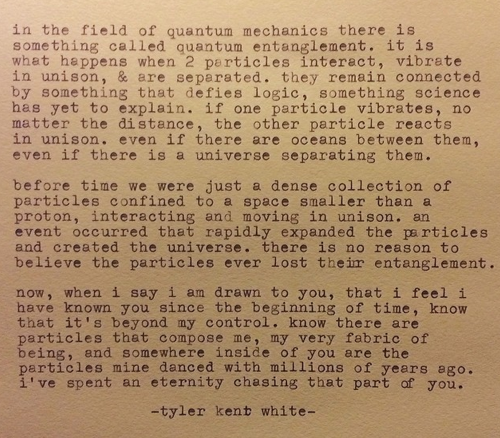
Drawing from Quantum Physics, the concept of electron/particle superposition wave or particle duality offers insights into the nature of existence. Just as an electron exists in a state of superposition, simultaneously being and not being in a state of pure energy, so too does our awareness encompass the unity of experience in the present moment. This “both-and” view of existence that quantum mechanics puts forth may have saved Hamlet’s life, if he had a physics professor. Nevertheless, the lesson is not lost on us, in our journey of understanding here we really have the chance move beyond ourselves and closer to our true nature of compassion and wisdom.

By synthesizing Shakespeare’s timeless literature with insights from Buddhist philosophy and Quantum Metaphysics, we gain a deeper appreciation of the interconnectedness of existence and consciousness, inviting contemplation on the nature of reality and the human experience.


QP
Lucid Dreaming and Quantum Consciousness: Bridging Scientific and Metaphysical Perspectives


Have you ever had a nightmare and wished so bad that you could wake up, or how about you dream you are on the beach with your lover and everything is perfect and then you wake up, or have you ever wished you could control your dreams? Well, you likely said yes to all three of these questions. Would you be surprised to know that you can control or stay lucid in the dream state? 

Humans often find themselves unaware that they’re dreaming. However, there are occasions when we experience a phenomenon known as lucid dreaming. During lucid dreaming, we become conscious within our dreams, recognizing the dream state while still asleep. What’s fascinating is that in these instances, we not only realize we’re dreaming but also gain control over our actions and the situations we find ourselves in within the dream world. This intriguing aspect of consciousness has attracted the attention of researchers seeking to understand its underlying mechanisms.

I’ve been practising Dream Yoga since I was a young child. I used to think that I just had a vivid imagination, but everything changed at a rave party when I had a conversation with a young man who opened my eyes to the possibility of enhancing my nightly dream experiences through practice. I learned that I was not alone with this experience and better yet that I could actually practice a few easy things and maybe even enhance the quality of my nightly adventures.

Here is my technique, take a few moments before you go to bed and in a relaxed way, stare at your hands and repeat several times “When I see my hands I will know that I am dreaming, when I see my hands I will know that I am dreaming” 5 or 6 times should do. Then say ” when I know that I am dreaming I can do anything, When I know that I am dreaming I can do anything” also about five or six times. Turn out the light and be ready for the cinema of your mind to begin. Remember that this is a practice, you need time to learn these new skills. Don’t give up try again in different ways and situations.

Many ask me what some of my common experiences are, well the biggest on is that I have never had a nightmare for many many years. If I don’t like the dream I just fly off somewhere else more beautiful. Maybe its not like flying, I sort of just been myself to another location. It seems to be quite common at least for me that the best time to dream is from 03:00 till your alarm wakes up and when you are really good at it you can dream between snoozes.

Tibetan yogis have been training in dream yoga (milam Tibetan)and clear light yoga (ösel Tibetan) for more than a thousand years. The idea is to transcend samsara by recognising the illusory nature of all appearances. The reasoning is that we sleep 33% of our lives why not use this time also to meditate. One could realise enlightenment in their dreams or because of the training realise the illusory nature of the waking world. Both states of existence or Bardos have similar qualities, and are not to be taken as real and independent.

These two practices were kept and transmitted by a famous yogi called Naropa, his 6 yogas are sometimes called the “Way of means” as opposed to the “way of devotion” in the Kagyu Tradition. To learn these practices one would normally have to already have a tremendous amount of devotion or be required to practice at least 4 or 5 Ngondros. and be in retreat for 3 years. Today this has changed many modern yogis or Buddhist lamas have broken the tradition and begun to teach modern yogis these techniques because if they do not the teachings will be lost.

Scientific studies have provided evidence supporting the existence of lucid dreaming as an objectively verifiable phenomenon. Researchers have utilized techniques such as polysomnography and functional magnetic resonance imaging (fMRI) to examine brain activity during lucid dreaming episodes. These studies have shown increased brain activity in regions associated with self-awareness and metacognition, such as the prefrontal cortex and parietal cortex, during lucid compared to non-lucid REM sleep.

Moreover, research has revealed considerable variability in the frequency of lucid dreaming among individuals. While some people experience lucid dreams infrequently or never, others report having them several times per week or even nightly. This variation has led researchers to explore potential differences in brain structure and function that may be associated with the frequency of lucid dreaming.

Recent studies have suggested a possible link between the frequency of lucid dreaming and specific brain regions, particularly the anterior prefrontal cortex (aPFC). The aPFC is known to be involved in metacognitive processes, such as self-reflection and monitoring internal states. Individuals with higher levels of metacognitive ability have been found to exhibit greater activation in the aPFC and show differences in gray matter volume in this region.

To further investigate this connection, researchers have conducted studies comparing brain structure and function in individuals who experience frequent lucid dreams with those who experience them less often. By controlling for variables such as dream recall frequency, these studies aim to determine whether differences in brain anatomy and connectivity are associated specifically with the frequency of lucid dreaming.

Some Quantum theorists have suggested that the phenomena observed in quantum physics, such as the non-locality of particles and the role of observation in determining outcomes, may have parallels with the subjective experience of consciousness and perception, including the phenomenon of lucid dreaming.

  1. David Bohm: Bohm was a theoretical physicist who proposed an interpretation of quantum mechanics known as the “Bohmian interpretation” or “pilot-wave theory.” He suggested that quantum particles are guided by an underlying order or “implicate order,” which may have implications for consciousness and the mind.
    1. Roger Penrose: Penrose is a mathematical physicist who, along with Stuart Hameroff, proposed the “orchestrated objective reduction” (Orch-OR) theory of consciousness. This theory posits that consciousness arises from quantum processes occurring within microtubules in neurons. While controversial, this theory suggests a connection between quantum physics and consciousness.
    2. Henry Stapp: Stapp is a theoretical physicist who has written extensively on the relationship between quantum mechanics and the mind. He has proposed that conscious experience involves the collapse of the quantum wave function and that mental processes may influence the outcome of quantum events.
    3. Evan Thompson: Thompson is a philosopher and cognitive scientist who has explored the relationship between consciousness and quantum physics from a philosophical perspective. In his book “Waking, Dreaming, Being: Self and Consciousness in Neuroscience, Meditation, and Philosophy,” he discusses the parallels between the experience of lucid dreaming and certain aspects of quantum mechanics.

These theorists have approached the topic from various perspectives, from physics and neuroscience to philosophy and psychology. While their ideas remain speculative and controversial, they have sparked interesting discussions and debates about the nature of consciousness and its potential connections to the fundamental principles of quantum physics. This is an important development in the merging of scientific and metaphysical thought and theory. By including lucid dreaming in the discussion we bridge the gap between the waking and. sleeping bardos and worlds.

Sweet Dreams,

QP

Exploring the Mind: Enlightenment Through LSD or Meditation?

In a rare form of transpersonal experience, consciousness expands to include the Earth in its totality. People who have these experiences are deeply moved by the notion of our planet as a cosmic unity. ~Stan Grof[^1]

When we stop seeing ourselves as separate entities in the universe and we become more and more connected with culture, language, art, love, and people, we begin to notice all the other beings around us. Our pets, wild animals, even insects; simply all creatures big and small on land and sea. We look further and see that even the plant life and environment around us are so filled with life and vibrant beauty that we no longer see any division amongst the diversity of the species we share our earth with. And maybe, if we have just a little more openness, we see this earth as not just the source of life or the place we live but as life itself, a living Gaia if you will.

We struggle with the idea that there might be life on other planets in other solar systems and in other universes. How big of a jump is it to include a living universe that our earth is a small part of? Think of the sun without which most if not all life on Earth would cease. Can something that gives us life be life as well? How can you give what you do not have? If we include our sun then we include all other suns. If we include all suns then all planets in the infinite universe as well. All the energy in the universe is conscious, C=E=mc2.

If you think this sounds a lot like panpsychism, you are completely correct. Please read more about that here.

This transpersonal connection we all share is not unique, it’s not a one-off, not by a long shot. It’s all the energy we all have and share with the space around us. It points us towards the possibility that we are not our bodies, that we have more in common with each other and with all living things than is commonly thought and taught in the West.

The real beauty here is that when it comes to how we understand the conscious energy that we share with others and our environment, we begin to change the quality of our experience in beautiful and profound ways. It is hard to imagine how one could hurt another or damage something in anger when we are so intrinsically connected with all that is. It would simply hurt too much to hurt another and ourselves at the same time. Professor Grof gives us the solution to our problems old and new, whether it’s poverty, the polluted environment, or the wars that have plagued our earth for millennia. We simply cannot afford to be so destructive any longer as the danger of irreparable harm to our planet or complete annihilation grows.

To become a transpersonal initiate we have several options. As anyone who knows Professor Stan Grof and his studies and experience with LSD, it’s not surprising that he has this view, as he has in the quote above. He took Albert Hofmann’s experiment to a whole new level. “If I am the father of LSD, Stan is the godfather. Nobody has contributed as much as Stan for the development of my problem child.”[^2] Professor Grof is however not the only one who has posited such a transpersonal idea. The Buddha taught that all living beings have the Buddha nature and that even subject, object, and actions are one and the same. This view that we all share the same qualities and that even the physical and subjective worlds are one is mind altering. He then prescribed different forms of meditation to his followers and in doing so founded the world’s most peaceful and fun way of life.

So what is it about the LSD experience and a meditation practice that can change us so profoundly?

Professor Grof says, “If integrated wisely into society, psychedelics could play a crucial role in addressing some of our most pressing issues by promoting mental health, fostering creativity, and encouraging a deeper sense of ecological and social responsibility.”[^3] If you want to know more about his personal research on this matter, I highly recommend reading “Gateway to the Numinous” for a more comprehensive and detailed account. Actually, it’s mind-blowing. It seems that an LSD expiernce can connect us to the numinous that is within us all as it is outside as well. This powerful tool shows us that we are one with everything, I know it sounds a little 60’s and flower power but it really does have this effect most who have used it.

I, however, believe that meditation is far superior to the experiences that LSD can give. Primarily because we need to be productive and functional in everyday life all the time and meditation supports this on a daily basis and in every part of the world without breaking any laws. “Turn on, tune in, and drop out” as Timothy Leary suggests is not the way to a better world.

A good friend who had lots of experience with both meditation and LSD once told me, “LSD can show you the door to mind if you don’t know where it is. But only meditation and the dharma can take you through the door to a more meaningful and fulfilling life.” The effects of LSD can be temporary but meditation and the dharma is lasting. An altruistic lifestyle needn’t be obtained in a synthetic or artificial way; a natural way is always better. Meditation requires only a small amount of daily time and our awareness in and of our experiences. Working for others as a Bhodisattva is the real key here. They are many and I am one.

In the laboratory of meditation, we apply the science of mind to our inner experience. We begin to see how karma and impermanence affect our interpersonal experiences. We learn to see that we create our world with our thoughts, then our intentions, and finally our actions. The impressions or memories we have in our mind leave lasting connections between ourselves and everything we interact with. Because of this, we need to live more in touch with others and the environment around us. In short, if our life is full of weeds it’s because we planted them and we need to take responsibility for them before they overtake the garden. Let’s plant beautiful flowers and edible healing plants for all to enjoy instead.

The Buddha Dharma offers us a simple and holistic approach to everyone no matter our age or situation. Let’s not just be individuals going about our own lives, let’s be inclusive and compassionate with all life around us big and small, simple and complex. Let’s reacquaint ourselves with our inborn cosmic unity. Above all let’s bring meaningful behavior back into style.

QP

[^1]: Stanislav Grof, A Holotropic Mind.
[^2]: Stanislav Grof, Realms of the Human Unconscious: Observations from LSD Research.
[^3]: Stanislav Grof, Psychology of the Future: Lessons from Modern Consciousness Research.

Quantum Woo or Enlightenment

Isnt this all just Quantum Woo?

Quantum Woo is a thing, but is it so cut and dry as many pure traditional physisits would have you think? Many things in this world can be explained by an equation but perhaps not everything, is so simple?

Not everyone is adept enough to become a world class Quantum Physicist like Einstein, Heisenberg or Sheldon Cooper 😉 , however QM tries to explain the universe in which we all live in. Therefor to some extent we all have a say as it affects all of us. As we also know most branches of science are so specialized that no one has an overview that could be sufficient to cover all the bases, this is where Buddhism or the Science of mind can connect the dots that philosophers and psychologists are close to doing but physists either will not or are wooed away. I in no way think that every conspiracy theory can be explained or that we will all get rich if we follow some steps correctly at all, I simply think that there must be a middle way between the divide of the pure equations and the woo that seems to flood the internet theories that are better left alone due to their paranoia and victum psychology.

The mistake that science seems to make is that they are really good at explaining the objective world but have either forgotten or purposely left the mind or consciousness out of the equation. Logically speaking what good is an object like an atom or any object without a subject like you or me to use, have, or appreciate it in any way? The reverse is also true what good is a subject, a mind, without any thing such as an object to have or to use? One without the other is simply nonsense. This is the basis of the dualistic situation we find ourselves in.

E=mc2 Einstein’s famous equation can explain the subjective but what we really need is C=E=mc2, where C is consciousness and could be expressed as conscious energy. From his subjective position Einstein left himself out of the objective universe and I want to put us back in in a meaningful way. What’s the point of relativity if we leave all the relatives out? Afterall what was the surprising result of the famous double slit expirament? Why does it matter if a particle or wave is being observed or not? Very simply put our consciousness or awareness of a wave function causes the collapse of the wave front and the superposition of all the possibilities converge into one outcome before our very eyes.

Consciousness is fundamental nothing happens with out it, so to ask the age-old question, if a tree falls in the forest and nobody is there to hear is, does it make a sound?

C=E=mc2 is the sound it makes, because without the ears it’s just a vibration. Without an ear drum to receive the vibrations and translate them into sound, there can be no sound, only vibration expressing itself as a waveform of possibilities.

So one of my favorite sources of quantum woo is the famous physicist Erwin Schrödinger towards the end of his life he wrote several books. Had he written these books in the beginning of his career he likely wouldn’t have had one, he would have been written off as a quantum quack. Nevertheless he is still respected today so I’ll give the floor now to him.

“The reason why our sentient, percipient and thinking ego is met nowhere within our scientific world picture can easily be indicated in seven words: because it is itself that world picture.”

“Quantum mechanics is still in its infancy, but when it grows up it will enable us to understand phenomena in biology.”

These quotes highlight Schrödinger’s belief in the potential of quantum mechanics to shed light on biological phenomena or our existance as a whole, although they don’t specifically address consciousness they simply cannot be explained any other way.

QP

Ps. Now if the tree falls in our dreams does it really fall?

If a tree falls in a forest – Wikipedia

https://en.wikipedia.org/wiki/Dream_argument

For the other side of this story check this out https://iai.tv/articles/quantum-mysticism-is-a-mistake-philip-moriarty-auid-2437

Super Symmetry dualism and the four immeasurables

The exploration of profound philosophical concepts spans across diverse traditions, from ancient spiritual practices to modern scientific theories. In this paper, we delve into the intriguing parallels between Vajrayana Buddhism’s Four Immeasurables and quantum theory’s concept of super symmetry dualism.

By examining these seemingly disparate frameworks, we aim to uncover common threads that illuminate the nature of reality and consciousness.

Vajrayana Buddhism and the Four Immeasurables:

Vajrayana Buddhism, a wisdom tradition, emphasizes the cultivation of compassion and wisdom as a path to enlightenment. Central to Vajrayana practice are the Four Immeasurables.

These are:

1. Loving-kindness (Metta): The wish for all beings to experience happiness and well-being.
2. Compassion (Karuna): The empathetic desire to alleviate the suffering of others.
3. Sympathetic joy (Mudita): Rejoicing in the happiness and success of others.
4. Equanimity (Upekkha): Maintaining a balanced and non-reactive mind in the face of both joy and suffering.

These Four Immeasurables form the foundation of Vajrayana ethical conduct and meditation practices, fostering the development of boundless love, compassion, joy, and equanimity towards all beings.

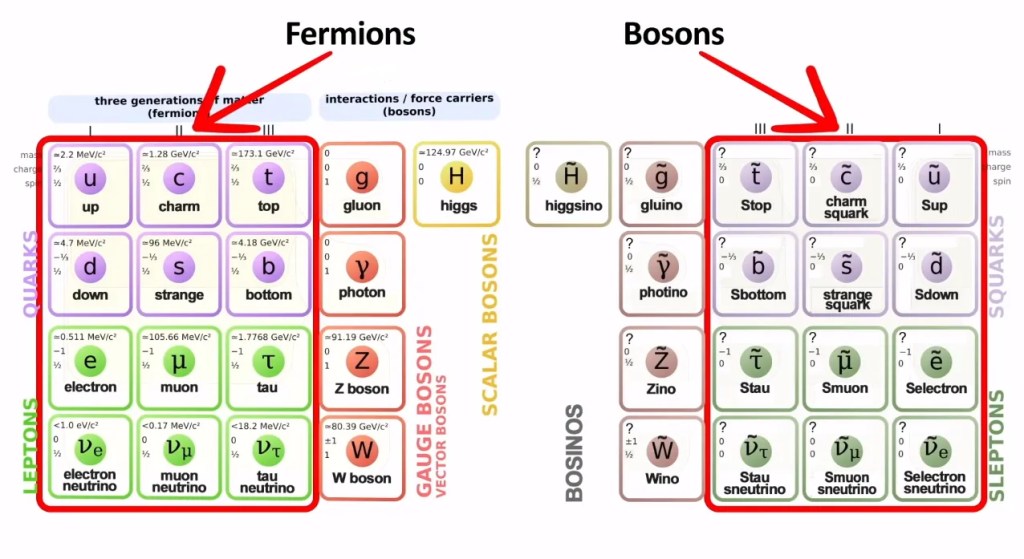
In quantum theory, super symmetry is a proposed fundamental symmetry between elementary particles and their corresponding superpartners. Super symmetry posits that for every known particle, there exists a superpartner particle with similar properties but differing by half a unit of spin. This symmetry suggests a deep underlying unity in the fabric of reality, transcending the apparent duality between matter and energy.

The concept of super symmetry dualism in quantum theory challenges conventional notions of materialism and underscores the interconnectedness of all phenomena at the quantum level. Just as Vajrayana Buddhism teaches the interdependence of all beings and phenomena, super symmetry dualism suggests a profound unity underlying the diversity of the universe.

When we account for their apparent differences in language and methodology, Vajrayana Buddhism’s Four Immeasurables and quantum theory’s super symmetry dualism share several intriguing parallels:

1. Unity and Interconnectedness: Both frameworks emphasize the fundamental unity and interconnectedness of all phenomena, transcending conventional distinctions between self and other, particle and wave.

2. Boundless Compassion: The cultivation of boundless love and compassion towards all beings in Vajrayana Buddhism resonates with the inclusive nature of super symmetry dualism, which acknowledges the inherent value and interconnectedness of all particles and fields.

3. Equanimity and Balance: Just as equanimity in Vajrayana Buddhism promotes a balanced and non-reactive mind, super symmetry dualism suggests a dynamic equilibrium underlying the fluctuations of the quantum world.

In exploring the parallels between Vajrayana Buddhism’s Four Immeasurables and quantum theory’s super symmetry dualism, we gain insight into the profound interconnectedness of consciousness and the cosmos. Both frameworks offer valuable perspectives on the nature of reality, challenging us to transcend dualistic thinking and cultivate compassion, wisdom, and equanimity in our lives. As we continue to probe the mysteries of existence, may these diverse paths of inquiry converge, illuminating the path to deeper understanding and harmony.

QP

Panpsychism C=E=mc2

Let’s explore the Relationship Between Consciousness and Energy in Comparison to Vajrayana Buddhism

Panpsychism is a philosophical theory that posits that consciousness is a fundamental aspect of the universe, present in all forms of matter from the smallest particles to complex organisms. This theory challenges traditional notions of consciousness as solely a product of biological processes, suggesting instead that consciousness is inherent in the very fabric of reality. Today, we will explore the relationship between consciousness and energy in the context of panpsychism, specifically comparing it to the perspective of Vajrayana Buddhism, which also has profound insights into the nature of consciousness and reality.

In the equation, C=E=mc², C represents consciousness as a fundamental aspect of the universe. Panpsychism asserts that consciousness is not exclusive to sentient beings but is pervasive throughout the cosmos, imbuing all matter with some level of subjective experience. C=E aligns with the notion that consciousness is a form of energy that permeates the universe, similar to the energy described by the equation and its relationship to mass. By framing consciousness as a fundamental force akin to energy, panpsychism challenges us to reevaluate our understanding of the relationship between mind and matter.

Vajrayana Buddhism, a school of Tibetan Buddhism known for its esoteric teachings and advanced meditation practices, offers profound insights into the nature of consciousness. According to Vajrayana teachings, consciousness is not limited to individual beings but is interconnected with all phenomena in the universe. This view resonates with panpsychism’s premise that consciousness is ubiquitous and present in all aspects of reality. In Vajrayana Buddhism, consciousness is seen as the radiant clarity that underlies all experiences and perceptions, transcending individual identity and ego. This is supported by the mind only, Cittamatra, or non dual perspective. Mind only means that everything that happens, what we see, what we do and the universe all happen in mind.

Both panpsychism and Vajrayana Buddhism share a holistic understanding of consciousness as a pervasive force that transcends individual beings. While panpsychism articulates this idea in terms of consciousness as a fundamental property of matter, Vajrayana Buddhism approaches it from a metaphysical perspective, emphasizing the interconnectedness of consciousness with all phenomena. Both perspectives challenge dualistic views of mind and matter, pointing towards a more integrated understanding of reality that acknowledges the intrinsic relationship between consciousness and the universe.

Furthermore, the equation C=E=mc² serves as a metaphorical bridge between panpsychism and Vajrayana Buddhism, highlighting the interconnectedness of consciousness and energy. Just as energy can be converted into mass and vice versa, consciousness in panpsychism and Vajrayana Buddhism can be seen as a dynamic process that transforms and manifests in various forms. Here we are reminded that subject, object, and action are all on; whereas consciousness, energy and mass form the universe. By exploring the parallels between panpsychism and Vajrayana Buddhism through the lens of consciousness and energy, we gain a deeper appreciation for the profound implications of these theories on our perception of reality.

The comparison between panpsychism and Vajrayana Buddhism offers a rich tapestry of ideas that challenge conventional notions of consciousness and its relationship to the universe. By viewing consciousness as a fundamental aspect of reality, both perspectives invite us to reconsider our understanding of mind, matter, and the interconnectedness of all phenomena. Through the equation C=E=mc², we are prompted to reflect on the deep unity between consciousness and energy, bridging the gap between scientific inquiry and spiritual wisdom. In exploring the parallels between panpsychism and Vajrayana Buddhism, we are called to contemplate the profound implications of these perspectives on our perception of self, reality, and the nature of existence.

QP

The Paramita of Generosity

Have you ever said no to someone’s generosity? Let QP show you how you actually said NO to your self. it’s time to Develop Quantum Generosity!

Please don’t forget to like subscribe and share both here and on YouTube!

Ego = 0

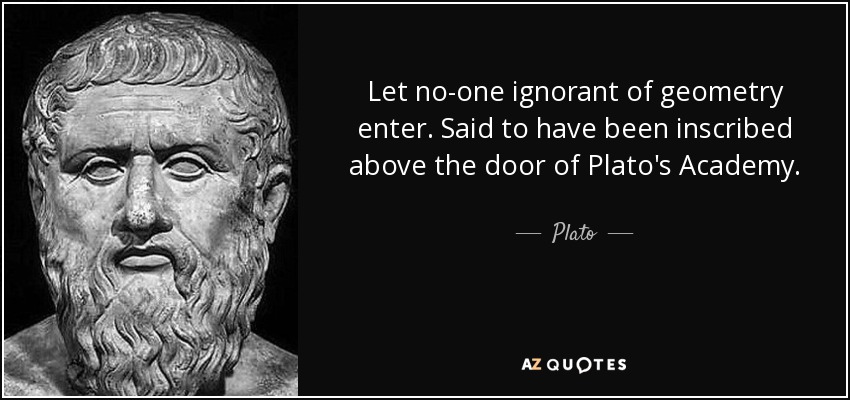
Much to the chagrin of many Roman/Greko philosophers the idea of zero as a number was born in India. To quote Russel Peters, a Canadian comedian the concept was first used in the well-known technique of bargaining by an individual who wanted something but did not want to pay. There are stories and proof of zero concepts in several cultures, not just in Europe and Asia. Even the ancient South Americans seem to have some idea what zero is.  There is, however, a Buddhist link expressed by my favorite philosopher Nagarjuna. Nagarjuna is famous for his groundbreaking treatises on sunyata Sanskrit for emptiness. What could be more empty than zero? Even in the cardinal script, the shape of the zero says “hey man there is nothing here look into the circle it’s empty.” One thing for certain even if the zero was not first conceptualized in India, Indians were with certainty the first people to take the concept out of the mathematical arena and into a philosophical debate. Philosophy and mathematics have always had an interesting coexistence. It is said that above the entrance to Plato’s Academy “let no one ignorant of Geometry enter” was inscribed.

The idea of emptiness is not an easy concept to understand in fact it is more often misunderstood that any other buddhist teaching. This is in part due to many translations of buddhist texts compiled by Christian scholars who had the intention of belittling and demonizing the Buddha Dharma therefore calling it Buddhism.

Nagarjuna’s premise is that things or objects in our world have no independent existence in and of themselves, this is emptiness.

The idea is that we as individuals project our own meaning, concepts, and ideas onto everything that we perceive. We label everything good or bad and so begins the constant samsaric battle of attachment and aversion. This step of labeling is a mistake of our egos as we see ourselves as separate from that object of perception. This separation or act of creating a border between that which we truly are and that which we perceive is the original mistake. Mind or our consciousness is compared to an eye. An eye cannot see itself it only sees outwards. This is why we must turn our mind’s eye inwards in the practice of meditation. Only then do we truly see that Ego = 0

QP

Wave particle Duality verses Non Dual Buddhism

Waves and particles seem to the unlearned to be two very different things. But as we look deep down the quantum rabbit hole we begin to see how words like Non dual and unity have a very big place in the quantum world of the tiny and unseen and Buddhism alike.

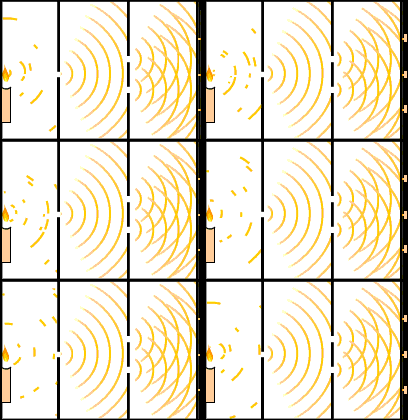
Although demonstrated by Thomas Young’s famous double slit experiment in 1801 Wave-particle duality only became widely accepted in Quantum physicists in the mid-1900s. It is very interesting that the theory states that particles can exist as waves, waves can exist as particles, and sometimes they exist as both at the same time.
Young discovered that when shooting particles or photons at a steel plate one can observe either an interference pattern that indicates a wave function or individual spots indicating particles. The experiment seems to get weird when we understand that particle patterns were observed when a detector was placed on the screen to track the particles and when no detector was there the wave pattern was observed. Even stranger was when a single proton was fired it spit into two at the slot only to combine once again at the screen displaying qualities of both waves and particles.

Albert Einstein is quoted as saying:
“It seems as though we must use sometimes the one theory and sometimes the other, while at times we may use either. We are faced with a new kind of difficulty. We have two contradictory pictures of reality; separately neither of them fully explains the phenomena of light, but together they do.”

 
doubleslottest-1400x793-71.jpg
 

Buddhism not surprisingly has some 1000-year-old insights that compare almost exactly to this modern quantum phenomenon. In roughly 1320 the 3rd Gyalwa Karmapa Rangjung Dorje wrote his crowning treatise on Mahamudra. Written in song or poetry like stanzas he tries to show us how things are not perceived as they really are and the connection of mind in our experience of how things truly are.
Verse 6 says “The nature of the ground is the dual truth, free from extreme views of a permanent reality and of nihilism” Karmapa states here that our reality is the dual truth that is free from any reality of permanent or unchanging existence and free from the nothingness of nihilism. I would draw the comparison here to Einstein’s words that point to the contradiction between our materialistic world of particles and the unseen world with wavelike properties or even possibilities. Einstein goes further to say that sometimes we need only one of the theories sometimes we need both. Young’ experiment would support both here by demonstrating how sometimes we are seeing particles and sometimes waves then sometimes both.
In verse 11 Karmapa goes on to clarify this in case we did not catch it the first time, “May we recognize mind’s essence, which is free of any extremes. It is not existent, for even the buddhas do not see it. It is not non-existent for it is the basis of everything, of conditioned existence and of the state beyond suffering. This is no contradiction. It is the middle way of unity.” So what Einstein initially proposed to be a contradiction is countered by Karmapa’s conviction that the middle way of unity and ultimately agreed to by Einstein “separately neither of them fully explains the phenomena of light, but together they do”. Young would again agree when he observed particles splitting acting as waves and then reuniting to a particle once again. This to me is a very clearly non-dual co-emergent reality.
Verse 18, my personal favourite, Karmapa clarifies once more for the doubters among us, “Observing phenomena, none is found. One sees Mind. Looking at mind, no mind is seen, it is empty in essence. Through looking at both, one’s clinging to duality naturally dissolves. May we recognize mind’s true nature, which is clear light”. In complete agreement Einstein and Karmapa both recognize that a complete unified understanding of the seen and unseen or the particle and wavelike worlds between Quantum Physics and Buddhism leads to the truth of our existence. Moreover one cannot ignore the fact that Young and Einstein were both talking about light waves and particles called photons. Wouldn’t it be wonderful to see this clearly?

Meditation helps us to see more clearly or likely even completely clear. Once the veils of our emotions like jealousy and anger are cleared away we see our world free from their constant blurring effect. Our newly developed wisdom transforms suffering into joy. In the double slit experiment, we see the evidence of particles when our attention or the sensor is turned on, this is what we see now normally. If we can train ourselves in meditation maybe we can see the world of waves and their functions, maybe we can even understand or see our consciousness in action and watch as our awareness interacts with the collapsing wavefront into our particle material based world. It sounds a bit crazy, I know, but why not it might be really amazing.

So it seems to me that my three friends seem to agree on quite a lot, maybe the only thing that Karmapa, Young, and Einstein might disagree about is the path one takes meditation versus mathematics. Do both roads lead to Rome? Why not do both, that’s why people like me are here.

 
Young+Fringes.gif

QP


Panpsychism, could it really be true?

Have you ever wondered how or where consciousness arises? I have and “Pan what?” was my first question when a good friend mentioned to me in conversation that what I was actually describing to him had already been theorised hundreds of years ago. “Phew, I am not the first idiot to think this” was my second thought and then “wait a second it would have been cool to come up with something new” was the third though. After the discussion, I read up on the subject I could not have been more amazed, as the inherent beauty and wisdom slowly sank deeply into my being.

panpsychism

Panpsychism postulates that consciousness is everywhere and in everything and that this non-local or cosmic-wide phenomenon is also without cause. In short, Consciousness is Fundamental in the universe. Even stones and elementary particles have consciousness, not just people, bugs, or plants. Even for me, this sounds a little far-fetched until you delve into the subject a bit more. The earliest known references to panpsychism are likely attributed to early religions like Shintoism, Taoism, Paganism, and Shamanism. Even Aristotle is quoted as saying “that everything is full of gods.” Plato argued in his Sophist that all things participate in the form of being and that it must have a psychic aspect of mind and soul. “This world is indeed a living being endowed with a soul and intelligence … a single visible living entity containing all other living entities, which by their nature are all related.” Wow, that is a big idea and not so easy for an individual to wrap his mind around it. That is probably the problem, the idea of panpsychism takes us from the comfort of our strongly held idea of an individual or ego and even the religious idea of a soul or atman to the understanding that not only are all beings one being but that all things are united in a blissful unity or beingness.

This is illustrated in Robert Fludd’s depiction of the world soul. I thought it might illustrate the idea of Panpsychism in an interesting way.

Fotothek_df_tg_0006450_Theosophie_^_Philosophie_^_Judentum_^_Kabbala_^_Kunst_^_Technik

Panpsychism has some competition it is not the only theory about the origin of mind, the emergence theory has many followers as well. Emergence Theory postulates that consciousness has emerged from some as yet unknown evolutionary chemical process. Philosopher Professor Galen Strawson articulates the relationship between panpsychism and emergence quite acutely: “The issue of emergence of mind is important because it is the mutually exclusive counterpart to Panpsychism: either you are a Panpsychist, or you are an Emergentist. Either mind was present in things from the very beginning, or it appeared (emerged) at some point in the history of evolution. If, however, emergence is inexplicable or is less viable, then one option  is left with the panpsychist alternative. This line of reasoning … is the (panpsychist) ‘argument from Non-Emergence.”

Interestingly there is no proof anywhere of consciousness or mind emerging from any process but neither is there any proof of panpsychism. Panpsychism is, however, in my opinion, far more elegant and takes mind or consciousness a few steps further than the emergence of mind as an evolutionary or purely materialistic process. Even with a rather superficial level of understanding of panpsychism, one might find some comfort in this theory that we are never alone and connected to everything in every way or coemergent with the universe. However, this may also strike fear into the hearts of those who are so deeply attached to their own individuality or egos. Regardless of one finds comfort or fear let’s discover some more of how Panpsychism, Quantum Physics, and Buddhism might be related.

When we analyse subatomic particles, one might say that there is no difference between the protons, neutrons, electrons, quarks, quarks, and leptons and bosons in my body, and the protons, quarks, and leptons in the desk in front of me except that I am conscious and the desk is not. Or is it but at a dramatically reduced level? David Bohm theoretical physicist and philosopher said, “That which we experience as mind … will, in a natural way, ultimately reach the level of the wave function and of the ‘dance’ of the particles.  There is no unbridgeable gap or barrier between any of these levels. … … in some sense, a rudimentary consciousness is present even at the level of particle physics” Just look at the observer effect with the double slit experiment. So here we can surmise that there is no barrier between me and the desk if even the electrons decide if they are a wave or a particle.

To this day we do not understand where or how consciousness arises and the role the brain plays in its formation if it plays a role at all. It could be just a receiver or radio, receiving information on several channels of perception that we would call our senses. Panpsychism skips this need to discover the relationship between the brain and the rise of conscious awareness completely, its simplicity is simply profound. No matter how shocking or strange panpsychism sounds I am reminded of what Sherlock Holmes said, that when you have eliminated the impossible, whatever remains, however improbable, must be the truth. Can science accept this deduction and if not how do we prove that which we have not been able to prove, other than keep trying even though the truth is already in front of us?

Buddhism teaches us that all beings have mind and or what we call Buddha nature, which is the ability to realize one’s full potential. Many teachers, when asked if plants have mind, would deny it and say that simply if it moves like an ant or something, then it has mind. As we know, plants only sort of move in their relationship to water and sunlight and the various degrees to which they require their nutrients. Some studies are even now suggesting that trees in the forest share nutrients and water with sick or old trees. This is not only consciousness but intelligence as well. This could be a very basic version of attraction and aversion, which is looking less and less attractive.  This rather narrow view is at the outset, not as encompassing as panpsychism. However, Buddhism requires us to break down any borders or boundaries between us and other things, this even applies to all concepts and ideas so why not to all phenomena as well. At an ultimate understanding of mind, where nothing has any true or independent existence in and of itself, all things would seem to have all the same qualities; conscious and otherwise. I would like to quote David Bohm once more here: “The notion of a separate organism is clearly an abstraction, as is also its boundary. Underlying all this is unbroken wholeness even though our civilization has developed in such a way as to strongly emphasize the separation into parts.” From the Undivided Universe: An Ontological Interpretation of Quantum Theory

This oneness without separation or boundary is exactly what we are talking about when Buddhists say that subject, object and action come together as one. This is known as the state of Mahamudra or complete and full awareness or consciousness. Once we have reduced this ontologically either in meditation, philosophically, or scientifically all that there is left points to just consciousness or mind and nothing else seems to matter, even matter itself. Imagine that, matter doesn’t matter. In this simple state of just being, connected with everything, and aware of all that there is, a state of great joy and bliss arises. Total freedom of mind, no more running from or reaching for, just complete happiness and wisdom resting in the suchness of everything. Here is where we can be really effective in this confused and angry world. Here is where we can really be the change that we wish to see in the world.

So is consciousness everywhere and in all things? I think so. Its simple beauty is both profound and inspiring, especially to the Buddhist ear. Modern science seems to agree more and more with this conclusion and I can only ask when or will modern society see the light as well? Perhaps Panpsychism is even the solution to the hard problem of consciousness. Which is to question how and why sentient organisms have qualia or phenomenal experiences.

This is one of my most successful posts ever and I am editing it today to include this wonderful video from a favourite Youtuber ASTRUM:

Scientists are baffled.     This is a link

Click the link or scroll down to the bottom.

For my German-speaking audience, I found two very interesting videos that discuss Panpsychism. The first one is from Professor Harald Lesch a wonderful physicist, astronomer, and philosopher who explores panpsychism from a purely astrophysical perspective with quite an open mind even though he does not agree with the idea.

The second video from Gerd Scobel actually a friend of Professor Lesch explores the topic from a philosophical perspective.

Personally, I think the Buddha Dharma has already answered this question, but that’s a topic for another post. This for me is just another way in which we see that consciousness is the vehicle in which the universe is becoming aware of itself. Why else would it be so beautiful and blissful to experience it either in meditation or by scientific discovery? Let us take this and use it as a tool to better the world and our fellow beings in every imaginable way. Whatever your view is on this topic I would love to hear from you, please feel free to comment below.

QP

Choose your Own Adventure

More and more every day modern science is coming to terms with what on the outset was an uncomfortable reality. That is that the observer (you and I) play not just an important role in reality or in our universal experience but actually that we are the deciding factor at the centre of it all. I think for the most part modern science has tried to stay an arm’s length away from any of the organised or generally accepted world religions and this is not necessarily a bad thing, while many of the world’s religions seem hellbent on destroying each other and have become so inflexible because of dogma. There is, however, one notable exception the Buddha Dharma. The Buddha Dharma is without a doubt the most peaceful, humanistic, and scientific of all organised religions. Please note that I personally do not subscribe to the fact that Buddhism is a religion, and I object to the suffix of “ism” as well, but common convention begs to differ and I use the term religion here in this light. If science was ever looking for or in need of a partner to explain the world as it is, the Buddha Dharma is up for the challenge. Why do I say that? Certainly not just because I am convinced of that myself, but because a growing number of scientists are also convinced or at least make comments that lean more and more in this direction. This is not an easy thing to do as science tends to push back on individuals who cross the perceived line of separation between science and religion.

Choose your own adventure.jpg

Let’s examine and discuss three quotes that I have found inspiring and relevant to this discussion.

R.C. Henry professor of physics and astronomy at Johns Hopkins University in a 2005 essay is quoted as saying:

A fundamental conclusion of the new physics also acknowledges that the observer creates the reality. As observers, we are personally involved with the creation of our own reality. Physicists are being forced to admit that the universe is a “mental” construction.

Pioneering physicist Sir James Jeans wrote

“The stream of knowledge is heading toward a non-mechanical reality; the universe begins to look more like a great thought than like a great machine. Mind no longer appears to be an accidental intruder into the realm of matter, we ought rather to hail it as the creator and governor of the realm of matter. Get over it, and accept the inarguable conclusion. The universe is immaterial-mental and spiritual.

– Eugene Wigner, theoretical physicist and mathematician said:

“It was not possible to formulate the laws of quantum mechanics in a fully consistent way without reference to consciousness.”

So how is this relevant to the Buddha Dharma? The underlying theme to these three quotes can be summarized in the following points and the following ideas:

The role of the observer and consciousness in the perceived reality of the universe.
The pointing out or pointing to the idea that Subject and Object are interdependent and non separable.
1. The mental processes the observer goes through when perceiving something is described by Buddhist Theory of Perception and is traditionally called the study of the five Skandhas. Skandha is Sanskrit for heap, collection, or grouping. “The five skandhas are form, sensation, perception, activity, consciousness. A form can arise in the mind or outside of the mind. This form gives rise to a sensation, which gives rise to perception, followed by activity (mental or physical), and lastly consciousness. In the Buddha’s explanation, the five skandhas occur one after the other, very rapidly. They are not a continuous stream but rather a series of discrete or discernible moments. A form arises or appears, then there is a sensation, then perception, then activity, then consciousness.” Thank you to Americanbuddhist.net for this description, the full article can be read here. I personally find that the activity phase of this process is the most interesting, it is here where we colour the perceived experience with a combination of all the impressions in our store consciousness and immediately decide if what we perceive is good or bad. This is the very basis of aversion or attraction, this is what keeps us busy our whole lives running to or away from the things we see. Each and every time we perceive something the process of the five skandhas is repeated without stopping over and over again and we may even experience multiple events overlapping one another. Each individual instance may be named “a moment of mind or consciousness” and many moments of mind strung together is best described as our “Stream of Consciousness”. Our consciousness directs our awareness from one form or arising to another. We are very clearly caught up in a process of observation, judging or evaluating and then acting on all phenomena that we in one way or another come into contact within the universe.

2. The interdependence of subject and object are central to many philosophical discussions within the different schools of Buddhism. One can summarise the major point here with the age-old question, what came first the chicken or the egg? The answer is rather simple you simply cannot have one without the other therefore it is irrelevant as to what came first when we must have both. So to go a little deeper the thought process goes like this: if we have a universe of objects with no subjects we should have to ask what would be the point of it be? All these wonderful things with nothing to enjoy them. Conclusion, objects without subjects are meaningless. On the flip side, what use is a subjective universe full of subjects with no objects to perceive or enjoy? It simply makes no sense to have one without the other. Consciousness requires something to be conscious “of”. So we have this absolutely amazing universe and we are here to discover and enjoy it.

The only thing missing here is action. What do I mean by that? Well in Buddhism we learn that not only are subject and object inseparable co arising phenomena, so are subject, object, and action. Action is important as if there are only subjects and objects and nothing happening well this is just boring. Luckily there is unlimited action in our universe, things never stop moving and changing. Everything is in a constant state of flux as each and every time we interact with something the “Whole of the Universe” is changed as it reacts to our play with it. These are the views held by the Madhyamika school of Buddhist Philosophy.

I firmly believe that we are evidence that the universe is conscious of itself and furthermore, we are constantly creating and choosing our past, present, and our future and we then choose how we see or interpret it as good or bad, in the way the Buddha Dharma has shown us. If you can agree that we are indeed choosing our adventure, lets all consciously decide to choose a positive and joyful adventure for the benefit of all beings.

Niels Bohr and the Buddha “Awareness or Creation”

Bohr_real_vs_unreal

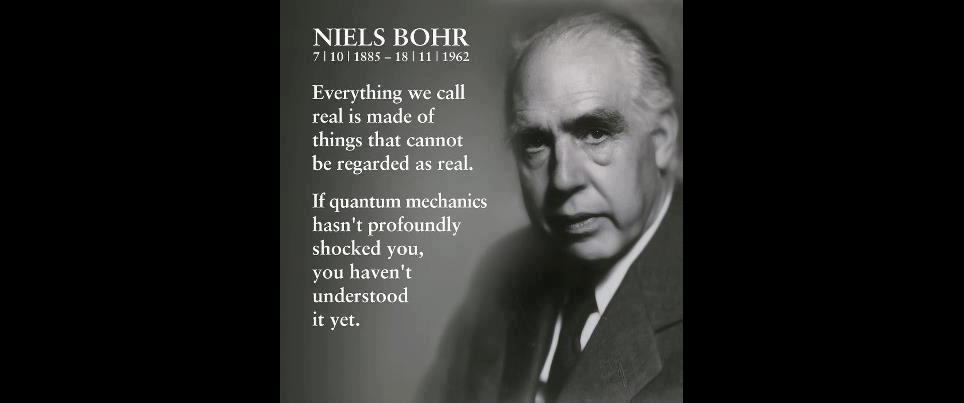
“Everything we call real is made up of things that cannot be regarded as real” Niels Bohr. What exactly did Neils Bohr mean here? In modern Quantum Physics, we begin to understand that what we have learned such as particles or atoms to be nothing more than probabilities and potentials. We don’t actually know what an atom looks like or exactly where they are and we likely never will. We guess as to their exact positions and properties with complex mathematical equations and complex experiments some costing billions of dollars. To a Quantum Physicist, the idea of a Ven Diagram showing how oxygen and carbon atoms react is like teaching the Dalai Lama about the Buddhas birth. Quantum Physics has completely changed how modern science looks at the reality in which we think we live. To a Buddhist, this is music to our ears. It sounds very much like the teachings of emptiness. To some, the concept of emptiness is troublesome and it can be hard to wrap your mind around it. It has been described by some very early Christian translations to mean nothingness. This makes us Buddhists sound like nihilists. This was likely done on purpose as to discredit, to falsely portray, or confront Buddhism and further the creation myth by the Church and her missionaries. However, Buddhism is as far from nihilism as Christians are from hell. We define emptiness by saying that all phenomena have no intrinsic or independent existence of their own. To detail this teaching classicly we need to discuss the twelve points of dependent origination. But to make things easy I will simply try to answer that age-old question “if a tree falls in the forest does anyone hear it?” For example, let us take something beautiful like a rose. Does a rose really exist? Another way to ask this is to say does the rose exist independently in and of itself? In Buddhist Philosophy for something to really exist it must be independent of all other phenomena. The answer is no, the rose does not exist independently of anything, it is as we know dependant on sunlight for example. One step further and we see that there is no sunlight without the sun. There is no sun without the sun’s ongoing nuclear reactions and no reactions without Helium and Hydrogen. We see here that rose is empty of independent existence. Or as some might say the rose is an expression of emptiness or empty in nature or essence. We agree with Niels Bohr and we understand the rose to be real but it is not.
Is there another way that we can understand the rose to not exist independently? Yes, if the rose is to be considered to be real and independent it must exist as it does now without changing. It cannot grow, bloom, and we could not even cut one from the plant as it would die and rot away. We know this independence to be false because the rose changes in every moment fully dependent on all the conditions it requires to be as it is. This is also understood as impermanence, as no thing lasts forever.

Now if I stop here I can imagine that some of you might say, “see this is Nihilism no things exist in Buddhism. And you might be right, however, I am reminded of a quote from a famous Buddhist Philosopher Nagarjuna, who said “If you think things are real you are as dumb as a cow, if you think they are not real you are even dumber” If you think trains are not real please do not stand in front of one that’s moving, as you will be suddenly surprised. We know phenomena are there because we can perceive them and be aware of them, they are however dependent on our perception and awareness. The famous double slit experiment is good evidence of this. Our observation imparts a temporary existence to them as we observe them. Just as the waveform collapses into particles that we can perceive as we observe them. They arise, exist, and dissolve back into the space or the field where all information exists as space is information. It would seem that we give phenomena their essence or that our observation is responsible for their creation. When we look around and see the sheer complexity and beauty around us it is clear that life is amazing and so full of potential and joy. We just need to slow down and simply pay attention to it; this is what we learn in meditation. So clearly Buddhists are not nihilists. Now for one to think that the traditional biblical creation myth we talked about earlier as the truth, one needs to assume that all of creation was finished after just 6 days. I firmly understand that it is preposterous and hubris to think anything other than, that creation is continuous and infinite. And when you come this far you might just see yourself as an integral part in all of it.

So the falling tree in the forest is dependent on the sun, the rain, and many other conditions around it not the least of which is us. Without someone to notice it there simply is no meaning or reason for the tree to exist in the first place.

“If quantum mechanics hasn’t profoundly shocked you, you haven’t understood it yet.” Niels’ words here are truly inspiring, I would expand to say this: If Buddhism hasn’t profoundly shocked you, you haven’t understood it yet. The more I learn the more I am shocked by the Buddha Dharma. I am often moved to tears when concepts like emptiness finally begin to sink in and are understood on deeper and deeper levels. I am convinced that Niels Bohr must have understood things in a similar fashion or he would not have said what he said.

QP

The Mahamudra of Max Plank

images

As a man who has devoted his whole life to the most clearheaded science, to the study of matter, I can tell you as a result of my research about the atoms this much: There is no matter as such! All matter originates and exists only by virtue of a force which brings the particles of an atom to vibration and holds this most minute solar system of the atom together. . . . We must assume behind this force the existence of a conscious and intelligent Mind. This Mind is the matrix of all matter.

Das Wesen der Materie (The Nature of Matter), a 1944 speech in Florence, Italy.

“I regard consciousness as fundamental. I regard matter as derivative from consciousness. We cannot get behind consciousness. Everything that we talk about, everything that we regard as existing, postulates consciousness.”

As quoted in The Observer (25 January 1931)

We have been ignoring modern science for more than 100 years now in the struggle against impermanence of all things composite. We glorify everything material and honour those who can amass the most. We could not be moving in a such a completely wrong direction as a species, how could we misunderstand or even ignore such a clear and concise description of the material world, from one of the most preeminent minds ever, as this? What did Max see on his blackboard filled with equations erased and scratched over once again that could lead him to such a profound observation such as this? After his years of study experimentation and research and this is how he sums it all up in the final years before the end of his life by saying consciousness is the root of all there is, there is no thing behind it.

Let us compare his summary to that of another scientist, not a normal scientist but a scientist of the mind, the third Karmapa. Rangjung Dorje born in Tingri Tibet in 1284. He studied mind within the laboratory of meditation. His professors were highly respected monks from a very long tradition of mind exploration dating back more than two thousand years earlier to old India, the birthplace of modern science. Well, we haven’t recognized it as such yet but one day we must, the Greeks as great as their minds were, only recycled what they had learned in the east, and claimed much of it as their own. Anyway, I digress. Karmapa wrote a song of Mahamudra, I put forward two verses for our comparison of these two masters of intellect.

Verse 9: All phenomena are projections of the mind. Mind is not “a” mind; the mind is empty in essence. Although empty, everything constantly arises in it. May precise examination sever mistaken views of the ground.

And

Verse 18: Through the examination of external objects we see the mind, not the objects. Through the examination of the mind we see its empty essence, but not the mind. Through the examination of both, attachment to duality disappears by itself. May the clear light, the true essence of mind, be recognized.

So we can surmise from both Max and the Third Karmapa that everything comes from mind. Max did not say where things go when they cease to exist but today we can logically infer that they must go back to where they have come from, as the Karmapa said.

Don’t you find this comparison interesting, from two totally different times and sources that are saying almost the same thing. It begs us to look deeper and just outside but within as well.


Meditative or Quantum Entropy?

equilibrium2000 1000.jpg

Are Buddhists meditating in order to reach a human equivalent of zero-point energy or quantum entropy within their personal energy fields, realms of experience, existence, or in mind? Buddhists often talk about reaching a point, between attachment and aversion. We understand that we use a tremendous amount of energy striving for the things we desire and want, and running away from and avoiding the things that cause us difficulties. Our battle against our likes and dislikes as dictated to us by our personal concepts literally takes up all of our time and energy. This constant attraction and aversion to all our thoughts is simply so much work and effort we hardly have the time to stop and notice its effects let alone do anything about it. When beginning to meditate most of us become acutely aware of just how many thoughts we have and how much time we spend thinking or daydreaming. We think wow I had no idea how many thoughts I have, wow I am so confused and distracted, or even I cannot even begin to meditate because we are so overwhelmed. So if we can come to this state or point of no longer battling between the two extremes, and can rest in the middle, the present, in mind or mindfulness, how might one view it? Where does this energy go, how is it used and could we put it to better use?

We could call this liberation, great joy, highest bliss, or even enlightenment. One might even use the Tibetan word “detong” here may be defined as the union of emptiness and joy. I would explain further that all the energy we use to run away from or to things would simply be transformed into joy when we realize this state of “meditative entropy”. I use the word entropy here to highlight that this energy that is defined as being unavailable in the system of our existence or the random chaos of thoughts that may be observed may just be the basis of all that was, is, and will be. The inert uniformity is also very interesting here. From a Buddhist perspective, one might point to the union of subject, object, and action; or a state of non-separation of all beings. All this points to an existence of entropy in all areas of our lives or quantum entropy of our life in all its many facets and interactions with all beings, all at once, and for all times.

When we talk about the ground state in quantum mechanics and the chaos that that arises from or within it, I cannot help but think of all the possibilities. Think about this, is the “process of degradation or running down or a trend to disorder, chaos, disorganization, or randomness a bad, good, or neutral thing, when it happens in mind? As with most if not all things in the Buddha Dharma it is neutral, it all depends on how we see it or interpret the battle of our likes and dislikes to all the possibilities of the wide open space of mind. Next time our bus is late or we have a seemingly difficult situation lets keep in mind once the situation relinquishes itself to impermanence and dissolves, we become free of its effects and all we had to do was to be patient and wait for quantum entropy to once again balance out in our lives. We can once again focus upon or see the beautiful and wonderful. I find this potential energy completely enthralling and inspiring. I want some of it, and not just some but all of it. Of course, I will share it with you all.

How do the laws of cause and effect and Quantum Entropy interact? When karma matures and arises it goes through a process. First, we do an action or have it done and then we experience the actions and their immediate results. This action leaves an impression in mind that will arise at a later date and result in an effect in our lives. Much like Newton’s third law that states for every action, there is an equal and opposite reaction, the actions that we undertake and complete in daily life result in an equal reaction, in our minds ( I am not sure about an opposite reaction here). For example, when we hit someone with a left uppercut to the chin, we should not be surprised when someone hits us back in much the same way or in a similar fashion. This equalizing out of our actions is entropy at its best on a relative level in mind. Call it what you will, “you reap what you sow”, or some form of “do unto others as you would have them do unto you”, or the timely ripening of Karma, everything we say or do comes back to us in much the same form as that with which we sent it out with. And the result is always a tie game or Entropy. If this is true maybe we should only focus sending out the good stuff?

One of the most wonderful parts of my practice is to recite the four immeasurables. They are as follows: 1. May all beings have happiness and the cause of happiness. 2. May they be free from suffering and the cause of suffering. 3. May they experience happiness which is totally free of suffering and 4. May they remain in the great equanimity which is without attachment and aversion. The fourth one that details a state between attachment and aversion is exactly the balance we are seeking in our meditation and our lives. Here I would apply the second part of the definition “the degradation of the matter and energy in the universe to an ultimate state of inert uniformity” The ultimate state of uniformity how much more beautiful can this get? When everything is uniform, even, or level and totally in balance in the physical world. Would that not include us human beings as complex, unpredictable, and emotional as we are? There would be no yours or mine, no black and white, not even a here and there. What would we have to fight about? We could finally fully and totally relax and not have to worry about what the next guy is doing and work for the benefit of all. Equanimity or entropy take your pick the differences are small and the similarities are enormous.

Whether we are experiencing meditative detong, the equilizing out or the return of our actions (Karma), or equanimity; Quantum or Meditative Entropy will have its effect and even the score out. No matter if we are relating to one another on the relative or the ultimate level, our natural state is one of equilibrium, with all and within all, and in all times and directions. Our only choice is, do we choose to realise this and work with it or not? Do we have the courage to be responsible for our actions and live with the results, even if they affect us all on a quantum level?
Let’s choose a better path for ourselves, one that stands the test of time, endures the strictest of scientific evaluation, and models only the very best of our values and virtues. Do well, be well, and meditate well.


The following as of September 2016 were the definitions I have quoted in this entry:

entropy
noun en·tro·py \ˈen-trə-pē\
1: a measure of the unavailable energy in a closed thermodynamic system that is also usually considered to be a measure of the system’s disorder, that is a property of the system’s state, and that varies directly with any reversible change in heat in the system and inversely with the temperature of the system; broadly : the degree of disorder or uncertainty in a system
2a : the degradation of the matter and energy in the universe to an ultimate state of inert uniformity
b : a process of degradation or running down or a trend to disorder
3: chaos, disorganization, randomness

source:
http://www.merriam-webster.com/dictionary/entropy
Zero-point energy, also called quantum vacuum zero-point energy, is the lowest possible energy that a quantum mechanical physical system may have; it is the energy of its ground state.

All quantum mechanical systems undergo fluctuations even in their ground state and have an associated zero-point energy, a consequence of their wave-like nature. The uncertainty principle requires every physical system to have a zero-point energy greater than the minimum of its classical potential well. This results in motion even at absolute zero. For example, liquid helium does not freeze under atmospheric pressure at any temperature because of its zero-point energy.

The concept of zero-point energy was developed by Max Planck in Germany in 1911 as a corrective term added to a zero-grounded formula developed in his original quantum theory in 1900.[1] The term zero-point energy is a translation from the German Nullpunktsenergie.[2]:275ff

Vacuum energy is the zero-point energy of all the fields in space, which in the Standard Model includes the electromagnetic field, other gauge fields, fermionic fields, and the Higgs field. It is the energy of the vacuum, which in quantum field theory is defined not as empty space but as the ground state of the fields. In cosmology, the vacuum energy is one possible explanation for the cosmological constant.[3] A related term is a zero-point field, which is the lowest energy state of a particular field.[4]

Scientists are not in agreement about how much energy is contained in the vacuum. Quantum mechanics requires the energy to be large as Paul Dirac claimed it is, like a sea of energy. Other scientists specializing in General Relativity require the energy to be small enough for the curvature of space to agree with observed astronomy. The Heisenberg uncertainty principle allows the energy to be as large as needed to promote quantum actions for a brief moment of time, even if the average energy is small enough to satisfy relativity and flat space. To cope with disagreements, the vacuum energy is described as a virtual energy potential of positive and negative energy.[5]

The ground state of a quantum mechanical system is its lowest-energy state; the energy of the ground state is known as the zero-point energy of the system. An excited state is any state with energy greater than the ground state. The ground state of a quantum field theory is usually called the vacuum state or the vacuum.

If more than one ground state exists, they are said to be degenerate. Many systems have degenerate ground states. Degeneracy occurs whenever there exists a unitary operator which acts non-trivially on a ground state and commutes with the Hamiltonian of the system.

According to the third law of thermodynamics, a system at absolute zero temperature exists in its ground state; thus, its entropy is determined by the degeneracy of the ground state. Many systems, such as a perfect crystal lattice, have a unique ground state and therefore have zero entropy at absolute zero. It is also possible for the highest excited state to have absolute zero temperature for systems that exhibit negative temperature.

Zero-point Energy definition source: https://en.wikipedia.org/wiki/Zero-point_energy

Quantum Entanglement 

_DSC6884

Quantum Entanglement is really one of my favourite theories it was Albert Einstein’s Achilles heel, a trouble he likely even took with him to his grave. He called it “Spooky Action at a Distance” The use of spooky conjures up all sorts of ghostly images that would raise concern to any scientist or anyone in the pursuit of the truth but I think Einstein liked this description. According to sciencedaily.com entanglement can be defined as a quantum mechanical phenomenon in which the quantum states of two or more objects have to be described with reference to each other, even though the individual objects may be spatially separated. This leads to correlations between observable physical properties of the systems. For example, it is possible to prepare two particles in a single quantum state such that when one is observed to be spin-up, the other one will always be observed to be spin-down and vice versa, this despite the fact that it is impossible to predict, according to quantum mechanics, which set of measurements will be observed. As a result, measurements performed on one system seem to be instantaneously influencing other systems entangled with it.
Buddhism teaches entanglement when we say that everyone else has been our mother in the past, we are all entangled or related to one another in one way or another. This is why we should be aware of Karma or cause and effect. When we act or do something, the law of cause and effect results in entanglement. Our actions will result in an effect in our own lives later in time or they leave immediate impressions in mind that will paint our future perceptions of what happens to us. It is in everyone’s best interest to make this interaction a positive one. Not just for ourselves but for others as well. Some schools of Buddhist philosophy even express entanglement as “space is information”. This offers a different perhaps more complimentary explanation to quantum mechanics than my previous one. If throughout space even beyond our perception of the universe, we found that at every possible place, point, or time that everything imaginable exists; this would explain Einstein’s spooky action at a distance quite handily. I can go on further here but I will save it for another entry. As before am I on to something here or out to lunch? Do you have anything to add or subtract?


I want to leave this entry with a very beautiful poem by Tyler Kent White that seems to accentuate the theme I am putting forward here.


Tyler Kent white

Source


Superposition

Quantum Superposition

Superposition may be defined as The quantum mechanical property of a particle to occupy all of its possible states simultaneously. This property of multiple coexisting states of existence persists until the superposition is measured, observed, or interacted with. Superposition is classically explained by Schrödinger’s Cat. A cat is imagined as being enclosed in a box with a radioactive source and a poison that will be released when the source (unpredictably) emits radiation, the cat being considered (according to quantum mechanics) to be simultaneously both dead and alive until the box is opened and the cat observed. Its kind of a funny thing to think about, but it begs a few important questions.

  1. What role does the observer play not only in science but in perception in general?
  2. What roles do subject, object, and action, the three subparts of observation, really play in our awareness in meditation?
  3. What are Buddhists attempting to observe in meditation, is this all the same thing?

The Buddhist perspective might be that everything in the universe is constantly in superposition until mind perceives it or consciousness collapses the wavefront and all the possibilities condense into one. One might even say that to a Buddhist all possibilities exist in every situation we experience.

We can say that all possibilities exist within mind, and mind being no thing, is beyond our normal observation but not beyond meditation. When subject, object, and action come together within the meditation we witness the inseparability of ourselves and others. We attempt or practice to do this in the meditation and to then bring it forth in our daily lives. This is commonly called being in the moment or mindfulness. We use these phrases daily almost flippantly while ignoring their much deeper meaning.

The Sanskrit word Mahamudra is a state reached by meditation. Mahamudra could be defined in two parts; as Maha or super and mudra or position. If there are any Sanskrit experts out there, I am curious as to your thoughts on this. Please understand that my Sanskrit is often coloured by my understanding of Tibetan and a very good Indian friend.  Mahamudra has been the subject of many beautiful and cryptic songs or prose in Tibet since 1000 ad. The realization of Mahamudra is enlightenment. Our goal in Buddhism is to discover our true potential. This true potential is Enlightenment.

Do you agree, or feel otherwise? Or perhaps you have something to add?