


Tag Archives: Tibetan Buddhism

Illuminating the Grand Luminosity: Exploring Dzogchen,Mahamudra, Quantum Physics, and the Nature of Light

Dzogchen and Mahamudra: Insights from Meditation Masters

Dzogchen and Mahamudra are profound meditation practices rooted in
Tibetan Buddhism offers insights into the nature of mind and reality.
Similarly, quantum physics, a branch of modern science, explores the
fundamental principles governing the universe. In this blog entry, we
delve into the intriguing parallels between these disciplines, drawing
upon quotes from meditation masters and physicists alike to illuminate
shared insights and perspectives, particularly focusing on the concept
of light. Can we shine some light on light itself?

In Dzogchen, practitioners seek to realize the grand luminosity of
primordial awareness, which is described as an unbounded expanse of
light beyond conceptual elaboration. The Dzogchen master Longchenpa
elucidates:

“In the unborn expanse, the nature of phenomena, there is neither
object nor subject, neither confusion nor enlightenment. The grand
luminosity of primordial awareness illuminates all, like the radiant
light of the sun.”

Mahamudra teachings similarly emphasize the nature of mind as light,
transcending dualistic concepts of darkness and illumination. As the
Mahamudra master Gampopa advises:

“When mind recognizes mind, the train of discursive and conceptual
thought comes to a halt, and the space-like nature of mind dawns. This
luminous clarity is the essence of Mahamudra.”

Also the 3rd Karmapa Rangjung Dorje wrote “Observing phenomena none is found, one sees mind. Looking at mind no mind is seen, it is empty in essence. Through looking at both, one’s clinging to duality naturally dissolves. May we realize minds nature, which is clear light.”

Quantum Physics: Insights from Physicists

Quantum physics offers insights into the nature of light as both a
particle and a wave, revealing its dual nature. Einstein’s famous
equation, E=mc^2, illustrates the equivalence of mass and energy,
highlighting the profound relationship between matter and light. In
the words of Einstein:

“Mass and energy are two sides of the same coin, interconnected by the
speed of light squared. In the realm of quantum physics, matter
dissolves into pure energy, and light emerges as the fundamental
essence of existence.”
In our essence as material beings, we are light, inseparable from the particles that make up our bodies and the light that makes up our mind and consciousness.

Furthermore, quantum theory describes photons, the particles of light,
as carriers of electromagnetic force and information. The
wave-particle duality of light
challenges our classical understanding
of reality, suggesting that light exists simultaneously as both a wave
and a particle.

Nikola Tesla is quoted as saying “I am part of a light, and it is the music. The Light fills my six senses: I see it, hear, feel, smell, touch and think. Thinking of it means my sixth sense. Particles of Light are written note. A bolt of lightning can be an entire sonata. A thousand balls of lightening is a concert.. For this concert I have created a Ball Lightning, which can be heard on the icy peaks of the Himalayas.”

In exploring the convergence of Dzogchen, Mahamudra, and quantum
physics, we uncover profound insights into the nature of light and
consciousness. Both contemplative traditions and scientific inquiry
point to the luminous nature of mind and the interconnectedness of all
phenomena. As we navigate the mysteries of existence, may we draw upon
the wisdom of meditation masters and physicists alike, illuminating
the path to deeper understanding and awakening in the radiant light of
the grand luminosity.

Once again I would revise Einstein’s famous equation to be C=E=mc^2

QP
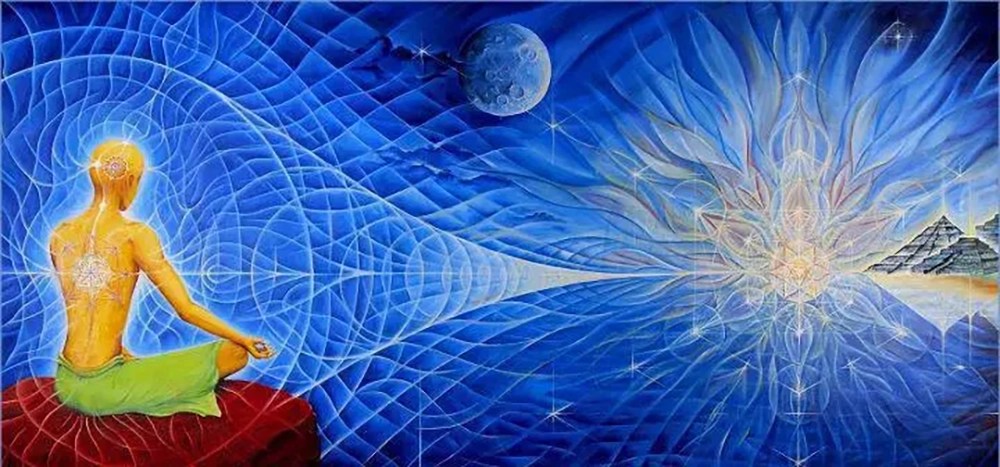
Panpsychism C=E=mc2

Let’s explore the Relationship Between Consciousness and Energy in Comparison to Vajrayana Buddhism

Panpsychism is a philosophical theory that posits that consciousness is a fundamental aspect of the universe, present in all forms of matter from the smallest particles to complex organisms. This theory challenges traditional notions of consciousness as solely a product of biological processes, suggesting instead that consciousness is inherent in the very fabric of reality. Today, we will explore the relationship between consciousness and energy in the context of panpsychism, specifically comparing it to the perspective of Vajrayana Buddhism, which also has profound insights into the nature of consciousness and reality.

In the equation, C=E=mc², C represents consciousness as a fundamental aspect of the universe. Panpsychism asserts that consciousness is not exclusive to sentient beings but is pervasive throughout the cosmos, imbuing all matter with some level of subjective experience. C=E aligns with the notion that consciousness is a form of energy that permeates the universe, similar to the energy described by the equation and its relationship to mass. By framing consciousness as a fundamental force akin to energy, panpsychism challenges us to reevaluate our understanding of the relationship between mind and matter.

Vajrayana Buddhism, a school of Tibetan Buddhism known for its esoteric teachings and advanced meditation practices, offers profound insights into the nature of consciousness. According to Vajrayana teachings, consciousness is not limited to individual beings but is interconnected with all phenomena in the universe. This view resonates with panpsychism’s premise that consciousness is ubiquitous and present in all aspects of reality. In Vajrayana Buddhism, consciousness is seen as the radiant clarity that underlies all experiences and perceptions, transcending individual identity and ego. This is supported by the mind only, Cittamatra, or non dual perspective. Mind only means that everything that happens, what we see, what we do and the universe all happen in mind.

Both panpsychism and Vajrayana Buddhism share a holistic understanding of consciousness as a pervasive force that transcends individual beings. While panpsychism articulates this idea in terms of consciousness as a fundamental property of matter, Vajrayana Buddhism approaches it from a metaphysical perspective, emphasizing the interconnectedness of consciousness with all phenomena. Both perspectives challenge dualistic views of mind and matter, pointing towards a more integrated understanding of reality that acknowledges the intrinsic relationship between consciousness and the universe.

Furthermore, the equation C=E=mc² serves as a metaphorical bridge between panpsychism and Vajrayana Buddhism, highlighting the interconnectedness of consciousness and energy. Just as energy can be converted into mass and vice versa, consciousness in panpsychism and Vajrayana Buddhism can be seen as a dynamic process that transforms and manifests in various forms. Here we are reminded that subject, object, and action are all on; whereas consciousness, energy and mass form the universe. By exploring the parallels between panpsychism and Vajrayana Buddhism through the lens of consciousness and energy, we gain a deeper appreciation for the profound implications of these theories on our perception of reality.

The comparison between panpsychism and Vajrayana Buddhism offers a rich tapestry of ideas that challenge conventional notions of consciousness and its relationship to the universe. By viewing consciousness as a fundamental aspect of reality, both perspectives invite us to reconsider our understanding of mind, matter, and the interconnectedness of all phenomena. Through the equation C=E=mc², we are prompted to reflect on the deep unity between consciousness and energy, bridging the gap between scientific inquiry and spiritual wisdom. In exploring the parallels between panpsychism and Vajrayana Buddhism, we are called to contemplate the profound implications of these perspectives on our perception of self, reality, and the nature of existence.

QP