Tag Archives: Religion

Hermetic Philosophy and the Great Seal Mahamudra, is there a Universal Wisdom?

Hermetic philosophy and the Great Seal, Mahamudra, may originate from different traditions, but they converge on universal truths about the nature of reality and the path to self-realization. Both systems offer profound insights, not only into the cosmos but also into the mind as a mirror of the infinite. Each path offers a way to transcend illusions and recognise the deeper truths that connect all things everywhere.

Hermeticism, grounded in the ancient teachings of Hermes Trismegistus, asserts that the universe is a unified whole governed by immutable principles. The Emerald Tablet, one of Hermeticism’s foundational texts, proclaims:

“That which is Below corresponds to that which is Above, and that which is Above corresponds to that which is Below, to accomplish the miracle of the One Thing.”

This principle of correspondence emphasizes the interconnectedness of all things. The inner world of the mind reflects the outer world of the cosmos, and understanding one allows access to the other. Hermeticism teaches that the transformation of the self is a key to unlocking universal truths, blending the mystical and the practical into a single path of self-discovery.

Mahamudra, a cornerstone of Vajrayana Buddhism, also delves into the nature of reality but approaches it through direct experience. Known as the “Great Seal,” Mahamudra reveals the inseparability of subject, object, and action, inviting practitioners to rest in the uncontrived awareness of the present moment. It teaches simplicity, pointing directly to the luminous, empty essence of mind. The seal it refers to symbolizes the inherent truth of reality, present in all beings, waiting to be recognized.

“Stop all physical activity: sit naturally at ease. Do not talk or speak: let sound be empty as an echo. Do not think about anything: look at experience beyond thought.”

Tilopa’s teachings echo the Hermetic focus on simplicity and direct experience. Just as Hermeticism calls for aligning with the natural order of the universe, Mahamudra invites practitioners to rest in the effortless awareness of the present moment, uncontrived and free from conceptual grasping.

Both traditions aim to transcend the illusions of duality. The Emerald Tablet declares:

“It ascends from the earth to the heaven, and again it descends to the earth, and receives the power of the superior and inferior things.”

This reflects Mahamudra’s recognition that samsara and nirvana are not separate realms but two aspects of the same reality. As the 3rd Karmapa Rangjung Dorje stated in his Aspiration Prayer of Mahamudra:

“Observing phenomena, none is found. One mind Looking at mind, no mind is seen, it is empty in essence. Through looking at both, one’s clinging to duality naturally dissolves. May we realize mind’s nature, which is clear light.”

These teachings align with Hermeticism’s view of the universe as a mental construct, where dualities like above and below, inner and outer, dissolve into the oneness of creation or pure light.

Perhaps most strikingly, both traditions guide practitioners toward liberation by turning inward Hermetic tools such as meditation, visualization, and alchemical transformation parallel Mahamudra’s focus on resting in the natural state of awareness. Both traditions emphasize simplicity, urging practitioners to move beyond complexity and directly experience the truth. Simplicity over dogma.

By bringing Hermetic philosophy and Mahamudra together, we find complementary paths to understanding the nature of reality. Hermeticism provides the structure of universal principles, while Mahamudra points to the direct experience of those principles through non-dual awareness.

Ultimately, both traditions lead to the same realization: the infinite is not something external to be sought—it is already within us. Whether approached through the mystical reflections of Hermeticism or the meditative clarity of Mahamudra, the journey unveils the truth of existence as boundless, interconnected, and ever-present. As Tilopa reminds us:

“What joy! Samsaric ways are senseless: they are seeds of suffering. Conventional ways are pointless. Focus on what is sound and true. Majestic outlook is beyond all fixation. Majestic practice is no distraction. Majestic behaviour is no action or effort. The fruition is there when you are free from hope and fear.”

Both the Emerald Tablet and the Tibetan Mahamudra Texts remind us that the Great Seal is not out there in the heavens or in some distant plane. It resides in the simple, open truth of the here and now. The challenge and invitation of both traditions is to awaken to this reality and embody it fully. The seal of the infinite is not outside us—it is, and always has been, within.

QP
Descartes Fourth Embracing the Path of Enlightenment: A Buddhist Perspective on Certainty and Truth

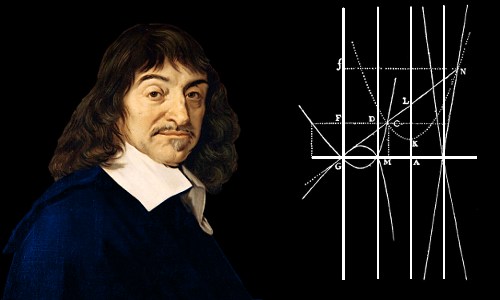
In our quest for truth and certainty, many philosophical traditions offer insights and guidance. While Descartes’ Fourth Meditation highlights the importance of God as the guarantor of truth, Buddhism takes a different approach, placing emphasis on the power of the mind and consciousness to unveil ultimate reality. Let’s explore this perspective through the lens of two key quotes from Descartes’ Fourth Meditation.

“For the more attentively I attend to God’s nature, the more evident it becomes that he cannot be a deceiver; and, accordingly, that everything which I clearly and distinctly perceive is of necessity true.”

While Descartes places trust in the existence of God as the foundation of truth, Buddhism directs attention inward, toward the nature of the mind and consciousness. In Buddhist philosophy, the mind is seen as the primary tool for uncovering truth and attaining enlightenment. Through practices such as mindfulness, meditation such as shine and laktong, and self-inquiry, individuals can cultivate clarity and insight into the nature of reality. Instead of relying on an external deity, Buddhists look within, recognizing the inherent wisdom and potential within their own consciousness.

“From this it follows that the certainty and truth of all knowledge depends uniquely on the knowledge of the true God, in so far as he is the sovereign and veracious author of all things.”

In contrast to Descartes’ reliance on God, Buddhism presents the concept of the Vajrayana truth state, which emphasizes clear or pure view and the full potential of enlightenment. In Vajrayana Buddhism, practitioners engage in transformative practices aimed at realizing the true nature of reality. Through methods such as visualization, mantra recitation, and energy channeling, individuals access deeper layers of consciousness and perception. This clear or pure view transcends conventional notions of truth, leading to a direct experience of mind and enlightenment—the ultimate state of awakening and liberation.

In conclusion, while Descartes’ Fourth Meditation offers insights into the quest for certainty and truth through the lens of God, Buddhism provides an alternative perspective centered on the power of the mind and consciousness. By embracing practices that cultivate clarity, insight, and realization of the Vajrayana truth state, individuals can journey toward enlightenment, unlocking their full potential and experiencing the profound depths of reality. Ultimately, the path of enlightenment beckons, inviting us to explore the boundless expanses of consciousness and truth within.

QP

Choose your Own Adventure

More and more every day modern science is coming to terms with what on the outset was an uncomfortable reality. That is that the observer (you and I) play not just an important role in reality or in our universal experience but actually that we are the deciding factor at the centre of it all. I think for the most part modern science has tried to stay an arm’s length away from any of the organised or generally accepted world religions and this is not necessarily a bad thing, while many of the world’s religions seem hellbent on destroying each other and have become so inflexible because of dogma. There is, however, one notable exception the Buddha Dharma. The Buddha Dharma is without a doubt the most peaceful, humanistic, and scientific of all organised religions. Please note that I personally do not subscribe to the fact that Buddhism is a religion, and I object to the suffix of “ism” as well, but common convention begs to differ and I use the term religion here in this light. If science was ever looking for or in need of a partner to explain the world as it is, the Buddha Dharma is up for the challenge. Why do I say that? Certainly not just because I am convinced of that myself, but because a growing number of scientists are also convinced or at least make comments that lean more and more in this direction. This is not an easy thing to do as science tends to push back on individuals who cross the perceived line of separation between science and religion.

Choose your own adventure.jpg

Let’s examine and discuss three quotes that I have found inspiring and relevant to this discussion.

R.C. Henry professor of physics and astronomy at Johns Hopkins University in a 2005 essay is quoted as saying:

A fundamental conclusion of the new physics also acknowledges that the observer creates the reality. As observers, we are personally involved with the creation of our own reality. Physicists are being forced to admit that the universe is a “mental” construction.

Pioneering physicist Sir James Jeans wrote

“The stream of knowledge is heading toward a non-mechanical reality; the universe begins to look more like a great thought than like a great machine. Mind no longer appears to be an accidental intruder into the realm of matter, we ought rather to hail it as the creator and governor of the realm of matter. Get over it, and accept the inarguable conclusion. The universe is immaterial-mental and spiritual.

– Eugene Wigner, theoretical physicist and mathematician said:

“It was not possible to formulate the laws of quantum mechanics in a fully consistent way without reference to consciousness.”

So how is this relevant to the Buddha Dharma? The underlying theme to these three quotes can be summarized in the following points and the following ideas:

The role of the observer and consciousness in the perceived reality of the universe.
The pointing out or pointing to the idea that Subject and Object are interdependent and non separable.
1. The mental processes the observer goes through when perceiving something is described by Buddhist Theory of Perception and is traditionally called the study of the five Skandhas. Skandha is Sanskrit for heap, collection, or grouping. “The five skandhas are form, sensation, perception, activity, consciousness. A form can arise in the mind or outside of the mind. This form gives rise to a sensation, which gives rise to perception, followed by activity (mental or physical), and lastly consciousness. In the Buddha’s explanation, the five skandhas occur one after the other, very rapidly. They are not a continuous stream but rather a series of discrete or discernible moments. A form arises or appears, then there is a sensation, then perception, then activity, then consciousness.” Thank you to Americanbuddhist.net for this description, the full article can be read here. I personally find that the activity phase of this process is the most interesting, it is here where we colour the perceived experience with a combination of all the impressions in our store consciousness and immediately decide if what we perceive is good or bad. This is the very basis of aversion or attraction, this is what keeps us busy our whole lives running to or away from the things we see. Each and every time we perceive something the process of the five skandhas is repeated without stopping over and over again and we may even experience multiple events overlapping one another. Each individual instance may be named “a moment of mind or consciousness” and many moments of mind strung together is best described as our “Stream of Consciousness”. Our consciousness directs our awareness from one form or arising to another. We are very clearly caught up in a process of observation, judging or evaluating and then acting on all phenomena that we in one way or another come into contact within the universe.

2. The interdependence of subject and object are central to many philosophical discussions within the different schools of Buddhism. One can summarise the major point here with the age-old question, what came first the chicken or the egg? The answer is rather simple you simply cannot have one without the other therefore it is irrelevant as to what came first when we must have both. So to go a little deeper the thought process goes like this: if we have a universe of objects with no subjects we should have to ask what would be the point of it be? All these wonderful things with nothing to enjoy them. Conclusion, objects without subjects are meaningless. On the flip side, what use is a subjective universe full of subjects with no objects to perceive or enjoy? It simply makes no sense to have one without the other. Consciousness requires something to be conscious “of”. So we have this absolutely amazing universe and we are here to discover and enjoy it.

The only thing missing here is action. What do I mean by that? Well in Buddhism we learn that not only are subject and object inseparable co arising phenomena, so are subject, object, and action. Action is important as if there are only subjects and objects and nothing happening well this is just boring. Luckily there is unlimited action in our universe, things never stop moving and changing. Everything is in a constant state of flux as each and every time we interact with something the “Whole of the Universe” is changed as it reacts to our play with it. These are the views held by the Madhyamika school of Buddhist Philosophy.

I firmly believe that we are evidence that the universe is conscious of itself and furthermore, we are constantly creating and choosing our past, present, and our future and we then choose how we see or interpret it as good or bad, in the way the Buddha Dharma has shown us. If you can agree that we are indeed choosing our adventure, lets all consciously decide to choose a positive and joyful adventure for the benefit of all beings.

Niels Bohr and the Buddha “Awareness or Creation”

Bohr_real_vs_unreal

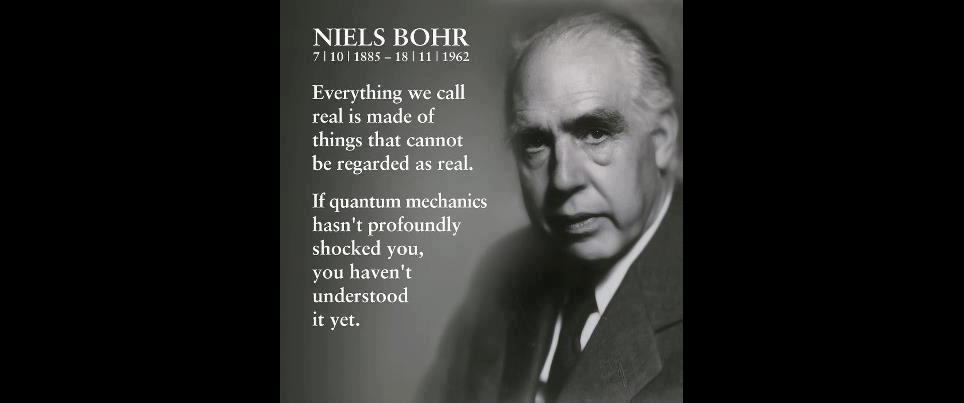
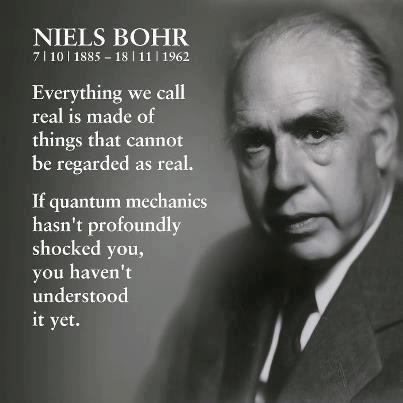
“Everything we call real is made up of things that cannot be regarded as real” Niels Bohr. What exactly did Neils Bohr mean here? In modern Quantum Physics, we begin to understand that what we have learned such as particles or atoms to be nothing more than probabilities and potentials. We don’t actually know what an atom looks like or exactly where they are and we likely never will. We guess as to their exact positions and properties with complex mathematical equations and complex experiments some costing billions of dollars. To a Quantum Physicist, the idea of a Ven Diagram showing how oxygen and carbon atoms react is like teaching the Dalai Lama about the Buddhas birth. Quantum Physics has completely changed how modern science looks at the reality in which we think we live. To a Buddhist, this is music to our ears. It sounds very much like the teachings of emptiness. To some, the concept of emptiness is troublesome and it can be hard to wrap your mind around it. It has been described by some very early Christian translations to mean nothingness. This makes us Buddhists sound like nihilists. This was likely done on purpose as to discredit, to falsely portray, or confront Buddhism and further the creation myth by the Church and her missionaries. However, Buddhism is as far from nihilism as Christians are from hell. We define emptiness by saying that all phenomena have no intrinsic or independent existence of their own. To detail this teaching classicly we need to discuss the twelve points of dependent origination. But to make things easy I will simply try to answer that age-old question “if a tree falls in the forest does anyone hear it?” For example, let us take something beautiful like a rose. Does a rose really exist? Another way to ask this is to say does the rose exist independently in and of itself? In Buddhist Philosophy for something to really exist it must be independent of all other phenomena. The answer is no, the rose does not exist independently of anything, it is as we know dependant on sunlight for example. One step further and we see that there is no sunlight without the sun. There is no sun without the sun’s ongoing nuclear reactions and no reactions without Helium and Hydrogen. We see here that rose is empty of independent existence. Or as some might say the rose is an expression of emptiness or empty in nature or essence. We agree with Niels Bohr and we understand the rose to be real but it is not.
Is there another way that we can understand the rose to not exist independently? Yes, if the rose is to be considered to be real and independent it must exist as it does now without changing. It cannot grow, bloom, and we could not even cut one from the plant as it would die and rot away. We know this independence to be false because the rose changes in every moment fully dependent on all the conditions it requires to be as it is. This is also understood as impermanence, as no thing lasts forever.

Now if I stop here I can imagine that some of you might say, “see this is Nihilism no things exist in Buddhism. And you might be right, however, I am reminded of a quote from a famous Buddhist Philosopher Nagarjuna, who said “If you think things are real you are as dumb as a cow, if you think they are not real you are even dumber” If you think trains are not real please do not stand in front of one that’s moving, as you will be suddenly surprised. We know phenomena are there because we can perceive them and be aware of them, they are however dependent on our perception and awareness. The famous double slit experiment is good evidence of this. Our observation imparts a temporary existence to them as we observe them. Just as the waveform collapses into particles that we can perceive as we observe them. They arise, exist, and dissolve back into the space or the field where all information exists as space is information. It would seem that we give phenomena their essence or that our observation is responsible for their creation. When we look around and see the sheer complexity and beauty around us it is clear that life is amazing and so full of potential and joy. We just need to slow down and simply pay attention to it; this is what we learn in meditation. So clearly Buddhists are not nihilists. Now for one to think that the traditional biblical creation myth we talked about earlier as the truth, one needs to assume that all of creation was finished after just 6 days. I firmly understand that it is preposterous and hubris to think anything other than, that creation is continuous and infinite. And when you come this far you might just see yourself as an integral part in all of it.

So the falling tree in the forest is dependent on the sun, the rain, and many other conditions around it not the least of which is us. Without someone to notice it there simply is no meaning or reason for the tree to exist in the first place.

“If quantum mechanics hasn’t profoundly shocked you, you haven’t understood it yet.” Niels’ words here are truly inspiring, I would expand to say this: If Buddhism hasn’t profoundly shocked you, you haven’t understood it yet. The more I learn the more I am shocked by the Buddha Dharma. I am often moved to tears when concepts like emptiness finally begin to sink in and are understood on deeper and deeper levels. I am convinced that Niels Bohr must have understood things in a similar fashion or he would not have said what he said.

QP

Science, Jesus, and the Buddha why cant we just get along?

Bg0zxQBCEAA4Jyl

Science, Jesus and the Buddha why can’t we just get along. I love WordPress immensely and the real sense of community that one with a little work can find here. Unfortunately, some of us are not so community orientated and like to bash others a bit, so what I would like to explore a bit is why it seems that Christians seem to want to single out and demonise Buddhists. Strangely enough, Christians do not seem to bash Islam or Hinduism hardly at all. Personally, I think this is strange because generally, Christians are great people they develop amazing Christ-like compassion and love. So why would they spread false information, call us idol worshipers and often even worse?
So why can’t we get along and respect each other and move forward with the things we agree on? Certainly what we agree on is more important than what divides us. Can we learn something from science in this area?
It seems to me that science stays out of the mess likely because you cannot prove dogma and we the religious ones simply cannot get along without our dogma. I would want to stay out as well if I was a scientist. So this asks the question what is dogma? A quick google search says “a principle or set of principles laid down by an authority as incontrovertibly true.
“the Christian dogma of the Trinity”
synonyms: teaching, belief, tenet, principle, precept, maxim, article of faith, canon;”

Wikipedia goes a little further to say: “Dogma is an official system of principles or tenets of a church, such as Roman Catholicism,[1] or a philosophy such as Stoicism.

Dogma is transliterated in the 17th century from Latin (Latin dogma) meaning “philosophical tenet”, derived from the Greek ‘dogma’ (Greek δόγμα) meaning literally “that which one thinks is true” and ‘dokein’ (Greek dokeo) “to seem good.”[2][3]

Dogma refers to positions such as those of a philosopher or of a philosophical school, or in a pejorative sense referring to enforced decisions, such as those of aggressive political interests or authorities.[4][5] More generally it is applied to some strong belief that the ones adhering to it are not willing to rationally discuss. This attitude is named as a dogmatic one, or as dogmatism, and is often used to refer to matters related to religion, but is not limited to theistic attitudes alone. In Pyrrhonist philosophy “dogma” refers to assent to a proposition about a non-evident matter.”

Or paraphrased “a dogma is a strong belief, principle, or set of principles laid down by an authority as incontrovertibly true that the ones adhering to it are not willing to rationally discuss.” This is quite telling for me as many of the discussions I have had online with Christians were not rational, logical, or at the very least objective. Many also do not even engage in dialogue. Commonly what one gets is that the Bible says this or that and that the Bible is the unquestionable word of the Christian god no matter how it may contradict itself and all reason it is the source of absolute truth. Circular logic and non-sequiturs are commonplace as there is no thought process behind the seemingly blind belief or faith. And to be honest I have like any other human my own beliefs. But I understand that beliefs or faiths do not need to rational or logical as long as one recognizes it as such and keeps it to oneself and does not force them on others or use them to discredit others.

Unknown

How does science deal with dogma? Science’s job is to ask meaningful questions, formulate hypotheses, and test them to the best of our ability with objective clarity and non-bias. This is not an easy challenge to stay rational and it simply demands logic and objectivity, the very opposite of what this system of religious dogma gives us. While scientific dogma does exist in the hearts of men and their favourite theories the very basis of science requires that when a new discovery is made and found to contradict a previously recognized truth the new discovery is subject to peer review and when warranted it is accepted by the review and the general community as a whole accepts it. But this can take time as the minds of men can become hard to change, but it can and does happen. Just think how long it took us to understand that the earth was not flat since the ancient Greeks theorised in the 6th century BC.

This is completely different from what we see in the three Abrahamic faiths all originating in the Middle East. Proponents of these “ideas” seem perpetually stuck in the idea that their version of the “truth” is the only one and the others are going to hell if they do not subscribe, swallow, or accept it. Worse yet many wars have been fought and will continue to be fought on the basis of irrational dogma and people who are incapable of rationally discussing and analysing their strongly held beliefs within and out from their respective communities. This downward spiral continues as long as those sacred beliefs are held to be true. This holding on to beliefs in spite of knowing rationally that there is no evidence to support them not only creates divisions where no divisions need to be but it suppresses any other new ideas from coming forth and to be developed for our society. This intolerance blossoms into anger, jealousy, and finally hate. The results of which the world knows all to well today when a terrorist expecting 72 virgins on his death walks into a crowded area and blows himself up along with all those around him. And why do we ask? Dogma. We see the same effects mirrored when a community of Palestinians is bulldozed to make way for Zionist condominiums and when Coptic Christians are beheaded by the fanatical ISIL in front of their place of worship in Egypt. Why can we not see the connection between stone thrower in one life and missile launcher in the next life. No matter how you look at it, it’s a simple textbook case of my book is more correct than yours when all the while they are worshipping the same god.

advice

How does the Buddha Dharma and those who truly practice it deal with dogma and strongly held beliefs? Well for starters Buddhists do not proselytise, or witness to others, so to speak in a Sunday Term. Instead of commandments, we have advice. And the beliefs Buddhists do hold are not forced upon those who practice and there are no good or bad ideas just the impartial results that these good or bad deeds develop into, in our lives. The entire system of the eightfold path, four noble truths and all the sutras and tantras are designed to help us on the way and then once we have arrived they are to be discarded, every last one of them, everything is seen as impermanent. It would be like if you were climbing a mountain for example. Imagine that there is a river in the way between you and the top, you need a boat to cross the river to get to the other side but you do not carry the boat to the peak of the mountain, now do you? In fact, the Buddha himself was only a man and he taught that none of his teachings should be taken as the truth just because he is the Buddha, and further said that they should be tested for ourselves against our own experiences for truth. This sounds a lot like the scientific process to me. If there ever was a dogma in Buddhism it is that there is not supposed to be any dogma whatsoever. In fact, it is entirely possible to be a Christian and a Buddhist from the Buddhist perspective.

350412

So what is it that Christians see in Buddhism that seems to be so threatening that in spite of other more deserving opportunities for them to fight against like violence, crime, and war? Could it be that what they see in the Buddha Dharma is the very same message that Jesus brought to the church in his reformation of the old Pharisees and the Scribes into a religion of forgiveness, compassion, non-violence, wisdom, and love for all? Are they reacting the same way that the Pharisees and Scribes did? When we minus all the violent genocidal baggage of the old testament most of the new testament is quite acceptable, maybe there is room for perhaps a third testament, after all the teachings of the Buddha and Jesus were not so different in their purest essence when all the hellfire and brimstone are left aside. The recent rise of curiosity to the eastern religions or wisdom traditions as of late for me represents a very humanistic/religious revival of sorts. Yoga schools, Buddhist centres and mindfulness teachers are popping up left right and centre. One can, of course, thank the well-laid foundation of freedom that we have from our Christian forefathers for this wondrous gift, maybe they feel threatened by Buddhism. As they see the positive growth and lasting change in Buddhist friends and even perhaps in other lands. The growth of the Buddha Dharma in the west is sure to keep on getting stronger and stronger as the critically thinking, well educated, and spiritually minded keep searching for lasting joy and wisdom in an ever more violent world of dogma and discourse. It seems to me that if science can help us it could only happen through education supported by the non-dogmatic discovery of meaningful scientific truth for the benefit of all living beings.quote-i-realize-that-many-elements-of-the-buddhist-teaching-can-be-found-in-christianity-judaism-nhat-hanh-12-30-64

Thanks for reading, please share your thoughts

QP

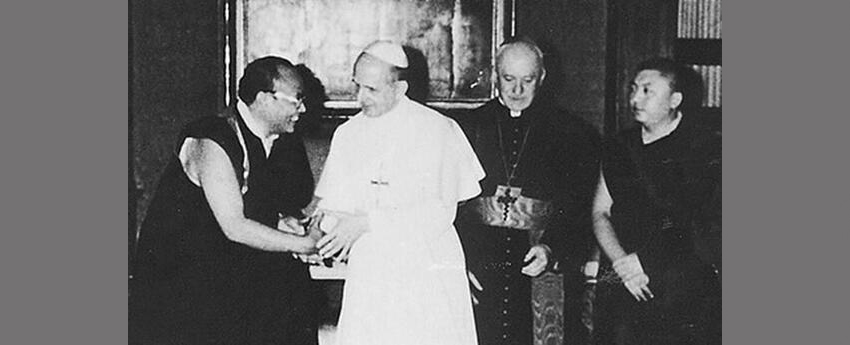
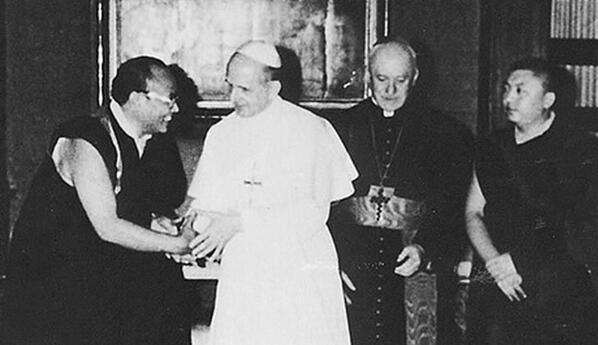
Feature image shows the 16th Karmapa with Pope Paul VI and attendant Jigmala Rimpoche in 1975