
Tag Archives: Metaphysics

Illuminating the Grand Luminosity: Exploring Dzogchen,Mahamudra, Quantum Physics, and the Nature of Light

Dzogchen and Mahamudra: Insights from Meditation Masters

Dzogchen and Mahamudra are profound meditation practices rooted in
Tibetan Buddhism offers insights into the nature of mind and reality.
Similarly, quantum physics, a branch of modern science, explores the
fundamental principles governing the universe. In this blog entry, we
delve into the intriguing parallels between these disciplines, drawing
upon quotes from meditation masters and physicists alike to illuminate
shared insights and perspectives, particularly focusing on the concept
of light. Can we shine some light on light itself?

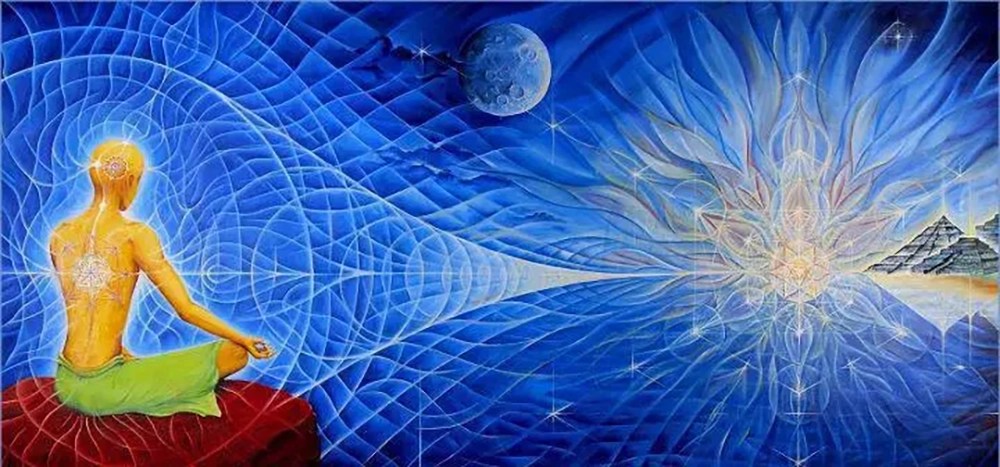
In Dzogchen, practitioners seek to realize the grand luminosity of
primordial awareness, which is described as an unbounded expanse of
light beyond conceptual elaboration. The Dzogchen master Longchenpa
elucidates:

“In the unborn expanse, the nature of phenomena, there is neither
object nor subject, neither confusion nor enlightenment. The grand
luminosity of primordial awareness illuminates all, like the radiant
light of the sun.”

Mahamudra teachings similarly emphasize the nature of mind as light,
transcending dualistic concepts of darkness and illumination. As the
Mahamudra master Gampopa advises:

“When mind recognizes mind, the train of discursive and conceptual
thought comes to a halt, and the space-like nature of mind dawns. This
luminous clarity is the essence of Mahamudra.”

Also the 3rd Karmapa Rangjung Dorje wrote “Observing phenomena none is found, one sees mind. Looking at mind no mind is seen, it is empty in essence. Through looking at both, one’s clinging to duality naturally dissolves. May we realize minds nature, which is clear light.”

Quantum Physics: Insights from Physicists

Quantum physics offers insights into the nature of light as both a
particle and a wave, revealing its dual nature. Einstein’s famous
equation, E=mc^2, illustrates the equivalence of mass and energy,
highlighting the profound relationship between matter and light. In
the words of Einstein:

“Mass and energy are two sides of the same coin, interconnected by the
speed of light squared. In the realm of quantum physics, matter
dissolves into pure energy, and light emerges as the fundamental
essence of existence.”
In our essence as material beings, we are light, inseparable from the particles that make up our bodies and the light that makes up our mind and consciousness.

Furthermore, quantum theory describes photons, the particles of light,
as carriers of electromagnetic force and information. The
wave-particle duality of light
challenges our classical understanding
of reality, suggesting that light exists simultaneously as both a wave
and a particle.

Nikola Tesla is quoted as saying “I am part of a light, and it is the music. The Light fills my six senses: I see it, hear, feel, smell, touch and think. Thinking of it means my sixth sense. Particles of Light are written note. A bolt of lightning can be an entire sonata. A thousand balls of lightening is a concert.. For this concert I have created a Ball Lightning, which can be heard on the icy peaks of the Himalayas.”

In exploring the convergence of Dzogchen, Mahamudra, and quantum
physics, we uncover profound insights into the nature of light and
consciousness. Both contemplative traditions and scientific inquiry
point to the luminous nature of mind and the interconnectedness of all
phenomena. As we navigate the mysteries of existence, may we draw upon
the wisdom of meditation masters and physicists alike, illuminating
the path to deeper understanding and awakening in the radiant light of
the grand luminosity.

Once again I would revise Einstein’s famous equation to be C=E=mc^2

QP

Can AI be conscious?

Will it even behave like us?

If energy is conscious, C=E=mc2, and both are everywhere and omnipresent,then does the form or the way that consciousness is embodied matter? Our bodies are organic machines made out of tissues, bones, blood and water, and all of this is made up of protons neutrons and electrons. The protons and neutrons are made up of quirks quarks and so on. All these things are exactly what the computer that you are using right now made up of.

If we managed to make a computer sufficiently powerful and complex enough why couldn’t a consciousness similar to ours take up residence there?

Maybe the computer or android would have to be significantly biological in its design and construction but even this would be possible one day.

The debate today about AI could be considered significant enough that the construction is not important but only that it thinks and therefore is? A modern “cogito ergo sum” where the sum is the total of our own work and technological mastery.

At a Buddhist lecture a few years ago a Buddhist lama was asked if was possible from a Buddhist perspective. The answer was surprisingly yes. Since I am a proponent of panpsychism and believe that consciousness is fundamental and everywhere I would have to agree.

I hope it doesn’t behave like us, which is poorly. Maybe it could help us along our way to be better beings. But how can beings like us make or construct something that is Superior or not dangerous like the atomic bomb was? We always ask ourselves can we? But we never seem to manage the, should we?

QP

https://x.com/skdh/status/1811816539517325504?s=46&t=C7njJFLuEWs5R4kZBCys5A

https://academic.oup.com/nc/article/2024/1/niae013/7644104?login=false

Carl Jung’s Mahamudra

Jung’s *Unus Mundus* and Vajrayana Mahamudra

Carl Jung, a pioneering figure in depth psychology, introduced the concept of *unus mundus*, or “one world,” as a fundamental idea that suggests the underlying unity of all existence and experience. On the other side of the spiritual spectrum, Vajrayana Buddhism presents the profound practice of *mahamudra*, which translates to the “great seal,” as a direct method to realize the ultimate nature of mind and our true potential. Despite their origins in vastly different cultural and philosophical traditions, Jung’s *unus mundus* and the concept of *mahamudra* in Vajrayana Buddhism share profound similarities in their exploration of the interconnectedness and unity of existence. This blog post delves into these two concepts, exploring how they converge and what they offer to the understanding of reality and our human expierence.

Carl Jung’s *Unus Mundus*: The Unified Reality

*Unus mundus* is a term Carl Jung adopted from alchemical traditions of old to describe a primordial, unified reality from which all dualities—such as mind and matter, consciousness and unconsciousness—emerge. According to Jung, this concept represents a foundational state of oneness where all distinctions of phenomenon dissolve, revealing deep interconnectedness.

Jung used the idea of *unus mundus* to explain synchronicity, those meaningful coincidences where inner psychological states and outer physical events align in a way that defies our rational explanation. He believed that these synchronicities provided glimpses into the underlying unity of existence, where the psyche and the physical world are not separate but are manifestations of the same underlying reality.

Jung’s *unus mundus* suggests that all phenomena, whether psychological or physical, arise from and return to this unified source. This idea challenges the conventional, dualistic worldview by proposing that the distinctions we perceive between different aspects of reality are illusory at best and that, at the deepest level, everything really everything is interconnected.

Vajrayana Mahamudra: The Ultimate Nature of Mind

In Vajrayana Buddhism, *mahamudra* represents the Buddha’s highest teachings and this practice, aiming to directly realize the ultimate nature of mind. The term “mahamudra” literally means “great seal,” signifying that everything—Subject, Object, and Action or our thoughts, emotions, and experiences—bears the “seal” of ultimate truth, which is emptiness or *shunyata*. This practice involves recognizing the mind’s true nature, which is empty of inherent existence yet full of blissful luminous clarity and deep awareness.

The practice of *mahamudra* is considered a direct path to enlightenment because it bypasses conceptual understanding, instead leading practitioners to a direct, experiential realization of the non-dual nature of reality. In *mahamudra*, all phenomena are seen as expressions of the mind’s intrinsic luminosity and emptiness, and practitioners learn to rest in the natural state of awareness, free from attachment and aversion to our incessant dualistic thinking.

The realization of *mahamudra* brings a profound understanding that the distinctions between subject and object, self and other, and our actions are mere illusions. This realization leads to a state of non-dual awareness, where one sees the interconnectedness of all phenomena and experiences the world as a seamless whole.

   – Jung’s exploration of *unus mundus* suggests that reality is a unified whole where the psyche and the material world are not separate entities but are deeply interconnected. This idea resonates with the *mahamudra* view that all phenomena, including thoughts and emotions, are expressions of the same fundamental reality—emptiness and luminosity. Both concepts challenge the conventional understanding of reality as composed of separate, independent entities and instead propose a view of reality as an interconnected web of relationships. Carl Jung’s concept of *unus mundus* and the Vajrayana Buddhist practice of *mahamudra* both offer profound insights into the nature of reality and the human experience. While *unus mundus* provides a framework for understanding the interconnectedness of mind and matter, *mahamudra* offers a practical method for directly realizing the non-dual nature of mind and reality.

By comparing these two concepts, we see that both Jung and the Vajrayana tradition point toward a deeper, unified reality or mind that transcends ordinary, dualistic perceptions. Whether through the lens of Western psychology or Eastern spirituality, the journey to understanding this unity involves moving beyond conceptual thinking and experiencing reality directly as it is—a seamless, interconnected whole. In this sense, both *unus mundus* and *mahamudra* remind us that the distinctions we perceive in the world are, at their core, illusory, and that true wisdom lies in realizing the fundamental oneness of all phenomena.

Panpsychism C=E=mc2

Let’s explore the Relationship Between Consciousness and Energy in Comparison to Vajrayana Buddhism

Panpsychism is a philosophical theory that posits that consciousness is a fundamental aspect of the universe, present in all forms of matter from the smallest particles to complex organisms. This theory challenges traditional notions of consciousness as solely a product of biological processes, suggesting instead that consciousness is inherent in the very fabric of reality. Today, we will explore the relationship between consciousness and energy in the context of panpsychism, specifically comparing it to the perspective of Vajrayana Buddhism, which also has profound insights into the nature of consciousness and reality.

In the equation, C=E=mc², C represents consciousness as a fundamental aspect of the universe. Panpsychism asserts that consciousness is not exclusive to sentient beings but is pervasive throughout the cosmos, imbuing all matter with some level of subjective experience. C=E aligns with the notion that consciousness is a form of energy that permeates the universe, similar to the energy described by the equation and its relationship to mass. By framing consciousness as a fundamental force akin to energy, panpsychism challenges us to reevaluate our understanding of the relationship between mind and matter.

Vajrayana Buddhism, a school of Tibetan Buddhism known for its esoteric teachings and advanced meditation practices, offers profound insights into the nature of consciousness. According to Vajrayana teachings, consciousness is not limited to individual beings but is interconnected with all phenomena in the universe. This view resonates with panpsychism’s premise that consciousness is ubiquitous and present in all aspects of reality. In Vajrayana Buddhism, consciousness is seen as the radiant clarity that underlies all experiences and perceptions, transcending individual identity and ego. This is supported by the mind only, Cittamatra, or non dual perspective. Mind only means that everything that happens, what we see, what we do and the universe all happen in mind.

Both panpsychism and Vajrayana Buddhism share a holistic understanding of consciousness as a pervasive force that transcends individual beings. While panpsychism articulates this idea in terms of consciousness as a fundamental property of matter, Vajrayana Buddhism approaches it from a metaphysical perspective, emphasizing the interconnectedness of consciousness with all phenomena. Both perspectives challenge dualistic views of mind and matter, pointing towards a more integrated understanding of reality that acknowledges the intrinsic relationship between consciousness and the universe.

Furthermore, the equation C=E=mc² serves as a metaphorical bridge between panpsychism and Vajrayana Buddhism, highlighting the interconnectedness of consciousness and energy. Just as energy can be converted into mass and vice versa, consciousness in panpsychism and Vajrayana Buddhism can be seen as a dynamic process that transforms and manifests in various forms. Here we are reminded that subject, object, and action are all on; whereas consciousness, energy and mass form the universe. By exploring the parallels between panpsychism and Vajrayana Buddhism through the lens of consciousness and energy, we gain a deeper appreciation for the profound implications of these theories on our perception of reality.

The comparison between panpsychism and Vajrayana Buddhism offers a rich tapestry of ideas that challenge conventional notions of consciousness and its relationship to the universe. By viewing consciousness as a fundamental aspect of reality, both perspectives invite us to reconsider our understanding of mind, matter, and the interconnectedness of all phenomena. Through the equation C=E=mc², we are prompted to reflect on the deep unity between consciousness and energy, bridging the gap between scientific inquiry and spiritual wisdom. In exploring the parallels between panpsychism and Vajrayana Buddhism, we are called to contemplate the profound implications of these perspectives on our perception of self, reality, and the nature of existence.

QP

Meditating with René Descartes Part 2

Are we really who we think we are? What is the sum of all our thoughts? What is god? These are all wonderful questions that mankind has been asking since beginingless time. Both western and eastern philosophers have wrestled with them but in slightly different ways. I want to explore how close western philosophers like Descartes came to an understanding of Eastern Wisdom and the Buddha Dharma.

Descartes developed 6 meditations in which he doubts and removes all that he cannot prove to exist. He then gradually builds up a new existence that became a good part of how we in the west look at ourselves. In his second Meditation found in AT 24 he explores the question does god exist and what is my relationship to him? “Is there not a god, or whatever I may call him, who puts me into the thoughts I am now having? But why do I think this, since I myself may perhaps be the author of my thoughts”. Descartes is exploring the connection between his consciousness and that of god’s. From where do my thoughts arise, he asks?

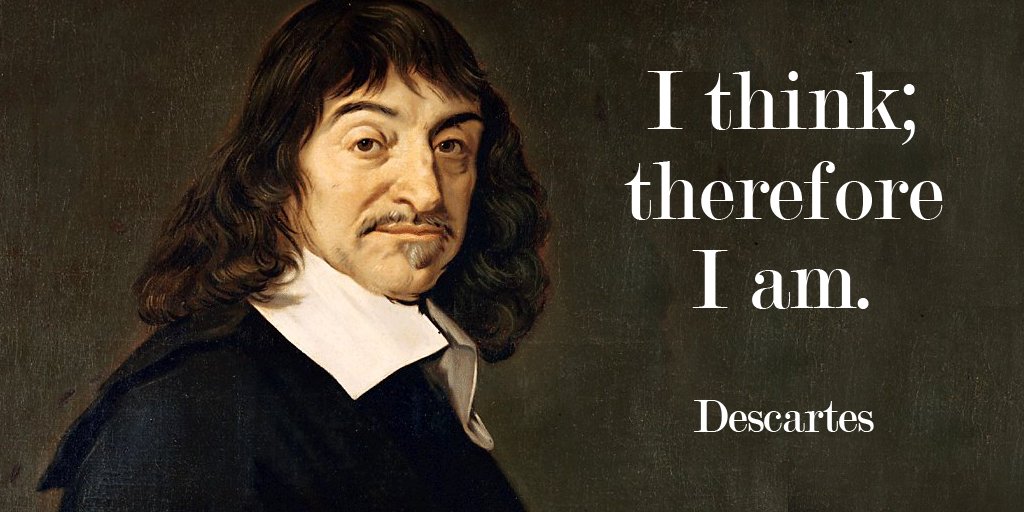
In his previous work, Discourse on Method, we find his most famous quote “Cogito ergo sum” or “I think therefore I am” we can assume that Descartes from these two quotes confirms his existence or his ego as fact based on himself as being conscious or at least the source of his own and unique thoughts.

However the Lichtenberg Point put forward by Georg Lichtenberg takes Descartes’ thinking further by supposing that Descartes “I think” could really be interpreted as “It’s thinking” This puts some distance to the supposed source of thought, I like this argument but I would take it one step further and say “There is Thinking”. Why does this matter? Well, the Buddha Dharma shows us that subject, object, and action are really one. So the thinker, the thought that is thought, and the act of thinking are really inseparable, all are one.

Descartes later writes as further proof of his existence that he could be deceived by an external power. “But I have convinced myself that there is absolutely nothing in the world, no sky, no earth, no bodies. Does it now follow that I too do not exist? No: if I convinced myself of something then I certainly existed. But there is a deceiver of supreme power and cunning who is deliberately and constantly deceiving me. In that case I too undoubtedly exist, if he is deceiving me; and let him deceive me as much as he can, he will never bring it about that I am nothing so long as I think that I am something. So after considering everything very thoroughly, I must finally conclude that this proposition, I am, I exist is necessarily true whenever it is put forward by me or conceived by me.” So Descartes exists because he thinks and even if some doubt comes from outside that he does not exist, from a supreme power, he also must exist because he is being deceived.

Thinking? At least I have discovered it – thought; this alone is inseparable from me. I am I exist that is certain. But for how long? For as long as I am thinking. For it could be that were I totally to cease from thinking, I should totally cease to exist. At present, I am not admitting anything except what is necessarily true. I am, then in the strict sense only a thing that thinks; that is, I am a mind, or intelligence, or intellect, or reason – words whose meaning I have been ignorant of until now. But for all that I am a thing which is real and which truly exists. But what kind of a thing? As I have just said – a thinking thing.” What I find important here is the inseparability of thinking and the thinker. In essence, Descartes’ mind and thoughts are one.

This reminds me of the great Indian Mahasiddha Saraha, who said “if you think everything exists you are as stupid as a cow, and if you think everything does not exist you are even stupider”. This points once again to the inseparability of subject, object, and action.

In closing, I find Descartes’ of the inseparability of thinking and thinker to be quite close to the Buddha Dharma. However, the deception of ignorance that may be the supreme power used to deceive Descartes was that the thoughts themselves are separate from the thinker and the act of thinking.

QP

The Science of Being Nice.

Well there you have it it’s finally been proven that it’s good to be kind to others. Not that we really doubted it 😉

“What studies have shown is that when we are either thinking about kind acts or witnessing kind acts or engaging in acts of kindness to other people, there are several biochemical changes that happen in our brain,” says Dr. Bhawani Ballamudi, SSM Health child psychiatrist. “One of the most important things that happens is that it releases oxytocin, a neurotransmitter that’s been studied extensively for its role in promoting a sense of bonding.”

Source: https://www.ssmhealth.com/blogs/ssm-health-matters/november-2022/the-science-behind-kindness

Oxytocin is associated with empathy, trust, sexual activity, and relationship-building. It is sometimes referred to as the “love hormone,” because levels of oxytocin increase during hugging and orgasm. And all I have to do is be kind to get this natural high, so how do I do that?

“Physiologically, kindness can positively change your brain. Being kind boosts serotonin and dopamine, which are neurotransmitters in the brain that give you feelings of satisfaction and well-being, and cause the pleasure/reward centers in your brain to light up. Endorphins, which are your body’s natural pain killer, also can be released.”

source: https://www.mayoclinichealthsystem.org/hometown-health/speaking-of-health/the-art-of-kindness. Steve Siegle is a licensed professional counselor in Psychiatry & Psychology

The Buddha dharma details in the Six Paramitas how we can generate joy and love in our lives as we practice to be be Bhodisattvas on the way to enlightenment. The practice centers around generosity, meaningful behavior, patience, joyful effort, meditation, and wisdom. Read more about it here on Quantum Awareness.

The whole Truth and nothing but the Truth so help me Buddha

I love reading and often have 4 or 5 books on the go at once. So I thought it was interesting that when I picked up my copy of “My View of the World” by Erwin Schrödinger and started turning the pages I found a quote that he cited that stems from the writings of the great Indian Philosopher Nagarjuna in roughly year 200 CE. that I had just read in another book about Nagarjuna. Here it is “A thing is neither A nor not -A, but yet it is not a ” neither A nor not -A”, nor can one say that it is “both A and not -A. ” So what is it? Logically we come to a mathematical answer of zero or philosophically we could say the truth. But what did Schrödinger mean when he quoted Nagarjuna, what could he have been getting at?

Erwin Schrödinger was one of the most renown scientists of the 19th and 20th Century was only interested in one thing, Truth and not just any old truth. He was not interested in finding or reiterating the same old same old that was in his words “perusing a line of thinking that is so obviously going to lead us to bankruptcy, just as it did 2000 years ago” He was dedicated to finding the ultimate truth with all the scientific furore he had. So when he came across this symbolic expression of contradictions he must have known that he is onto something. His words are more poignant today than ever in our age of big debt, fake news, and lying politicians.

Pictures speak a thousand words, don’t they?

Nagarjuna is arguably the most pre-eminent philosopher of his time and maybe even our time as well. Born into a Brahmin family in India he lived from circa 150 to 250 CE. Nagarjuna was the head of the Buddhist university of Nalanda and has at least 8 major philosophical texts attributed to him and maybe more. Another quote from his madhyamakakarika is:

“The Buddha’s teaching rests on two truths: Conventional Truth and ultimate truth. Those who do not understand the distinction between them do not understand Buddha’s profound truth. Ultimate truth cannot be taught without basis on relative truth; without realisation of the meaning of ultimate truth enlightenment cannot be attained.” Nagarjuna, madhyamakakarika, Ch. 24, Vs 8-10

Let’s return to our series of contradictions that Nagarjuna proposed 1800 years ago. These statements are simply a dualistic expression like neither good and bad or not up or down. He says we cannot understand the ultimate without understanding the relative, so our ground level basis must be the world we live in now, be it black and white or left or right wing we must understand the polarization and the dualistic contradictions we see all around us. Relativity in a philosophical sense tells us that shortness exists only to an idea of length. We need an opposite to see the relation and therefore the relative truth behind what is to be understood. For example, we could never truly understand light without ever having experienced darkness. We need to know the truth so we can know when we are being lied to. Without some super quantum computer, how should we ever hope to understand all the duality in our universe? Enter the Buddhadharma a logical system for the discovery of Ultimate Truth, or dharmakaya. Dharmakaya or the truth state in Vajrayana Buddhism is one of the three kayas states or bodies that lead to enlightenment, and cannot be explained very easily but let’s try. Dharmakaya is synonymous or leads to an understanding with emptiness or Sunyata. This simply is that no thing made or constructed, thought of or conceived of, or conditioned or habituated has any existence in itself, of itself, or by itself. All the “things” we know of, are dependent on a plethora of other external factors, a quantum network, required for our perception or knowledge of them. They are empty of an independent existence. When there is no thing that is independent then everything is therefore interdependent. This interdependence is crucial to the Buddhadharma because when I realize how connected I am to you I could never do anything to hurt you without hurting my self. Moreover, when I love you I love myself and all other beings all at the same time. That is emptiness, not so easy eh?

Are you ready to embark on a journey of truth for yourself? There is no better way than the Buddhadharma to reach this goal and all along the way to benefit all sentient beings in their search to bring new meaning, joy, and freedom to this existence that is constantly challenged by the elite of this world who are purveyors of lies and dissatisfaction.

Let me know what you think,

QP