Tag Archives: Karma

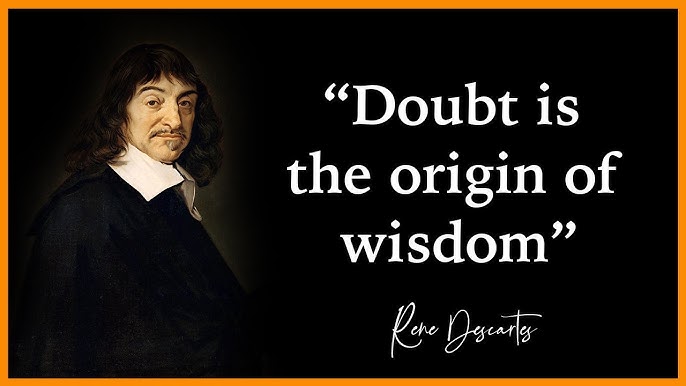
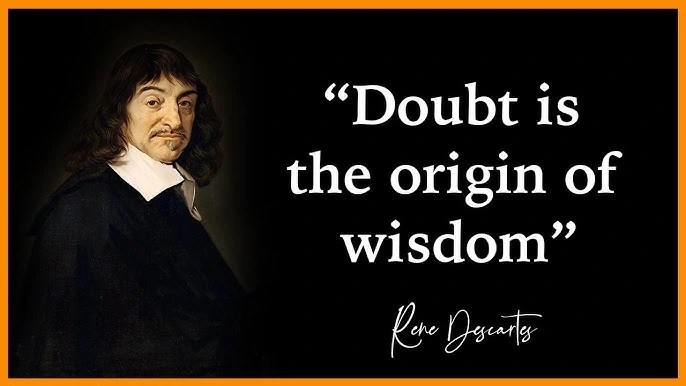
Could Descartes speak his mind or did the Church threaten his existence? The Cartesian Conundrum

Descartes, a pivotal figure in the history of Western philosophy, grappled with the complex relationship between the mind and the church during his lifetime. His radical ideas about the nature of existence and consciousness challenged traditional religious doctrine, raising questions about the compatibility of his philosophical inquiries with the orthodoxy of the Catholic Church.

René Descartes is best known for his famous statement, “Cogito, ergo sum” (I think, therefore I am), which epitomizes his method of radical doubt and the primacy of consciousness in philosophical inquiry. However, his exploration of the mind’s nature and its relationship to the body inevitably brought him into conflict with the religious authorities of his time.

Descartes’ philosophical views, particularly his dualistic theory of mind and body, posed a challenge to the prevailing Aristotelian-Thomistic worldview endorsed by the Catholic Church. According to Descartes, the mind (or soul) and the body are distinct substances, with the mind being non-material and immortal, while the body is material and mortal. This dualism stood in contrast to the Catholic doctrine of the unity of body and soul, which held that the two were inseparable and dependent on each other.

While Descartes did not directly challenge religious dogma in his philosophical works, his ideas had profound implications for theological beliefs about the nature of the soul, free will, and the afterlife. As a result, his works were subject to scrutiny and censorship by ecclesiastical authorities, who were wary of any doctrines that diverged from orthodox teachings.

Although Descartes faced criticism and condemnation from some religious quarters, particularly Jesuit theologians who viewed his philosophy as a threat to traditional Scholasticism, there is little evidence to suggest that his life was directly threatened by the church. Descartes was careful to navigate the political and religious landscapes of his time, and he often sought to reconcile his philosophical ideas with religious doctrine to avoid controversy.

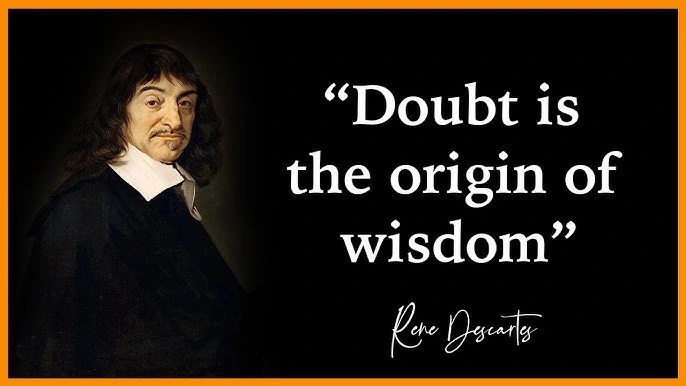
Buddhism, like many other religious traditions, has also grappled with the complexities of translation of its texts throughout history. One notable example is the mistranslation of key Buddhist concepts in early encounters with Western scholars and missionaries. As Western scholars began to study Buddhist texts, they often struggled to accurately convey the nuanced meanings of terms such as “karma,” “nirvana,” and “emptiness.” This led to misunderstandings and misinterpretations that shaped early Western perceptions of Buddhism. The Buddha himself is credites with saying “don’t trust me because the Buddha said something, test it and try it out for yourself and see if it is true, #doubtit

Just as Descartes’ ideas challenged the orthodoxy of the Catholic Church, certain Buddhist teachings have posed challenges to traditional interpretations within the religion itself. For example, the concept of anatta, or “no-self,” challenges the notion of a permanent, inherent self, which is a central tenet in many other religious traditions. This concept has led to debates and interpretations within Buddhism about the nature of personal identity and consciousness, similar to the debates sparked by Descartes’ dualistic theory of mind and body. Overall, both Descartes’ philosophical inquiries and Buddhist teachings illustrate the ongoing dialogue between religion, philosophy, and cultural interpretation. All our ideas should be critiqued and improved on continuously. Isn’t this exactly what we should be doing more of?

In conclusion, while Descartes’ philosophical inquiries into the nature of the mind may have raised eyebrows within religious circles, there is no concrete evidence to suggest that he faced direct threats to his life from the church. However, his intellectual legacy continues to provoke debate and reflection on the boundaries between philosophy, science, and religious belief.

QP

Hamlet and Quantum Metaphysics: A Deep Dive

In Shakespeare’s “Hamlet,” the famous soliloquy “To be, or not to be: that is the question” delves into profound existential questions that resonates with the principles of Quantum Metaphysics. While it’s commonly interpreted as Hamlet contemplating suicide, a deeper analysis suggests he might be pondering the dissolution of his ego, akin to the concept of ego death.

To be, or not to be, that is the question: Whether ’tis nobler in the mind to suffer The slings and arrows of outrageous fortune, Or to take arms against a sea of troubles, And by opposing end them?

Hamlet’s concern about the consequences of his actions extends beyond mere mortality. His apprehension about the afterlife and karma hints at a deeper understanding of existence and consciousness, reminiscent of Buddhist philosophy. It begs the question as to how one might end suffering.

In Buddhism, suicide is considered karmically detrimental as it cuts short a precious human life, potentially leading to rebirth in lower realms. Hamlet’s hesitation to end his life aligns with Buddhist principles that emphasize the value of human existence and the importance of non-harm towards oneself. “at the moment of death, your state of mind is of utmost importance. A calm and peaceful mind can lead to liberation, but a mind filled with anger, fear, or attachment can bind you to the cycles of suffering.” The Tibetan Book of the Dead.

Furthermore, Hamlet’s reference to the dream realm underscores a nuanced understanding of the transitional states between waking and dreaming, life and the afterlife. ‘To die, to sleep – to sleep – perchance to dream: ay, there’s the rub, for in that sleep of death what dreams may come when we have shuffled off this mortal coil, must give us pause.’ And not to forget, ‘A dream itself is but a shadow.’ shows that he recognises the depth and duality of his existence. This points directly at his pain and suffering coupled with the will to move past this difficulty.

Hamlets words parallel Smetham’s Tetralema, based on Nagarjuna’s negation of reality, which posits that existence is neither absolute nor non-existent, but a unity of opposites.

Drawing from Quantum Physics, the concept of electron/particle superposition wave or particle duality offers insights into the nature of existence. Just as an electron exists in a state of superposition, simultaneously being and not being in a state of pure energy, so too does our awareness encompass the unity of experience in the present moment. This “both-and” view of existence that quantum mechanics puts forth may have saved Hamlet’s life, if he had a physics professor. Nevertheless, the lesson is not lost on us, in our journey of understanding here we really have the chance move beyond ourselves and closer to our true nature of compassion and wisdom.

By synthesizing Shakespeare’s timeless literature with insights from Buddhist philosophy and Quantum Metaphysics, we gain a deeper appreciation of the interconnectedness of existence and consciousness, inviting contemplation on the nature of reality and the human experience.


QP

Exploring the Mind: Enlightenment Through LSD or Meditation?

In a rare form of transpersonal experience, consciousness expands to include the Earth in its totality. People who have these experiences are deeply moved by the notion of our planet as a cosmic unity. ~Stan Grof[^1]

When we stop seeing ourselves as separate entities in the universe and we become more and more connected with culture, language, art, love, and people, we begin to notice all the other beings around us. Our pets, wild animals, even insects; simply all creatures big and small on land and sea. We look further and see that even the plant life and environment around us are so filled with life and vibrant beauty that we no longer see any division amongst the diversity of the species we share our earth with. And maybe, if we have just a little more openness, we see this earth as not just the source of life or the place we live but as life itself, a living Gaia if you will.

We struggle with the idea that there might be life on other planets in other solar systems and in other universes. How big of a jump is it to include a living universe that our earth is a small part of? Think of the sun without which most if not all life on Earth would cease. Can something that gives us life be life as well? How can you give what you do not have? If we include our sun then we include all other suns. If we include all suns then all planets in the infinite universe as well. All the energy in the universe is conscious, C=E=mc2.

If you think this sounds a lot like panpsychism, you are completely correct. Please read more about that here.

This transpersonal connection we all share is not unique, it’s not a one-off, not by a long shot. It’s all the energy we all have and share with the space around us. It points us towards the possibility that we are not our bodies, that we have more in common with each other and with all living things than is commonly thought and taught in the West.

The real beauty here is that when it comes to how we understand the conscious energy that we share with others and our environment, we begin to change the quality of our experience in beautiful and profound ways. It is hard to imagine how one could hurt another or damage something in anger when we are so intrinsically connected with all that is. It would simply hurt too much to hurt another and ourselves at the same time. Professor Grof gives us the solution to our problems old and new, whether it’s poverty, the polluted environment, or the wars that have plagued our earth for millennia. We simply cannot afford to be so destructive any longer as the danger of irreparable harm to our planet or complete annihilation grows.

To become a transpersonal initiate we have several options. As anyone who knows Professor Stan Grof and his studies and experience with LSD, it’s not surprising that he has this view, as he has in the quote above. He took Albert Hofmann’s experiment to a whole new level. “If I am the father of LSD, Stan is the godfather. Nobody has contributed as much as Stan for the development of my problem child.”[^2] Professor Grof is however not the only one who has posited such a transpersonal idea. The Buddha taught that all living beings have the Buddha nature and that even subject, object, and actions are one and the same. This view that we all share the same qualities and that even the physical and subjective worlds are one is mind altering. He then prescribed different forms of meditation to his followers and in doing so founded the world’s most peaceful and fun way of life.

So what is it about the LSD experience and a meditation practice that can change us so profoundly?

Professor Grof says, “If integrated wisely into society, psychedelics could play a crucial role in addressing some of our most pressing issues by promoting mental health, fostering creativity, and encouraging a deeper sense of ecological and social responsibility.”[^3] If you want to know more about his personal research on this matter, I highly recommend reading “Gateway to the Numinous” for a more comprehensive and detailed account. Actually, it’s mind-blowing. It seems that an LSD expiernce can connect us to the numinous that is within us all as it is outside as well. This powerful tool shows us that we are one with everything, I know it sounds a little 60’s and flower power but it really does have this effect most who have used it.

I, however, believe that meditation is far superior to the experiences that LSD can give. Primarily because we need to be productive and functional in everyday life all the time and meditation supports this on a daily basis and in every part of the world without breaking any laws. “Turn on, tune in, and drop out” as Timothy Leary suggests is not the way to a better world.

A good friend who had lots of experience with both meditation and LSD once told me, “LSD can show you the door to mind if you don’t know where it is. But only meditation and the dharma can take you through the door to a more meaningful and fulfilling life.” The effects of LSD can be temporary but meditation and the dharma is lasting. An altruistic lifestyle needn’t be obtained in a synthetic or artificial way; a natural way is always better. Meditation requires only a small amount of daily time and our awareness in and of our experiences. Working for others as a Bhodisattva is the real key here. They are many and I am one.

In the laboratory of meditation, we apply the science of mind to our inner experience. We begin to see how karma and impermanence affect our interpersonal experiences. We learn to see that we create our world with our thoughts, then our intentions, and finally our actions. The impressions or memories we have in our mind leave lasting connections between ourselves and everything we interact with. Because of this, we need to live more in touch with others and the environment around us. In short, if our life is full of weeds it’s because we planted them and we need to take responsibility for them before they overtake the garden. Let’s plant beautiful flowers and edible healing plants for all to enjoy instead.

The Buddha Dharma offers us a simple and holistic approach to everyone no matter our age or situation. Let’s not just be individuals going about our own lives, let’s be inclusive and compassionate with all life around us big and small, simple and complex. Let’s reacquaint ourselves with our inborn cosmic unity. Above all let’s bring meaningful behavior back into style.

QP

[^1]: Stanislav Grof, A Holotropic Mind.
[^2]: Stanislav Grof, Realms of the Human Unconscious: Observations from LSD Research.
[^3]: Stanislav Grof, Psychology of the Future: Lessons from Modern Consciousness Research.

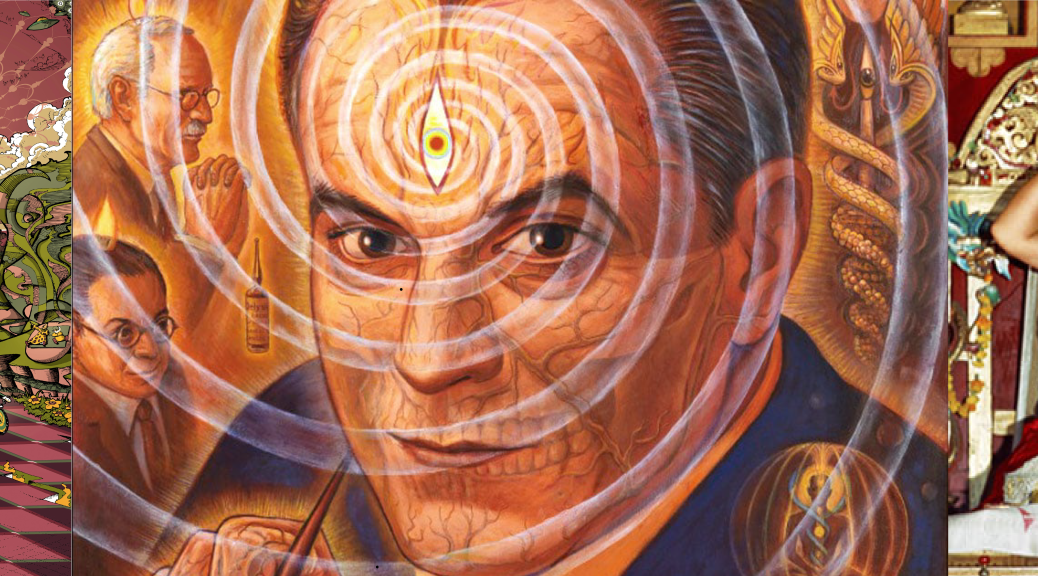
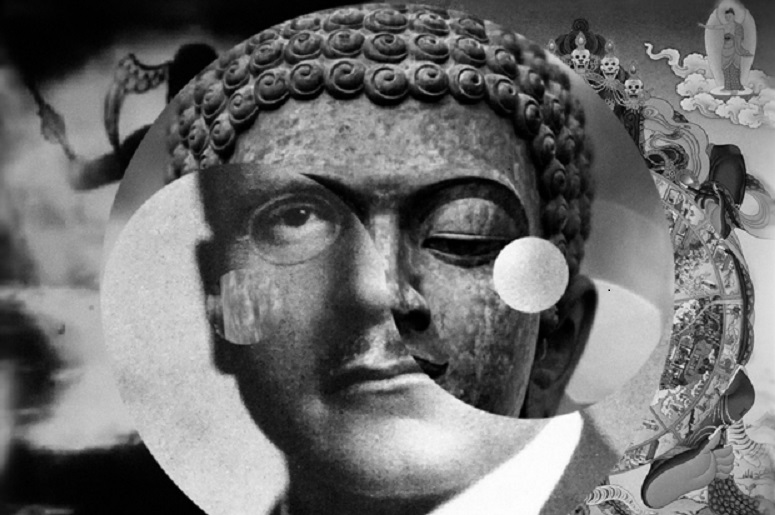
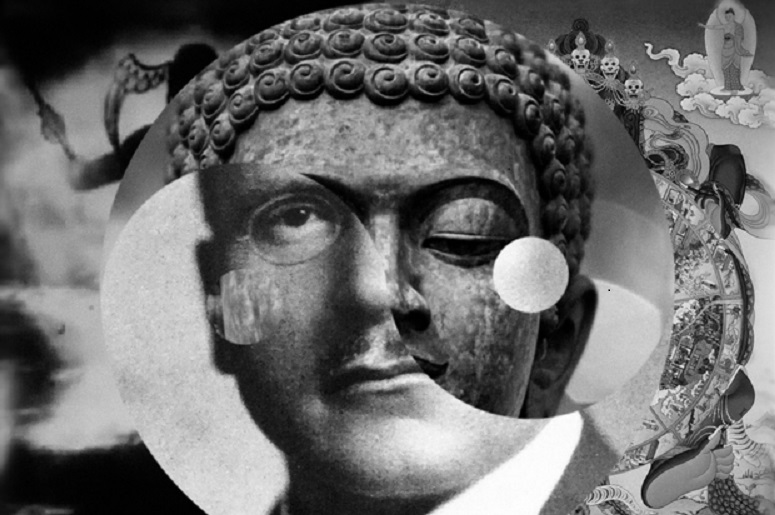
Jung vs Buddha Exploring Inner Wisdom

In the vast landscape of psychological, philosophical, and spiritual thought, the teachings of Carl Jung and the Buddha stand out as beacons of wisdom, offering profound insights into the human condition. While their backgrounds and contexts may differ, there are striking similarities in their messages, particularly when it comes to the exploration of the inner self and the pursuit of inner peace.

Carl Jung, a pioneering figure in psychology, emphasized the importance of delving into the depths of one’s own consciousness. Jung is quoted, “Your vision will become clear only when you look into your heart. Who looks outside, dreams, who looks inside, awakes,” encapsulates the idea that true clarity and understanding can only be found through introspection and meditation. By turning our attention inward, we awaken to the truths that lie beneath the surface of our everyday existence. Jung believed that by confronting our innermost thoughts, feelings, and fears, we can achieve a deeper sense of self-awareness and ultimately, a more meaningful life. I can certainly agree with him completely.

Jung surpassed Freuds work on ego and surmised that looking within would be the best path to inner strength and freedom.  Freud choose to look outwards for the cause of psychological problems, as Jung chose to engage man’s darkest shadow.

Similarly, the teachings of the Buddha resonate with the importance of inner exploration and self-discovery. The Buddha’s timeless wisdom, encapsulated in the quote “Peace comes from within. Do not seek it without,” emphasizes the inherent capacity for peace that resides within everyone. Albeit at different depths. Instead of seeking external sources of happiness or fulfillment, the Buddha’s teachings encourage us to turn inward and cultivate a sense of inner tranquility as we learn to touch our mind our innate or timeless source. True peace, according to the Buddha, is not dependent on external circumstances, but rather, it arises from a deep sense of acceptance and contentment with the present moment. This can only be achieved through meditation and complete awareness in every moment and situation we experience. Here one learns
to balance or surf on the waters of aversion and attraction.

Both Jung and Buddha recognize the transformative power of inner work. Jung’s insight that “Until you make the unconscious conscious, it will direct your life and you will call it fate,” mirrors the Buddha’s teachings on the importance of mindfulness and self-awareness. By shining a light on the unconscious aspects of our psyche, we gain greater control over our thoughts, emotions, and actions. Instead of being at the mercy of unconscious patterns and impulses, we become active participants in our own lives, capable of consciously steering our own destiny. We learn to create good Karma and cease the cycle of pain and suffering we know as samsara.

The simple essence of the teachings of Carl Jung and the Buddha converge on the fundamental truth that true wisdom and peace are found within. Whether through introspective analysis or mindfull meditation practice, both paths lead to a deeper understanding of the self and the world around us. By embracing the journey of inner exploration, we unlock the potential for profound transformation and lasting fulfillment in our lives. We become the owners of the cinema instead of just a patron, we identify with the light of the projector instead of the projector or the screen. Or more simply said we bring our shadow into the light.

QP

Nothingness and Nihilism, Meditating with Descartes Part 1

Descartes is undoubtedly one of the most influential philosophers of our time. He formed our concepts in the west about mind and our existence, although heavily influenced by the catholic church his ideas and theories are here to stay in one form or another. This discussion I intend to start is to discover what similarities can be found between Descartes’ western and christian theories and those of the Buddha Dharma one of the more influential wisdom traditions of the east. As I am here to learn I welcome as always welcome you to reach out and share your thoughts with the community here.

Descartes six meditations are truly a wonderful thought experiment in which he disassembles the foundation of all he believes to exist and then slowly builds them back up only as he in his mind can prove to himself their existence. I cannot understate how similar this process is to the Tibetan Guru Yoga that I practice almost daily. Where after focusing on the four basic thoughts and then taking refuge we dissolve the conditioned world and then slowly build it all back up again in a meaningful way.

Descartes rightfully understood that he held way too many ideas and concepts to doubt and move away from one at a time so he developed a way to deny the existence of large groups of concepts. This way instead of having to dismantle the wall one brick at a time he pulls away at the foundation and lets it all fall in on itself. He does this by doubting; if he can find a reason to believe that he might have been deceived or fooled in any way he removes everything he knows from his existence, even himself, his mind and god.

I think like most philosophers and physicists one must really come to a point where one seriously doubts or denies the existence of everything. We need to explore what the idea of nothing or nihilism might mean. Nihilism, the rejection of all religious and moral principles, in the belief that life is meaningless, but to an even greater degree that of existence as a whole. This is nothingness the absence or cessation of life or existence is at the centre of Descartes’ contemplation.

Over the years I have noticed in discussions with many people that a general conception about Buddhism is that we are nihilists. This misconception seems to be based on the idea that there is no right or wrong in Buddhism, only consequences or cause and effect. I would also add that when one mentions ego destruction it might seem like Buddhists want to kill themselves or something like this. The biggest misconceptions arise when we talk about emptiness, here almost every critic seem to think that Buddhists simply wish to end their existence in a pool of nothingness. These misconceptions could not be further from the truth the Buddha Dharma does not deny the existence of anything or anyone we simply say that things do not exist in the way in which it seems. The Buddha Dharma teaches us clearly that things truly exist but they do so in a way that is free of our concepts and ideas. This is the idea of emptiness, things are empty of the judgments we place on them when we decide or think that something is good or bad. Emptiness is not to be confused with nothingness. However, no thing, or no thingness, seems to be highly relevant in the discovery of our existence.

This is quite similar to the journey that Descartes begins here in his first meditation. Let’s meet soon for our next discussion in Rene Descartes’ second meditation.

QP

The Science of Being Nice.

Well there you have it it’s finally been proven that it’s good to be kind to others. Not that we really doubted it 😉

“What studies have shown is that when we are either thinking about kind acts or witnessing kind acts or engaging in acts of kindness to other people, there are several biochemical changes that happen in our brain,” says Dr. Bhawani Ballamudi, SSM Health child psychiatrist. “One of the most important things that happens is that it releases oxytocin, a neurotransmitter that’s been studied extensively for its role in promoting a sense of bonding.”

Source: https://www.ssmhealth.com/blogs/ssm-health-matters/november-2022/the-science-behind-kindness

Oxytocin is associated with empathy, trust, sexual activity, and relationship-building. It is sometimes referred to as the “love hormone,” because levels of oxytocin increase during hugging and orgasm. And all I have to do is be kind to get this natural high, so how do I do that?

“Physiologically, kindness can positively change your brain. Being kind boosts serotonin and dopamine, which are neurotransmitters in the brain that give you feelings of satisfaction and well-being, and cause the pleasure/reward centers in your brain to light up. Endorphins, which are your body’s natural pain killer, also can be released.”

source: https://www.mayoclinichealthsystem.org/hometown-health/speaking-of-health/the-art-of-kindness. Steve Siegle is a licensed professional counselor in Psychiatry & Psychology

The Buddha dharma details in the Six Paramitas how we can generate joy and love in our lives as we practice to be be Bhodisattvas on the way to enlightenment. The practice centers around generosity, meaningful behavior, patience, joyful effort, meditation, and wisdom. Read more about it here on Quantum Awareness.

You decide if it’s good or bad!

There is nothing either good or bad, but thinking makes it so. Hamlet

William Shakespeare

I wonder if Shakespeare knew this statement’s depth when he wrote it? I haven’t been blogging much in the last few years as I have been going through the most difficult situations in my life. Two and a half years ago my ex and I split up and the battle began over where our daughter was to live. As I am sure many of you have been through something like this you know things can get really bad really quickly. Even for two Buddhists who have promised their lama and all beings to work for their benefit until enlightenment. With such a shared altruistic goal how could things go so wrong?

For over one year I focused on all the bad things that she did and was doing and I spiraled down a very dark rabbit hole. I have never been so negative in my life. Slowly even my best friends started to wisely but compassionately warn me that they could not hear my constant telling of all the things that she was doing wrong. I was becoming bitter and hard not to mention very angry. I had been giving all my energy to and focusing on the bad things that were happening. And not to my surprise but bad things kept happening, it was as if I was willing these things into existence with my attention and awareness and then amplifying them to absurd proportions.

Just like Hamlet, I was a prisoner of my own mind as he was contemplating the murder of his father and his killer King Claudius.

Then the change came, at the behest of my lawyer and a few good friends I began to keep a log of all the things that “she was doing” so that if needed I could use this protocol in court. The first time I started doing this I was emotionally triggered. Fast heart rate, shaking hands, you name it. However, her bad actions had now become my ammunition and my mental health began to improve. I wrote the things down and began to let them go. I was actually happy when she did something stupid so I could write it down. As more and more bad became good I started to see more and more good all around me. Paradox?

My fortunes had begun to change, and I began to heal from deep within. Anger turned to joy and love. The more she did that was meant to hurt me the more healing I found. I found that my own thinking was the key I could decide what I wanted. Heaven or hell was my choice and my choice alone. By choosing to place my attention on negative things or thoughts I was feeding my anger and hastening my own demise. I managed to bring my meditation practice into my daily life and by resting in my heart and consciously directing my thoughts in the direction of love and joy I turned my mind around 180 degrees. I can even say today that I am thankful for her bad actions as I was able to transform them into love and now my relationships have completely changed. Old childhood wounds that had been festering for decades began to heal and the sun started shining brighter than ever before in even the darkest corners of my mind. I am less and less triggered by her actions all the time. It’s clear to me that if I had focused on revenge and anger I would not have only lost my relationship with my daughter but like Hamlet, I would have lost much more.

In my Buddhist practice, I have been taught to build up good impressions in mind. How do we do this? Through mandala practice or volunteering benefiting others, or even just in simple meditation. This is really an interesting thing to do. The more good memories or thoughts you have the easier it is to have something good to focus on. It is much better to wake up from a good dream than a bad one any day of the week. It is as if our minds are hungry and our very attention to one thought or another is the food or energy we expend. We choose to feed our minds with good or bad things at every moment. Of course, sometimes bad things come up in mind, we need only to think, about how interesting, and then let it go back to from whence they came. It is dangerous to deny the energy of stifled or repressed emotions. We simply need to use this energy or fuel in a new way. Give it a new direction and watch our lives change.

Choose today in this very moment what thoughts you want to feed and watch them grow in the garden of your mind. We are the sower and reaper of all things in mind, this is Karma. Remember that being angry is natural but if you feed it, it’s like drinking poison yourself and expecting the other person to die. This is never going to work.

We are in control of our mind in fact we possess mind. Mind does not possess us. This is what we learn in meditation. And to have this come forth in daily life is one expected result of any meditative practice.

QP

Newton’s Third Law of Karma?

I almost always focus on Quantum Physics but for a change, I have decided to delve into, if even for an instant into some Newtonian Physics.

Sir Isaac Newton’s Third Law of Motion, which states that for every action there is an equal and opposite reaction, or in other words, if Ido something there will be a direct measurable result to my actions. I don’t know about you but this sounds a lot like Karma or cause and effect to my very Buddhist ears. How so, you ask? Let us jump right in.

As I push on the wall with my finger the wall exerts an equal force back onto my finger. The result here is balance unless one force overpowers the other. This is relatively easy to understand.

Now, if I hurt you, you likely will hurt me this is also clear. If I hurt you, do I by default also hurt myself? I think so, at the very least from an emotional or psychological standpoint. Even on an interpersonal level Newton’s third law still stands. And the proof is in the pudding. The residual effect of violence is that one has mental imprints of guilt, sadness, and hate. Positive actions function in exactly the same way. Acts of kindness perpetuate more acts of kindness and positive emotions. I remember the “pay it forward” idea in the early 2000’s. In the drive thru lines in Canada people were paying the food bills for the others in the line with no expectation of anything in return other than a good feeling of doing something nice. This phenomenon continued for some time.

It seems that even Newton knew about Karma at least on a physical level. If it’s true that on a psychological or interpersonal level that a similar law exists we would be wise to begin treating every being as we ourselves would like to be treated or at least stop planting weeds in our own minds. If we don’t the wall will begin to push back on us in ways we will not like.

QP

The Paramita of Generosity

Have you ever said no to someone’s generosity? Let QP show you how you actually said NO to your self. it’s time to Develop Quantum Generosity!

Please don’t forget to like subscribe and share both here and on YouTube!

John Wheeler,​ Are we Observing or could we actually be Participating in the Universe?

” ‘Participant’ is the incontrovertible new concept given by quantum mechanics. It strikes down the ‘observer’ of classical theory, the man who stands safely behind the thick glass wall and watches what goes on without taking part. It can’t be done, quantum mechanics says it…May the universe in some sense be ‘brought into being’ by the participation of those who participate?”

John Wheeler


This statement from John Wheeler is game-changing. The movement from static observer status to that of a dynamic conscious participant is truly revolutionary or is it? Science is often slow to react to such outrageous ideas such as this. Remember how long it took us to accept that the earth was a sphere and that it orbited around the sun? Even Quantum Physics had taken its time in the last 100 years to become a household word where many have a basic understanding of at least some the simplest ideas it has proposed to mankind. How would science test John Wheeler’s aforementioned statement other than referring to the famous double slit experiment? How would one propose to observe the participation of the observer on a universal scale and in a scientific frame? This question has many philosophical ramifications as well. But when we want to explore these scientific and philosophical ideas perhaps we do not need to reinvent the wheel. Perhaps the Hermitic axiom of as above so below or as outside so inside might help us here to understand this very complex relationship we find ourselves in. If the answers we are seeking can be found within then we need’ent look further than to understand the Buddha Dharma and Adhyatma Vidya. The Science of Mind has for 1000’s of years clearly pointed out our conscious interactions with the form-based or objective world that we find ourselves in.

As a practitioner of the Buddha Dharma, I have come to understand observation and participation quite intimately. I observe my mind daily; both in everyday situations and in meditation. I examine my actions after I do them and I examine how thoughts arise, exist, and return to mind in meditation. I know that Buddha nature is in everyone and everywhere, and all living beings want to be happy and avoid suffering. I understand that we are participating in consciousness, both karmically and actively by choosing not only what we do and how we do it but how we see and understand everything around us. I have also grown to know freedom and wisdom very well. Freedom in both mind and in the world is the underlying cause of great bliss and joy. Wisdom and deep understanding are knowing not only how to do something but why, if, or when it needs to be done.

For example, the Buddha Dharma teaches us that there are 4 factors that maximize the effects of karma. They are 1) That we know and understand the situation, 2) Wish or plan to do it or wish or plan to have it done 3) Then do the act or have it done, and 4) Being happy or satisfied about the results afterwards. Let us examine two slightly extreme examples. The first, both before and during WW2 Adolf Hitler was chancellor of Germany no one should have had a better understanding of Germany’s situation better than him. He and his government planned the return of Germany to the top of the world stage. Then the plan was methodically enacted step by step. I think that even in his death Hitler was happy and proud of what he had done. Here all four factors of Karma are strongly realised. The next example is related but fictional. Let’s suppose that I was alive in Hitler’s time and I killed him before the first concentration camp opened up. I knew and understood the situation, I planned the act of his assassination and then carried it out. I was devastated to have killed someone but undeniably happy to have saved millions of lives and untold suffering. So here as well all four criteria are met for the strongest karmic imprints in one’s mind. OK perhaps, they are 95% met as I was not happy to have killed in the first place, but I was only happy with the result. Does this 5% make a big difference here? Of course, there is and its a question of wisdom and compassion.

Buddhism teaches us that there needs to be a balance between our actions of compassion and wisdom. When one acts or participates only with compassion we are soft and even mushy. We can be slow to stand up and act in ineffective ways. I think we all know how cold and hard pure wisdom can be. Imagine telling a loved one or family member the truth about something hurtful but in a direct and unloving way. Wisdom and compassion show us how to be loving and effective in the world. Sometimes the most compassionate thing to do is to act with wisdom and kill the Hitlers of this world or stand up and protect others and our freedoms that are constantly under attack. The question is one of motivation, do we act from love or anger do we benefit only ourselves or do we benefit all? Understanding the mindful identification of what is driving our participation in the universe is a central tenant of the Buddha Dharma. I would challenge everyone reading this to think about how your actions resonate not only within your personal lives but on a universal scale as well. Don’t just observe but participate actively for the benefit of all. Be the change we want to see in the world. Be the change that this world so desperately needs.

May the universe you”bring into being”by your conscious, active, and mindful participation be one of great bliss.

May all beings know and live in freedom and have the causes of freedom.

QP

Meditative or Quantum Entropy?

equilibrium2000 1000.jpg

Are Buddhists meditating in order to reach a human equivalent of zero-point energy or quantum entropy within their personal energy fields, realms of experience, existence, or in mind? Buddhists often talk about reaching a point, between attachment and aversion. We understand that we use a tremendous amount of energy striving for the things we desire and want, and running away from and avoiding the things that cause us difficulties. Our battle against our likes and dislikes as dictated to us by our personal concepts literally takes up all of our time and energy. This constant attraction and aversion to all our thoughts is simply so much work and effort we hardly have the time to stop and notice its effects let alone do anything about it. When beginning to meditate most of us become acutely aware of just how many thoughts we have and how much time we spend thinking or daydreaming. We think wow I had no idea how many thoughts I have, wow I am so confused and distracted, or even I cannot even begin to meditate because we are so overwhelmed. So if we can come to this state or point of no longer battling between the two extremes, and can rest in the middle, the present, in mind or mindfulness, how might one view it? Where does this energy go, how is it used and could we put it to better use?

We could call this liberation, great joy, highest bliss, or even enlightenment. One might even use the Tibetan word “detong” here may be defined as the union of emptiness and joy. I would explain further that all the energy we use to run away from or to things would simply be transformed into joy when we realize this state of “meditative entropy”. I use the word entropy here to highlight that this energy that is defined as being unavailable in the system of our existence or the random chaos of thoughts that may be observed may just be the basis of all that was, is, and will be. The inert uniformity is also very interesting here. From a Buddhist perspective, one might point to the union of subject, object, and action; or a state of non-separation of all beings. All this points to an existence of entropy in all areas of our lives or quantum entropy of our life in all its many facets and interactions with all beings, all at once, and for all times.

When we talk about the ground state in quantum mechanics and the chaos that that arises from or within it, I cannot help but think of all the possibilities. Think about this, is the “process of degradation or running down or a trend to disorder, chaos, disorganization, or randomness a bad, good, or neutral thing, when it happens in mind? As with most if not all things in the Buddha Dharma it is neutral, it all depends on how we see it or interpret the battle of our likes and dislikes to all the possibilities of the wide open space of mind. Next time our bus is late or we have a seemingly difficult situation lets keep in mind once the situation relinquishes itself to impermanence and dissolves, we become free of its effects and all we had to do was to be patient and wait for quantum entropy to once again balance out in our lives. We can once again focus upon or see the beautiful and wonderful. I find this potential energy completely enthralling and inspiring. I want some of it, and not just some but all of it. Of course, I will share it with you all.

How do the laws of cause and effect and Quantum Entropy interact? When karma matures and arises it goes through a process. First, we do an action or have it done and then we experience the actions and their immediate results. This action leaves an impression in mind that will arise at a later date and result in an effect in our lives. Much like Newton’s third law that states for every action, there is an equal and opposite reaction, the actions that we undertake and complete in daily life result in an equal reaction, in our minds ( I am not sure about an opposite reaction here). For example, when we hit someone with a left uppercut to the chin, we should not be surprised when someone hits us back in much the same way or in a similar fashion. This equalizing out of our actions is entropy at its best on a relative level in mind. Call it what you will, “you reap what you sow”, or some form of “do unto others as you would have them do unto you”, or the timely ripening of Karma, everything we say or do comes back to us in much the same form as that with which we sent it out with. And the result is always a tie game or Entropy. If this is true maybe we should only focus sending out the good stuff?

One of the most wonderful parts of my practice is to recite the four immeasurables. They are as follows: 1. May all beings have happiness and the cause of happiness. 2. May they be free from suffering and the cause of suffering. 3. May they experience happiness which is totally free of suffering and 4. May they remain in the great equanimity which is without attachment and aversion. The fourth one that details a state between attachment and aversion is exactly the balance we are seeking in our meditation and our lives. Here I would apply the second part of the definition “the degradation of the matter and energy in the universe to an ultimate state of inert uniformity” The ultimate state of uniformity how much more beautiful can this get? When everything is uniform, even, or level and totally in balance in the physical world. Would that not include us human beings as complex, unpredictable, and emotional as we are? There would be no yours or mine, no black and white, not even a here and there. What would we have to fight about? We could finally fully and totally relax and not have to worry about what the next guy is doing and work for the benefit of all. Equanimity or entropy take your pick the differences are small and the similarities are enormous.

Whether we are experiencing meditative detong, the equilizing out or the return of our actions (Karma), or equanimity; Quantum or Meditative Entropy will have its effect and even the score out. No matter if we are relating to one another on the relative or the ultimate level, our natural state is one of equilibrium, with all and within all, and in all times and directions. Our only choice is, do we choose to realise this and work with it or not? Do we have the courage to be responsible for our actions and live with the results, even if they affect us all on a quantum level?
Let’s choose a better path for ourselves, one that stands the test of time, endures the strictest of scientific evaluation, and models only the very best of our values and virtues. Do well, be well, and meditate well.


The following as of September 2016 were the definitions I have quoted in this entry:

entropy
noun en·tro·py \ˈen-trə-pē\
1: a measure of the unavailable energy in a closed thermodynamic system that is also usually considered to be a measure of the system’s disorder, that is a property of the system’s state, and that varies directly with any reversible change in heat in the system and inversely with the temperature of the system; broadly : the degree of disorder or uncertainty in a system
2a : the degradation of the matter and energy in the universe to an ultimate state of inert uniformity
b : a process of degradation or running down or a trend to disorder
3: chaos, disorganization, randomness

source:
http://www.merriam-webster.com/dictionary/entropy
Zero-point energy, also called quantum vacuum zero-point energy, is the lowest possible energy that a quantum mechanical physical system may have; it is the energy of its ground state.

All quantum mechanical systems undergo fluctuations even in their ground state and have an associated zero-point energy, a consequence of their wave-like nature. The uncertainty principle requires every physical system to have a zero-point energy greater than the minimum of its classical potential well. This results in motion even at absolute zero. For example, liquid helium does not freeze under atmospheric pressure at any temperature because of its zero-point energy.

The concept of zero-point energy was developed by Max Planck in Germany in 1911 as a corrective term added to a zero-grounded formula developed in his original quantum theory in 1900.[1] The term zero-point energy is a translation from the German Nullpunktsenergie.[2]:275ff

Vacuum energy is the zero-point energy of all the fields in space, which in the Standard Model includes the electromagnetic field, other gauge fields, fermionic fields, and the Higgs field. It is the energy of the vacuum, which in quantum field theory is defined not as empty space but as the ground state of the fields. In cosmology, the vacuum energy is one possible explanation for the cosmological constant.[3] A related term is a zero-point field, which is the lowest energy state of a particular field.[4]

Scientists are not in agreement about how much energy is contained in the vacuum. Quantum mechanics requires the energy to be large as Paul Dirac claimed it is, like a sea of energy. Other scientists specializing in General Relativity require the energy to be small enough for the curvature of space to agree with observed astronomy. The Heisenberg uncertainty principle allows the energy to be as large as needed to promote quantum actions for a brief moment of time, even if the average energy is small enough to satisfy relativity and flat space. To cope with disagreements, the vacuum energy is described as a virtual energy potential of positive and negative energy.[5]

The ground state of a quantum mechanical system is its lowest-energy state; the energy of the ground state is known as the zero-point energy of the system. An excited state is any state with energy greater than the ground state. The ground state of a quantum field theory is usually called the vacuum state or the vacuum.

If more than one ground state exists, they are said to be degenerate. Many systems have degenerate ground states. Degeneracy occurs whenever there exists a unitary operator which acts non-trivially on a ground state and commutes with the Hamiltonian of the system.

According to the third law of thermodynamics, a system at absolute zero temperature exists in its ground state; thus, its entropy is determined by the degeneracy of the ground state. Many systems, such as a perfect crystal lattice, have a unique ground state and therefore have zero entropy at absolute zero. It is also possible for the highest excited state to have absolute zero temperature for systems that exhibit negative temperature.

Zero-point Energy definition source: https://en.wikipedia.org/wiki/Zero-point_energy

Quantum Entanglement 

_DSC6884

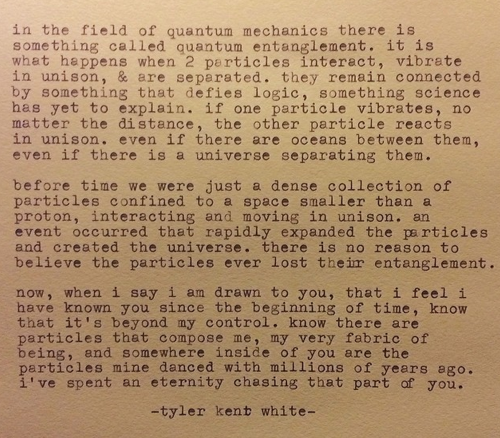
Quantum Entanglement is really one of my favourite theories it was Albert Einstein’s Achilles heel, a trouble he likely even took with him to his grave. He called it “Spooky Action at a Distance” The use of spooky conjures up all sorts of ghostly images that would raise concern to any scientist or anyone in the pursuit of the truth but I think Einstein liked this description. According to sciencedaily.com entanglement can be defined as a quantum mechanical phenomenon in which the quantum states of two or more objects have to be described with reference to each other, even though the individual objects may be spatially separated. This leads to correlations between observable physical properties of the systems. For example, it is possible to prepare two particles in a single quantum state such that when one is observed to be spin-up, the other one will always be observed to be spin-down and vice versa, this despite the fact that it is impossible to predict, according to quantum mechanics, which set of measurements will be observed. As a result, measurements performed on one system seem to be instantaneously influencing other systems entangled with it.
Buddhism teaches entanglement when we say that everyone else has been our mother in the past, we are all entangled or related to one another in one way or another. This is why we should be aware of Karma or cause and effect. When we act or do something, the law of cause and effect results in entanglement. Our actions will result in an effect in our own lives later in time or they leave immediate impressions in mind that will paint our future perceptions of what happens to us. It is in everyone’s best interest to make this interaction a positive one. Not just for ourselves but for others as well. Some schools of Buddhist philosophy even express entanglement as “space is information”. This offers a different perhaps more complimentary explanation to quantum mechanics than my previous one. If throughout space even beyond our perception of the universe, we found that at every possible place, point, or time that everything imaginable exists; this would explain Einstein’s spooky action at a distance quite handily. I can go on further here but I will save it for another entry. As before am I on to something here or out to lunch? Do you have anything to add or subtract?


I want to leave this entry with a very beautiful poem by Tyler Kent White that seems to accentuate the theme I am putting forward here.


Tyler Kent white

Source