

Tag Archives: Albert Einstein

Illuminating the Grand Luminosity: Exploring Dzogchen,Mahamudra, Quantum Physics, and the Nature of Light

Dzogchen and Mahamudra: Insights from Meditation Masters

Dzogchen and Mahamudra are profound meditation practices rooted in
Tibetan Buddhism offers insights into the nature of mind and reality.
Similarly, quantum physics, a branch of modern science, explores the
fundamental principles governing the universe. In this blog entry, we
delve into the intriguing parallels between these disciplines, drawing
upon quotes from meditation masters and physicists alike to illuminate
shared insights and perspectives, particularly focusing on the concept
of light. Can we shine some light on light itself?

In Dzogchen, practitioners seek to realize the grand luminosity of
primordial awareness, which is described as an unbounded expanse of
light beyond conceptual elaboration. The Dzogchen master Longchenpa
elucidates:

“In the unborn expanse, the nature of phenomena, there is neither
object nor subject, neither confusion nor enlightenment. The grand
luminosity of primordial awareness illuminates all, like the radiant
light of the sun.”

Mahamudra teachings similarly emphasize the nature of mind as light,
transcending dualistic concepts of darkness and illumination. As the
Mahamudra master Gampopa advises:

“When mind recognizes mind, the train of discursive and conceptual
thought comes to a halt, and the space-like nature of mind dawns. This
luminous clarity is the essence of Mahamudra.”

Also the 3rd Karmapa Rangjung Dorje wrote “Observing phenomena none is found, one sees mind. Looking at mind no mind is seen, it is empty in essence. Through looking at both, one’s clinging to duality naturally dissolves. May we realize minds nature, which is clear light.”

Quantum Physics: Insights from Physicists

Quantum physics offers insights into the nature of light as both a
particle and a wave, revealing its dual nature. Einstein’s famous
equation, E=mc^2, illustrates the equivalence of mass and energy,
highlighting the profound relationship between matter and light. In
the words of Einstein:

“Mass and energy are two sides of the same coin, interconnected by the
speed of light squared. In the realm of quantum physics, matter
dissolves into pure energy, and light emerges as the fundamental
essence of existence.”
In our essence as material beings, we are light, inseparable from the particles that make up our bodies and the light that makes up our mind and consciousness.

Furthermore, quantum theory describes photons, the particles of light,
as carriers of electromagnetic force and information. The
wave-particle duality of light
challenges our classical understanding
of reality, suggesting that light exists simultaneously as both a wave
and a particle.

Nikola Tesla is quoted as saying “I am part of a light, and it is the music. The Light fills my six senses: I see it, hear, feel, smell, touch and think. Thinking of it means my sixth sense. Particles of Light are written note. A bolt of lightning can be an entire sonata. A thousand balls of lightening is a concert.. For this concert I have created a Ball Lightning, which can be heard on the icy peaks of the Himalayas.”

In exploring the convergence of Dzogchen, Mahamudra, and quantum
physics, we uncover profound insights into the nature of light and
consciousness. Both contemplative traditions and scientific inquiry
point to the luminous nature of mind and the interconnectedness of all
phenomena. As we navigate the mysteries of existence, may we draw upon
the wisdom of meditation masters and physicists alike, illuminating
the path to deeper understanding and awakening in the radiant light of
the grand luminosity.

Once again I would revise Einstein’s famous equation to be C=E=mc^2

QP

Wave particle Duality verses Non Dual Buddhism

Waves and particles seem to the unlearned to be two very different things. But as we look deep down the quantum rabbit hole we begin to see how words like Non dual and unity have a very big place in the quantum world of the tiny and unseen and Buddhism alike.

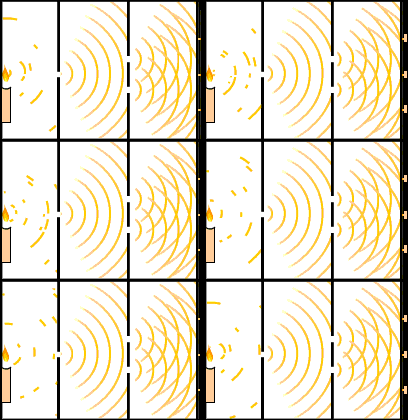
Although demonstrated by Thomas Young’s famous double slit experiment in 1801 Wave-particle duality only became widely accepted in Quantum physicists in the mid-1900s. It is very interesting that the theory states that particles can exist as waves, waves can exist as particles, and sometimes they exist as both at the same time.
Young discovered that when shooting particles or photons at a steel plate one can observe either an interference pattern that indicates a wave function or individual spots indicating particles. The experiment seems to get weird when we understand that particle patterns were observed when a detector was placed on the screen to track the particles and when no detector was there the wave pattern was observed. Even stranger was when a single proton was fired it spit into two at the slot only to combine once again at the screen displaying qualities of both waves and particles.

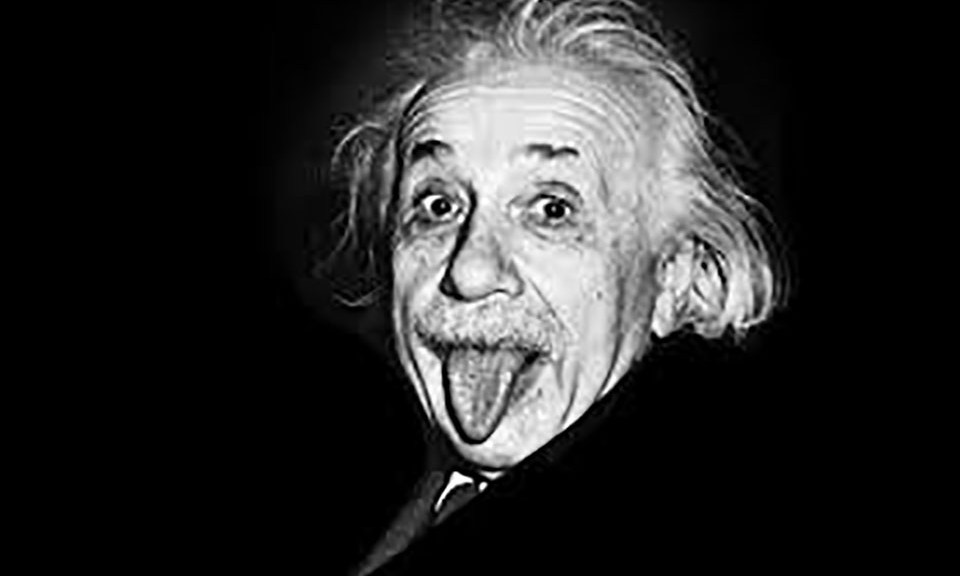
Albert Einstein is quoted as saying:
“It seems as though we must use sometimes the one theory and sometimes the other, while at times we may use either. We are faced with a new kind of difficulty. We have two contradictory pictures of reality; separately neither of them fully explains the phenomena of light, but together they do.”

 
doubleslottest-1400x793-71.jpg
 

Buddhism not surprisingly has some 1000-year-old insights that compare almost exactly to this modern quantum phenomenon. In roughly 1320 the 3rd Gyalwa Karmapa Rangjung Dorje wrote his crowning treatise on Mahamudra. Written in song or poetry like stanzas he tries to show us how things are not perceived as they really are and the connection of mind in our experience of how things truly are.
Verse 6 says “The nature of the ground is the dual truth, free from extreme views of a permanent reality and of nihilism” Karmapa states here that our reality is the dual truth that is free from any reality of permanent or unchanging existence and free from the nothingness of nihilism. I would draw the comparison here to Einstein’s words that point to the contradiction between our materialistic world of particles and the unseen world with wavelike properties or even possibilities. Einstein goes further to say that sometimes we need only one of the theories sometimes we need both. Young’ experiment would support both here by demonstrating how sometimes we are seeing particles and sometimes waves then sometimes both.
In verse 11 Karmapa goes on to clarify this in case we did not catch it the first time, “May we recognize mind’s essence, which is free of any extremes. It is not existent, for even the buddhas do not see it. It is not non-existent for it is the basis of everything, of conditioned existence and of the state beyond suffering. This is no contradiction. It is the middle way of unity.” So what Einstein initially proposed to be a contradiction is countered by Karmapa’s conviction that the middle way of unity and ultimately agreed to by Einstein “separately neither of them fully explains the phenomena of light, but together they do”. Young would again agree when he observed particles splitting acting as waves and then reuniting to a particle once again. This to me is a very clearly non-dual co-emergent reality.
Verse 18, my personal favourite, Karmapa clarifies once more for the doubters among us, “Observing phenomena, none is found. One sees Mind. Looking at mind, no mind is seen, it is empty in essence. Through looking at both, one’s clinging to duality naturally dissolves. May we recognize mind’s true nature, which is clear light”. In complete agreement Einstein and Karmapa both recognize that a complete unified understanding of the seen and unseen or the particle and wavelike worlds between Quantum Physics and Buddhism leads to the truth of our existence. Moreover one cannot ignore the fact that Young and Einstein were both talking about light waves and particles called photons. Wouldn’t it be wonderful to see this clearly?

Meditation helps us to see more clearly or likely even completely clear. Once the veils of our emotions like jealousy and anger are cleared away we see our world free from their constant blurring effect. Our newly developed wisdom transforms suffering into joy. In the double slit experiment, we see the evidence of particles when our attention or the sensor is turned on, this is what we see now normally. If we can train ourselves in meditation maybe we can see the world of waves and their functions, maybe we can even understand or see our consciousness in action and watch as our awareness interacts with the collapsing wavefront into our particle material based world. It sounds a bit crazy, I know, but why not it might be really amazing.

So it seems to me that my three friends seem to agree on quite a lot, maybe the only thing that Karmapa, Young, and Einstein might disagree about is the path one takes meditation versus mathematics. Do both roads lead to Rome? Why not do both, that’s why people like me are here.

 
Young+Fringes.gif

QP


Quantum Entanglement 

_DSC6884

Quantum Entanglement is really one of my favourite theories it was Albert Einstein’s Achilles heel, a trouble he likely even took with him to his grave. He called it “Spooky Action at a Distance” The use of spooky conjures up all sorts of ghostly images that would raise concern to any scientist or anyone in the pursuit of the truth but I think Einstein liked this description. According to sciencedaily.com entanglement can be defined as a quantum mechanical phenomenon in which the quantum states of two or more objects have to be described with reference to each other, even though the individual objects may be spatially separated. This leads to correlations between observable physical properties of the systems. For example, it is possible to prepare two particles in a single quantum state such that when one is observed to be spin-up, the other one will always be observed to be spin-down and vice versa, this despite the fact that it is impossible to predict, according to quantum mechanics, which set of measurements will be observed. As a result, measurements performed on one system seem to be instantaneously influencing other systems entangled with it.
Buddhism teaches entanglement when we say that everyone else has been our mother in the past, we are all entangled or related to one another in one way or another. This is why we should be aware of Karma or cause and effect. When we act or do something, the law of cause and effect results in entanglement. Our actions will result in an effect in our own lives later in time or they leave immediate impressions in mind that will paint our future perceptions of what happens to us. It is in everyone’s best interest to make this interaction a positive one. Not just for ourselves but for others as well. Some schools of Buddhist philosophy even express entanglement as “space is information”. This offers a different perhaps more complimentary explanation to quantum mechanics than my previous one. If throughout space even beyond our perception of the universe, we found that at every possible place, point, or time that everything imaginable exists; this would explain Einstein’s spooky action at a distance quite handily. I can go on further here but I will save it for another entry. As before am I on to something here or out to lunch? Do you have anything to add or subtract?


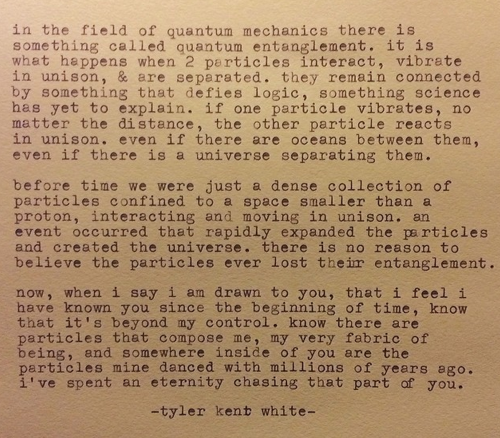
I want to leave this entry with a very beautiful poem by Tyler Kent White that seems to accentuate the theme I am putting forward here.


Tyler Kent white

Source