
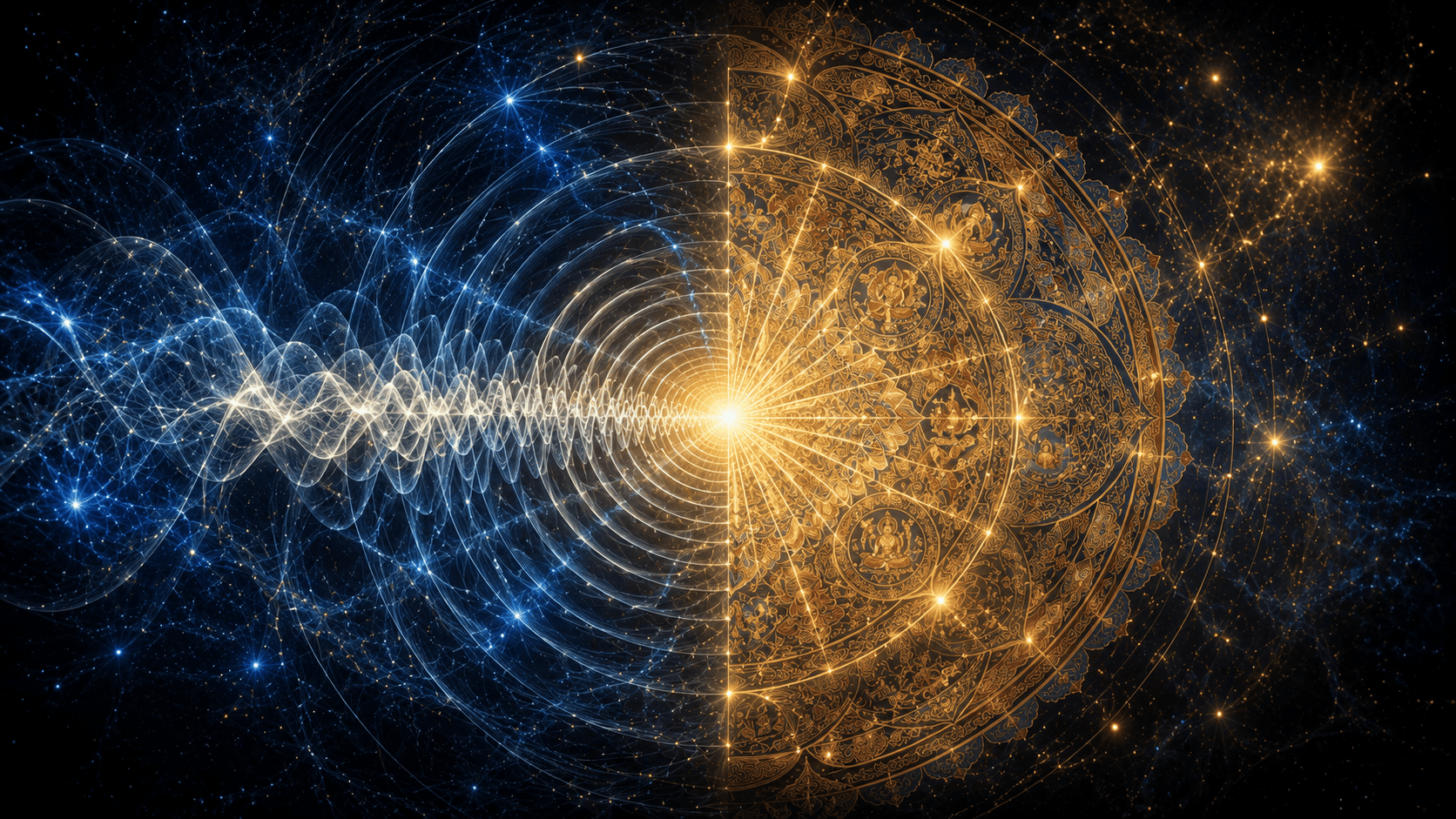
Dzogchen and Mahamudra are profound meditation practices rooted in
Tibetan Buddhism offers insights into the nature of mind and reality.
Similarly, quantum physics, a branch of modern science, explores the
fundamental principles governing the universe.
In this blog entry, we delve into the intriguing parallels between these disciplines, drawing
upon quotes from meditation masters and physicists alike to illuminate
shared insights and perspectives, particularly focusing on the concept
of light. Can we shine some light on light itself?
Dzogchen and Mahamudra: Insights from Meditation Masters

In Dzogchen, practitioners seek to realize the grand luminosity of
primordial awareness, which is described as an unbounded expanse of
light beyond conceptual elaboration. The Dzogchen master Longchenpa
elucidates:
“In the unborn expanse, the nature of phenomena, there is neither
object nor subject, neither confusion nor enlightenment. The grand
luminosity of primordial awareness illuminates all, like the radiant
light of the sun.”
Mahamudra teachings similarly emphasize the nature of mind as light,
transcending dualistic concepts of darkness and illumination. As the
Mahamudra master Gampopa advises:
“When mind recognizes mind, the train of discursive and conceptual
thought comes to a halt, and the space-like nature of mind dawns. This
luminous clarity is the essence of Mahamudra.”
Also the 3rd Karmapa Rangjung Dorje wrote “Observing phenomena none is found, one sees mind. Looking at mind no mind is seen, it is empty in essence. Through looking at both, one’s clinging to duality naturally dissolves. May we realize minds nature, which is clear light.”
Quantum Physics: Insights from Physicists
Quantum physics offers insights into the nature of light as both a
particle and a wave, revealing its dual nature. Einstein’s famous
equation, E=mc^2, illustrates the equivalence of mass and energy,
highlighting the profound relationship between matter and light. In
the words of Einstein:

“Mass and energy are two sides of the same coin, interconnected by the
speed of light squared. In the realm of quantum physics, matter
dissolves into pure energy, and light emerges as the fundamental
essence of existence.” In our essence as material beings, we are light, inseparable from the particles that make up our bodies and the light that makes up our mind and consciousness.
Furthermore, quantum theory describes photons, the particles of light,
as carriers of electromagnetic force and information. The
wave-particle duality of light challenges our classical understanding
of reality, suggesting that light exists simultaneously as both a wave
and a particle.
What strikes me about placing these three voices side by side — a Dzogchen master, a Mahamudra teacher, and a physicist — is that none of them arrived at luminosity by borrowing from the others. Longchenpa never studied electromagnetic theory. Einstein never sat in retreat.
And yet both traditions kept reaching for the same word: light, not as metaphor but as the closest available language for what they’d actually found at the bottom of their respective inquiries.
That convergence doesn’t prove one field explains the other. It suggests something plainer and stranger — that luminosity might simply be what’s there, waiting in both directions, for anyone who looks closely enough.
In exploring the convergence of Dzogchen, Mahamudra, and quantum
physics, we uncover profound insights into the nature of light and
consciousness. Both contemplative traditions and scientific inquiry
point to the luminous nature of mind and the interconnectedness of all
phenomena. As we navigate the mysteries of existence, may we draw upon
the wisdom of meditation masters and physicists alike, illuminating
the path to deeper understanding and awakening in the radiant light of
the grand luminosity.
It would be easy to read all of this as a kind of decoration — physics borrowed to make an old teaching sound current, or mysticism borrowed to make a hard science sound profound. I don’t think that’s what’s actually happening here, and I want to be precise about why.
Longchenpa wasn’t reaching for a metaphor when he described the unborn expanse as luminous. He was reporting something he’d directly encountered in meditation, in language that was the closest fit available to him in fourteenth-century Tibet.
Einstein wasn’t reaching for poetry when he wrote E=mc². He was describing a measured, testable relationship between mass and energy that has since been confirmed to extraordinary precision. These are two people, separated by six centuries and every possible cultural distance, independently arriving at descriptions that keep circling back to the same word.
That doesn’t mean they’re describing identical things. A physicist’s photon and a meditator’s clear light are not the same object, and I want to resist the temptation to collapse them into one just because the language rhymes.
What I think is actually happening is narrower and, to me, more interesting: both disciplines, working from opposite ends — one turning attention outward toward measurement, one turning attention inward toward direct experience — keep running into luminosity as a kind of basic feature of reality, not an incidental one.
Light isn’t just what things are made of. It’s what shows up, again and again, whenever anyone looks closely enough at the nature of anything, whether that thing is a particle or the mind observing it.
What This Convergence Actually Means
I don’t have a tidy conclusion to offer here, and I’m suspicious of anyone who does. What I have instead is a standing invitation, the same one Dzogchen and Mahamudra have been extending for a thousand years and quantum physics has been extending for barely more than a hundred: look directly.
Not at a description of the thing, not at someone else’s report of what they found. Look at the actual texture of your own experience, right now, and notice what’s already luminous about it before you have a chance to conceptualize it into something duller. That’s not a metaphor either.
That’s the actual practice, in both traditions, however differently they each arrived at recommending it.
Once again I would revise Einstein’s famous equation to be C=E=mc^2
QP
Further Reading:
Mass–energy equivalence (for the E=mc² reference)
Leave a Reply