
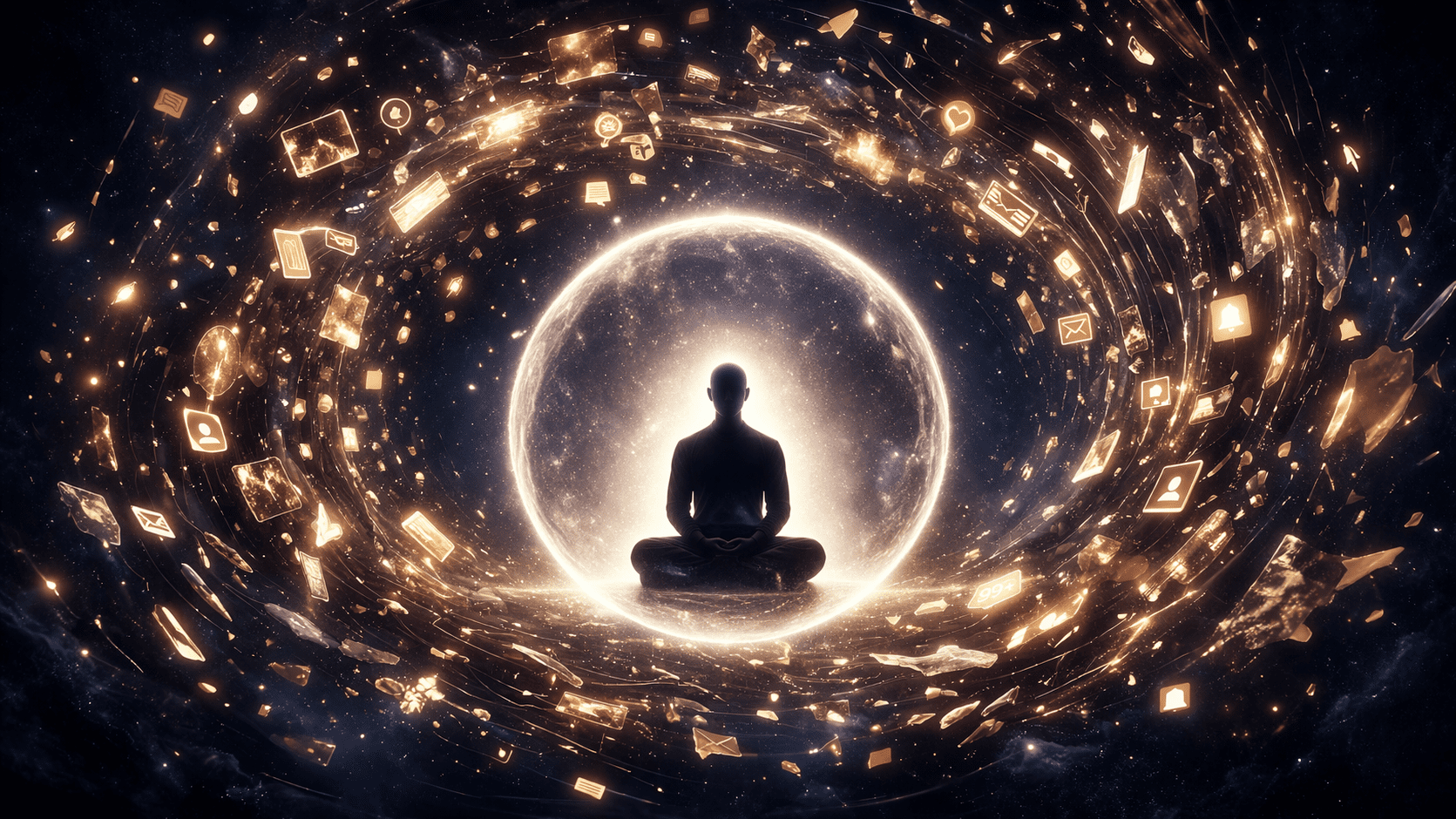
Everyone who has ever sat down to meditate has met them. The three obstacles in meditation that no teacher warns you about loudly enough — and that every teacher has personally wrestled with.
Distraction is the obvious one. The mind that won’t stay where you put it, the thought train that departs the station before you’ve even noticed you boarded it. But distraction has two deeper relatives that are less talked about and arguably more insidious: drowsiness and hyperactivity. In the Vajrayana tradition, these are named precisely — laxity and excitation — and they are not merely inconveniences. They are the two fundamental ways a mind can fail to rest in its own nature. Too collapsed, or too scattered. The dull state, or the restless one.
What neuroscience now calls default mode network activity and arousal dysregulation, the Kagyu teachers were mapping in precise detail a thousand years ago. Same territory, different instruments.
This page covers all three obstacles — what they are, why they arise, and what the tradition actually prescribes for each one.
Distraction — The Single Biggest Challenge on the Cushion
Distraction is a fact of life for everyone. It seems that we are in fact in love with distractions — after all, what is the newest gadget and how will it make my life better is all we seem to ask ourselves? Everything new is just another distraction from our own sometimes very desperate unhappiness. So it seems to me that distraction is at the very core of so many of our problems. It is without a doubt the single biggest challenge most if not all meditators face.
The great news is that once one has begun to take control of the runaway train of one’s thoughts, the results can often be seen in everyday life as well, not just on the meditation cushion. Many beginning meditators think that they cannot meditate or that they are especially distracted after only one or two sittings. This could not be further from the truth. It is simply that this is the first time you have meditated and you have realised just how distracted you normally are. With time and some subtle effort, we can learn to effectively work with distractions in your meditation. And really, with time and effort, I really mean years and diligence.
Science
🔬 Research on self-transcendent experiences — moments when the boundary between self and other becomes permeable — consistently shows measurable reductions in the default mode network activity associated with self-referential rumination. Stellar, Gordon, and colleagues (2017) demonstrated that practices cultivating awe and self-transcendence produce significant decreases in pro-inflammatory cytokines, suggesting that consistently placing the self in a larger context has measurable physiological benefits. The compassion training research of Klimecki, Leiberg, Lamm, and Singer (2013) showed that sustained other-focused practice produces increases in positive affect and prosocial behaviour alongside reductions in personal distress — precisely the inner architecture that Bodhichitta training is designed to build.
Learn to Notice WHEN You Are Distracted
The first technique is crucial and is the basis for all the others. We must learn to recognise WHEN we are distracted and then — without any judgement or further thought — return focus to the meditation. This is easier said than done. Noticing that you are distracted takes time and attention, and then to NOT hop on the “oh man I was distracted again” train of thought is also not so easy to do. But we must let the thief come into an empty home. Don’t give him anything to steal.
“Don’t wait till you fall asleep, ok? When you do the mantra and you can sort of feel that you cannot keep the concentration — then before it’s gone you just stop for a moment and then again you start. There you have to cut that habit.”
— Hannah Nydahl
Body, Speech and Mind — Three Tools Against Distraction
Buddhists learn to use their totality — their total being — to notice distraction, and we do this by using body, speech, and mind together. With the body, we must learn to sit correctly, be mindful of the breath, and use a mala. Correct meditation posture is our foundation — grounding and connecting us in practice. The breath brings attention inwards. The mala unifies body, speech, and mind in action and in essence.
Using speech to hinder distraction normally involves the use of mantras. A mantra — a phrase in Tibetan or Sanskrit such as Om Mani Padme Hung or Karmapa Chenno — is repeated thousands of times. As one repeats without stopping we are creating a feedback loop in awareness. When distracted, we notice that we are saying a mantra and are gently reminded that we are still meditating. We return to the meditation without self-judgement. The mala functions in the same way, you are thinking about your grocery list and all of a sudden you notice your mala in your hand, and you quietly return.
Using Distraction Against Itself
On the level of mind, there are things one can do here as well. These techniques are rather advanced and better left to the experts to explain fully, but I will touch on one of my favourites to pique your curiosity. It is really genius actually — how the best way to control one’s distractions is to use distractions themselves.
This is done in two ways. First, by noticing that you are distracted and then trying to hold that distraction in mind as long as you can without finding a new one — impure focus. You will find that you cannot hold your focus on your distraction any longer than you could on your object of meditation.
Second — pure focus — the meditation itself is usually constructed in such a way as to constantly supply the mind with a new distraction. The difference is that this is a distraction with a goal, designed to use our desire to keep our focus on what we want.
Take for example, a Chenrezig or Loving Eyes meditation. During the building up phase of the meditation, we are guided through all his amazing attributes — the mala, the lotus, the wish-fulfilling jewel, the deerskin. We are even flooded with the white, red, and blue lights that shine deeply into the head, throat, and heart centres. Each one is just long enough to train your attention and then relax mind in between and move on to the next.
These “enlightened” distractions narrow our field of view. Each sends a deep message on the subconscious level, and they are beautiful — which keeps us coming back for more. This is exactly like tying a horse to a post. The mind is anchored, but the anchor itself is luminous.
So don’t be frustrated with distractions — they can be the fuel that supports your meditation practice. Transformation is after all at the very core of the Vajrayana Karma Kagyu teachings. And that begins with working with exactly what is there, including the wandering mind. Using the tools described above you can master distraction and transform it into a useful friend supporting your practice.

Drowsiness and Laxity — When the Mind Collapses
Everyone who has ever meditated has struggled with drowsiness at one time or another. I am sure even the Buddha did as well, falling asleep under the Bhodi Tree in the Indian Summer Heat. In the Vajrayana tradition this state has a precise name: laxity. It is not simply tiredness. It is the mind collapsing inward, losing its clarity and grip, settling into a pleasant but useless fog. And it is one of the two fundamental obstacles to genuine Shiné.
Hannah Nydahl, in her teachings on Shiné practice, named it precisely as the “dull state” — what her Husband Ole Nydahl called the “white wall.” A passive, unclear state of mind that resembles peace but is not meditation. Genuine calm abiding requires total lucidity. The mind is still, yes — but it is awake, clear, and alert. Not floating. Not numb.
“Sometimes if people don’t know what meditation is and they just think it means to sit down and sit like that for a while… you can get into a pleasened kind of sleepy mood and you relax and you think that this is meditation, but it’s not. That is what Ole is warning against — this kind of white wall thing, the dull state, where the mind is kind of unclear. And that you definitely don’t want. And if you get used to this short, short concentration and interrupting and concentration and interrupting then you will never fall into that trap. The mind will really stay fresh.”
— Hannah Nydahl
The Practical Antidotes
We will begin with the easy solutions. Get proper rest before you meditate — seven hours on average per night. If you don’t, the chances of falling asleep in meditation are greatly increased. The same is true if you meditate at three in the afternoon or after a big meal. You are simply way more likely to be tired. Drinking a glass of tepid water before and during your session is also very helpful.
Prostrations work wonders for drowsiness. Not only is the body calmer afterwards but the one-pointedness of the practice really keeps you mindful and directed during your next session. When one is tired and does some prostrations, you really get the blood pumping and moving. One Mala is often enough with a short break in between to have a glass of water and freshen up. Jumping directly from one meditation session into the next is not recommended — please take a small break.
The mala also has a practical function in keeping us awake. I have been awakened several times as it hit the floor the moment it fell from my hands as I drifted off. An accidental but effective alarm system.
Binding Above — The Traditional Method for Laxity
On a more traditional level, there is a precise method for raising one’s energy when drowsiness has taken hold. It is called binding the mind above. We picture a shiny four-petalled silver lotus flower in the heart centre. In the centre of the flower sits a radiant white sphere the size of a pea. We inhale and hold for a second, then eject the lotus and the sphere upward through the top of the head. It stays in the sky above us. We maintain our body posture and keep our gaze slightly higher than normal.
On a less traditional level, one could call to mind the image of bubbling water rising from the heart centre — like a freshly opened bottle of sparkling mineral water. The technology of meditation here is to combine the upward movement, the lift, the effervescence. The principle is the same.
Science
🔬 Research on drowsiness in meditation corresponds to what neuroscience identifies as alpha wave dominance — the brain’s default state of relaxed, unfocused wakefulness. As attention collapses toward sleep, theta waves increase and the prefrontal cortex — responsible for sustained, directed awareness — disengages. Adenosine buildup from sleep deprivation compounds this: the longer you have been awake, the more adenosine has accumulated, and the more powerfully it suppresses arousal circuits. The binding-above technique works against this by activating an upward attentional shift and mild breath retention — both of which increase sympathetic tone and cortical arousal. The body is being used to regulate the mind.
Hyperactivity and Excitation — When the Mind Scatters
The opposite of laxity is excitation — and it is equally an obstacle. The mind that cannot settle, that generates thought after thought in rapid succession, that feels like it is running a race it never chose to enter. Everyone who has ever meditated has struggled with this at one time or another as well.
Where laxity is the mind too collapsed to see clearly, excitation is the mind too agitated to rest. Both prevent the stable ground from which Laktong — clear seeing — can arise. And both, critically, require different remedies. The mistake many practitioners make is applying the same approach to both.
Binding Below — The Traditional Method for Excitation
The traditional antidote for hyperactivity is binding the mind below. In the heart centre, we visualise a black four-petalled lotus flower facing or opening downwards. A shiny black ball the size of a pea sits in its centre. We lower the flower slowly down through the tailbone — like a spider descending on a web — many, many metres below us. It acts as an anchor holding a ship in a bay during a storm. We maintain our body posture and lower our gaze slightly.
If this visualisation is too involved, try imagining a single black drop of tar or molasses in the heart centre and lower it in the same fashion. The simplicity of the image does not diminish its effectiveness. Once again here we have the technology of meditation, exactly prescribed by the Ninth Karmapa in the book, Mahamudra The Ocean of True Meaning.
Prostrations also work here — perhaps counterintuitively. The one-pointedness of the practice channels and settles scattered energy. And one may alternate between binding above and binding below to find perfect one-pointedness — the ground state between collapse and agitation.
Science
🔬 Research on hyperactivity in meditation maps onto what neuroscience calls sympathetic nervous system dominance — the body’s arousal state, driven by cortisol and adrenaline, characterised by elevated beta wave activity in the prefrontal cortex. A scattered, restless mind is a mind locked in high-frequency electrical activity that prevents the slower, more integrated gamma-wave states associated with deep meditative absorption. Heart rate variability (HRV) — a reliable measure of the nervous system’s capacity to self-regulate — is consistently lower in states of high mental agitation. The binding-below technique works by directing attention downward and inward, activating a parasympathetic shift. The visualised weight, the lowered gaze, the grounding anchor — these are not poetic devices. They are precise physiological levers.
The Underlying Pattern — One Root, Three Expressions
Here is what neither of the original pages that became this one said out loud — and what took years of practice to see clearly.
Distraction, laxity, and excitation are not three separate problems. They are three expressions of the same root: the mind’s inability to simply be where it is. The Defence Mechanism of the EGO.
Distraction is the mind reaching sideways — following the next thought, the next sensation, the next interesting object. Laxity is the mind collapsing inward — losing its edge, its clarity, its willingness to stay present and awake. Excitation is the mind spinning outward — generating its own turbulence, unable to find the ground beneath the movement. Different directions. Same departure from presence.
The Kagyu tradition does not treat these as character flaws or signs of failure. They are recognised as the natural behaviour of an untrained mind — and the entire architecture of Shiné practice is designed to work with them, not against them. You do not suppress the distraction. You do not force yourself awake. You do not clamp down on the agitated mind. You use the method appropriate to the obstacle, return to the focus, and begin again.
What the tradition understood — and what neuroscience is now mapping in detail — is that the mind has a natural resting state. It is not the scattered state, not the collapsed state, not the distracted state. Those are departures from it. The entire point of working with these three obstacles is not to manufacture some special meditative condition. It is to stop doing the things that prevent the mind from resting in what it already is.
“Don’t wait till you fall asleep, ok? When you do the mantra and you can sort of feel that you cannot keep the concentration — then before it’s gone you just stop for a moment and then again you start. There you have to cut that habit.”
— Hannah Nydahl
These qualities — the discipline, the patience, the willingness to return again and again without self-judgement — are precisely what the Six Paramitas describe as the complete training of a Bodhisattva. The obstacles in meditation are not separate from the path. They are the path. Every time you notice distraction and return, you have practised and learned a new neural pathway is opened. Every time you lift a collapsed mind with binding above, you have practised. Every time you ground an agitated mind with binding below, you have practised. The training is the obstacle itself, met with method.
Further Reading & Practice
On the science of mind-wandering:
The Killingsworth and Gilbert study — published in Science in 2010 — found that people’s minds wander 46.9% of the time regardless of what they are doing, and that mind-wandering is reliably associated with unhappiness. Tibetan Buddhism would not disagree. It would simply add that there is something you can do about it.
Continue the practice:
Meditation posture steadies the body. Breath meditation steadies the mind. The mala unifies both. Once those tools are established, visualisation meditation is where the engineered-distraction principle described on this page reaches its fullest expression. For the complete traditional framework of how these practices sit within Tibetan meditation, see Shiné and Laktong and Kyerim and Dzogrim.
QP