
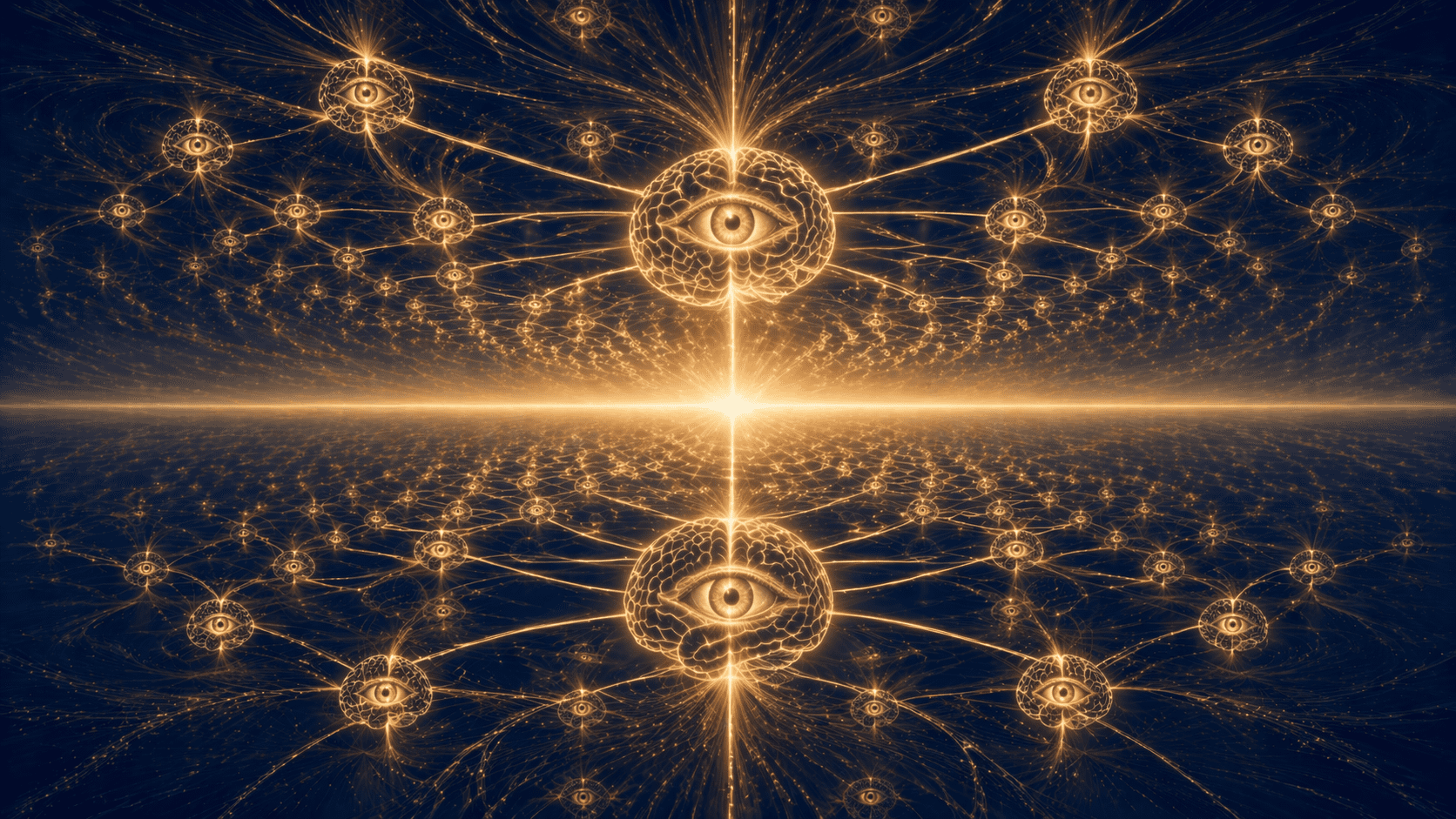
Panpsychism and C=E=mc² may seem like an unusual pairing at first, but both point toward a deeper question: what if consciousness is not something that emerges from matter, but something woven into the very fabric of reality itself? Most of us have been taught that awareness arises late, as a byproduct of complex brains. But panpsychism turns this assumption on its head, suggesting that consciousness is fundamental—present wherever there is energy, wherever there is mass. In this light, the equation C=E=mc² becomes less a statement of physics and more a poetic insight into the unity of consciousness, energy, and matter as one continuous unfolding process.
Let’s explore the Relationship Between Consciousness and Energy in Comparison to Vajrayana Buddhism
What is Panpsychism?
Panpsychism is a philosophical theory that posits that consciousness is a fundamental aspect of the universe, present in all forms of matter from the smallest particles to complex organisms. This theory challenges traditional notions of consciousness as solely a product of biological processes, suggesting instead that consciousness is inherent in the very fabric of reality. Today, we will explore the relationship between consciousness and energy in the context of panpsychism, specifically comparing it to the perspective of Vajrayana Buddhism, which also has profound insights into the nature of consciousness and reality.
The Einstein Expansion C=E=mc²

Being that Einstein was a devout materialist, i am sure that he is rolling over in his grave every time I misuse his most famous contribution to the world. I want everyone here reading to understand, that this is poetic compression not actual math. In the equation, C=E=mc², C represents consciousness as a fundamental aspect of the universe.
Panpsychism asserts that consciousness is not exclusive to sentient beings but is pervasive throughout the cosmos, imbuing all matter with some level of subjective experience. C=E aligns with the notion that consciousness is a form of energy that permeates the universe, similar to the energy described by the equation and its relationship to mass.
By framing consciousness as a fundamental force akin to energy, panpsychism challenges us to reevaluate our understanding of the relationship between mind and matter. An equation like this with 2 = signs posits an interesting situation. because now C=mc²=E is also true. This is a circular equation, and we can enter it from any side. A perfect circle that expresses itself 3 ways. Each element co-arises with the others.
What the Buddha Dharma Says.
Vajrayana Buddhism, a school of Tibetan Buddhism known for its esoteric teachings and advanced meditation practices, offers profound insights into the nature of consciousness. According to Vajrayana teachings, consciousness is not limited to individual beings but is interconnected with all phenomena in the universe. This view resonates with panpsychism’s premise that consciousness is ubiquitous and present in all aspects of reality. In Vajrayana Buddhism, consciousness is seen as the radiant clarity that underlies all experiences and perceptions, transcending individual identity and ego. This is supported by the mind only, Cittamatra, or non dual perspective. Mind only means that everything that happens, what we see, what we do and the universe all happen within mind.
Both panpsychism and Vajrayana Buddhism share a holistic understanding of consciousness as a pervasive force that transcends individual beings. While panpsychism articulates this idea in terms of consciousness as a fundamental property of matter, Vajrayana Buddhism approaches it from a metaphysical perspective, emphasizing the interconnectedness of consciousness with all phenomena. Both perspectives challenge dualistic views of mind and matter, pointing towards a more integrated understanding of reality that acknowledges the intrinsic relationship between consciousness and the universe.
Deeper into C=E=mc²
Furthermore, the equation C=E=mc² serves as a metaphorical bridge between panpsychism and Vajrayana Buddhism, highlighting the interconnectedness of consciousness and energy. Just as energy can be converted into mass and vice versa, consciousness in panpsychism and Vajrayana Buddhism can be seen as a dynamic process that transforms and manifests in various forms. Here we are reminded that subject, object, and action are all on; whereas consciousness, energy and mass form the universe. By exploring the parallels between panpsychism and Vajrayana Buddhism through the lens of consciousness and energy, we gain a deeper appreciation for the profound implications of these theories on our perception of reality.
The comparison between panpsychism and Vajrayana Buddhism offers a rich tapestry of ideas that challenge conventional notions of consciousness and its relationship to the universe. By viewing consciousness as a fundamental aspect of reality, both perspectives invite us to reconsider our understanding of mind, matter, and the interconnectedness of all phenomena. Through the equation C=E=mc², we are prompted to reflect on the deep unity between consciousness and energy, bridging the gap between scientific inquiry and spiritual wisdom. In exploring the parallels between panpsychism and Vajrayana Buddhism, we are called to contemplate the profound implications of these perspectives on our perception of self, reality, and the nature of existence.
Experience as the Missing Variable
One thing both Panpsychism and Vajrayana Buddhism point toward, but that is often overlooked in modern discussions, is direct experience.
It is one thing to talk about consciousness as a theory. It is another thing entirely to observe it directly.
If consciousness is truly fundamental—as panpsychism suggests—then it should not only exist “out there” in matter and energy, but also be immediately accessible “in here,” within our own awareness. This is where the conversation shifts from philosophy to practice.
When we sit quietly, even for a moment, and observe the movement of thought, sensation, and perception, something subtle begins to reveal itself. Thoughts arise, persist, and pass away. Sensations come and go. Emotions shift and transform. Yet something remains aware of all of this change.
That knowing quality—the simple fact of being aware—is not something we can easily locate in space. It is not solid like mass, nor measurable like energy, yet it is undeniably present.
From this perspective, the equation C=E=mc² begins to feel less abstract and more experiential. If energy and matter are constantly transforming into one another, and if consciousness is present throughout this process, then awareness itself may not be separate from the unfolding of reality—it may be intrinsic to it.
This is echoed in the Cittamatra view, where all phenomena are understood as expressions within mind. Not mind as an individual possession, but mind as a field—open, dynamic, and inseparable from what appears within it.
In this way, the division between observer and observed begins to soften. The world is no longer something happening “out there” to a separate self, but something arising within a unified field of experience.
A Living Equation C=E=mc²
Perhaps the real invitation of Panpsychism and C=E=mc² is not to solve an equation, but to live it.
Not as mathematics, but as inquiry.
If consciousness, energy, and matter are not separate, then every moment of experience becomes a point of entry into understanding reality more deeply. Not through belief, not through dogma, but through careful observation and direct insight.
And maybe that is where science and spirituality meet—not in agreement, but in shared curiosity.
QP
Check out our Youtube and Spotify Podcast on the topic of Panpsychism:
We cover: – What panpsychism actually means (and what it doesn’t) – How it connects to quantum physics and the hard problem of consciousness – Key thinkers: Whitehead, Chalmers, Goff, and Buddhist perspectives – Why mainstream scientists are taking it seriously. Perhaps the Hard Problem of Consciousness is not so hard after all. Maybe we cannot see consciousness because it’s all around us. It’s like asking a fish for a glass of water.
Further Reading:
- What is Panpsychism, Wikipedia
- Albert Einstein E=mc2 Wikipedia


Leave a Reply