
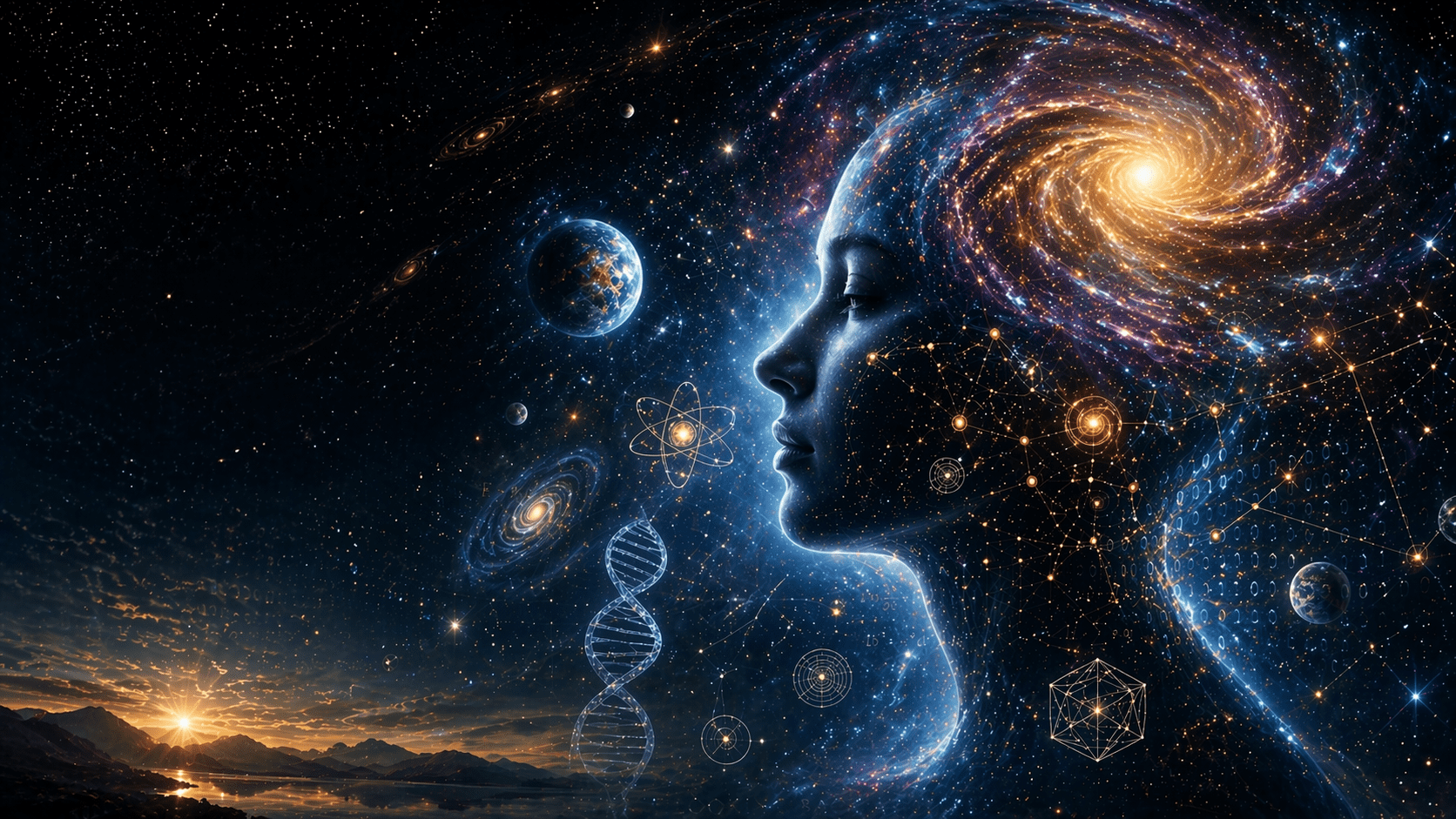
The Universe’s journey to self-knowing is one of the most profound ideas at the intersection of physics, consciousness, and philosophy. Paul Davies explores the possibility that the cosmos is not only evolving physically, but also moving toward a state of complete self-awareness. In this view, consciousness is not separate from the universe, but an expression of it. Paul Davies proposes an essential process through which reality comes to understand itself. This perspective connects modern physics, information theory, and deeper philosophical questions about the nature of existence and meaning.
The Universe’s Journey to Self-Knowing
The quest for understanding the universe and its underlying principles has long captivated human curiosity. Paul Davies, a renowned physicist and thinker, has contributed significantly to this discourse, particularly with his contemplation on the universe becoming “completely self-known.” This notion suggests a point at which the universe achieves a form of closure through a full understanding of itself, a concept that bridges physics, philosophy, and metaphysics. We will explore the implications of Davies’ idea, examining how the universe might achieve such a state and the broader implications for our understanding of consciousness, information, and the ultimate fate of the universe.

Consciousness as Participation
At the heart of Davies’ proposition is the idea that the universe is not just a collection of physical processes and entities but also a complex system capable of generating consciousness and, consequently, self-awareness. The notion of the universe becoming “completely self-known” implies a future state where all physical processes and their underlying principles are fully understood, potentially by the universe itself through consciousnesses it has given rise to.
This self-knowledge would represent a form of closure, a completion of the universe’s evolutionary journey from simplicity to complexity, and ultimately to self-awareness. To quote another physicist Michio Kaku “The material world may come and go, but consciousness remains as the defining element, which means that consciousness, in some sense, creates reality.” We can understand this to mean that consciousness cannot be taken apart or constructed, it simply is.
Information as the Fabric of Reality
Key to Davies’ concept is the role of consciousness in the universe. The emergence of conscious beings within the universe can be seen as a way for the universe to achieve self-awareness. Through the scientific endeavor, humans and potentially other conscious beings elsewhere in the universe contribute to the gradual unveiling of the universe’s laws and structures. In this view, consciousness is not an accidental byproduct of physical processes but an integral part of the universe’s progression towards self-knowledge.
Moreover, information plays a critical role in this framework. Information theory, which has become increasingly central in physics, suggests that information is a fundamental component of the universe. From this perspective, the universe’s journey towards being “completely self-known” is also about fully decoding and understanding the information it embodies. This encompasses not only the tangible aspects of the universe, such as particles and forces, but also the laws that govern their interactions and the initial conditions that set the universe in motion. Here I will quote my Lama „Space is Information” this sums it all up very well.
The Participatory Universe: How Consciousness Crafts Reality
This journey toward self-knowledge is rooted in the Participatory Universe hypothesis. If, as John Wheeler famously suggested, “no phenomenon is a real phenomenon until it is an observed phenomenon,” then the universe requires conscious agents to transition from a state of vague quantum possibility into concrete reality. In this light, our telescopes and particle accelerators are not just tools of discovery; they are the sensory organs of the cosmos. As we map the cosmic microwave background or decode the Higgs boson, Paul Davies argues that the universe is effectively looking in a mirror. This collapses the wall between the ‘objective’ world and the ‘subjective’ mind, suggesting a symbiotic loop where consciousness and matter co-evolve.
Paul Davies suggests that this is no accident; rather, the universe possesses a “bio-friendly” subtext. He posits that the laws of physics might not be static, but could involve a form of backward causation, where the eventual emergence of consciousness influences the very initial conditions of the Big Bang. In this view, universe self-awareness is the “attractor” at the end of time, pulling the cosmos toward a state of total comprehension.
Scientific and Philosophical Implications

Davies’ idea has profound implications for both science and philosophy. Scientifically, it posits an end-goal for the pursuit of knowledge: a complete theory of everything that not only describes how the universe operates but also why it exists at all. Philosophically, it raises questions about the nature of consciousness and its place in the cosmos, suggesting a universe in which consciousness is not only emergent but fundamentally intertwined with the fabric of reality itself, or that consciousness is simply fundamental.
Paul Davies’ concept of the universe becoming “completely self-known” offers a fascinating lens through which to view the cosmos and our place within it. It suggests a universe that is not static or indifferent but is instead dynamic and, in a sense, introspective.
Meaning, Purpose, and Closure
Moreover, the notion of the universe achieving closure through self-knowledge invites reflection on the purpose and meaning of existence. If the universe is on a trajectory towards self-awareness, then the emergence of life and consciousness could be seen as pivotal steps in its evolutionary journey, imbuing them with intrinsic value and purpose. Nothing could be more beautiful than this.
This perspective suggests that meaning is not something imposed externally, but something that arises naturally as the universe becomes aware of itself. The development of intelligence, culture, and scientific understanding may all be expressions of this deeper movement toward self-recognition. Rather than being isolated phenomena, they become part of a larger, coherent process unfolding over cosmic time.
Towards the Omega Point: The Evolution of Cosmic Intelligence
We must also consider the physical mechanism of this closure. If the universe’s trajectory is toward “complete self-knowledge,” we may be witnessing the infancy of a Global Brain. As biological intelligence gives way to post-biological, digital forms, the speed at which the universe processes its own information increases exponentially.
Some theorists, building on the work of Paul Davies and Pierre Teilhard de Chardin, refer to this as the Omega Point—a future state of infinite information density. In this scenario, the transition from “Space is Information” to “The Universe is a Computer” becomes literal. Our current digital revolution isn’t just a human milestone; it is the universe upgrading its hardware to better facilitate the massive data-crunching required for total universe self-awareness.
Conclusion
Paul Davies’ concept of the universe becoming “completely self-known” offers a fascinating lens through which to view the cosmos and our place within it. It suggests a universe that is not static or indifferent but is instead dynamic and, in a sense, introspective.
This perspective not only expands the scope of scientific inquiry but also offers a profound philosophical vision of a cosmos in which the emergence of life and consciousness serves a critical role in the universe’s journey towards understanding itself. Or to quote Michio Kaku once more, “Physicists are made up of atoms. A physicist is an attempt by an atom to understand itself.” As we continue to explore and uncover the mysteries of the cosmos, we partake in this grand narrative of the universe gradually becoming completely self-known.
QP
Leave a Reply