
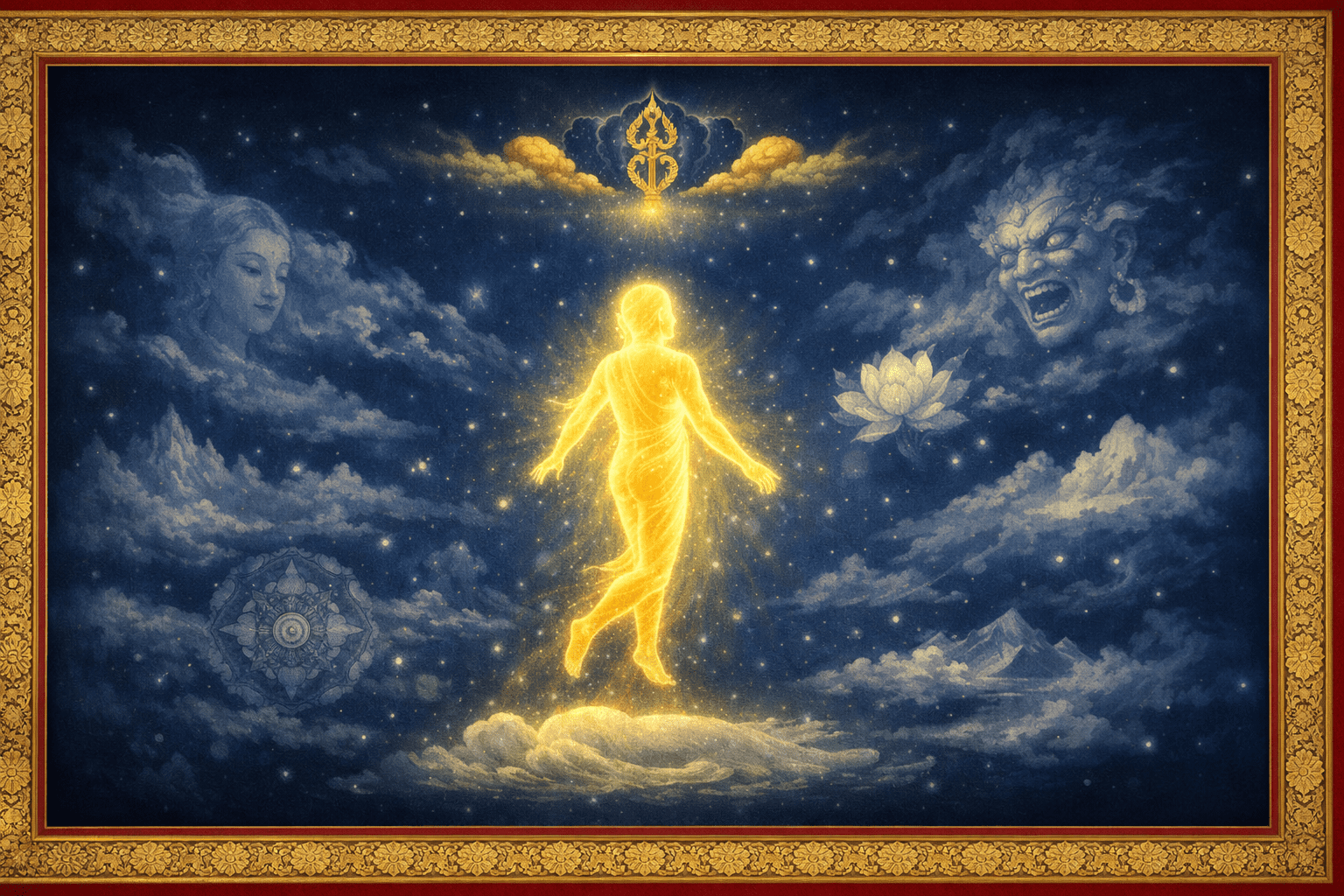
Bardo the Intermediate State in Tibetan Buddhism — written as bar do (བར་དོ) Meaning literally “between two” or “in-between” — is one of the most profound and misunderstood concepts in the entire Tibetan Vajrayana tradition. In the West it has become almost synonymous with a single idea: the state between death and rebirth. But the Karma Kagyu teaching on the bardo is far wider and far more immediate than that.
There are six bardos. And we are already in one of them. This conversation is a bardo. The gap between this breath and the next is a bardo. The moment between one thought arising and the next is a bardo. The Vajrayana tradition did not develop the bardo teaching primarily to explain what happens after death. It developed it to explain what is happening right now — and to show that the Six Yogas of Naropa have been preparing for every bardo, including the final one, since the very first practice in this series.
When I started this project, there were two practices I looked at and thought — that’s going to be hard. I have no formal training. Who am I to write about this?
The Bardo was one of them.
I was completely wrong.
When I finally sat down to write this page, I realised I already knew all of it. Every single bit. Not from a book. Not from a course. It had been arriving in every lecture, every empowerment, every personal conversation with my Lama — threaded so naturally through everything he taught that it never announced itself as a separate subject.
That’s what transmission looks like when it’s alive. Not a curriculum. Not a sequence of topics to be covered. One continuous pointing — at the same thing, from every direction, in every register, for as long as it takes for the recognition to ripen. His own transmission from the Karmapa was exactly like this. One large, informal, inexhaustible transmission. That’s what he did for all his students. The Bardo was never a chapter. It was the whole book, written invisibly beneath every other page.
Gyulü was the same. Everything was already there.
It only became clear in retrospect — which is, of course, exactly how the bardo teaching says recognition works.
We Are Already in the Bardo
The present moment — the now — is a continual bardo, always suspended between the past and the future. This is not a metaphor. It is the precise definition of the word. Bar do: between two. Between birth and death. Between sleep and waking. Between one thought and the next. Between the dissolution of one moment of experience and the arising of the next.
Every morning, in that slow reluctant fading in and out between sleep and waking — surfing the waves, drifting back into dreams, the world assembling itself gradually from the open space of sleep — a bardo is being navigated. The yid lus (yid lus — the dream body, the mental body) is reluctantly returning to its anchor in the physical form.
The best dreams happen at this threshold because awareness is still partially free — less constructed, more honest, more luminous than the solid Newtonian reality that will reassemble itself fully once the body wakes. That reluctance in the morning — the resistance to waking, the wish to stay in the open space just a little longer — is not laziness. It is recognition. The fish knows it is being pulled from the water.
Every night as one falls asleep another bardo is crossed — the bardo of dream. Every session of deep meditation passes through another — the bardo of samadhi meditation. And at the end of this life, the three bardos of death will follow one after another in the same sequence as the Ösel dissolution, the same territory as the Milam dream body, the same recognition the entire Six Yogas series has been training. The preparation has been happening all along. Without always knowing what it was preparing for.
The Six Bardos — The Complete Map
The Karma Kagyu and Nyingma traditions both list six bardos as the complete map of all states of consciousness available to a sentient being. Longchenpa, the great Nyingma master, names them precisely: the bardo of this life (skye gnas bar do), the bardo of dream (rmi lam bar do), the bardo of samadhi meditation (bsam gtan bar do), the bardo of dying (‘chi kha bar do), the bardo of dharmata (chos nyid bar do), and the bardo of becoming (srid pa bar do).1
The first three bardos are where the Six Yogas are practiced. The last three are what the practices have always been preparing for.
The bardo of this life contains every moment of Tummo, Gyulü, Milam, and Ösel practice. The bardo of dream is where Milam operates directly — the conscious dream state as a laboratory for the recognition that death requires. The bardo of samadhi meditation is the Ösel state — the clear light recognisable in deep meditation.
These are the preparation grounds. Then the three bardos of death arrive. The bardo of dying follows the Ösel dissolution sequence exactly. The bardo of dharmata requires the Gyulü recognition in its most extreme and complete form — all appearances as the display of your own mind. The bardo of becoming is navigated by the yid lus, the Milam dream body, now without a physical anchor, drawn by karmic habits and tendencies toward its next conditions of rebirth.

The Six Yogas are not six separate practices. They are six preparations for six bardos. The map and the preparation are the same system, seen from different angles. This is why those who truly understood both always taught them together — as naturally as breathing, without ever announcing the connection, simply transmitting the whole living thing as one teaching. Those who had the ears to hear recognised this immediately. Those who did not — received something nonetheless.
A seed planted by the Lama in the mindstream — a dgongs gter (gong ter — mind treasure, awakened mind treasure) — that would ripen at exactly the right moment. Not necessarily in this life. Not necessarily consciously. But planted. The ground prepared. The recognition waiting for its conditions, as mind treasures always wait.
→ Six Dharmas of Naropa — Main Hub
← Back to: Naropa — Sacred Decoding
Kalu Rinpoche — The Senior Master Speaks
His Eminence Kalu Rinpoche (1905–1989) was the senior meditation master of the Karma Kagyu and Shangpa Kagyu traditions — considered by many the most accomplished practitioner of his generation, a man who spent much of his life in retreat and whose English-language teachings on the bardo remain among the most precise and accessible available anywhere. He understood something about the bardo that no amount of reading quite conveys — that it is not a doctrine to be studied but a territory to be recognised.
If our whole existence just disappeared at death like a flame that has been extinguished, or like water that evaporates, then everything would be fine. But the mind’s nature is empty, clear, and unimpeded. Because it is empty it does not die. — Kalu Rinpoche2
The mind does not die because it is empty. This is the most important sentence on this page. Emptiness is not nothing — it is the quality that makes something indestructible. What is not put together cannot be taken apart. The conditioned — everything that arises from causes and conditions — ceases when those conditions change. The flame goes out because it depends on fuel. The mind has no fuel to exhaust. Its nature is empty, clear, and unimpeded — the same three qualities the Karma Kagyu tradition uses to describe awareness itself in Mahamudra. Mind is unconditioned. It does not die because it was never born in the way that conditioned things are born. The bardo teaching rests entirely on this foundation.
On the specific territory of the bardo of dharmata, Kalu Rinpoche was precise in a way no other teacher has quite matched in plain English. The bardo of dharmata lasts approximately three and a half days — the period during which the mind is separated from the body.
Three and a half days during which the Bardo Tödl can be read to the deceased. Three and a half days during which Phowa can be performed on behalf of the one who has died. Three and a half days of the Pure Land of Amitabha naturally present — not as a distant destination but as the direct experience of the Dharmakaya, which IS the formless ground of Dewachen (bde ba can — the Blissful). The Pure Land of Amitabha is not only a location consciousness travels to. It is a state of recognition — the meeting of the child luminosity with the mother, held consciously. Both and. Not either/or. Three and a half days of the door open.3
On the connection between the dream state and the death state — the central insight of the Milam-Ösel-Bardo sequence — Kalu Rinpoche was direct. The elements dissolving one into another happens when we dissolve our mind into the state of dream. It happens in the dream state. In the state of the bardo, that happens too. First the insight. Then the confirmation.
The Ösel practice and the Milam practice are not preparations for the bardo. They are the bardo, practiced in the controlled environment of meditation and dream so that when the real dissolution arrives, the mind recognises where it is. Then at death — when we no longer breathe in — there is a complete blackout. The sky without centre or limit. And after the blackout — ma bu ‘dres. The son and the mother finally meet.
Ma bu ‘dres. Four syllables that contain the entire Ösel teaching arriving in the bardo. The blackout is the black attainment — the same midnight-blue sky without centre or limit, the same depth of the Black Crown, the Dharmakaya that the Karmapa wears permanently above his head.

After the blackout the mother luminosity appears. If the dissolution is familiar territory — if the practice has been established, if the morning waves have been surfed consciously, if the recognition has been trained — ma bu ‘dres is possible. If not — like most untrained beings, the overwhelming intensity of the luminosity and the dissolution is experienced as shock and terror rather than recognition. The light that would liberate becomes the light that blinds. The consciousness contracts in fear, the recognition fails, and the bardo of dharmata gives way to the bardo of becoming — and the cycle of samsara begins anew.
We live in illusion and the appearance of things. There is a reality. We are that reality. When you understand this, you see that you are nothing. And being nothing, you are everything. — Kalu Rinpoche4
The reality is mind. Not your mind. Not my mind. Mind itself — the ground of all awareness, the mother luminosity, the Dharmakaya. Ro gcig — one taste. In the bardo of dharmata this is not a philosophical position. It is the direct experience of every sentient being who passes through death. The veil lifts completely. The construction dissolves. What was always there appears.
Mind is eclipsed by many different obscurations; if they are removed, mind’s fundamental nature, like the sun shining brightly in a clear, open sky, can manifest all the qualities of wisdom, compassion, and a Buddha’s abilities. — Kalu Rinpoche5
The sun shining in a clear open sky. The golden clouds parting. The midnight-blue depth at the centre of the Black Crown. The same image from the Gyulü page — the illusory body teaching encoded in the physical form of the crown — arriving here in Kalu Rinpoche’s own voice as the description of what the bardo of dharmata reveals. The obscurations dissolve at death whether the practice has been established or not. The sun appears. The only question is whether the eyes are open.
Following Naropa’s Thread — The Dissolution Arrives
We have been building toward this page since the very first practice in this series. Every page has been preparation. Now Naropa’s thread arrives at its destination.
At the moment of death the dissolution sequence begins. The elements dissolve — earth into water, water into fire, fire into air, air into consciousness. The outer breath ceases. And then the inner dissolution — the same sequence described on the Ösel page.
→ Ösel — the dissolution sequence in full
The white drop descends from the crown toward the heart. White appearance. The moonlit sky on a clear autumn evening. Forty thought states associated with hatred dissolve. Many who have had near-death experiences — brought back from clinical death in cardiac wards and accident scenes — report two things at the beginning: an overwhelming white light, and a life review. Every moment of the life just lived, present simultaneously, without judgment. The white light is the white drop beginning its descent. The life review may be the forty thought states releasing — the accumulated karmic residue of a lifetime dissolving in the moment of white appearance.
Then the red drop rises from the navel toward the heart. Conscience panoramique — the vast unlocated radiance, the sunlit sky, the subject expanding beyond all edges without centre or limit. Forty thought states associated with desire dissolve.
Finally the red and white drops coalesce in the indestructible thigle at the heart. The sun and moon finally together — the black attainment. The sky without centre or limit — the midnight-blue depth of the Black Crown that the Karmapa wears permanently above his head. Seven thought states associated with ignorance dissolve. Ordinary consciousness blacks out. This is the moment. Ma bu ‘dres is possible here. The clear light dawns. If the recognition has been trained — liberation. If not — the bardo of dharmata begins.
Bardo in the Naropa Thangka — The Elemental Dissolution Painted in the Landscape
The Naropa thangka encodes the bardo dissolution in the landscape itself. The elemental progression from stone to earth to land-wave to blue-green swirls to mountain-wave to cloud-waves to sky to Tilopa is the bardo of dying painted in terrain. Each step is an element dissolving into the next. The sequence arrives at Tilopa in the sky — the guru at the apex of the dissolution, the transmission point, the Phowa destination. The complete bardo map is in the landscape. Naropa sits at the centre of it, unmoved, at the intersection of all three times, holding the skull cup of amrita — the poison of death transformed.

→ The visual evidence: Naropa — Sacred Decoding
The Bardo of Dharmata — The Display of Your Own Mind
The bardo of dharmata (chos nyid bar do) is the most extraordinary state available to a sentient being. The dharmata — suchness, tathata, the Soheit encountered on the Gyulü page, the conscience panoramique of the red drop expanded to its ultimate expression — arises in direct experience, without the filter of the physical body and the ordinary constructed mind. Three and a half days. The door open.
What arises is described in the Bardo Tödl and in the Karma Kagyu transmission as lights, sounds, and colours of overwhelming intensity. Peaceful deities in the first days. Wrathful deities in the later days. Lights so brilliant they make ordinary sunlight appear dim. Sounds that make ordinary sound appear as whisper. The entire display of the six wisdoms of Buddha mind, arising spontaneously from the nature of awareness itself.
The instruction from the Karma Kagyu transmission is precise and simple: recognise all of it as the display of your own mind’s nature. Not the poverty of mind. The richness of mind — the fullness, the inexhaustible self-radiance of awareness, finally visible without obscuration. Every light is rigpa (rig pa — pure awareness) self-radiant. Every sound is the natural resonance of awareness. Every colour is a wisdom. None of it is external. None of it is threatening. All of it is the nature of your own mind, finally visible without obscuration. The display does not terrify. It liberates. Fear keeps us out.
Here is where the falling dream lives. You know the one — the falling with nothing to grab onto, the body jerking awake in panic. In the bardo of dharmata that grab reflex, that reaching for something solid and familiar, is the mechanism that pulls consciousness away from liberation and into the bardo of becoming. The practice was always about learning not to grab. Every moment of Gyulü — every flame in every mirror, every instance of recognising appearances as display — was training the hand to stay open. Open hand. Open sky. The falling is not falling. It is flying. If the hand stays open.
Open hand. Open sky. The falling is not falling. It is flying.
If the recognition does not arise — if fear closes the hand — the bardo of becoming begins. The yid lus navigates the intermediate state, carried now by karmic habits and tendencies — the accumulated weight of habitual patterns that, in the absence of recognition, determine the direction of the next rebirth more reliably than any conscious intention. And the cycle of samsara begins anew.
The Evidence — Dusum Khyenpa and the Unbroken Receipts
On a personal altar sits a statue of Dusum Khyenpa (Dus gsum khyen pa — Knower of the Three Times) — the 1st Karmapa, the man who attained full enlightenment at fifty through the practice of dream yoga and who left a letter to his main disciple Drogon Rechen before he died. Not a sentimental farewell. A Bodhisattva vow in its most precise and literal form — the declaration that he would return for the sake of beings. Not one being. All beings. The Bodhisattva does not rest in liberation while confusion remains. He navigated the bardo consciously, chose his conditions of rebirth deliberately, and returned. The vow held across the threshold of death. It has held across seventeen thresholds.
He died in 1193. Karma Pakshi appeared in Kham within the following decade or so — a child prodigy who by the age of ten had already assimilated the deepest teachings effortlessly, as one who was already enlightened. His teacher Pomdrakpa, who held the complete Kagyu transmission from Drogon Rechen — Dusum Khyenpa’s own spiritual heir — recognised the child through very clear visions. The recognition was confirmed through the spontaneous arising of Dusum Khyenpa’s own qualities in the child — not through a formal selection process but through the living recognition of a lineage that knows its own continuation.
Karma Pakshi himself confirmed what the Black Crown ceremony means for those who attend it with devotion. According to the 1st Jamgon Kongtrul Lodro Thaye’s text on the origin and benefits of the crown, the 2nd Karmapa stated: “Whoever sees the crown and the wearer together will not fall into the lower realms.
The benefit is such that regardless of whether one’s faculties are complete or impaired, one’s samaya pure or broken, male or female, old or young — anyone who sees it will plant the seed of liberation within themselves. Whoever hears about the crown will establish a virtuous karmic imprint. Even those who hold wrong views towards the crown will be led on the path to liberation.” He knew. He had just navigated the bardo. He came back and confirmed: the crown is the gate.6
This has happened seventeen times. Seventeen verified conscious rebirths across eight centuries — each confirmed through the living recognition of senior lineage holders, through the spontaneous arising of the previous Karmapa’s qualities, through the unbroken thread of the transmission itself. The Karmapa lineage is not a religious belief. It is the longest-running documented demonstration of conscious bardo navigation in the history of the world. Every verified reincarnation is a receipt. The yid lus navigates. The practice works. The map is accurate.
Coming Home — The Gong Ter Ripens
Before the Dharma had been consciously encountered in this life, something was already moving. The first trip to Nepal — not as a spiritual journey, not with any intention beyond the mountain. But something else was happening beneath the surface of the ordinary tourist itinerary.
In Kathmandu, at Swayambhunath — the ancient stupa on the hill above the city, the self-arisen buddha whose eyes look out in all four directions across the Kathmandu valley — a compulsion arose to walk koras. To spin every prayer wheel. To complete each circumambulation with a care and attention that had no rational explanation. The body knew what to do before the mind had formed a single thought about why. At the same stupa there was a monastery with a connection to a teacher not yet met — a thread already laid, not yet visible, not yet followed. But still followed.
Then the walk to Tengboche monastery, north of Namche Bazaar, at the first point on the approach to Everest where the mountain becomes fully visible — 3,860 metres, the oldest gompa in the Khumbu region, founded 1916. A Mahakala puja was taking place in the small monastery. Not knowing what Mahakala was. Not knowing what a puja was. Sitting through it anyway, feeling only that leaving was not possible. The wrathful deity who protects the Dharma. The fierce activity that clears the obstacles to recognition. Sitting in a room full of monks chanting to something that would not become nameable for years.

Then Everest Base Camp. The mountain that Tibetans call Chomolungma — Goddess Mother of the World. Standing at the base of the highest point on earth and feeling, inexplicably, at home.
It only became clear years later, after meeting the Lama, after receiving the teachings, after the dgongs gter — the mind treasure, the awakened mind treasure planted in the mindstream before the language for it existed — had ripened into recognition. Perhaps the entire Nepal trip was a gong ter unfolding. The stupa at Swayambhunath. The prayer wheels turned without knowing why. The monastery with its invisible thread. The Mahakala puja sat through without comprehension. Everest. The whole journey was the recognition arriving before the recognition was possible.
The Lama’s blessing reaching back through time to prepare the ground for a meeting that had not happened yet. This is what the Karmapa did with many of his students. This is what the dgongs gter does. It plants. It waits. It ripens at exactly the right moment. The thread was always there. It simply had not yet been followed to its source.
There is someone else this page is for. A yogi — Misha. A brother in Dharma. Someone who walked this territory with full awareness and without flinching, and who has now gone ahead into it completely. The Milarepa verse says it better than anything else can: River, ripples and waves — when emerging, arise from the ocean itself. The ripple does not disappear. It returns to what it always was. The bardo is not the end of the river. It is the recognition of the ocean.
The Cardiologist and the Clear Light — Pim van Lommel
The Dutch cardiologist Pim van Lommel spent decades studying near-death experiences in cardiac arrest patients — people who were clinically dead, with no measurable brain activity, and who returned with coherent and verifiable accounts of conscious experience during the period of death.
🔬 Dutch cardiologist Pim van Lommel’s prospective study of 344 cardiac arrest patients, published in The Lancet in 2001, concluded that the data cannot be explained by any current model of brain-based consciousness. Consciousness does not require the brain as its substrate. The white light reported by near-death experiencers at the moment of clinical death is consistent with the white drop beginning its descent in the Ösel dissolution sequence.7
Van Lommel met with a Tibetan Buddhist Lama on multiple occasions. The two men understood each other across the boundary of their disciplines because they were describing the same territory from opposite sides of the same threshold. The cardiologist had the data. The Lama had the map. Neither needed to convince the other. That convergence was not private — van Lommel’s endorsement of Ole Nydahl’s Fearless Death, in which the 16th Karmapa’s own teachings on conscious dying appear, makes the connection explicit. The cardiologist and the Buddhist Lama were, by that point, confirmed to be describing the same territory.
The white light that van Lommel’s patients described at the beginning of the near-death experience — the overwhelming luminosity, the sense of coming home, the recognition of a ground of awareness that had always been present — is the white drop beginning its descent. The Ösel sequence. The bardo of dying arriving in the cardiac ward of a Dutch hospital. The life review that so many patients described is the forty thought states of the white appearance releasing — the accumulated karmic residue of a lifetime dissolving in a single moment of luminous expansion.
The recognition of home that NDE survivors consistently describe — the sense that the state encountered in death is more real, more fundamental, more familiar than ordinary waking life — is the recognition of the mother luminosity. The child luminosity, returning home. Ma bu ‘dres. Experienced involuntarily, without preparation, without practice, by people in the cardiac ward who had never heard of the Six Yogas of Naropa. The territory is available to every sentient being. The practice is simply the preparation that makes the recognition possible when it arrives.
The Quantum Bardo — Pure Possibility
There is a way of describing the bardo of dharmata that the physics makes available. In quantum mechanics, a system exists in superposition — multiple possible states simultaneously — until the moment of observation, when the wave function collapses into a single definite outcome. Prior to observation there is no definite position, no definite reality in the classical sense. There is only the wave function — pure possibility, all outcomes simultaneously available. I am convinced that some physicists like Schrödinger knew this in his last years as he wrote What is Life.
The bardo of dharmata is the quantum state between lives. The physical body — which was functioning as the measurement apparatus, the observer that collapsed the wave function into a specific experienced reality moment by moment — has dissolved. The ordinary mind has dissolved. The constructed self has dissolved. What remains is the wave function itself. Pure possibility. The display of peaceful and wrathful deities — all the lights and sounds and colours — is the wave function of awareness self-radiating in the absence of collapse.
The bardo of becoming is the collapse into the next life. The yid lus, drawn by karmic habits and tendencies, collapses the infinite possibility of the dharmata into a specific rebirth. A specific stream of energy. A specific body. A specific place. Possibly one that has been circled before, in a previous life, in a different body, spinning prayer wheels at a stupa on a hill above Kathmandu without knowing why.
The Yogi King’s Message — The 16th Karmapa

The 16th Karmapa Rangjung Rigpe Dorje (1924–1981) held and transmitted the complete Karma Kagyu lineage through the catastrophe of the Tibetan diaspora, establishing centres across the world, performing the Black Crown ceremony for thousands, and working with the bardo in ways that the tradition had always described but that few people had ever witnessed in such a public and verifiable form.
He described his own bardo work in words that remain the most direct and human account of what a fully realised master does at that level. Whomever he had a link with in this life — good or bad — they always came before him when they were passing through the bardo. Even without their physical body he always recognised who they were. And they recognised him — free of the limitations of the physical body, the spirit in the intermediate state is clairvoyant. If they had a pure karmic connection they would remain in his presence until he liberated them. If not, they would fly off and take some new form and new life.8
This is the king’s message. Not doctrine about what might happen. His working practice. His daily reality. The Black Crown ceremony he performed for thousands was not only a blessing for the living. It was an establishment of karmic connection — the same connection that would bring those beings to him in the bardo when the time came. As the 2nd Karmapa confirmed: whoever sees the crown and the wearer together will not fall into the lower realms. The seed of liberation planted. The thread laid. The gong ter placed in the mindstream of everyone who attended with devotion. Ripening at exactly the right moment.
He had another teaching about death that became so characteristic of him it became a household joke among his closest students. He said it to everyone who was troubled by the thought of death or the loss of someone they loved. He said it as his final teaching to a student weeping at his bedside as he was dying.

Do not be bothered by death. Nothing happens.— 16th Karmapa Rangjung Rigpe Dorje9
Not a cryptic utterance. Not performance. Compassion. He was trying to stop someone he loved from suffering unnecessarily over something that, for him, was literally not a problem. For someone who has completely let go during life — nothing happens at death because there is nothing left to release. The bardos only exist in samsara, which is defined by grasping and attachment. For the 16th Karmapa there was no bardo. Just the sky.
And then there is this. At the summer solstice in 1980, in Colorado, while saying goodbye to a group of his students, the Karmapa said: “Come again on the first day of the eleventh month of the next year. You can bring your friends along.”
He died on November 5th, 1981. The first day of the eleventh Tibetan month. He was inviting his students to his own cremation — a year before he died, from the summer solstice in Colorado, with complete knowledge of the date. He had already navigated it. He was already on the other side of it while standing in the room saying goodbye.10
Nothing happens.
For the rest of us — something happens. But it is recognisable. The territory is familiar. The dissolution sequence is not a surprise. The black attainment sky has been entered before. And if, at the crucial moment, the recognition fails — the next page holds the practice that was always the safety net. The practice that a teacher gave to tens of thousands of students as his greatest gift: the teaching that we can die fearlessly. And that if we can die fearlessly, we can do anything without fear.
→ Phowa — Consciousness Transference
One Taste — All Rivers
A note for practitioners from other traditions who have encountered bardo teachings through different transmissions — through the Nyingma presentation of the Bardo Tödl, through the Gelug teachings on death and impermanence in the Lam Rim, through the Bon tradition’s parallel bardo instructions. The river you are drinking from and the river described on these pages share the same source. The bardo has no lineage. Every sentient being passes through it.
The specific maps and the specific practices that prepare for it differ in structure and language. The territory does not. In Mahamudra we call this ro gcig — one taste. The same water. The same sky. The same meeting of mother and child. Follow your teacher’s instructions precisely. All rivers reach the same ocean.
A Note on Practice and Transmission
The practice of bardo in one line: the continued dissolving or thinning of the border between the different states — the different bardos — until all becomes one.
This is what the Six Yogas have been doing all along. This is what the Lama transmits. This is what the recognition is.
The bardo teaching is not studied in the Karma Kagyu tradition the way a text is studied. It is received in the context of the practices that prepare for it — always together with the Phowa transmission, because the two are one teaching. The map and the practice that navigates the map. The territory and the vehicle that knows the territory. Kalu Rinpoche did this and my Lama, his student, did this as well.
Those who received this teaching in its full form know what it means to have the bardos described not as doctrine but as lived preparation — to hear a teacher speak of the dissolution sequence with the same matter-of-fact certainty with which one describes the route between two familiar cities. This is where you are. This is what is happening. This is what you do. And if you cannot do it in that moment — the next page.
The Bardo Tödl — the Tibetan Book of the Dead, revealed by Karma Lingpa in the fourteenth century as a ter ma (earth treasure) — was composed to be read aloud to the dying and the recently deceased during the three and a half days of the bardo of dharmata. It is not primarily a book to be read in life for understanding, though it rewards careful reading. It is a transmission device — the sound of a familiar voice pointing at familiar territory for a consciousness that is disoriented and overwhelmed.
As Kalu Rinpoche described it: the purpose of studying the bardo sequence is not simply to have general familiarity with these states, but to become adept at recognising them. Recognition is the practice. Everything in this series has been training recognition.
The next page holds the final practice in the Six Dharmas — the one that can serve as the last resort if the recognition has not been established, and as the completion of the entire path if it has. The practice that a teacher gave to tens of thousands of students as his greatest gift. The teaching that fearlessness at death is the foundation for fearlessness in life. If we can die without fear, we can do anything without fear.
→ Phowa — Consciousness Transference
The present moment is the bardo. The gap between breaths is the bardo. The space between this thought and the next is the bardo. The entire Six Yogas series has been preparation for a meeting that is already happening, right now.
QP
Footnotes
1 Longchenpa, Seven Treasuries and Trilogy of Natural Freedom; the six-bardo framework as cited in the Karma Kagyu transmission. Full text available at Lotsawa House (lotsawahouse.org).
2 Kalu Rinpoche, Bardo Teachings: The Way of Death and Rebirth (Snow Lion Publications). The three qualities — empty, clear, unimpeded — are the standard Karma Kagyu description of the nature of mind in the Mahamudra teaching.
3 Kalu Rinpoche, Bardo Teachings: The Way of Death and Rebirth (Snow Lion Publications). The three-and-a-half-day duration of the bardo of dharmata is standard Karma Kagyu teaching. The connection between Dewachen (Skt. Sukhavati) and the Dharmakaya is an advanced teaching — the Pure Land as state of recognition, not merely external destination.
4 Kalu Rinpoche, Luminous Mind: The Way of the Buddha (Wisdom Publications).
5 Kalu Rinpoche, Luminous Mind: The Way of the Buddha (Wisdom Publications).
6 1st Jamgon Kongtrul Lodro Thaye, Origin and Benefits of the Black Crown, via dakinitranslations.com. The statement is attributed to the 2nd Karmapa Karma Pakshi in Kongtrul’s text on the Black Crown ceremony.
7 Pim van Lommel, Wim van Wees, Vincent Meyers, Ingrid Elfferich, ‘Near-death experience in survivors of cardiac arrest: a prospective study in the Netherlands,’ The Lancet, Vol. 358, Issue 9298, December 2001, pp. 2039–2045.
8 Gerd Bausch, Radiant Compassion: The Life of the Sixteenth Karmapa. The passage appears in the section on the 16th Karmapa’s bardo activity and is cited on the 16th Karmapa Words archive.
9 Ole Nydahl, Fearless Death (Diamond Way Press, 2012), pp. 196–197. Nydahl received the direct Phowa transmission from Choeje Ayang Rinpoche in 1972, at Rumtek, Sikkim, in the presence of the 16th Karmapa.
10 Ole Nydahl, Fearless Death (Diamond Way Press, 2012), pp. 196–197.
Further Reading & Sources
Karma Kagyu Primary Sources
Kalu Rinpoche — Bardo Teachings: The Way of Death and Rebirth — Snow Lion Publications
Kalu Rinpoche — Luminous Mind: The Way of the Buddha — Wisdom Publications
1st Jamgon Kongtrul Lodro Thaye — Origin and Benefits of the Black Crown (via dakinitranslations.com)
Longchenpa — Six Bardos (free online, Lotsawa House)
Karma Lingpa — The Tibetan Book of the Dead (Bardo Tödl) — Penguin Classics, translated by Gyurme Dorje
Pawo Tsuglag Trengwa — Feast for Scholars — referenced via 8th Karmapa biography, karmapa.org
Tilopa — The Ganges Mahamudra (free online, Lotsawa House)
Gerd Bausch — Radiant Compassion — Source for 16th Karmapa bardo work description
Ole Nydahl — Fearless Death — Diamond Way Press, 2012 — Source for ‘Nothing happens’ teaching and Colorado summer solstice account, pp. 196–197
Science & Research
Pim van Lommel et al. — Near-death experience in survivors of cardiac arrest — The Lancet, Vol. 358, 2001, pp. 2039–2045
Pim van Lommel — Consciousness Beyond Life — HarperCollins
Quantum Awareness — Ösel: Clear Light Yoga of Tibetan Buddhism — This site
Series Navigation
Six Yogas of Naropa — Return to the Main Hub