
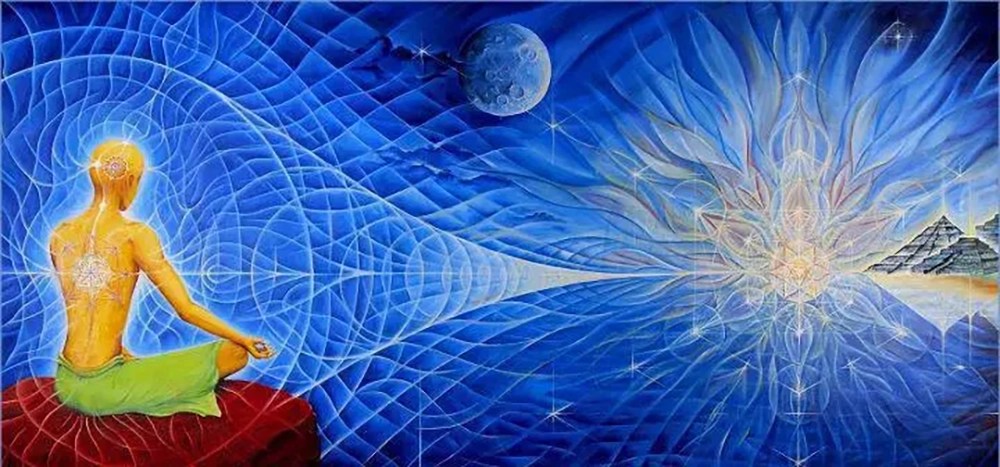

Let’s explore the Relationship Between Consciousness and Energy in Comparison to Vajrayana Buddhism
Panpsychism is a philosophical theory that posits that consciousness is a fundamental aspect of the universe, present in all forms of matter from the smallest particles to complex organisms. This theory challenges traditional notions of consciousness as solely a product of biological processes, suggesting instead that consciousness is inherent in the very fabric of reality. Today, we will explore the relationship between consciousness and energy in the context of panpsychism, specifically comparing it to the perspective of Vajrayana Buddhism, which also has profound insights into the nature of consciousness and reality.
In the equation, C=E=mc², C represents consciousness as a fundamental aspect of the universe. Panpsychism asserts that consciousness is not exclusive to sentient beings but is pervasive throughout the cosmos, imbuing all matter with some level of subjective experience. C=E aligns with the notion that consciousness is a form of energy that permeates the universe, similar to the energy described by the equation and its relationship to mass. By framing consciousness as a fundamental force akin to energy, panpsychism challenges us to reevaluate our understanding of the relationship between mind and matter.
Vajrayana Buddhism, a school of Tibetan Buddhism known for its esoteric teachings and advanced meditation practices, offers profound insights into the nature of consciousness. According to Vajrayana teachings, consciousness is not limited to individual beings but is interconnected with all phenomena in the universe. This view resonates with panpsychism’s premise that consciousness is ubiquitous and present in all aspects of reality. In Vajrayana Buddhism, consciousness is seen as the radiant clarity that underlies all experiences and perceptions, transcending individual identity and ego. This is supported by the mind only, Cittamatra, or non dual perspective. Mind only means that everything that happens, what we see, what we do and the universe all happen in mind.
Both panpsychism and Vajrayana Buddhism share a holistic understanding of consciousness as a pervasive force that transcends individual beings. While panpsychism articulates this idea in terms of consciousness as a fundamental property of matter, Vajrayana Buddhism approaches it from a metaphysical perspective, emphasizing the interconnectedness of consciousness with all phenomena. Both perspectives challenge dualistic views of mind and matter, pointing towards a more integrated understanding of reality that acknowledges the intrinsic relationship between consciousness and the universe.
Furthermore, the equation C=E=mc² serves as a metaphorical bridge between panpsychism and Vajrayana Buddhism, highlighting the interconnectedness of consciousness and energy. Just as energy can be converted into mass and vice versa, consciousness in panpsychism and Vajrayana Buddhism can be seen as a dynamic process that transforms and manifests in various forms. Here we are reminded that subject, object, and action are all on; whereas consciousness, energy and mass form the universe. By exploring the parallels between panpsychism and Vajrayana Buddhism through the lens of consciousness and energy, we gain a deeper appreciation for the profound implications of these theories on our perception of reality.
The comparison between panpsychism and Vajrayana Buddhism offers a rich tapestry of ideas that challenge conventional notions of consciousness and its relationship to the universe. By viewing consciousness as a fundamental aspect of reality, both perspectives invite us to reconsider our understanding of mind, matter, and the interconnectedness of all phenomena. Through the equation C=E=mc², we are prompted to reflect on the deep unity between consciousness and energy, bridging the gap between scientific inquiry and spiritual wisdom. In exploring the parallels between panpsychism and Vajrayana Buddhism, we are called to contemplate the profound implications of these perspectives on our perception of self, reality, and the nature of existence.
QP
 QUANTUM AWARENESS Where Science and the Buddha Meet
Fascinating. Many Buddhist teachers distinguish between consciousness and awareness, and those who do may be more comfortable with using “awareness” in this piece. (I’m not sure I agree with them but I thought I’d post the thought.)
LikeLiked by 1 person
I agree there is a difference between consciousness and awareness but where exactly do you think awareness would fit better? Write down an example please.
We simply don’t have the same vocabulary that one does in Sanskrit or Tibetan for example. Cause there are even finer words that might be used here.
LikeLike
I think the idea is that “consciousness” in English often implies being conscious of the self (I think therefore I am), so some (myself included) prefer “awareness” as a more open term. Whatever it is, it needs to be in ultimate reality (never having been born and never dying), so if consciousness depends on recognizing a self, then it’s in virtual reality and will die. Awareness, on the other hand, is universal and undying.
LikeLiked by 1 person
Humm Actually I think one can be conscious or aware of everything. In my vocabulary and perception it’s very difficult to separate the two. I even used Quantum Awareness as my website but yet I talk about consciousness all the time.
A. Am I aware that I am conscious?
B. Am I conscious that I am conscious?
C. Am I conscious that I am aware?
D. Am I aware that I am aware?
E. All of the above?
I can even have a bad conscience
I really like the French term conscience panoramique that even seems to combine the two quite nicely.
I think only through discourse can we separate and discover the truth.
LikeLike