

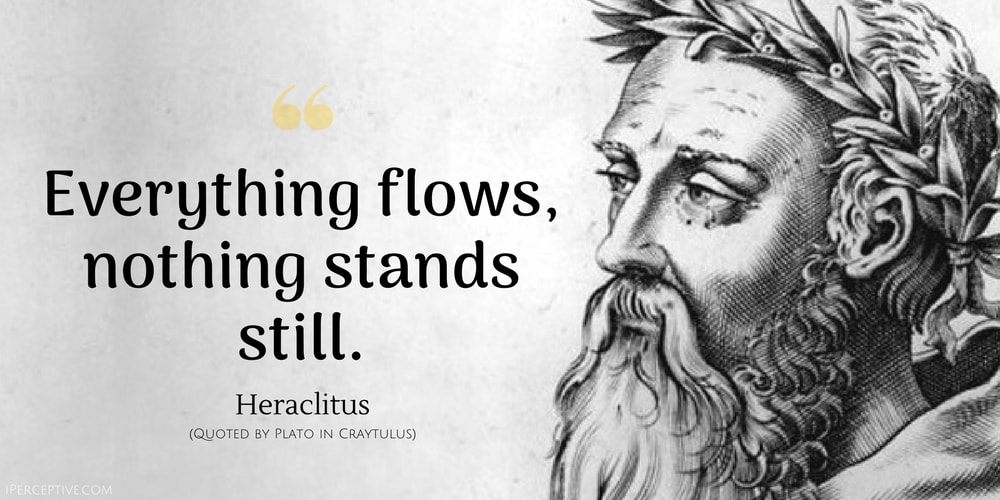
Heraclitus was born in circa 500 BC in a city Called Ephesus, this is roughly the same time as the Historical Buddha Shakyamuni was born in Lumbini Nepal.
Both the Buddha and Heraclitus were influential figures in the history of philosophy, and while they emerged from very different cultural contexts and traditions, there are some interesting philosophical similarities between their teachings.
The Buddha’s concept of “Anicca” (impermanence) and Heraclitus’s famous quotes “Everything flows (Panta rhei) or nothing stands still” and “No man steps in the same river twice” reflect this shared perspective. I always love any comparison between mind and water. Here Heraclitus knows that by the virtue of the flow or flux of the water that impacts one small stone or grain of sand in the river, it has changed since the last time you stepped in it. In fact, one might say that we are this river and our constant state of experience changes our karma and energy that we continue moving forward with.
Both philosophers focused on the importance of wisdom and self-realisation. The Buddha’s teachings centred on attaining enlightenment or nirvana through understanding the nature of suffering and the self. Similarly, Heraclitus believed that wisdom was achieved through understanding the underlying unity and harmony of the cosmos. Since we are a part of the cosmos and so is our mind, it is not difficult to see how this congruency is easily understood in a symmetrical and complimentary way.
The significance of the mind and its role in shaping perception and understanding is also an area of agreement. The Buddha’s teachings on mindfulness and meditation and Heraclitus’s belief in the logos (universal reason) point to this shared emphasis.
Non-Attachment was also emphasised by the Buddha and Heraclitus to achieve a state of inner peace and harmony. The Buddha taught about detachment from desires and cravings, while Heraclitus believed in finding unity with the universal flow by not clinging to specific outcomes. Heraclitus’ flow or flux theory is echoed in much of the Buddha Dharma.
In these ways both teachers reject materialism and suggest that an inward focus can lead to happiness and contentment in life. I find it wonderfully interesting how conscious mind and ideas can exist in more than one place at the same time. This really points to a co-emergence of awakening for people all over the world. Maybe these teachers and their ideas are not as separated as we might have thought. Are there more examples of this that are more recent or contemporary that you can think of? Drop a comment down below, I would love to hear from you.
QP
 QUANTUM AWARENESS Where Science and the Buddha Meet