
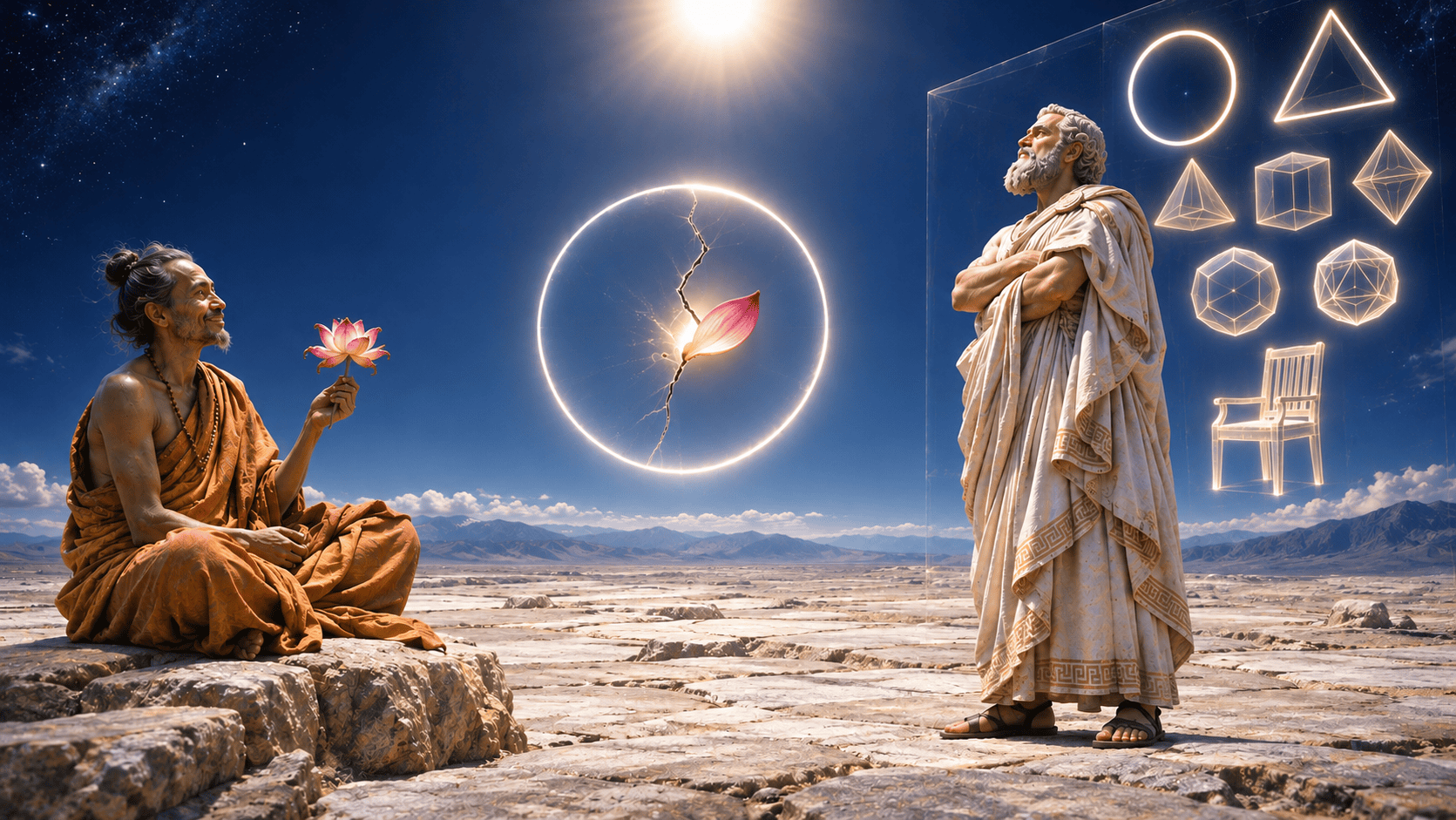
Plato’s theory of forms is the most beautiful idea in Western philosophy. Nāgārjuna’s emptiness is the most dangerous idea in Buddhist philosophy. Put them in the same dusty street at high noon and something has to give.
Plato says what is truly real never changes. Nāgārjuna says nothing truly real can be found at all and that this is good news. Bout 9 of The Emptiness Debates is the granddaddy: the eternal Forms against dependent origination, the allegory of the cave against the middle way, and one quantum question physics still can’t answer. Is math invented, or discovered?
Holster check. Draw.
Plato Draws First: The Theory of Forms
The chair you’re sitting on will rot. The Form of the Chair will not.
That’s the theory of forms in one sentence, and it’s not as silly as your first-year philosophy TA made it sound. Plato had a real problem. Heraclitus said everything flows. If everything flows, nothing holds still long enough to be known. And if nothing can be known, philosophy is just people shouting in a market.
Not so effective, eh?
So Plato asked a better question. Draw a triangle on paper. It’s wobbly. The lines have width. The angles are off by a hair. Yet you know, with total certainty, that the angles of a triangle add up to 180 degrees. Where did that certainty come from? Not from the wobbly drawing. Not from your eyes.
It came from somewhere the drawing only copies.
That somewhere is the realm of the Forms: the Triangle itself, Justice itself, Beauty itself. Perfect. Changeless. Not made of matter. Not ideas floating in your skull, either, Plato is very clear on that. The Forms are the architecture of reality. Your triangle participates in the Triangle the way a shadow participates in the body that casts it.
And here’s the steel in his argument: whatever explains a changing world must itself not change. Otherwise the explanation is as wobbly as the thing it explains.
BANG!
Out of the Shadows: The Allegory of the Cave
Then Plato tells the most famous story in philosophy. The allegory of the cave.
Prisoners are chained facing a wall. Behind them a fire burns, and objects are carried past it. All the prisoners ever see are shadows. They name the shadows, rank them, bet on them. They think the shadows are the world.
One prisoner is freed. He turns around. The fire hurts his eyes. He’s dragged up and out into daylight and, after a long time, he can look at the sun itself, which Plato calls the Form of the Good, the source of everything’s being and everything’s intelligibility.

He goes back down to tell the others. They laugh at him. Then, Plato hints darkly, they would kill him if they could. Socrates was not a hypothetical.
Notice Plato’s best card. The Good is not just one more Form at the top of the pile. It’s beyond being altogether.
🏛️ BEYOND BEING — PLATO, REPUBLIC 509b
“The good may be said to be not only the author of knowledge to all things known, but of their being and essence, and yet the good is not essence, but far exceeds essence in dignity and power.” — Plato, Republic VI, 509b (trans. Benjamin Jowett, 1871)
Remember that phrase. A thing beyond being. It’s going to come back at the end and cause trouble.
Plato isn’t a naive dualist. He’s a dualist because the world of flux needs explaining, and he refuses to explain it with more flux. Fair enough.
Nāgārjuna has been sitting on his rock the whole time, turning a lotus in his fingers. He smiles. He hasn’t drawn yet.
BANG BANG!
Nāgārjuna Emptiness Fires Back: The Form That Can’t Be Found
Here’s what Nāgārjuna does not say. He does not say “the Forms are just ideas in your head.” Plato would yawn and walk off. That’s a misreading he already refuted.
Nāgārjuna’s move is colder and better. He asks one question of anything that claims to be ultimately real: does it have svabhāva — own-being, an essence that needs nothing outside itself? Then he takes the claim at its word and tests it.

Take the Form of the Chair. What makes it the Form of the Chair? That it’s the Form of chairs. Its whole identity is the job of explaining chairs. Strip away every chair that ever was or could be, and ask what’s left. A characteristic with nothing to characterize isn’t a characteristic. It’s a word with the lights off.
That’s straight out of the Mūlamadhyamakakārikā, chapter 5, (say that word once without tying your tongue in knots) The defining mark and the thing defined lean on each other. Neither stands first.
So Plato is caught in a fork. If the Form is defined by what it explains, it depends on chairs — so it isn’t independent. If it isn’t defined by what it explains, it explains nothing — so why keep it?
Then comes the second barrel: the participation problem. Something truly changeless can’t do anything. It can’t cast a shadow, cause a copy, or even be known. Knowing is a relationship. A relationship is a dependence. The moment the Triangle touches your mind, it has a dependent life.
This is Nāgārjuna emptiness in action. Not a theory of nothing. A test that every candidate for “really, ultimately real” fails.
And careful here, because this is where most people get Nāgārjuna wrong. Emptiness is not nothingness. Your chair still holds you up. Triangles still add up to 180. Nāgārjuna keeps two truths: conventional things work perfectly well; they just don’t work by having an essence that is completely independent. Emptiness isn’t the absence of chairs. It’s the absence of the extra, invisible Chair-thing Plato bolted on behind them.
BANG!
No Chair, No Chair-ness: Dependent Origination
Now Nāgārjuna flips Plato’s whole argument over.
Plato said: the world changes, so we need something changeless to explain it. Nāgārjuna says: only things that are empty can change. If a seed had a fixed essence, it could never become a sprout. If a mind had a fixed essence, it could never wake up. Dependent origination isn’t the problem Plato needs solving. It’s the reason anything happens at all.
Whatever arises dependently, that is what we call emptiness. It is a designation that depends on something else, and it is itself the middle way.
— Nāgārjuna, Mūlamadhyamakakārikā 24.18 Garfield, Siderits & Katsura
A few verses earlier, in 24.14, Nāgārjuna puts it as a dare: where emptiness works, everything works. Where it doesn’t, nothing does.
And one more twist before the reload. Nāgārjuna won’t claim the prize. In his Vigrahavyāvartanī he says he has no thesis of his own to defend. He isn’t swapping Plato’s universe for a Nāgārjuna universe. He’s showing that every universe-with-an-essence collapses when you look at it closely, his own included.
That’s why debating him feels like punching fog that’s laughing at you.
Click….
The Sting: Plato Already Shot Himself
Here’s the part your TA definitely skipped.
Plato saw the crack himself. In his dialogue Parmenides, he puts a young Socrates in the ring with the old master Parmenides, and Parmenides takes the theory of forms apart. If large things are large because they share in the Form of Largeness, then the large things and the Form together need another Form to explain what they share. Then another. Then another. Philosophers later called it the Third Man argument: an infinite regress, Forms all the way up.
Plato wrote that. About his own theory. Then he told young Socrates, through Parmenides, to keep training rather than give up.
He never abandoned the Forms. But he’s the first Greek on record to run a reductio this close to Madhyamaka on his own best idea. Nāgārjuna, some five centuries later and half a world east, would have bought him a drink.

The Vajra Twist: Diotima’s Ladder and the Bliss of Emptiness
Now for the twist that cuts under both gunslingers. Yes, both.
In the Symposium, Socrates admits he learned the truth about love from a woman: Diotima, a priestess of Mantinea. She teaches him a ladder. You begin by loving one beautiful body. Then all beautiful bodies. Then beautiful souls, laws, kinds of knowledge. And at the top, suddenly, Beauty itself — pure, unmixed, eternal.
The engine of the whole climb is eros. Desire. Plato’s most mystical moment runs on the same fuel as a teenage crush.
But look at the direction. Diotima’s ladder climbs away. Each rung leaves the last behind. In the Phaedo, Plato goes further and calls philosophy a practice for dying — the soul training to get free of the body.
Here’s what Plato and the debating halls both miss. Vajrayana has a ladder too. And in my lineage, Nāgārjuna’s Madhyamaka is one rung on it — not the roof.
It’s the sharpest knife ever forged for cutting through essence. But an emptiness you reach by argument is still an emptiness you concluded. A brilliant map of the territory, drawn by a very good mind. Not yet the territory.
The rungs keep going. Analysis gives way to direct recognition. The body stops being a problem and becomes the vehicle: the subtle body — channels, winds and drops — is the laboratory where emptiness is tasted, not concluded. And what’s tasted isn’t cold. Emptiness turns out to be inseparable from bliss. Desire isn’t left at the bottom of the ladder. It’s recognized as the ladder’s own energy, and ridden all the way home.
So the real difference isn’t ladder versus no ladder. Plato’s ladder drops each rung behind it: the body, then the senses, then the world. The Vajrayana ladder drops nothing. Every rung is carried up and transformed — the body, the desire, even Nāgārjuna’s logic.
Plato climbs out of the world. Nāgārjuna dissolves the world’s essence. Vajrayana finds the world was luminous the whole time.
Here’s my framing, and it’s a rhyme, not an equation. Plato’s sun outside the cave and the clear light of mind rhyme beautifully. Both make everything else visible. But Plato’s Good stands beyond being, above the world, far away. The clear light is empty of being, and it was never anywhere but here — in the mud, where lotuses grow.
Plato wanted purity through transcendence. Nāgārjuna wanted freedom through analysis. Vajrayana keeps both, through complete non-avoidance.
Same gold. Different shovel.
And Diotima? A woman who teaches the great philosopher that desire, rightly ridden, leads to truth. In my lineage we have a word for women like that. I’ll let you guess it.
QP’s Quantum Question: Is Math Invented or Discovered?

Here’s why this isn’t an antique shootout.
As a teenager, Werner Heisenberg read Plato’s Timaeus — the dialogue where the elements are built from perfect geometric solids. It stayed with him for life. Later, as a founder of quantum mechanics, he argued that the smallest building blocks of matter look less like tiny objects and more like mathematical forms.
Carlo Rovelli, a century on, went the other way. His relational interpretation of quantum mechanics says a system has no properties of its own at all — only properties relative to other systems, realized in interactions. In Helgoland he says he found that idea’s best philosophical companion in Nāgārjuna.
Two physicists. Two corners of the same dusty street.
🔬 HEISENBERG VS ROVELLI
Werner Heisenberg: “Modern physics has definitely decided in favor of Plato.” For him, elementary particles were mathematical forms, as in the Timaeus. Carlo Rovelli’s relational quantum mechanics holds instead that physical variables have values only relative to other systems — and in Helgoland (2020) he turns to Nāgārjuna’s emptiness to make sense of it.
So, QP’s question:
If the quantum world obeys mathematics with absurd precision — are we discovering Plato’s eternal Forms, or are the equations, like everything else, dependently arisen between mind and world? And is there any experiment that could ever tell the difference?
Who Won?
▸ Plato, Nāgārjuna, or “they were always talking about the same thing badly”? Cast your vote in the comments. Bring arguments. Bring jokes. Leave the shadows at home.
Further Reading
Lucid Dreaming and Dream Yoga — Plato’s prisoners mistake shadows for the world; dream yoga trains you to recognize the dream while you’re in it. The allegory of the cave, practised at night. →
Quantum Buddhism and Coemergence — Where Nāgārjuna emptiness meets physics: appearance and emptiness arising together, without an eternal Form behind them. →
Quantum Consciousness, Meditation and Hilbert Space — If math is invented or discovered, what is the mathematical space quantum states live in? A deeper dive into the structures QP’s question is pointing at. →
Nāgārjuna — Stanford Encyclopedia of Philosophy — Jan Westerhoff’s scholarly entry on emptiness, svabhāva and dependent origination. →
Plato — Stanford Encyclopedia of Philosophy — The standard academic overview of Plato, including the theory of forms and the Parmenides problem. →
Relational Quantum Mechanics — Stanford Encyclopedia of Philosophy — Rovelli’s interpretation, where properties exist only between systems: dependent origination, written in physics. →
Leave a Reply