
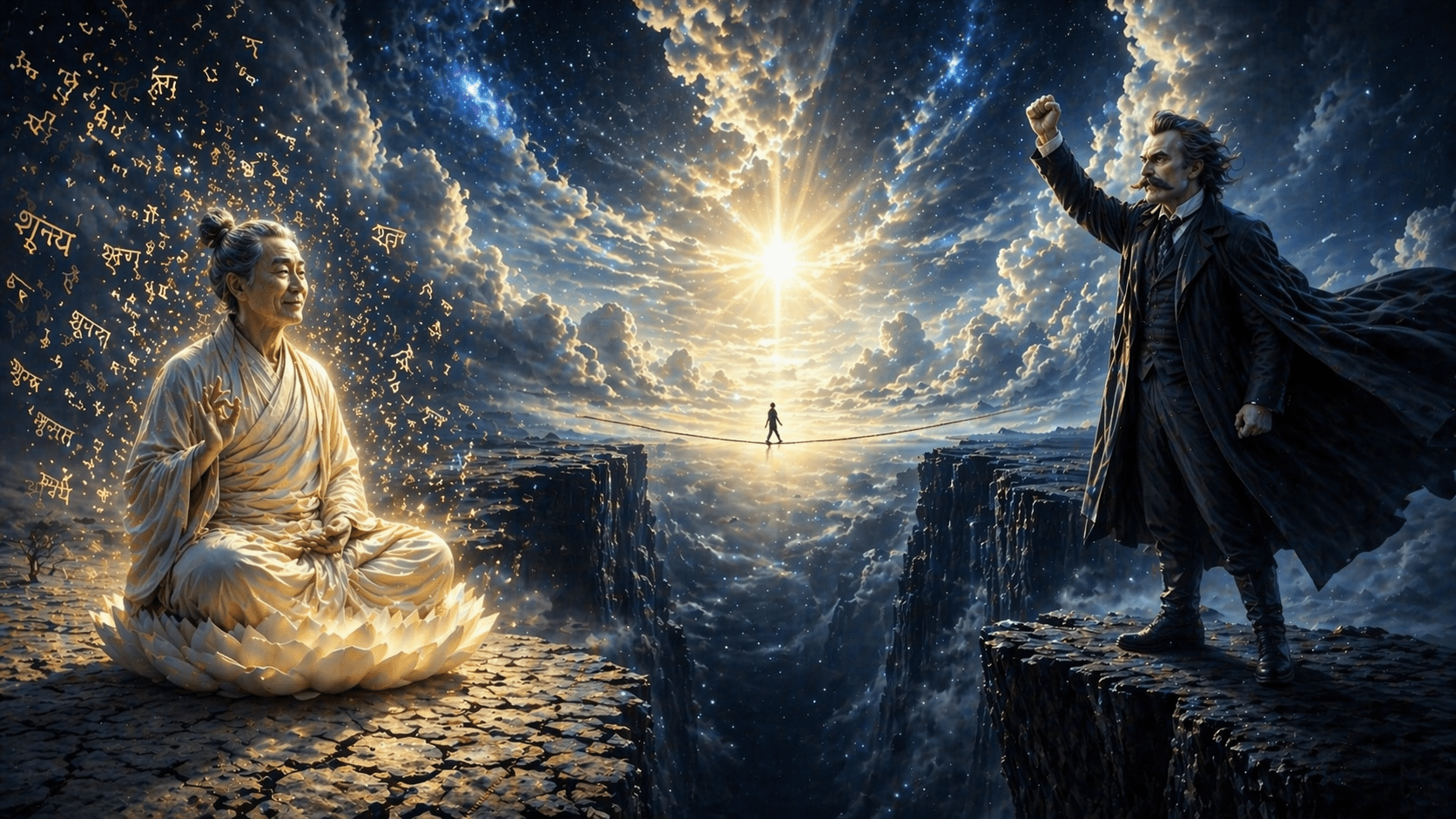
NIETZSCHE
Nietzsche arrives loudly, which is how he arrives everywhere. He has read the Buddhists. He has opinions. Buddhism, he announces, is a nihilism of the East — a life-denying death cult that calls its exhaustion enlightenment and its resignation peace.
The will to nothingness disguised as the will to nothing. He is not here for it. Life affirms itself, it overflows, it creates, it destroys and creates again — and any philosophy that tells you to sit quietly and detach from it is simply the philosophy of the weak calling their weakness virtue. The will to power is not cruelty. It is the fundamental drive of all living things to express, expand, and become. Emptiness, Nietzsche says with magnificent contempt, is just giving up and calling it God.
NĀGĀRJUNA
Nāgārjuna listens with genuine interest and then asks one question: this will to power — does it exist inherently? Does it have a fixed, independent, findable essence? Because if it does, Nietzsche should be able to point to it directly, isolated, apart from the conditions that give rise to it — the body, the drives, the history, the culture, the language, the very concept of power itself.
Nāgārjuna is not saying nothing exists. He is saying nothing exists *the way Nietzsche needs it to.* The will to power without inherent existence is perfectly fine — it arises, it acts, it moves. But Nietzsche’s version requires a self that wills, a power that is owned, an overcoming that accumulates. That’s not life-affirmation. That’s just a very energetic form of grasping. Śūnyatā or emptiness is not exhaustion. It’s the reason the dance is possible at all.

THE VAJRA TWIST
Vajrayana doesn’t choose the middle path here — it dances on both edges simultaneously. The wrathful deities of the Tibetan pantheon are not life-denying. Mahākāla is not detached. They are the full force of awareness meeting the full force of reality without flinching and without grasping — which is, ironically, far closer to what Nietzsche was reaching for than what he found in the Buddhism of his day.
The Vajra body is not resigned. It is indestructible precisely because it has no fixed essence to protect. Nietzsche wanted a philosophy that could say yes to everything, including destruction. Vajrayana built one. It just requires you to dissolve your self first, which Nietzsche was not going to do on a Tuesday.
QP’S QUANTUM QUESTION
If a particle has no determined state until it’s observed — is the will to power the particle, or the observer, or the moment of measurement?
▸ WHO DO YOU THINK WON? Tell us in the comments.
Continue Reading:
1. Nietzsche Wikipedia
2. Nāgārjuna Wikipedia
Leave a Reply