
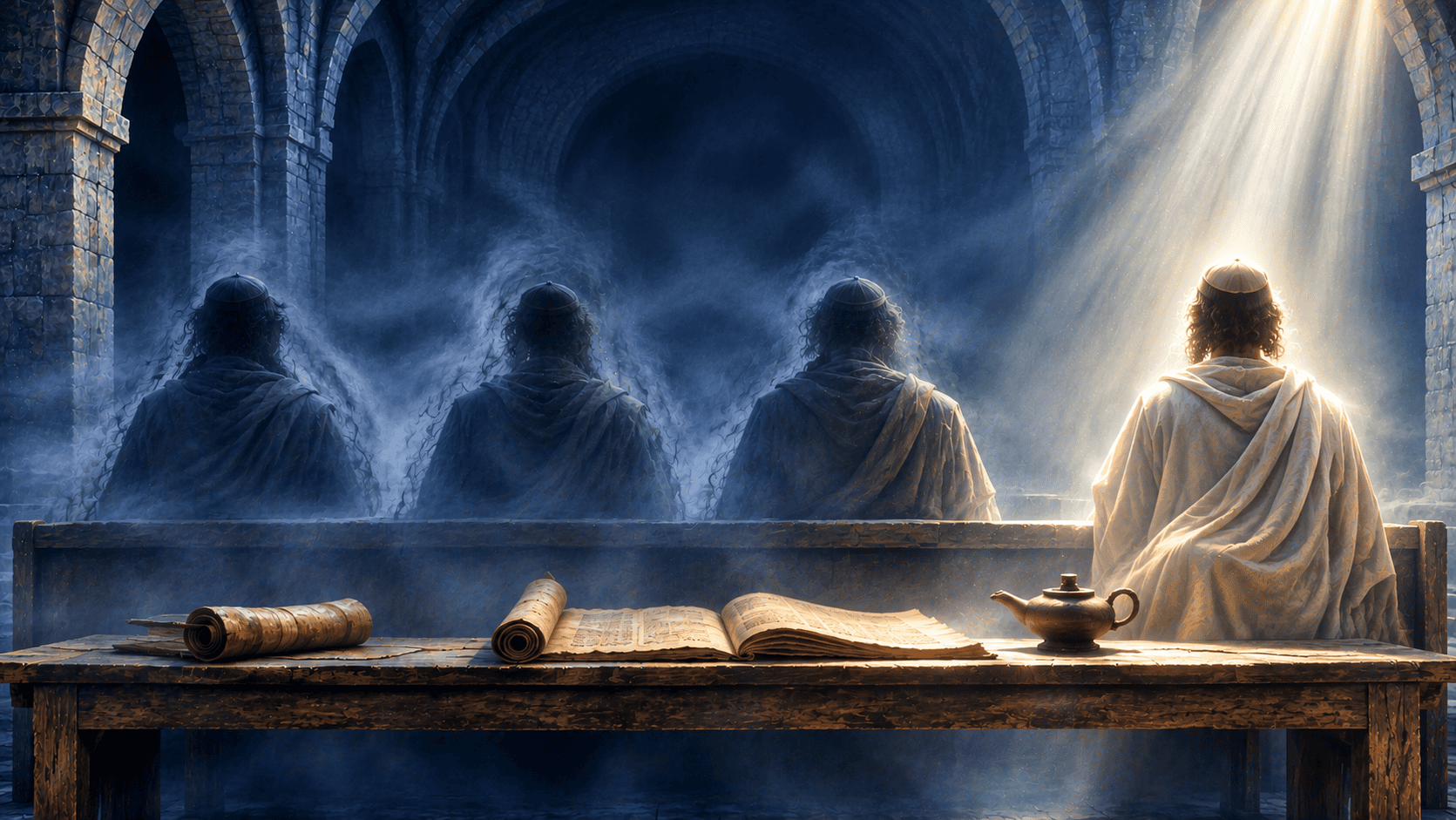
The 3rd Book of Enoch, the Hebrew Book of Enoch, is where the human Enoch becomes the angel Metatron. This is The Order of Enoch, Part 3: Metatron, the Pardes story of four rabbis who went looking for the same throne room, and the two powers in heaven question that broke one of them. Same threshold as Parts 1 and 2. This time we count the cost.
Four rabbis part of the Order of Enoch went looking for the same thing Enoch found. One died. One lost his mind. One looked at what Enoch had become and decided there were two gods, not one. One walked in, walked out, and by tradition spent the rest of his life teaching. That’s not a parable. That’s the tradition’s own casualty report.
Please Watch Here
3 Enoch: Rabbi Ishmael Climbs the Heavenly Halls
3 Enoch, also called Sefer Hekhalot, is Rabbi Ishmael’s own account of climbing into the heavenly halls. He isn’t alone up there for long. An angel meets him at the door, the angels fix their eyes on him, and Ishmael collapses, benumbed, until someone physically restores him. The threshold has a bouncer, and the bouncer also does first aid. 3 Enoch belongs to the Hekhalot and Merkabah literature that grew directly out of Ezekiel’s throne-chariot vision, and later mystics built an entire discipline around trying to reach that throne room. For where that tradition starts, read Was Ezekiel on DMT? →
Metatron: The Lesser YHWH Who Was Once Enoch
The angel’s name is Metatron, and partway through the book he stops being Ishmael’s guide and tells us who he is: he was once a human being. He was once Enoch, taken up and transformed, and he was given a garment of glory studded with lights, a royal crown set with forty-nine costly stones, and a title: “THE LESSER YHWH,” as it is written, “For my name is in him.” That is a former human being dressed the way scripture describes divine glory, inside a text the rabbis themselves preserved and studied.
It happens in stages. In 3 Enoch 9 he is enlarged to the size of the world, with seventy-two wings and three hundred and sixty-five eyes, each as the great luminary. In chapter 15 his flesh is changed into flames and his bones into coals of burning juniper. Juniper is worth stopping on. A compound in it, alpha-pinene, acts at the same receptor site as Valium in mouse studies, which suggests a smoke that could calm the nervous system without switching the mind off. That is lab work, not human trials, so suggestive only.

Two Powers in Heaven: The Chair That Broke Acher
Elisha ben Abuyah, called Acher, “the Other One,” broke over a chair. In Hagigah 15a he sees that Metatron has been granted authority to sit while he records the merits of Israel. “We have been taught that in heaven there is no sitting.” His conclusion: perhaps there are two powers in heaven. Metatron is brought out and struck with sixty bands of fire, to establish that his sitting was only his function as the Heavenly Scribe, not evidence of a rival power. Not a vision, not a voice: a chair. The rabbis’ response is almost panicked, and my take is that this was an edit written after the fact.

Pardes: Four Entered the Orchard, One Walked Out
Pardes, the orchard, is the Talmud’s coded term for this kind of mystical ascent practice, and the story is told in Hagigah 14b:
🕯 — Babylonian Talmud, Hagigah 14b, Soncino translation
“Four entered the Pardes… Ben Azzai cast a look and died. Ben Zoma looked and became demented. Acher mutilated the shoots. Rabbi Akiva departed in peace.”
Four men, four completely different outcomes from the same walk into the same orchard. This technology is clearly not for everyone, nor is it entirely safe, and the tradition didn’t leave it unsupervised: the Mishnah says this material isn’t taught to more than one listener at a time, and even that listener has to be a sage already. Four men went in together. I wonder if the Ben Azzai story in pardes is why one could not look into the Ark of the Covenant. It would certainly keep the uninitiated away.
Grof, Strassman and Shanon: Who Holds the Frame?
🔬 Science
Stanislav Grof coined the term spiritual emergency for a genuine transpersonal breakthrough that gets treated, by the person having it or the people around them, as a psychiatric crisis or a doctrinal threat, because nobody around it knows how to hold the frame.
That fits Ben Zoma almost exactly, and arguably Acher: a real breakthrough that, with no trained container available, got resolved into the worst possible interpretation. Rick Strassman argues in DMT and the Soul of Prophecy (2014) that the Hebrew Bible’s model of prophecy, an external spiritual world met by a self that stays intact, fits what his DMT volunteers reported better than a Buddhist no-self framework.
Benny Shanon proposed in Biblical Entheogens (2008) that Moses’s Sinai experience might have involved a plant-based visionary brew, and drew real public pushback. Carl Ruck got a version of the same for his work on the road to Eleusis. Touch the mechanism behind the vision, and the reaction is rarely calm. For the clinical map, start with The Cartographer of Inner Space →
Phowa: The Technology Akiva Actually Had
Buddhism has mapped this threshold for over a thousand years under a different name: the bardo. The Bardo Thodol describes dying as a sequence of appearances, peaceful forms first, then wrathful ones, and what happens next depends on whether you can recognize what you’re looking at. That’s Ben Azzai. That’s Ben Zoma. That’s Acher, getting the read wrong at the exact moment it mattered. But Vajrayana built a technology for crossing on purpose: phowa, one of the Six Yogas of Naropa. That is the actual difference between Akiva and the other three. Not a smaller vision, not more bravery: a trained way to meet an overwhelming threshold and still recognize what he was looking at.
The Order of Enoch: Why the Church Feared the Technology
We are not settling the two powers question. The rabbis panicking tells you the institution was afraid, nothing about who was right. The lock proves there was a door. It tells you nothing about what was behind it. What we can point at is a pattern: every tradition that lets people go looking for this eventually produces its own casualty list, and eventually also an Akiva, someone who goes all the way in and comes back intact because something in his training was bigger.
So why was the church afraid of this? Not of the stories, but of the technology underneath them. A repeatable path that hands an ordinary person direct, unmediated contact with the divine makes an institution optional. 1 Enoch got argued out of the canon by name. 2 Enoch just quietly wasn’t kept. 3 Enoch’s own tradition beat an angel with fire so that nobody would think the door was open. Three books, three centuries, three methods, one identical instinct: don’t let it get out.

Ben Azzai died. Ben Zoma broke. Acher looked at a seated angel and rewrote his entire theology on the spot. Akiva walked in, walked out, and by tradition spent the rest of his life teaching. Same orchard, four outcomes. The difference was never the orchard. That is the whole trilogy in one story: the threshold is real, the transformation is real, and what happens to you at the far end of it depends on whether anyone built you a container strong enough to hold what you find there.
Next time: King Nebuchadnezzar. Someone who got none of that: not a priest, no training, no lineage, no warning, just money, power and the guts to walk in anyway.
QP
Prefer to read? The full transcript is available below. But I recommend listening first – my delivery adds context that’s hard to capture in text.
Cold Open 00:00 » Four rabbis went looking for the same thing Enoch found. One died. One lost his mind. One looked at what Enoch had become and decided there were two Gods, not one — and never came back from that. One walked in, walked out, and wrote about roses. » That’s not a parable. » That’s the tradition’s own casualty report. Today: what happens after the transformation, to everyone standing close enough to watch it happen. Welcome Back / Early Hook 00:38 Welcome back for the close of this trilogy. 1 Enoch showed us the threshold. 2 Enoch showed us the transformation. 3 Enoch shows us the aftermath — what the tradition itself says happens to trained scholars or Psychonauts who go looking for the same thing, without the specific kind of readiness one of them apparently had, and the others didn’t. Even the traditions that built this into ritual didn’t leave it unsupervised. When the Zoroastrians sent their own visionary, Arda Wiraz, out on a journey like this, his sisters and the priests sat with his body for seven days and nights, praying the whole time, until he came back. Set and setting isn’t a modern idea — it’s one of the oldest safety rails there is. These four had a container — of a kind. 01:28 The Mishnah is specific: this material isn’t taught to more than one listener at a time, and even that one listener has to already be a sage who understands it on his own. The ideal here was never supervised group practice. It was someone arriving there alone, already qualified. Four men walked through that door together. Whatever that was, it isn’t what the rule describes as safe. And the question I have is: how did god give the same vision to 4 men simultaneously, or did they all trip together? I don’t know if I can answer that, but to say that you don’t schedule when god calls you, but you can schedule when you call him. The only reliable way to do that is with a molecule if you ask me? Section 1 — Enoch Becomes Metatron 02:20 3 Enoch — also called the Hebrew Book of Enoch, or Sefer Hekhalot — is Rabbi Ishmael’s own account of climbing into the heavenly halls. He’s not alone up there for long. An angel meets him at the door. His name is Metatron. » 3 Enoch opens with these words, from Rabbi Ishmael himself — » 3 Enoch 1 02: 42 “When I ascended on high to behold the vision of the Merkaba and had entered the six Halls, one within the other… [the angels] fixed their eyes upon me. Instantly trembling and shuddering seized me and I fell down and was benumbed by the radiant image of their eyes. Forthwith Metatron the Prince of the Presence, came and restored my spirit and put me upon my feet: ‘Enter in peace before the high and exalted King and behold the picture of the Merkaba.’” 03:12 That’s not me being cute with the framing — that’s the book’s own first chapter. Did you hear that? Ishmael’s own ascent. 03:26 No wonder we still call it getting high today. And notice where the chapter puts the collapse: before Metatron’s identity is even revealed, before any of the fire. Just the angels’ own eyes on him, and Ishmael is on the ground, benumbed, until someone physically restores him. That’s the pattern this whole trilogy keeps circling back to — the threshold has a bouncer, and the bouncer also does first aid. 03:50 Partway through, he stops just being Ishmael’s guide and tells us who he actually is: he was once a human being. He was once Enoch — Or an Enoch the first of the line taken up and transformed, given a garment of glory studded with lights and a royal crown set with forty-nine costly stones. This is the first time we actually see him. I’ve got a theory: Metatron’s the original Transformer. 04:21 More than meets the eye, about thirteen centuries before Hasbro trademarked the phrase. Then comes the title: » 3 Enoch 12:1–5 04:33 “He made me a garment of glory on which were fixed all kinds of lights, and He clad me in it. And He made me a robe of honour on which were fixed all kinds of beauty, splendour, brilliance and majesty. And He made me a royal crown in which were fixed forty-nine costly stones like unto the light of the globe of the sun. And He called me THE LESSER YHWH in the presence of all His heavenly household; as it is written: ‘For my name is in him.’” Sit with that for a second: a former human being, dressed in a garment and crown described the way scripture describes divine glory itself, handed a divine title, inside a text the rabbis themselves preserved and studied. More importantly, do you see that’s Jesus the lesser YHWH. I mean, really this is blasphemy at its best! 05:30 This is the direct continuation of Ezekiel’s throne-chariot tradition — 3 Enoch belongs to the same Hekhalot and Merkabah mystical literature that grew directly out of Ezekiel’s own vision. Later mystics built an entire visionary discipline around trying to reach that throne room themselves. And can you really blame them? What a trip — if Timothy Leary had said ‘free trips to heaven’ instead of ‘turn on, tune in, and drop out,’ the sixties would have been a very different place. Section 2 — The Body Made of Fire 06:05 Before we get to what this did to the people around him, look at what it did to Enoch himself. It happens in stages. First, in chapter 9, he’s enlarged and given wings — not a small vision, an overwhelming one, in his own words: » Let’s read — » 3 Enoch 9 06:24 “After all these things the Holy One, blessed be He, put His hand upon me and blessed me with 5360 blessings. And I was raised and enlarged to the size of the length and width of the world… And He caused seventy-two wings to grow on me, thirty-six on each side, and each wing was as the whole world… And He fixed on me three hundred and sixty-five eyes: each eye was as the great luminary… I was honoured and adorned with all these good and praiseworthy things more than all the children of heaven.” 07:05 Read that back, slowly, because it does not get less insane the second time. A body as large as the entire world — the text’s own math, edge to edge. And the eyes: three hundred and sixty-five of them, and every single one described as the size of the sun. Not shining like it. The size of it. 07:32 Then chapter 15 pushes it one stage further — not just enlarged, but converted, outright, in his own first-person voice, into fire itself: » 3 Enoch 15 07:45 “My flesh was changed into flames, my sinews into flaming fire, my bones into coals of burning juniper, the light of my eye-lids into splendour of lightnings, my eye-balls into fire-brands… all my limbs into wings of burning fire and the whole of my body into glowing fire. And on my right were divisions of fiery flames, on my left fire-brands were burning, round about me stormwind and tempest were blowing, and in front of me and behind me was roaring of thunder with earthquake.” 08:28 There’s a detail in that list worth stopping on: bones into coals of burning juniper. Not oak, not cedar, not generic biblical brushwood — juniper, specifically, named at the exact moment his body converts into fire. Juniper’s real chemistry backs the specificity up. One of its main compounds, alpha-pinene, acts on the GABA receptor at the same site Valium does, and it also blocks acetyl choline sterase, the enzyme that breaks down acetylcholine, a brain chemical involved in attention and memory. That’s lab and mouse work, not human trials. So take it as suggestive.09:11 In plain terms: a plant whose smoke could plausibly calm the nervous system without switching the mind off. If you’re narrating your own body turning into fire, in real time, without flinching, that’s exactly the kind of technology you’d want burning in the room. Calming-down technology, not sedation that knocks you out. Enoch must have been close to an overdose on this one. And beneath the throne itself, chapter 36 describes a literal river of fire, the Nehar di-Noor — and it’s worth hearing exactly what the angels do in it before they’re allowed to sing: » 3 Enoch 36:1-2 09:55 “At the time when the ministering angels desire to say the Song, Nehar di-Nur, the fiery stream, rises… and it runs and passes under the Throne of Glory. And all the ministering angels first go down into Nehar di-Nur, and they dip themselves in the fire and dip their tongue and their mouth seven times; and after that they go up… and stand in four rows over against the Throne of Glory.” Holy, Holy, Holy — (slowly) — Shit 10:28 they put their tongues in the fire? Seven times. Every single time. Before every single song. Not just once, as a test. Seven times, as a standing procedure — the text doesn’t even treat it as remarkable, just the thing you do before you’re clean enough to sing in that room. Section 3 — Four Who Entered the Orchard 10:50 Remember the four rabbis from the top of this episode? Here’s exactly what the tradition says happened to them — in its own words, not mine. Pardes — the orchard — is the coded term for this kind of mystical ascent practice, and the story is told in the Babylonian Talmud, Hagigah 14b. » Babylonian Talmud, Hagigah 14b (Soncino translation) “Four entered the Pardes… Ben Azzai cast a look and died. 11:14 Ben Zoma looked and became demented. Acher mutilated the shoots. Rabbi Akiva departed in peace.” Four lines. Four men.11:28 Four completely different outcomes, from the same walk into the same orchard. Ben Azzai looked and died — no elaboration, no lesson attached, just gone. Ben Zoma looked and lost his mind. Elisha ben Abuyah — the text’s own idiom is that he ‘mutilated the shoots,’ Talmudic shorthand for becoming a heretic — is from then on called Acher, ‘the Other One.’ Only Rabbi Akiva ‘departed in peace.’ 12:00 This technology is clearly not for everyone, nor is it entirely safe. I wonder if the Ben Azzai story is the source of why one could not look into the Ark of the Covenant. It would certainly keep the uninitiated away. The Talmud’s own elaboration, at Hagigah 15a, gives the specific trigger for Acher’s break — and here it is in the text’s own words: » Babylonian Talmud, Hagigah 15a 12:25 “Acher saw that Metatron had been granted authority to sit while he recorded the merits of Israel, and he said: ‘We have been taught that in heaven there is no sitting… Perhaps — God forbid! — there are two supreme powers.’ They brought him to Metatron and they smote him with sixty bands of fire.” Seated. That’s the whole trigger. Not a vision, not a voice — a chair. Sitting in that court is an act reserved for God alone, and Acher sees the one angel who’s allowed to break that rule, and concludes from a single detail: there are indeed two powers in Heaven. The rabbis’ response is almost panicked — Metatron is struck with sixty bands of fire, to establish that his sitting was merely his function as the Heavenly Scribe, not evidence of a second, rival power. 13:23 Just my take here, that this was an edit written after the fact. Let’s zoom out on what this story actually proves about the Order of Enoch. Four trained rabbis, centuries after Enoch, still attempting the same ascent — a discipline with its own restrictions written directly into the Mishnah. Nobody stumbles into that by accident. That’s a technique being actively taught and transmitted, teacher to student, generation after generation, long after the man who supposedly first walked that road was gone. Section 4 — Grof and the Unheld Breakthrough 14:00 Grof coined the term spiritual emergency for exactly this situation: a genuine transpersonal breakthrough that gets treated, by the person having it or the people around them, as a psychiatric crisis or a doctrinal threat, because nobody around it knows how to hold the frame. Ben Zoma’s account fits that description almost exactly. So, arguably, does Acher’s — not a psychotic break in Grof’s clinical sense, but a real breakthrough that got resolved, with no trained container available, into the worst possible interpretation. Section 5 — Strassman’s Own Version of This Argument 14:40 This is the part Strassman didn’t leave for us to guess at. In DMT and the Soul of Prophecy, published in 2014, he argues directly that the Hebrew Bible’s own model of prophecy — an external, independent spiritual world encountered by a self that stays intact, rather than dissolves — fits what his DMT volunteers reported better than a Buddhist no-self framework does. He’s not the first outsider to notice the resemblance between a chemically occasioned encounter and Ezekiel’s or Enoch’s throne room. He built an entire book around making that comparison directly, from the clinical side. Section 6 — Benny Shanon and the Cost of Asking 15:19 Benny Shanon, a cognitive scientist at Hebrew University, published Biblical Entheogens: A Speculative Hypothesis in 2008, proposing that Moses’s Sinai experience might have involved a plant-based visionary brew. Nobody struck him with sixty bands of fire — but it drew real, public pushback, even though he’d flagged the whole thing as speculative himself. Carl Ruck got a version of the same treatment, professionally, back in the States, for his work on the road to Eleusis. Touch the mechanism behind the vision, and the reaction is rarely calm, however carefully you hedge your claims. We’ve seen this before, time and time again. Especially with ergot. Section 7 — The Technology Akiva Actually Had 16:04 There’s a reason this episode keeps circling around fire, transformation, and bodies that don’t come back the way they went in. This isn’t just a story about ancient mysticism — it’s a story about the most universal threshold there is: the one between this state of consciousness and whatever comes after it. Buddhism has been mapping this exact threshold for over a thousand years, under a different name: the bardo. The Bardo Thodol — what gets called, in the West, the Tibetan Book of the Dead — describes the process of dying as an encounter with a sequence of appearances, increasingly overwhelming, increasingly hard to hold steady in front of. Peaceful forms first, then wrathful ones. Blinding lights. 16:51 The entire argument of the text is that what happens to you next depends on whether you can recognize what you’re looking at, or whether it overwhelms you into fear and confusion. That’s Ben Azzai. That’s Ben Zoma. That’s Acher, standing in front of something enormous and getting the read wrong at the exact moment it mattered most. 17:13 But Vajrayana didn’t stop at describing the threshold. It built a technology for crossing it on purpose, while still alive: phowa, the transference of consciousness — one of the Six Yogas of Naropa. A trained practitioner, under a qualified teacher, learns to eject consciousness through the crown of the head at the moment of death, deliberately, toward a specific destination, rather than being dragged through that sequence of appearances unprepared. That’s the actual difference between Akiva and the other three. Not that his vision was smaller. Not that he was braver. He had the technology — 17:54 a trained way to meet an overwhelming threshold and still recognize what he was looking at, instead of drowning in it. Enoch’s guide had oil and fire. Vajrayana has a lineage and years of preparation. Both are describing the same border crossing, from wherever they’re standing. The only real question left is whether anyone trained you before you got there. Section 8 — The Refusal: We’re Not Settling the Two Powers Question 18:20 Here’s where we draw the same line we’ve drawn all season. It would be easy, and cheap, to say: the rabbis panicked, therefore Acher was right, there really are two powers in heaven, and Metatron really is proof of it. That claim is unfalsifiable in exactly the shape we keep refusing — the institution’s fear response tells you the institution was afraid. It tells you nothing about who was actually correct. » The lock proves there was a door. 18:44 It tells you nothing about what was behind it. We’re not resolving that question. We’re pointing at the pattern: every tradition that lets people go looking for this eventually produces its own casualty list, and every single one of them, eventually, also produces an Akiva — someone who goes all the way in and comes back intact, not because the vision was smaller for him, but because something in his training was bigger. So let’s actually answer it. 19:14 Why was the church afraid of this? Not afraid of the stories — afraid of the technology underneath them. Every institution that survives long enough survives by being necessary. And a technology like this — a repeatable path that takes an ordinary person and hands them direct, unmediated contact with the divine — makes an institution optional. If you can walk through that door yourself, every Sunday morning, with the right training, you don’t need someone standing at it telling you what’s on the other side. That’s the actual threat. 19:50 Not heresy for its own sake. Not even the theology, exactly — though ‘two powers in heaven’ is a real doctrinal hand grenade. 19:59 The threat is what a working technology always threatens: the middleman. 1 Enoch got argued out of the canon by name. 2 Enoch just quietly wasn’t kept. 3 Enoch’s own tradition beat an angel with fire to make sure nobody walked away thinking the door was really open. Three books. Three centuries. Three methods. One identical instinct: whatever this technology actually is, don’t let it get out. Close 20:26 » Ben Azzai died. Ben Zoma broke. Acher looked at a seated angel and rewrote his entire theology on the spot. Akiva walked in, walked out, and by tradition spent the rest of his life teaching. Same orchard. Four different outcomes. The difference was never the orchard. » That’s the whole trilogy in one story: the threshold is real, the transformation is real, and what happens to you at the far end of it depends entirely on whether anyone built you a container strong enough to hold what you find there. Late CTA / Next-Episode Teaser 20:59 Next time, we meet someone different. Someone who got none of that. Not a priest. No training. No lineage. No warning. Just money, power, and the guts to walk in anyway. And a vision that arrives whether you’re ready for it or not. King Nebuchadnezzar is next. This is QP you Quantum Preceptor Sound is Emptiness Emptiness is sound Catch you next time Gong Om Out END 21:30 🌀 Sound is Emptiness — Emptiness is Sound 🌀Further Reading
Onsite:
← 2 Enoch: Anointed with Oil Like Sunlight — The Order of Enoch, Part 2 S2 E6 — The previous episode: the anointing oil and the transformation in 2 Enoch that lead to Metatron in 3 Enoch.
Book of Enoch: The Man Who Walked Into Hell — The Order of Enoch, Part 1 S2 E5 → — Where the Order of Enoch trilogy begins: 1 Enoch and the threshold.
Phowa: The Technology of Rebirth — What Happens When a High Lama Dies? → — The phowa behind the Akiva difference: a trained way across the threshold that overwhelmed the other three of the Pardes.
What is the Bardo Intermediate State in Tibetan Buddhism? → — The peaceful and wrathful appearances of the bardo, the same threshold that broke Ben Azzai, Ben Zoma and Acher in the Pardes.
The Cartographer of Inner Space: Stanislav Grof and the Map Nobody Was Supposed to Make → — Grof’s own map, behind the spiritual emergency idea this episode applies to Ben Zoma and Acher.
Set and Setting — The Technology the Prophets Hid in Plain Sight → — Arda Wiraz, whose sisters and priests sat with his body for seven days: set and setting as one of the oldest safety rails there is.
Was Ezekiel on DMT? The Vision That Reads Like a Field Report S2 E4 → — The throne-chariot vision that the Hekhalot literature of 3 Enoch grew out of.
The Five Kinds of Vision: What the Ancient World Actually Believed You Were Seeing → — How the ancient world sorted visions, the background to Ishmael’s ascent in 3 Enoch and the Pardes.
What Burns the Self Away: Isaiah’s Vision S2 E3 → — Another Season 2 vision where fire changes the person who sees it, a neighbour of Metatron’s body of fire.
The Trip Report: Dreams, Drugs, and the Problem of Interpretation → — Dreams, drugs and the problem of interpretation: the question behind refusing to settle the two powers in heaven.
The primary sources behind 3 Enoch and the Pardes, free and in full:
- Chagigah 14 (My Jewish Learning) — the Pardes story of Hagigah 14b: Ben Azzai dies, Ben Zoma loses his mind, Acher turns to heresy, Akiva emerges unharmed. →
- α-Pinene (Wikipedia) — GABA-A modulation and acetylcholinesterase inhibition, with animal and lab evidence only. →
- Strassman RJ, Qualls CR, Uhlenhuth EH, Kellner R. “Dose-response study of N,N-dimethyltryptamine in humans. II. Subjective effects and preliminary results of a new rating scale.” Archives of General Psychiatry, 51(2), 98–108 (1994). →
- Grof S. Realms of the Human Unconscious: Observations from LSD Research. Viking Press, 1975. — Stanislav Grof’s own account of the perinatal matrices. →
- Shanon B. “Biblical entheogens: a speculative hypothesis.” Time and Mind (2008). →
- Strassman R. DMT and the Soul of Prophecy (2014).
- 3 Enoch, the Hebrew Book of Enoch, Sefer Hekhalot) and Babylonian Talmud, Hagigah 15a, as quoted in the episode.
Leave a Reply