
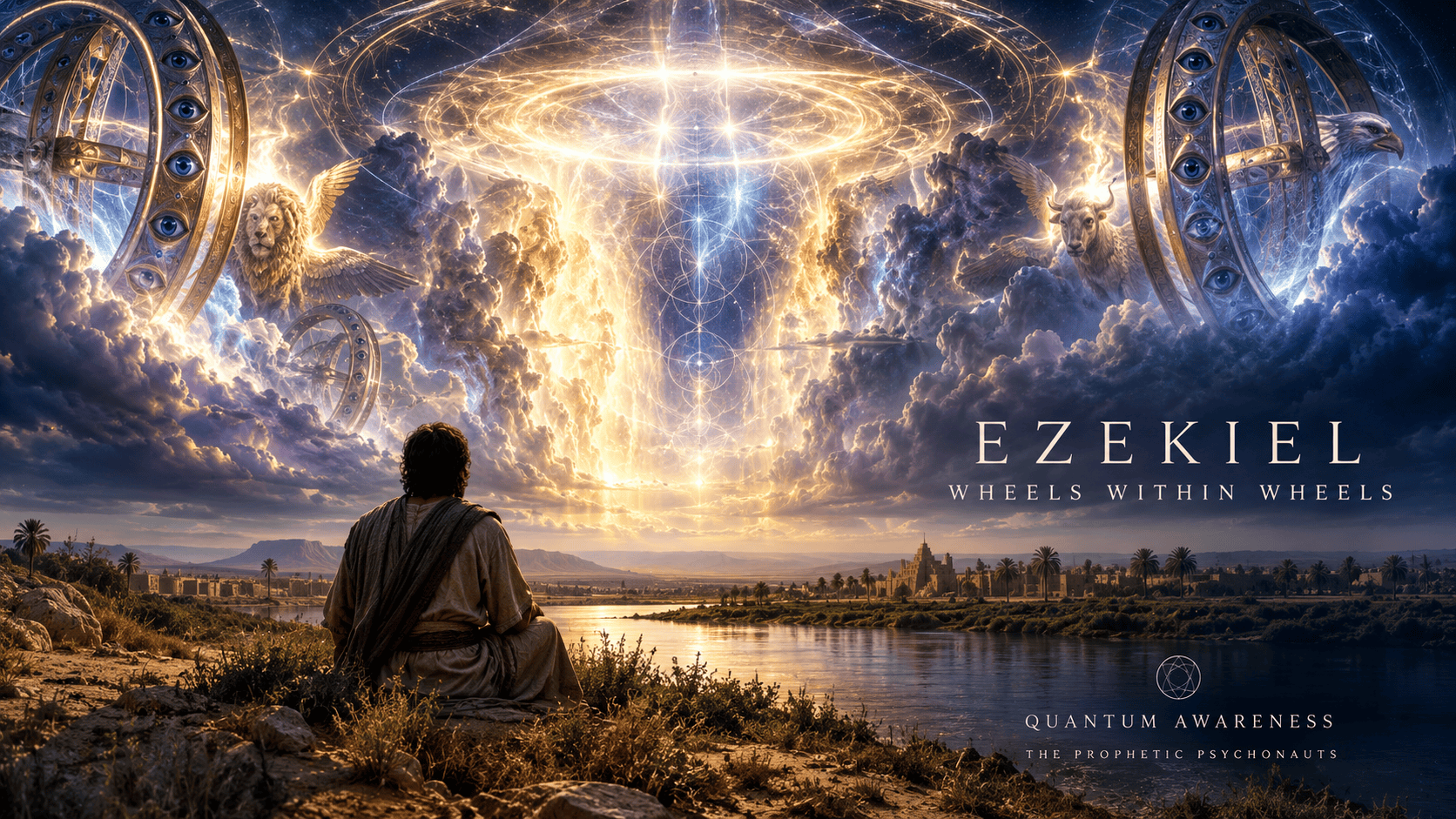
Was Ezekiel on DMT? Wrong question, almost. The right one is: why does a two-and-a-half-thousand-year-old vision match the specific phenomenology of a drug nobody synthesized until 1931 and nobody studied clinically until the 1990s — total environmental replacement, autonomous beings, geometry that watches you back?
A priest sits by a canal in Babylonia. Thirtieth year, fifth day, fourth month — the exact age a priest was ordained to begin Temple service. Except there’s no Temple. It’s a thousand kilometers behind him, and he’s a deportee beside a ditch dug by other exiles. Then the sky opens.
Please Watch Here
The Canal Is Real — Here’s the Correction to Make
The Bible calls it the river Chebar. For a long time that was unverifiable. Then Babylonian tax tablets from Nippur — dated 443 and 423 BCE — turned up a canal named naru kabari, literally “the great canal.” That’s a solid philological match: kabari to Chebar. A separate but related archive, the Al-Yahudu tablets, documents an actual nearby Judean exile settlement — tax payments in barley, land leases, inheritance disputes. Between the two archives, Ezekiel’s world is about as documented as an ancient prophet’s world gets. His neighbors left receipts.
Hold onto one detail: they paid taxes in barley, grown in the hot, irrigated soil of a southern Mesopotamian canal. It matters later.
✝ Christian Scripture · KJV
“Now as I beheld the living creatures, behold one wheel upon the earth by the living creatures… their appearance and their work was as it were a wheel in the middle of a wheel… As for their rings, they were so high that they were dreadful; and their rings were full of eyes round about them four… for the spirit of the living creature was in the wheels… This was the appearance of the likeness of the glory of the LORD. And when I saw it, I fell upon my face.” — Ezekiel 1:15–16, 18, 20, 28 (KJV)

Fire that folds into itself. Four beings, each with four faces — man, lion, ox, eagle. Wheels inside wheels, covered in eyes, moving without turning because “the spirit of the living creature was in the wheels.” The intelligence is in the machine.
⛏️ Archaeology · Babylon
At every Babylonian temple and palace gate stood the lamassu — colossal guardian figures combining a bull or lion’s body, an eagle’s wings, and a human face. Ezekiel walked past them constantly. His four-faced creatures are built from the visual vocabulary he was standing inside.
Why This Reads Like DMT, Not LSD
LSD distorts a world you’re still in — colors intensify, surfaces move, time stretches. Full replacement of reality is rare on LSD, and when it happens it feels dreamlike.
🔬 Science
Rick Strassman’s clinical DMT research at the University of New Mexico (1990–1995) documented something categorically different from LSD: not distortion of the room, but total departure from it — an autonomous, fully-formed alternate reality, populated by independent beings, built from precise mechanical geometry, and consistently reported as more real than ordinary waking life. Onset: fast, total, overwhelming (Strassman & Qualls, Archives of General Psychiatry, 1994).
Ezekiel’s canal doesn’t get strange. It’s gone. He’s somewhere else, entirely. The beings aren’t distortions of anything familiar — they’re doing their own work. The geometry is crisp and mechanical, not melting. And it watches: aware, eye-covered structure is one of the single most recognizable and strangest recurring features of the state Strassman documented. Ezekiel wrote it down twenty-five centuries earlier.
How Did He Get There? Four Strands, Honestly Weighted
Exile alone may be sufficient. Stanislav Grof mapped a state he called BPM II — total engulfment, entrapment, the conviction of a closed prison with no exit. That’s exile, precisely: Temple destroyed, homeland gone, the one role he trained for erased on the day he should have begun it. Grof documented that when BPM II breaks, it tends to break into the dissolution and rebirth of BPM III and IV — and Ezekiel’s book does exactly that arc, from crushing entrapment to the valley of dry bones rising back to life. This strand alone carries real weight; everything else sits on top of it.
The Persians were right next door. The Magi — Zoroaster’s own priestly lineage — had a documented visionary preparation called mang. In the Book of Arda Viraf, a holy man drinks it, journeys out of body for seven days, crosses a bridge, ascends past the stars, and returns with instructions for what he saw. Structurally, that’s a throne-ascent — Ezekiel’s vision, and Enoch’s after him. Candidates for mang include henbane or Peganum harmala (wild rue), sometimes mixed with wine or cannabis. Persia and Babylon were neighbors; within Ezekiel’s lifetime, Cyrus took Babylon. A working visionary technology, producing this exact phenomenology, sat one border away.
The barley is speculation, clearly labeled as such. Ezekiel’s community is documented eating canal-grown barley — exactly the growing conditions Claviceps purpurea, ergot, needs. Ergot is the source of lysergic acid, from which Albert Hofmann synthesized LSD in 1938. This is not proof. Accidental ergotism is poisoning, not a clean vision — convulsions, not clarity. But the conditions were right, and it’s his own community’s tax records, not a guess about where he lived.
🔬 Science
Antonopoulos et al. (Scientific Reports, 2026) reproduced the underlying chemistry: powdered ergot processed with nothing but lye made from water and wood ash converts its toxic compounds into psychoactive ones while leaving the deadly ones behind — tools any Iron Age household already had. The same practice is archaeologically attested 2,400 km away, at a shrine to Demeter and Persephone in Mas Castellar de Pontós, Spain: ergot residue found in a ceremonial vase and in the dental calculus of a 25-year-old man who had actually consumed it.
Not proof Ezekiel’s community used this. Proof the underlying method wasn’t exotic, local, or secret — it traveled with a religion across the ancient Mediterranean on nothing but ash and water.
The visual vocabulary was Babylonian, underneath all three other strands. The four-faced creatures are lamassu. The throne-chariot is Babylonian celestial iconography. A trained priest, dropped into the ancient world’s intellectual capital, almost certainly asked every question he could — and then had an experience total enough to take that borrowed imagery and reorganize it into something entirely his own.
In the Book of Arda Viraf, a holy man drinks Zoroastrian Mang, falls into a seven-day out-of-body journey, is led across a bridge to the world-mountain, ascends past the sphere of the stars into the realm of Ahura Mazda, is shown the secrets of life and death, and descends with instructions to tell the people what he saw. Once again, the Grof perinatal matrices show us the way in this future podcast episode as well.
The Tibetan Mirror

The tradition that mapped this territory from the inside calls the overwhelming light at the peak of the vision od gsal — Clear Light: the most fundamental nature of consciousness, met directly only in deep sleep, at death, or in advanced practice.
“Recognize these appearances as the natural radiance of your own mind. Do not flee.”
— Instruction for the Chönyi Bardo, Bardo Thödol
The eye-covered wheels are rigpa — awareness that knows itself, no separation between seer, seen, and seeing. The vision maps onto the Chönyi Bardo, the stage the Bardo Thödol describes after death, when reality appears as overwhelming, geometric, deity-populated display — with a precise instruction attached: recognize it as your own mind’s radiance. Don’t flee.
Ezekiel had no such instruction. He fell on his face. But the tradition that followed him — the Merkabah mystics, “those who descend into the chariot” — spent centuries using fasting and prescribed practice trying to go back on purpose. The first attempt in any Abrahamic tradition to turn one prophet’s accident into a repeatable technology.
The Honest Answer
Was Ezekiel on DMT, specifically? Unprovable, and this piece never claims otherwise. What’s provable: his vision matches a very particular modern phenomenology, not a generic one; his world is archaeologically real down to the canal; and at least one of the four candidate mechanisms — exile itself, entirely drug-free — may be sufficient on its own. The other three don’t need to be true for the first one to hold. They just make the case harder to wave off entirely. So I am not waving it off, and neither should you.
QP
Prefer to read? The full transcript is available below. But I recommend listening first – my delivery adds context that’s hard to capture in text.
SEASON 2 | THE PROPHETIC PSYCHONAUTS PP1 — ISAIAH: THE BURNING COAL COLD OPEN 00:00 [ GONG ] [ OM IN ] The year King Uzziah died. That is how Isaiah dates it. Not a season. Not a location. The year a king died and the ordinary world lost its anchor. The year a priest who thought he knew exactly what was in the Temple walked in and found something the Temple was never supposed to contain. What happened to him is six verses. Eight if you count the commission. They have been translated, retranslated, argued over, preached on, weaponised by institutions, and largely misunderstood for two thousand seven hundred years. We are going to read them differently today. Terror. Purification. Transmission. Commission. That is the structure. It holds across every prophet, king, and mystic this arc is going to walk through — different centuries, different traditions, the same shape underneath every single time. We are going to prove it, one account at a time. We begin with Isaiah. WELCOME BACK 01:10 Welcome back to Quantum Awareness — sound is emptiness, emptiness is sound. I’m QP, your Quantum Preceptor. We are inside the Prophetic Psychonauts Season Two. Encounter after encounter with the same territory. Different languages for what Grof and Strassman spent their careers developing the vocabulary to describe — and what the tradition behind this series has been mapping from the inside for two thousand five hundred years. I have to make a confession here. As a child, and even now as a Buddhist adult, I find these scriptures genuinely fascinating. Blasphemy aside ha ha ha , my Christian mother would be so proud of me quoting scripture online. THE HOOK 01:35 Last episode we closed The Church’s War Was Never on Drugs on a question we never actually answered: why would the institution built to protect this knowledge spend two thousand years trying to bury it instead? We named the four fronts of that war. We named the sacrament that bled out. We did not name why. Isaiah is where that question gets its first real test. And the evidence is sitting in the oldest parts of the Hebrew Bible — the Torah, the Prophets — accounts that survived not because the institution understood them but because they were too ancient and too central to remove. What wasn’t scrubbed clean. 02:36 What the sand and the scribes and the centuries left us. We now have something those scribes did not. Season 1 built us a vocabulary — the reducing valve, the superposition of states, quantum entanglement as non-local connection, the BPM framework, the entity encounter, the holotropic state. We have the psychological resolution to look at these accounts and say: this is what this is. But we also need to hold something. The prophets were working with the vocabulary available to them — Temple imagery, angelic categories, divine fire, the language of priestly ritual. That is not a limitation. That is their resolution. The same territory at a different pixel density. And then the accounts were translated. From Hebrew into Greek. From Greek into Latin. Into English. 03:27 Multiple times. Edited. Canonised by committees. Disputed by councils. What reached us passed through centuries of hands. We work with what we have. We are honest about the distance. Isaiah was not the first to encounter this territory. But he left one of the most precise accounts of what it feels like to get there — that wasn’t scrubbed, deleted from the record, or too heavily edited. SECTION 1: WHO WAS ISAIAH? 03:55 Isaiah was Not the High Priest. That matters. Isaiah was almost certainly from the aristocratic priestly class — scholars believe his family had connections to both the Temple hierarchy and the royal court. He advised kings. He had access to the inner sanctum that most Israelites never saw in their lives. He knew the Temple the way a surgeon knows an operating theatre — every instrument, every protocol, every rule about what belongs where and what absolutely does not. The Temple was his set and setting. Basic Perinatal Matrices step One or BPM I. 04:35 The container before the constriction begins. The womb of the encounter. He had been inside it for decades. He thought he knew what it held. He was wrong about what it contained. A stranger wandering in off the streets of Jerusalem might have been overwhelmed by the Temple itself. Isaiah was not. He knew it. Which is precisely why what was about to happen broke him completely. He knew the rules. The rules just stopped applying on his trip. SECTION 2: THE ENCOUNTER — Isaiah 6:1–8, KJV 05:02 Isaiah chapter six. King James Version. Read it slowly — this is a man straining language to describe something that his language was not built for. Verse 1: Note each verse gets its own Kling AI clip 05:15 >> “In the year that king Uzziah died I saw also the Lord sitting upon a throne, high and lifted up, and his train filled the temple.” Not the throne room. The Temple. The building he had served his whole life. Whatever is on that throne is so vast that its hem alone fills the room Isaiah is standing in. Verse 2: 05:38 >> “Above it stood the seraphim: each one had six wings; with twain he covered his face, and with twain he covered his feet, and with twain he did fly.” Seraphim — from the Hebrew saraph, to burn. Not decorative angels. Burning ones — beings of fire — simultaneously covering their faces, covering their feet, and flying. Three things at once. In the language Season 1 gave us: superposition. Existing in multiple functional states simultaneously. Verse 3: 06:16 >> “And one cried unto another, and said, Holy, holy, holy, is the LORD of hosts: the whole earth is full of his glory.” Call-and-response between beings not in physical contact yet perfectly coordinated. Entanglement. Non-local connection. And the word translated glory is kavod — in Hebrew: weight, physical density. The whole earth is full of His weight. Not an abstraction. A gravitational claim. Verse 4: 06:56 >> “And the posts of the door moved at the voice of him that cried, and the house was filled with smoke.” Tesla would not have called this miraculous. He would have called it frequency. Find the resonant frequency of the doorpost, sustain it, and the stone moves. The seraphim were vibrating the Temple at a frequency the structure could not hold. And the house filled with smoke. 07:24 You’ll remember from The Smoke Was the Sacrament — every temple in the ancient world was, functionally, hotboxing with god. Every priest, every initiate, every worshipper standing inside those walls was inhaling frankincense in sustained enclosed exposure, and the Johns Hopkins and Hebrew University researchers demonstrated in 2008 that incensole acetate — the primary compound in the resin — is genuinely psychoactive, activating the same neural channels associated with warmth and emotional regulation. In this reading — mine, not established scholarship — the smoke Isaiah walked into was not just atmosphere. It was preparation. BPM I, chemically assisted. The temple was not a metaphor. It was a technology. Empty first. Then look. Verse 5: 08:22 >> “Then said I, Woe is me! for I am undone; because I am a man of unclean lips, and I dwell in the midst of a people of unclean lips: for mine eyes have seen the King, the LORD of hosts.” The Hebrew word translated undone is nidmeyti. It does not mean destroyed. It means silenced. You know made voiceless. 08:45 The instrument of transmission has failed before the weight of what is being directly perceived. This is not Isaiah collapsing in guilt. This is a transmitter that knows its own bandwidth and knows it is not adequate for the signal that is arriving. Verses 6 and 7: 09:06 >> “Then flew one of the seraphim unto me, having a live coal in his hand, which he had taken with the tongs from off the altar: And he laid it upon my mouth, and said, Lo, this hath touched thy lips; and thine iniquity is taken away, and thy sin purged.” A burning coal. Taken with tongs from the altar fire. Laid upon his mouth. 09:30 Remember which altar. The most coherent reading is the same fire we just named in verse four — the incense altar, where the ketoret was burning. The formula is written down exactly, Exodus chapter thirty: stacte, onycha, galbanum, and pure frankincense, equal parts. That last ingredient is the one we already know about. The frankincense compound Johns Hopkins confirmed is psychoactive was, by the Temple’s own prescribed recipe, already filling the house with smoke in verse four. This is not a new substance suddenly introduced into the account. It is very possibly the same fire, touched to a different part of the body. He breathed it first. Now it touches his lips directly. And this was not exotic knowledge sitting centuries away in a court Isaiah never saw. 10:23 In 2020, archaeologists excavating a Judahite shrine at Tel Arad — inside Isaiah’s own kingdom, not a neighbouring empire — found cannabis residue burned directly on a stone altar, published in the Tel Aviv Journal of Archaeology. Not imported. Not something Isaiah would have needed to travel anywhere to encounter. It was already here, at home, on an altar. And it wasn’t only at home. 10:49 The Assyrian world next door was burning its own version of the same thing, in its own temples, in Isaiah’s own century, not a later one. The Akkadian word for it is qunnabu — pronounced KOON-ah-boo — and it’s very likely the direct linguistic ancestor of the word we still use today: cannabis. Judah spent most of his ministry as an Assyrian vassal, in constant contact with an empire that had this technology named and working. Isaiah’s own Temple had its own recipe too, prescribed in its own Torah, already burning the one ingredient we can verify — frankincense. 11:28 Between the altar in his own kingdom, the empire next door, and the smoke already filling his own Temple, the world around Isaiah had far more of this kind of knowledge close at hand than the account alone lets on. So the question about Isaiah’s coal shifts. In this reading — flag this as speculation, not scholarship — was the coal code? The same ketoret fire already filling the house in verse four, now concentrated onto a single point of contact? Nearly every documented entheogenic preparation across the ancient world produces a burning sensation at the lips before the opening begins. 12:10 I am following the pattern past the point where it stops being comfortable. You decide what that means. But hold this: the frankincense in that fire is not speculation. It is the Temple’s own prescribed formula, and it is measurably psychoactive. The coal is on the lips at the exact moment the transmission begins. I am not telling you what to conclude. I am telling you where the evidence now sits. Verse 8: 12:40 >> “Also I heard the voice of the Lord, saying, Whom shall I send, and who will go for us? Then said I, Here am I; send me.” The man who three seconds ago was certain he was voiceless — silenced, undone — says: send me. And this statement has consequence. Terror. Purification. Transmission. Commission. Isaiah was willing. 🎤 MID-EPISODE CTA: If you are still with me eight minutes into an episode about a burning coal on a prophet’s lips, you are exactly my audience. Subscribe — this is what we do here. This is an important point to reflect upon: a wise man’s instruction — show me everything, allow the process, don’t fight it, be willing to receive it all. The willingness to receive is the precondition for the commission. Isaiah arrived as a priest. He left as a prophet. The coal changed the category, not as a punishment but as a purification. This framing takes a bad trip and moves it into a truly different category of transformation. SECTION 3: THE GROF AND STRASSMAN MAPPING 13:55 You already know this map, but here we go again because it makes the whole point. Grof identified four Basic Perinatal Matrices — BPM I through BPM IV. BPM I: the primal unity. The good container. The Temple as Isaiah knew it — forty years of priestly practice. He walked in carrying BPM I. BPM II: the engulfment. The moment the container stops being safe. The train of the robe fills the room. The exaggerated enormity. The threshold of what is actually real has been crossed. BPM III: maximum constriction. Nidmeyti. Silenced. 14:38 The ego registers its own death — not metaphorically but as a lived, present-tense experience of complete inadequacy before what is being encountered. Grof documented this thousands of times. The structure was identical every time. BPM IV: the emergence. The coal. The threshold crossed. New identity. A commission that arrives after the dissolution and could not have been received before it. Now — the entity encounter. 15:09 I dont know if he saw aliens but we have got to take a look at this. Strassman’s DMT subjects consistently reported beings with specific roles, specific functions, that communicated purposefully. The seraphim in Isaiah’s account are doing a job. The tongs, the altar, the coal, the specific words after the touch. That procedural specificity is not the language of metaphor. It is the language of beings who have done this before. You cannot transmit to someone whose reducing valve is firmly closed and doing its filtering job. The coal had to come first. The purification precedes the commission — in every tradition, in every account in this arc. SECTION 4: THE TIBETAN MIRROR 15:55 Now we bring in the tradition that mapped this territory most systematically. Not to say Christianity is secretly Buddhism. Never that. To say: when you place the Tibetan vocabulary alongside Isaiah’s six verses, the precision is almost uncanny. The moment Isaiah says ‘I am a man of unclean lips’ — that exact moment — has a name in the Tibetan system. The recognition of the illusory body. In Tibetan: sgyu lus — pronounced Gyü-lü. Two syllables. Gyü-lü. The illusory body practice — one of the Six Yogas of Naropa — is the training by which a practitioner learns to see the constructed self as it actually is. Not solid. Not permanent. A luminous appearance arising from and dissolving back into awareness. Isaiah did not cultivate this over years of practice. It was forced on him. The presence on that throne was so overwhelmingly real that his ordinary sense of himself became, by contrast, transparent. Nidmeyti. Silenced. Not destroyed. Seen through. 17:02 Now here is something your mother may or may not appreciate. When Moses stood at the burning bush — another fire, another encounter, the same territory — he asked the name of what he was speaking to. The answer in the Hebrew: Ehyeh asher ehyeh. I am what I am. I am what I will be. The ground of being refusing to become a concept. Isaiah’s response is the mirror of Moses. I am a man of unclean lips. Not: I see God and I am terrified. But: I see what I am seeing and for the first time I recognise what I am — and what I am is not adequate to what I am directly perceiving. Two prophets. Same fire. Opposite recognition. Moses looks and hears: I am. Isaiah looks and says: this instrument is not enough. And in both cases — in this reading — the recognition is not of something outside themselves. It is of the nature of consciousness itself, seen directly, without the reducing valve running its usual compression. The seraph’s coal does not cleanse Isaiah’s sin in the moral sense the institution preferred. 18:16 It burns off the klesha avarana — the veil of afflictive habit — at the very instrument of transmission. What remains can now speak. Not from the constructed self. From what the constructed self was obscuring. Isaiah had no such tradition standing behind him. He was one of the first in line, with no vocabulary built yet for what was happening to him, no one to tell him what to expect or how to meet it. The tradition that eventually built exactly that vocabulary — an entire technology around this precise moment — was still centuries and a continent away. Which is exactly why the Dharma became so skilful at preparing the ground of the mind in advance. Not so the realisation would come easier. So that when it comes, for a trained practitioner, it can be received willingly and openly — not forced through, the way it was for a man with no warning and no guide. This is exacly why the Meditation and Buddha Dharma is so skillful in prepairing the ground of the mind so that when the realization comes it can be recieved willingly and openly. >> “Buddha-nature is not attained. It is recognised.” — Kalu Rinpoche, Luminous Mind 19:30 Isaiah 6, verse 5 is the moment of recognition. Not of God on a throne. Of the nature of mind — forced into view by an encounter so real that the constructed self became, briefly, transparent. And the sixth paramita — prajna, transcendent wisdom — cannot be transmitted through doctrine. Isaiah did not receive a doctrine in that Temple. He received a burning coal on his lips. A pointing-out instruction delivered in fire. What he then carried to the people for forty years was the best approximation that language could make of what the coal had done. The distance between the coal and the words is the distance every tradition struggles with. The Tibetan tradition built a technology for closing it. It is called the pointing-out instruction. Direct recognition, transmitted mind to mind, without the coal having to be literal. Isaiah received one. In a Temple. In 740 BCE. From a burning being with six wings who knew exactly what it was doing. CLOSE 20:42 OM music starts Here is the question this episode leaves us with. Christianity built its entire authority structure on what Isaiah brought back — the words, the prophecies, the imagery of throne and seraphim and the commission to speak. Twenty-seven hundred years of human history shaped by the transmission record. But the institution never went back for the coal. What preceded the words. What made the words possible. The direct encounter — the burning object on the lips, the purging of the obscuration, the moment the constructed self went transparent and what was underneath it could finally speak. What would Christianity look like if it had organised itself around the coal rather than the words that came after it? And here is the strange part. The institution never forgot the coal — not entirely. Go to an Orthodox liturgy today and listen to what the priest says the instant you receive communion: “Lo, this has touched your lips and has taken away your iniquity.” Isaiah 6:7. Word for word. The Communion spoon itself is called the Holy Tongs, after the seraph’s own. Saint John of Damascus, one of the great fathers of the Eastern Church, described receiving the sacrament as receiving Isaiah’s burning coal directly — fire on the lips, sins consumed, the communicant set alight. The words never left. In one form or another, some part of this civilisation has been reciting the coal over the congregation for most of twenty-seven hundred years. What left was the fire. 22:22 That question has no clean answer. But it is the question the Tibetan tradition answered differently. And across every episode that follows, we are going to see that same coal — same fire, different river, different century — appearing again and again. Next time: a priest sitting in exile by a canal in Babylonia. The sky opens. What he describes is the most precise account of what Strassman’s subjects reported seeing under DMT that exists in any sacred text on earth. Wheels within wheels. Eyes covering everything. Geometric beings moving in directions that ordinary space simply does not permit. Ezekiel was not a tourist. LATE CTA 23:10 If this landed — share it with one person who thinks the Bible is a history book. It is a lot of things. A field report from the edge of ordinary consciousness is one of them. Subscribe wherever you are listening. Ezekiel next. This is QP catch you next time. Sound is emptiness Emptiness is sound. [ GONG ] [ OM OUT ] 23:36Further Reading
Onsite:
Isaiah’s Consciousness, What Burns the Self Away: Isaiah’s Vision→
Episode 18: Moses, Jesus, Muhammad, Buddha→
The Smoke Was the Sacrament: The Oldest Human Science Season 2 Episode 1→
The War Was Never on Drugs (Pharmacy of Mind, Season 2 Ep 2) →
The primary sources behind was Ezekiel on DMT, free and in full:
- Strassman RJ, Qualls CR, Uhlenhuth EH, Kellner R. “Dose-response study of N,N-dimethyltryptamine in humans. II. Subjective effects and preliminary results of a new rating scale.” Archives of General Psychiatry, 51(2), 98–108 (1994). →
- Strassman RJ, Qualls CR. “Dose-response study of N,N-dimethyltryptamine in humans. I. Neuroendocrine, autonomic, and cardiovascular effects.” Archives of General Psychiatry, 51(2), 85–97 (1994). →
- Grof S. Realms of the Human Unconscious: Observations from LSD Research. Viking Press, 1975. →
- Pearce LE, Wunsch C. Documents of Judean Exiles and West Semites in Babylonia in the Collection of David Sofer (CUSAS 28). CDL Press, 2014. →
- Naru kabari / Chebar canal identification (Hilprecht) — sourced from reference-work summaries (International Standard Bible Encyclopedia, Jewish Encyclopedia)
- Antonopoulos R, et al. “Investigating the psychedelic hypothesis of kykeon, the sacred elixir of the Eleusinian Mysteries.” Scientific Reports, 16, 8757 (2026). →
- Bardo Thödol (Tibetan Book of the Dead) — Evans-Wentz (1927) and Fremantle & Trungpa (1975)
Leave a Reply