
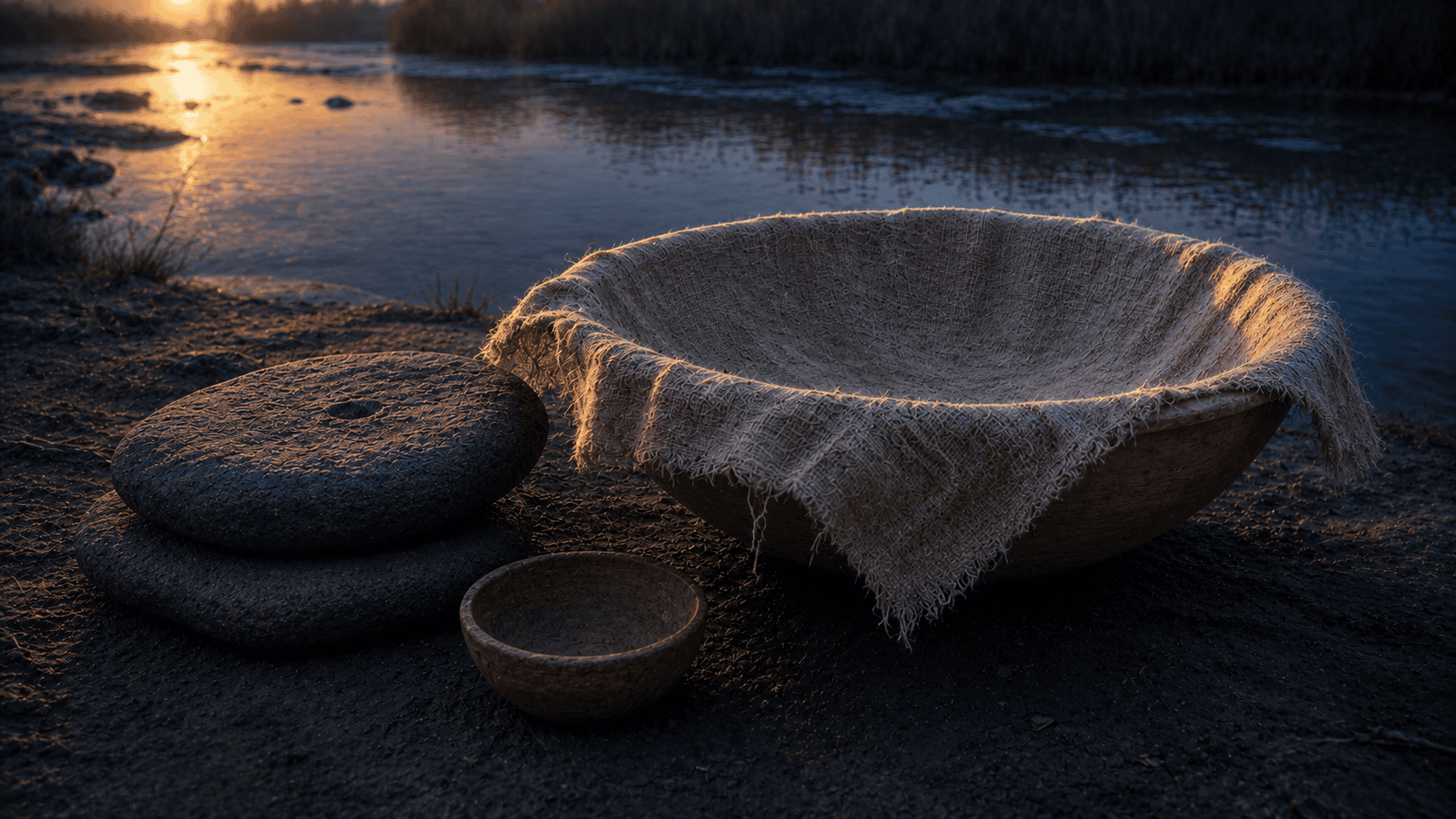
Every other post in this series has been forensics. Soma is the exception, and I did not expect it to be. Scraping a cup. Reading a manual nobody can use. Standing in a razed sanctuary trying to work out what was in the drink from the shape of the hole it left. In every case the tradition went quiet at exactly the moment you most want it to speak.
India wrote it down.
The supply chain. The shortage. The substitutes, in order of preference. The rule about who was still allowed the real thing. The myths composed afterwards to make the replacements respectable. And at the end of it, centuries later, a physician setting down in his own pharmacopoeia that nobody knew what the plant had been.
They kept the receipts.
Soma: The Plant, and the Report
Start where it starts. The Rigveda was most likely composed in the Punjab river system, and Book 9 of it — one hundred and fourteen hymns — is addressed to a single plant. Soma is the plant, the drink pressed from it, and the god. The word covers all three.
And somebody wrote down what it did.
— Rigveda 10.119 · trans. R.T.H. Griffith, 1896
🕯️ “Like violent gusts of wind the draughts that I have drunk have lifted me — Have I not drunk of Soma juice?”
“The five Tribes are no more to me than a mere mote within the eye — Have I not drunk of Soma juice?”
“The heavens and earth themselves have not grown equal to one half of me — Have I not drunk of Soma juice?”
“I in my grandeur have surpassed the heavens and all this spacious earth — Have I not drunk of Soma juice?”
That is a trip report. First person, three thousand years old, with a refrain that will not let you forget what caused it — the scale distortion, the grandiosity, the entire world reduced to a speck in the eye of somebody who has become enormous. Anyone who has read a modern account will recognise it before they finish the second line.
And the god who drinks the soma goes out and kills. Indra takes the soma and then slays Vritra and lets the rivers loose. The pressing hymns are war hymns.
There Was a Supply Chain
Here is the first thing nobody tells you. The soma did not grow where it was drunk.
In the Baudhayana Srautasutra, the officiating priest asks the seller whether the soma came from Mujavat. There is a named mountain source, a trade, a middleman, and a priest checking provenance at the point of purchase — written into the ritual manual, because it mattered whether you were being sold the real thing.
Then Mujavat starts to recede from the maps. By the Maitrayani Samhita it has become the frontier, the edge beyond which lies the unknown.
And something else was happening to the landscape at the same time. The Rigveda praises the Sarasvati as the greatest of rivers, mightiest of all — and the Sarasvati dried up. Not the Indus, which still runs. A different river, celebrated by name, now gone.
Tier 2 — My Framing
Put those together and a sequence suggests itself, and I want to flag that the sequence is mine and that each link in it is argued over separately. The river fails. The population shifts east into the Ganges plain. The distance back to Mujavat lengthens with every generation, the trade thins, and the mountain becomes first far away and then legendary. Nobody banned anything. Nobody burned anything. The road just got longer. The identification of the Sarasvati with the dry Ghaggar-Hakra channel is contested and politically charged in Indian archaeology, so take that piece lightly.
If They Cannot Get It: The Soma Substitution Ladder
And then, in the ritual literature, the soma priests write the sentence that no other tradition in this series ever wrote down.
— Satapatha Brahmana 4.5.10 · trans. Julius Eggeling, 1885
🕯️ “If they cannot get the Syenahrita, he may press Adara plants. If they cannot get Adaras, he may press brown Dub plants, for they, the brown Dub plants, are akin to the Soma: therefore he may press brown Dub plants. If they cannot get brown Dub plants, he may also press any kind of yellow Kusa plants.”
If they cannot get. If they cannot get. If they cannot get. A descending ladder, written into the liturgy, by the priests, for the priests, so that the rite could continue when the plant did not arrive.
The full order of preference for a soma substitute runs: the Phalguna plant with the red blossom, then the Syenahrta, then the Adara, then the reddish Dub, and at the bottom — any kind of yellow grass. Other Brahmanas add the putika creeper as a soma substitute, a dark grass called arjunani, millet, muñja grass, and more.
Now look at that list again and notice what governs it. Red blossom. Reddish Dub. Yellow grass. The ladder descends by colour.
They were not testing whether the replacement worked. They were checking whether it looked right. Which tells you, more clearly than any confession could, that the effect was already out of reach when the rule was written — and that what they were preserving by then was the appearance of the rite.
Two Rules That Give the Game Away
Two more details, and both are uncomfortable.
The Katyayana Srautasutra instructs priests not to give genuine soma to a Kshatriya or a Vaisya even when it is available. They get the juice of the fig instead. There would be no need for a two-tier system when the substance is benign, in writing: the real thing reserved to the priesthood, the substitute distributed downward, by rule, while stocks lasted.
This series has usually argued that priesthood is a safety technology — the people who hold the container so the door can be opened without wrecking anybody. That rule is the other face of it. Sometimes the priesthood is simply the last people with access.
And then the myths. Syenahrta is explained as a shoot that fell to earth when Gayatri was carrying the soma down. Adara took shape from the juice that sprang from the severed head of the sacrificial victim. Stories composed after the substitutions, to make them legitimate — the paperwork of a downgrade.
But here is the detail that redeems the whole record. The Brahmanas never pretend. They reserve the name Soma for the original plant and call these things its substitutes. They knew exactly what they were doing, and they said so in writing.
Nobody destroyed this. They filed it.
The Other Technology in the Same Book: The Kesin

There is a second thing in the Rigveda, and until recently I had no idea it was there.
Hymn 10.136, the Kesin hymn, is about people the priesthood did not run — and it sits in the same collection as the soma hymns.
— Rigveda 10.136, the Kesin hymn · trans. R.T.H. Griffith, 1896
🕯️ “The Munis, girdled with the wind, wear garments soiled of yellow hue. They, following the wind’s swift course, go where the Gods have gone before.”
“Transported with our Munihood we have pressed on into the winds: you therefore, mortal men, behold our natural bodies and no more.”
“The Muni, made associate in the holy work of every God, looking upon all varied forms, flies through the region of the air.”
“Vayu hath churned for him: for him he poundeth things most hard to bend, when he with long loose locks hath drunk, with Rudra, water from the cup.”
The Kesin are long-haired wanderers in dust-coloured rags, girdled with wind, homeless. They fly. They see all forms. And something is churned and pounded for them, and they drink it with Rudra — where Griffith’s decorous “water from the cup” renders a Sanskrit word that means poison.
Read verse three again, because it is a report and not a metaphor. Behold our natural bodies and no more. You can see the body. That is not where I am.
So the oldest text in the tradition contains two technologies of ecstasy, side by side. One is priestly: soma, pressed at the fire, communal, administered to you by specialists, and the reports are expansive and euphoric. The other is 10.136: solitary, wandering, outside the institution, a different substance, a different god — and the reports are flight and leaving the body behind.
Karel Werner calls the Kesin hymn the earliest evidence of yoga anywhere. Rudra becomes Shiva. And the line that begins here runs on through the wandering ascetics, the Shaiva orders, and eventually the Nath yogis — which matters at the end of this post more than it looks like it will.
Tier 3 — Speculation
What was in the cup with Rudra, nobody knows. I will name one candidate and then stop, because it is the only plant in this entire series that still kills people every year. Dhatura is a genuine poison and a deliriant — it produces flight sensations and the seeing of forms, with no accompanying sense that anything unusual is happening. It is offered to Shiva in Indian temples to this day, and Rudra is Shiva’s predecessor. That is a resemblance and a continuity, not evidence. I am not recommending anything and there is nothing safe here.
Soma Was Never a Plant
Which brings me to the thing that dissolved the whole problem for me.
Two centuries of scholarship have gone into asking which species soma was. Fly agaric, ephedra, cannabis, harmal, rhubarb, a dozen others have all been proposed as the soma plant. Nobody has settled it and the arguments have got no better.
But look at the word. Soma comes from the root su, to press. It means, quite literally, that which is pressed.
It is not a plant name. It is a process word.
And once you see that, the identification problem stops being a mystery and becomes a category error. Hillebrandt noticed more than a century ago that the Rigveda’s own descriptions of the plant do not agree with each other, as though several different things were already in use. Of course they were. Soma is not a species. It is what happens when you press something at the fire, strain it through wool, mix it, and sing over it.
I have written about this before without realising I was writing about soma. Dioscorides catalogues dozens of medicated wines: the vehicle stays constant, the active ingredient varies, and everything is called wine. Soma is the same structure, named one step further back — not for the vehicle but for the operation.
Nobody can identify soma because there was never one thing to identify. It was a functional slot, and the word says so.
Which changes what the ladder in the Satapatha Brahmana actually is. Not a decline from the real thing. The same practice continuing after the best available ingredient stopped arriving. If they cannot get the Syenahrita, he may press Adara plants — they kept pressing. The pressing was the point.
The Fire Moves Inside
And then the tradition does something that no other tradition in this series managed. It relocates.
In the Upanishads the sacrifice goes interior. The fire becomes internal, the breath becomes the offering, and knowledge does the work the pressing used to do. It is a complete migration of the technology from the altar into the body, and it happens over a few centuries in plain view.
The Katha Upanishad shows you what the new preparation looks like. A boy named Nachiketa is given to Death by his father in anger. He goes to Yama’s house — a living child at the door of the dead — and Yama is out. So he waits three nights without food.
When Yama returns he apologises for leaving a guest unfed, and grants three boons. Nachiketa spends the third boon on what happens after death. Yama deflects, offering wealth, sons, long life, chariots, dancing girls. The boy refuses every one of them. Only then does he get the teaching, and only then does he go home.
Selection. Fasting. A threshold. An autonomous being who tells him he should not really be there. Temptations refused, teaching received, and a return.
If that shape looks familiar it is because you have met it three times already in this series, in Persia and in Egypt and by a river in Babylon. Here it is in Sanskrit, with a fast at the front of it, in one of the oldest layers available.
The Vision With No Plant At All

Then, later still, the Bhagavad Gita, chapter eleven — and the substitution completes itself.
Arjuna asks to see Krishna’s true form. And Krishna tells him something the text does not have to say and says anyway: you cannot see this with the eyes you have. I give you a divine eye. The faculty has to be supplied from outside.
What follows is not serenity. A thousand suns bursting at once. The whole universe gathered in one body. Arjuna’s hair stands on end. He sees the warriors of both armies rushing into the mouths of the thing like moths into a fire. And then he breaks.
I have seen what was never seen before, and I am glad — and my mind trembles with fear. Show me again that other form.
He begs for it to stop. Krishna withdraws it and tells him not to be afraid.
That is not an enlightenment narrative. Nobody hands you awakening, nobody finds it unbearable, and nobody asks for it to be taken back. It is a hard passage, honestly recorded, by a tradition that could easily have tidied it and did not — which is exactly what Muhammad’s people did not tidy either, when they wrote down a man coming off a mountain shaking and asking to be covered.
And a few verses later the chapter says something that ought to stop this entire series in its tracks.
— Bhagavad Gita 11.48
🕯️ “Neither by the study of the Vedas, nor by sacrifices, nor by gifts, nor by rituals, nor by severe penances is this form of Mine to be seen in the world of men by anyone but you.”
Read the list. Vedic study. Sacrifice — which is the soma rite. Ritual. Austerity. Every technology this series has documented, named and ruled out. The text is saying that no method produces the vision, and that what Arjuna got was a gift.
I do not have an answer to that. I think it is the strongest thing anyone has said against the whole project of these ten posts, and it is said inside scripture by the tradition with the best receipts. I would rather put it in front of you than pretend I had not read it.
The Lens, Running Backwards
One more thing about chapter eleven, and it is not a coincidence.
When Robert Oppenheimer wanted language for what he had done in New Mexico, he took Krishna’s line from that same chapter — now I am become Death, the destroyer of worlds. And when Robert Jungk wrote the first serious history of the bomb in 1956 he called it Brighter Than a Thousand Suns, which is the same chapter again, eleven verses earlier.
I have argued in another post that a vision arrives and gets described in whatever machinery the visionary has. Ezekiel got wheels because a wheel was the most complex thing he had ever seen. The Sanskrit epics got chariots.
Here it runs the other way. The machinery arrived first, at Alamogordo, and there were no words for it — so the physicists reached back three thousand years and borrowed the vision.
Which proves the same thing from both ends. The experience and the vocabulary are separate systems. When you have nothing to say it with you borrow — forward from your machines, or backward from your scriptures.
Not Correctly Identified
And then the end of the line, in a medical text.
The Bhavaprakasha Nighantu is a standard Ayurvedic pharmacopoeia. It has an entry for somalata — the soma creeper. And the entry is headed with the note that the plant is not correctly identified.
Indian physicians, in their own reference work, in their own tradition, recording that they no longer knew what soma was. Not a foreign scholar. Not a critic. The people who inherited the pharmacy, writing it down.
Meanwhile ephedra is still sold in Indian markets under the name somalata. The name endured. The referent went.
They Lost the Ingredients

So here is the whole thing in five words, and they are not mine — they came out of a conversation and they are better than anything I had.
They lost the ingredients. They did not lose the technology.
That is what the receipts show. The pressing continued. The fire moved inside. The vision arrived without a plant in the room. What ran out was the supply, and the supply was never the technology — which is precisely what the word soma has been saying since the beginning.
And two and a half thousand years later, in the same watershed, somebody did the arithmetic properly.
The Brahmana priests substituted by resemblance. Red blossom for red blossom, and down the ladder to yellow grass. They preserved how it looked, which is what you do when you no longer know what it did.
Guru Nanak substituted by function. Take the still apart, he says, and I will tell you what each part is for: wisdom is the molasses, meditation is the fermenting flowers — the living agent, the thing that actually performs the transformation — good deeds are the bark, and love is the cup. He was not matching appearance. He asked what the apparatus was doing and rebuilt it out of things that cannot run out. And he said it to a yogi, in the yogi’s own technical vocabulary — a man from the line that begins in that hymn about the wind-girdled wanderers.
My own tradition is the odd case, and it took me all of this to see why. Nobody in the Vajrayana ever lost the ingredients, because there were none. What had to be carried was the operation, and the operation is a person. That is a fragile way to hold something and it is also the only way that walks. In 1959 it walked over a mountain pass, a hundred and sixty people, twenty-one days, with the texts and the relics on their backs.
You cannot lose the ingredients if the ingredient is a human being who has already been through it.
QP
Further Reading
On this site:
• The Recipe You’d Die For — Dioscorides, Dionysus and the Kykeon →
• Set and Setting — The Technology the Prophets Hid in Plain Sight →
• The Mithras Liturgy — A Procedure Without a Priest →
• The Villa Vesuvio Apotheke →
The primary texts, free and in full:
• The Kesin hymn, Rigveda 10.136, trans. Griffith →
• Satapatha Brahmana 4.5.10, trans. Eggeling →
Sound is Emptiness — Emptiness is Sound
Discover more from QUANTUM AWARENESS
Subscribe to get the latest posts sent to your email.
Leave a Reply