In 1996, on the outskirts of Pompeii, in a town called Scafati, archaeologists dug up a farmhouse and named it the Villa Vesuvio. Inside they found seven large vessels, and at the bottom of each one a dry organic crust — the residue of whatever had been in them on the day the mountain came down.
Then, for the most part, the story stops. The pots went into storage. They joined the enormous, silent inventory of things that have been excavated and catalogued and shelved, in a region so rich with buried material that the backlog is measured in decades.
The Greeks had a word for a place like that. Apothēkē — ἀποθήκη, from apo and tithēmi, to put away. A storehouse. A place for things set aside and kept. The Romans borrowed it as apotheca, the Germans still say Apotheke when they mean a pharmacy, and the English boutique comes down the same line, worn smooth by French.
So the pharmacy and the storeroom have always been the same word. Which is the joke this whole post is built on. The Villa Vesuvio was an apothēkē, and everything it produced is now sitting in another one.
But somebody did analyse one of those jars. What she found is the reason we are here.
[EMBED — Spotify player]
[EMBED — YouTube]
Prefer to listen? This post accompanies the episode.
The Villa Vesuvio: Seven Jars and a Yellow Foam
Seven vessels. Fifty species of plant. One yellow, foamy residue.
The Villa Vesuvio vessel that mattered held what the report describes as a yellow, foamy matrix — drug residue, dried and preserved. The archaeobotanist Marina Ciaraldi went through it and identified more than fifty species of plant material.
Most of the Villa Vesuvio residue is what you would expect from a working farm in Campania — willow, beech, peach, walnut, grapevine. Ordinary agricultural life, pressed and dried and preserved by catastrophe.
And then, in the same residue: opium poppy. Cannabis. White henbane. Black nightshade.
The last two are the ones to sit with. Both belong to the nightshade family and both carry tropane alkaloids. Black nightshade is a source of scopolamine, which does not produce pleasant visions but full deliriant states — the kind in which a person does not know that anything unusual is happening to them. These are not recreational plants. They are the heavy end of the European pharmacopoeia, the ones that reappear fifteen centuries later in the recipes for witches’ flying ointment.
And in the same Villa Vesuvio jar, lizard bones.
Tier 2 — My Framing
Reptile material turns up in ancient pharmacological and magical recipes across the Mediterranean, so lizard bones in a jar of this kind are not unheard of. What they were doing in this particular jar, nobody knows. I include them because leaving them out would be tidying the evidence, and the evidence is not tidy.
One more thing about the day the Villa Vesuvio jars were sealed. The greatest authority on plants in the Roman world was a few kilometres away when it happened. Pliny the Elder, who had catalogued the entire pharmacopoeia of the empire, was commanding the fleet at Misenum, took his ships toward the mountain to help, and died on the shore. His nephew watched from a distance and wrote it down.
🏛️ “Your request that I would send you an account of my uncle’s death, in order to transmit a more exact relation of it to posterity, deserves my acknowledgments; for, if this accident shall be celebrated by your pen, the glory of it, I am well assured, will be rendered for ever illustrious.”
— Pliny the Younger, Letters 6.16, trans. William Melmoth
The man who wrote down what every plant in the empire did was killed by the event that preserved a farm full of them. I have no argument to build on that. I simply cannot get over it.
The Excavator’s Own Verdict
Here is the part of the Villa Vesuvio story I want to be careful with, because it is where this kind of story usually goes wrong.
The conclusion that the Villa Vesuvio was a drug operation is not mine, and it is not a psychedelic enthusiast’s. It belongs to the person who did the analysis. Ciaraldi’s own summary, quoted in Brian Muraresku’s The Immortality Key, is that for her the Villa Vesuvio was a small farm specifically designed for the production of drugs.
That distinction matters more than almost anything else in this post. There is a whole genre of writing about the ancient world in which an outsider reads an archaeological report and finds in it exactly what he came to find. This is the opposite case. The specialist looked at her own data and reached the strong conclusion. The rest of us are only reading her.
What the Villa Vesuvio Does Not Prove
And now the other side of the Scafati case, at full strength.
When Muraresku presented this material at Harvard, the theologian Charles Stang accepted all of it — a potion maker near Pompeii, entirely believable, probably one of many — and then asked the question that has to be asked. What connects any of it to Christians? Nothing in those jars mentions a church. Nothing dates them to a ritual rather than a business. A farm producing pharmacologically active preparations in first-century Campania is a farm producing pharmacologically active preparations. It is not a communion cup.
Muraresku’s answer, in the room, was that the find is illustrative of the possibility.
I think that is the honest answer, and I think it is worth less than it is usually made to carry. The Villa Vesuvio proves the technology existed, that it was agricultural in scale, and that it was operating a few kilometres from a Roman city on an ordinary afternoon in AD 79. Scafati proves capability. It does not prove any particular use of that capability by any particular group. Hold those two apart and this evidence is unshakeable. Collapse them and you lose the argument to the first person who checks the footnotes.
What we can say is that people lived next door to it. Whatever the Villa Vesuvio was doing, somebody down the road could smell it on certain mornings and knew exactly what it was. And living beside an operation like that is either heaven or hell depending on who you are — a farm producing relief for the dying, or a farm producing something you would not want your children near. Probably both, depending which day you asked. It is the one thing about this site I feel certain of. It was ordinary. Somebody’s neighbour ran it.
The Villa Vesuvio Shelf
Which brings me to the part of the Villa Vesuvio story that actually keeps me up.
Seven vessels came out of the ground at Scafati. One was analysed. And the rest of what has come out of the Vesuvian region across two and a half centuries of excavation — the jars, the cups, the flasks, the unguentaria, the sealed vessels with crusts dried into the bottom — sits in storerooms.
This is not a scandal and nobody is hiding the Villa Vesuvio material. It is a resourcing problem, and beneath that an older one: for most of the history of the discipline, nobody thought to ask. If you do not believe the ancients were compounding psychoactive preparations, then drug residue in the bottom of a pot is just dirt. Dirt gets a line in the catalogue and a place on the shelf.
The material evidence for the Villa Vesuvio question is not lost. It is not suppressed. It is sitting in climate-controlled rooms, unscraped, waiting for somebody with a budget and a reason to ask.
That is a very different problem from the one this series has been describing. Everywhere else the technology was buried, legislated, cut from a canon, or simply allowed to stop. Here it survives — physically, chemically, in the actual drug residue — and the only thing between us and it is that the work has not been done.
When Somebody Finally Scraped One — Not at the Villa Vesuvio
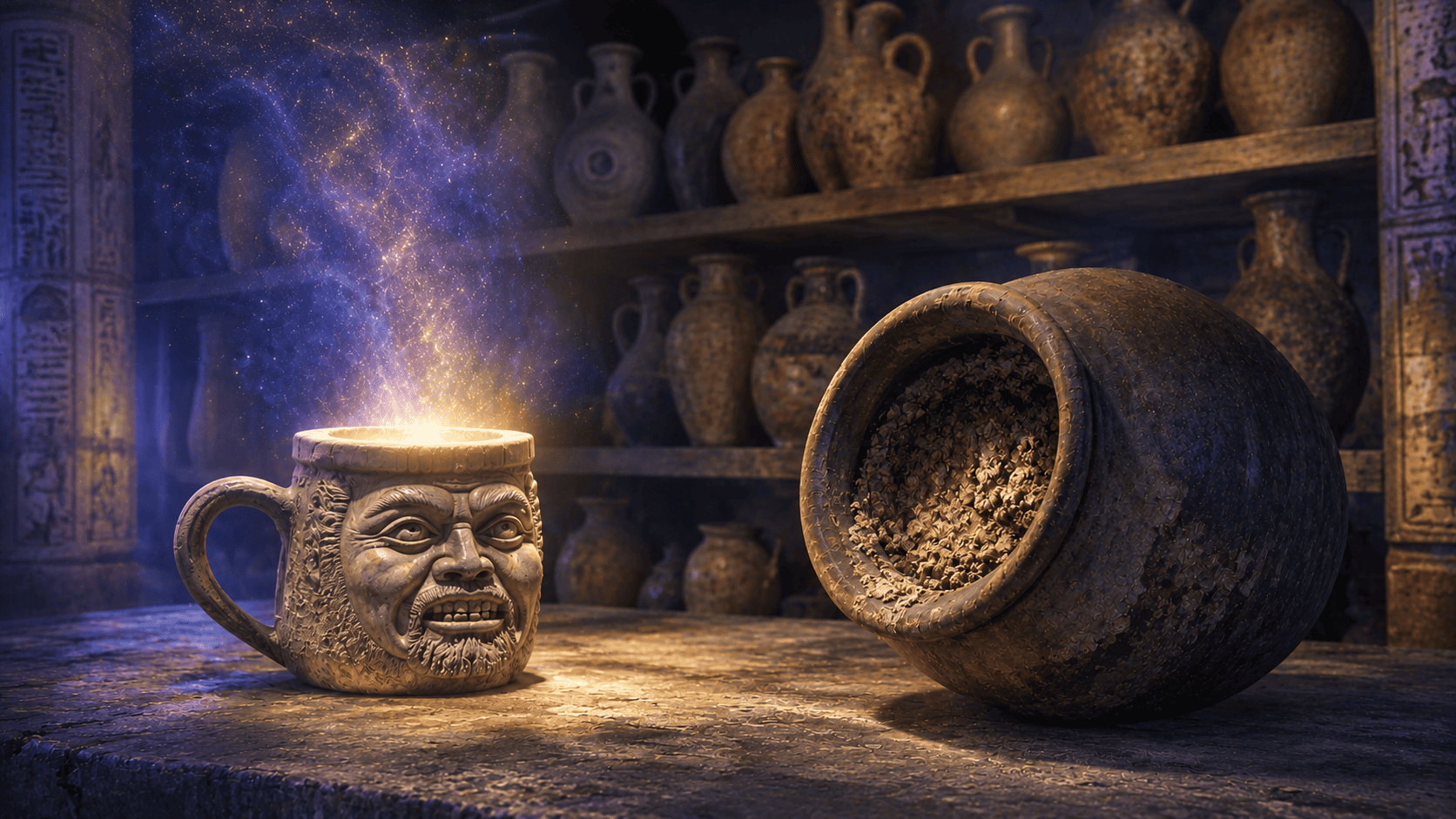
You drink from the god’s face. The cup is the temple.
And then, in 2024, somebody did — though not to a Villa Vesuvio jar.
Not at Scafati. In Egypt — or rather in Florida. A small ceramic drinking mug, four and a half centimetres high, a Bes vase, moulded in the shape of the god, donated to the Tampa Museum of Art in 1984 and sitting there unpublished ever since.
Science
🔬 In 2024 a team led by Davide Tanasi published a multianalytical study of this Bes vase in Scientific Reports. Drug residue was scraped from the inner walls and put through four independent methods — proteomics, metabolomics, ancient DNA metabarcoding, and synchrotron radiation-based infrared microspectroscopy — each cross-checking the others.
The DNA returned three plant families. In order of abundance: Nitrariaceae at about 64% of reads, Nymphaeaceae at 26%, and Cleomaceae at 10%. Combined with the chemistry, these resolve to Peganum harmala — Syrian rue — together with blue water lily (Nymphaea nouchali var. caerulea) and a plant of the Cleome genus.
The infrared work found crystallised harmaline directly in the sample. Alongside it: tartaric acid salts and fermentation yeasts, confirming a fermented fruit alcohol; honey or royal jelly; wheat and sesame; and, the authors argue, deliberately added human fluids.
Tanasi, D. et al., “Multianalytical investigation reveals psychotropic substances in a ptolemaic Egyptian vase”, Scientific Reports 14, 27891 (2024). Open access.
Syrian rue. Blue water lily. A Cleome species. A fermented fruit alcohol — most probably grape wine, though the specific wine markers were not recovered, so the authors stop short of saying so. Honey. And a sweetener, and a god’s face on the outside of the cup.
If that is not a Holy Grail, I do not know what is.
For decades Egyptologists had argued about what a Bes vase held — sacred water, milk, wine, beer, kohl, perfume, medicine. Nobody knew. An earlier study of twenty-three Bes vases recovered almost nothing: four gave results, all cattle protein. Then four analytical methods and one scraped cup, and we know what was in this one.
That is the proof of concept for every Villa Vesuvio jar still unopened. The method works. The drug residue survives. The information is recoverable. When somebody finally asked a cup what had been in it, the cup answered — and the answer was more specific, and stranger, than anyone had been willing to guess.
Tier 2 — My Framing
Two honest weaknesses, before anyone else raises them. First, the human fluids are the loudest finding and the least secure: blood rests on a single haemoglobin peptide, and the authors themselves note that most human protein in archaeological residue is contamination. Their control is a deamidation index that separates ancient protein from modern, which is real, but it is one peptide. Second, the date. The 2nd century BCE comes from the antiquities dealer who sold the mug in Cairo in 1960, and the paper states plainly that no documentation supports either the stated provenance or the dating. Egyptian origin is secure because the mould matches a mug from the Fayum. The century is a dealer’s word.
The Map
The black land. Four points on one river, six hundred years apart.
Now put the sites on a map alongside the Villa Vesuvio, and something uncomfortable happens.
The mould that made this cup also made a Bes mug from the El-Fayūm Oasis, in Middle Egypt. The Greek Magical Papyri came out of Thebes, further up the Nile. The Mithras Liturgy sends its reader to Menelaitis, in the Delta, to find a plant at the riverbank — and describes the ground it grows in as the regions of the black earth. That phrase is not decoration. Kemet, the black land, was what the Egyptians called their own country: the black earth of the Nile silt, as against deshret, the red desert. The writer thinks he is giving a soil type. He is giving the name of the nation.
Now add the neighbours. At Elephantine, on the southern frontier, a Jewish garrison community lived for generations and built its own temple to YHW; we have their letters, in Aramaic, from the fifth century BCE. At Alexandria, the Septuagint was translated in the third century BCE for one of the largest Jewish populations in the world. And far south at Soleb, in a temple list of Amenhotep III, Egyptian scribes recorded a people they called the Shasu of yhw.
Tier 2 — My Framing
Many scholars read that yhw as the earliest surviving appearance of the name Yahweh, cut into Egyptian stone in the fourteenth century BCE. Serious scholars accept it and serious scholars do not. I am reporting a live scholarly position, not a settled fact, and the whole Egyptian question looks different depending which way you go on it.
These are not parallel worlds. They are the same river, the same black earth, the same few hundred miles.
The Cup Is the Temple
And here is the thing I keep coming back to, a thousand miles from the Villa Vesuvio.
You drink from the god’s face. The vessel is moulded as Bes, which means that at the moment of ingestion the thing in your hands is the deity whose protection you are drinking for. Nobody had to build a temple around that. The cup is the temple.
Arda Viraf had a fire temple, seven nights of vigil, and three cups he did not pour for himself. Daniel had three weeks without meat or wine and the bank of a great river. This man had a cup with a face on it — the whole container reduced to something you can hold in one hand and lift.
And it was not private. Bes appears in Egyptian art as an attendant of Hathor, and Hathoric festivals involved deliberate mass intoxication: tomb scenes show banqueters drinking to get there as quickly as possible, and vomiting when they overshot. Sanctioned, communal, on a fixed day of the calendar. Set: you know why you are here. Setting: the festival, the crowd, and the god in your hands.
There is more. Bes was an incubation god. Consultants slept in the Bes Chambers at Saqqara to receive prophetic dreams, and at Abydos his oracle drew visitors for centuries — hundreds of them scratched Greek graffiti on the walls of the temple of Seti I, calling him the giver of oracles and the giver of dreams. And the harmala alkaloids in that cup are specifically oneirophrenic: they produce dream-like states. The pharmacology fits the practice.
It fits the god, too. Bes protected childbirth. Peganum harmala contains vasicine, which acts on the uterus. Cleome gynandra is used across Africa to promote labour. Two of the three plants in that cup do the thing Bes was for.
The god was not a decoration on the outside of the medicine. The god was a description of what the medicine did.
How Old Is the Recipe?
The tested cup is second century BCE, on a dealer’s word. That is the only dating we have.
But the Bes vase was produced, by the study’s own account, from around the sixteenth century BCE to the fifth century CE. Two thousand years of the same object. And Peganum harmala seeds have been found in Egypt from the pre-Dynastic period, thirty-seven centuries before the common era, at Maadi in the north; Cleome remains go back further still, to a Neolithic house at Nabta Playa around 6000 BCE. The plants were on the ground long before the cup was moulded.
And a recipe like this does not appear all at once. Look at what it took to arrive at: knowing that these particular plants do something, knowing which parts of them, knowing what carries them, and knowing what they do together — because a compound is not the sum of its parts, and the only way to find that out is to try it. Every one of those facts was bought by somebody. Some of them were bought expensively.
That is generations of accumulated trial before anyone could write anything down. And writing it down is the last step, not the first — the point at which a tradition has become confident enough in a formula to fix it. So the cup we tested is not the beginning of anything. It is a snapshot from somewhere in the middle of a very long process, and the process is older than the pot.
Tier 3 — Speculation
Here is the guess, and I am flagging it as a guess. If the vessel form held its function across those two thousand years, the compound could reach back to the New Kingdom — three and a half millennia. Nobody has tested a New Kingdom Bes vase. The researchers say they now want to test more mugs to find out whether the recipe holds, which means this is a speculation with an experiment attached to it. That is the best kind to make, and I will happily be wrong in public when the results come in.
Which raises a question I cannot leave alone. The Bes vase was already in use, by any chronology, during the period the Exodus is traditionally placed. And Bes was not an exotic mystery cult — he was the god of the household, protector of women in childbirth, of newborns, of infants, of people asleep. He was on the furniture. He was in the nursery. Bes imagery even turns up at Amarna, in the workers’ houses, during Akhenaten’s reign: the pharaoh abolished the state gods and the household gods stayed.
So split the question, because it has two halves and only one of them is hard. Did Moses know these vessels? If the man existed and grew up where the story says, then near-certainly, the way you know what a teacup looks like. That is not speculation. That is furniture.
Tier 3 — Speculation
Did he know what some of them held? Here I will tell you what I think and then tell you I cannot show it. I think he did. A man raised inside an Egyptian household, who later walks out of Egypt with a working knowledge of what a mountain encounter does to a person, did not learn all of that in the desert. But I have no cup with his name on it and I never will. If I wrote that as a finding rather than a conviction, I would be doing the exact thing this whole post exists to argue against.
The Tradition That Never Needed a Lab
Everything above — the Villa Vesuvio, the Bes vase, all of it — is forensics on drug residue.
Scraping, spectroscopy, DNA, a synchrotron in Trieste firing infrared light at four milligrams of powder from the inside of a cup. This is recovery work, and recovery work is what you do when something has already been lost. We are reverse-engineering a pharmacology from drug residue, because there is nobody left to ask.
There is one tradition where that was never necessary.
Tibetan medicine — Sowa Rigpa — compounds its formulas from dozens of ingredients, and it has never stopped. The recipes were not recovered; they were handed on. A physician learns them from a physician, who learned them from a physician, and the medicines are still made and still given. Nobody had to scrape a bowl in Lhasa to find out what was in it, because the people who know are still alive and still making it.
That is the whole difference this series has been circling. Not which plants. Not which cup. Whether the chain of people held.
And there is a limit to what the residue can ever give us, which no amount of budget will fix. We now know, with real confidence, what was in that Bes vase. We know the plants, the alcohol, the honey, the alkaloids crystallised on the clay. What we do not know, and cannot recover by any method, is what it was for — what the person holding it was trying to do, what they were told beforehand, what they understood afterwards, and who was in the room.
The residue will tell you what was in the cup. It will never tell you what the cup was for.
Six of the seven Scafati jars are still on a shelf near Naples. Somebody should go and ask them.



Leave a Reply