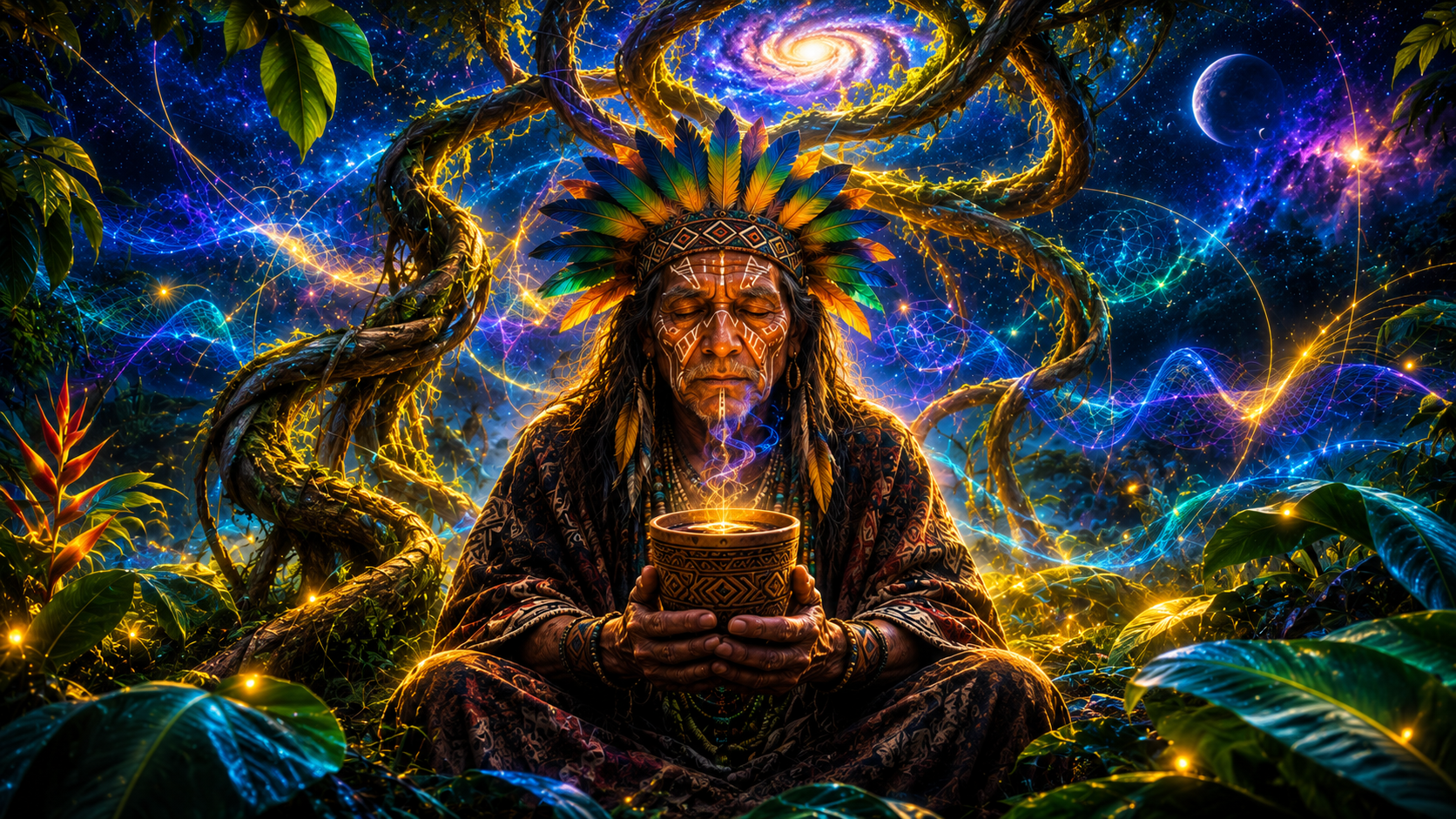
An Amazonian Santo Daime ayahuasca ceremony — the witchdoctor, the vine, and the sacred cup at the origin of the tradition

I Flew Through the Most Blue Sky I Had Ever Seen. And Came Home Unchanged. Podcast Episode 17

Years ago I sat in a Santo Daime ayahuasca ceremony in Amsterdam, did everything properly — the preparation, the lineage, the experienced hands ready to catch anyone who fell — and I flew through the most blue sky I had ever seen, with no body, just awareness.

Then I woke up the next morning and I was the same person. No hangover. No negative effects. And no enlightenment either.

This is the part of the psychedelic conversation almost nobody says out loud. The experience was real. It just wasn’t transformative. And the gap between those two words is the whole teaching.

The Man Who Went Into the Forest

The Amazon. Brazil. 1930. A rubber tapper named Raimundo Irineu Serra — the son of African slaves, a giant of a man nearly two metres tall — walked alone into the forest carrying a medicine the indigenous peoples of the region had used in ceremony for longer than any written record exists.

He stayed eight days. What happened there he described not as a vision or a hallucination but as a meeting — with a being he called the Queen of the Forest, who gave him hymns and a new understanding of the relationship between the wisdom of the Amazon, the Catholic tradition his ancestors had carried across the ocean in chains, and something that underlay both.

He came out with a religion. Santo Daime — the Holy Give-Me. Give me love, give me light, give me strength. It is still alive today, a recognised faith with legal protection in Brazil, and its sacrament is ayahuasca: the brew of the vine and the leaf.

The Vine and the Leaf: An Impossible Discovery

Start with the chemistry, because the chemistry is itself extraordinary. Out of roughly forty thousand plant species in the Amazon basin, the indigenous peoples of the region knew that two specific plants had to be combined. When Western scientists asked how, the answer came back consistent across cultures and generations: the plants told us. The alternative — blind trial and error across forty thousand species — is statistically almost impossible. Something guided the investigation.

In Tibetan Buddhist terms, every sentient being has Buddha nature; every sentient being is capable of awareness. The forest may know more than we have been prepared to hear.

The Spirit Molecule

In the early 1990s, the psychiatrist Rick Strassman at the University of New Mexico received the first regulatory approval in twenty years to run a psychedelic study in the United States. The compound was DMT. Across sixty volunteers, the reports came back consistent, structured, and profoundly strange: encounters with entities that felt independent, purposeful, and communicative — not projections of the subject’s own mind, but presences that seemed to know things. Strassman called DMT the spirit molecule.

The Tibetan tradition describes exactly such a threshold — the dissolution sequence at the moment of death, which we mapped through Grof across the last three episodes:

The earth element dissolves and the body grows heavy. The water element dissolves and the visual field hazes. The fire element dissolves and mirage-like appearances begin. The wind stops and the ordinary world recedes far above. Then the inner dissolutions — white light like moonlight, red light like sunrise, the darkness before the dawn. KALU RINPOCHE — LUMINOUS MIND

The molecule the Amazon has worked with ceremonially for centuries may be the same molecule the body produces at its most extreme edges. But the point is not whether the molecule works. It is whether the molecule is necessary. And the answer the dharma gives is the one it always gives: it depends entirely on what you are trying to build.

What I Found With Santo Daime

Flying through blue sky over the Himalaya after ayahuasca — no body, just awareness, the Matrix 4 breakthrough
No body. Just awareness. Flying. The experience was completely real — that was never the question. Extraordinary is not the same as transformative.

Many years ago I sat in a Santo Daime ceremony in Amsterdam. At that time, the church’s use of ayahuasca enjoyed legal protection in the Netherlands as a recognised religious sacrament. In Santo Daime the ceremony is called the Work — o Trabalho — and it was extraordinarily well organised. When a newcomer asked how the medicine compared to other substances, the lead woman smiled and said: “It has no comparison that we know of.”

We were seated around a central altar in concentric rings — a mandala, arranged with the precision of a liturgy that knew exactly what it was doing. The hymns began, the icaros: not improvised, not performed, but transmitted, handed down, earned. I was bored, so I began to meditate — which turned out to be exactly the right preparation. Then, as in church, we were called to the altar. A thick brown syrup the colour of dark molasses. We drank, and returned to our seats. Later, a second serving. And then I sank.

Into a deep, warm, dark hole — not frightened, but going deeper, the music now far above me like sound heard from beneath the ocean. And then, like a rocket, I was off. Flying through the most sunny and blue sky I have ever seen. When I say I, I mean my mind — there was no body.

Just the real me.

Just awareness, flying. A woman off to one side began to say, over and over, “Oh God, oh God.” Before I could even finish the thought, an experienced practitioner was already beside her, guiding her gently to a place to lie down. We were really cared for. That is what gets lost when the molecule leaves the ceremony.

DMT Didn’t Change Me

Now the part most people leave out. The next day I woke up and I was the same person. No hangover, no negative effects — as innocuous as a Sunday sermon. And I was not enlightened. This molecule leads nowhere. Not because the experience wasn’t real; it was extraordinary. But extraordinary is not transformative. Visiting a country is not living there.

A friend of mine — a practitioner — once became completely convinced, after an experience with ketamine, that he had been enlightened. He wanted me to try. I said no, but I suggested something better: ask your Lama.

🕯️ THE TEACHING

My friend described the experience to his Lama and asked whether it had been enlightenment. The Lama said: “Once enlightened — always enlightened. Do you feel enlightened right now?” My friend said: “No.” The Lama replied: “Well then — you have your answer.” Four words, no doctrine — just a question the student answered himself.

That is the teaching. That is the whole teaching.

What the Spirit Molecule Cannot Do: The Six Paramitas

Hands planting flowers in the garden of the mind — the Six Paramitas grown through daily practice, not through a molecule
The real Work is planting more flowers in the garden of your mind where once were only weeds. The molecule shows you the fruit; only practice grows the tree.

The molecule can give you the experience of every single Paramita — the feeling of boundless generosity, of perfect ethical clarity, of unshakeable patience, of joyful effort, of deep meditative stillness, and of the direct seeing of the nature of mind itself. But the Six Paramitas are not experiences. They are qualities of being, built through practice — the sustained, unglamorous, daily work of choosing the wider response over the reactive one, in relationship with other people, in the world. Not when you are high.

The molecule cannot be patient with your difficult colleague. It cannot choose the ethical response when the reactive one is easier. It cannot show up for someone who needs you on a Wednesday morning. Because the paramitas require others — they are built in the friction and the beauty of being alive in a body with other people, and that is exactly where the molecule cannot follow. The molecule can show you the fruit. Only practice grows the whole tree.

Santo Daime Ayahuasca and the Living Religion

What Irineu Serra built is one of the great religious syntheses of the modern world: the medicine held inside a framework of Catholic hymns, African spiritual traditions, and indigenous Amazonian knowledge, the daime received collectively as communion. In 2006 the question reached the United States Supreme Court. In Gonzales v. O Centro Espírita Beneficente União do Vegetal, the DEA had seized the sacrament of the UDV, and the church sued under the Religious Freedom Restoration Act.

The Court ruled for the church — unanimously, eight to nothing, with the newly-confirmed Justice Alito taking no part; Chief Justice Roberts, a conservative, wrote the opinion. The container was recognised even by the highest court in the land as the thing that separates sacrament from substance.

The protection is real but not permanent. In the Netherlands — where the ceremony I described took place — the Santo Daime church won recognition in the early 2000s, but in October 2019 the Dutch Supreme Court reversed roughly seventeen years of tolerance, ruling that the Opium Act took precedence over religious freedom, a decision later upheld by the European Court of Human Rights.

Nothing here should be read as a statement of current legal status anywhere. And one debt must be named: this medicine originated in the Amazon, in knowledge systems that developed the vine-and-leaf combination through a process Western science still cannot fully explain. The icaros are not background music; they are technology refined over generations. The lineage is the container without which everything dissolves.

The Real Work

So here is where we land. The Work in Amsterdam was a religious party — a beautiful one, a safe one, a genuinely loving one. But it was a party. One evening. One window. And anyone can have a good time with a molecule. The real Work is something else: being a Bodhisattva to someone who hates your guts, and doing it anyway; showing up week after week in your sangha; planting more flowers in the garden of your mind where once were only weeds. The technology of compassion has no shortcuts. The wisdom and merit you find is more than a party — and it lasts lifetimes.

The molecule opens the window. Practice plants the garden. You grow it yourself. On your own will.

Full Episode Transcript

Prefer to read? The full transcript is available below. But I recommend listening first – my delivery adds context that’s hard to capture in text.

[GONG] [OM CHANTING IN]

COLD OPEN

The Amazon. Brazil. 1930. A man named Raimundo Irineu Serra goes alone into the forest. He is a rubber tapper. The son of African slaves. A giant of a man — nearly two metres tall — who has been living and working in the Amazon for years. He has been introduced to a medicine that the indigenous people of the region have been using in ceremony for longer than any written record exists.

He goes into the forest alone with the medicine. He stays for eight days. What happens in those eight days he describes as a meeting. Not a vision. Not a hallucination. A meeting. With a being he calls the Queen of the Forest — a figure of extraordinary luminosity and compassion who teaches him.

Who gives him hymns. Who gives him a new understanding of the relationship between the indigenous wisdom of the Amazon, the Catholic Christian tradition his ancestors carried across the ocean in chains, and something that underlies both. Something that neither tradition had a name for but that both had always been pointing toward.

He comes out of the forest with a religion. Santo Daime. The Holy Give-Me. Give me love. Give me light. Give me strength. It is still alive today. Growing. Spreading. Recognised as a legitimate religion with full legal protection in Brazil and increasingly around the world. Its sacrament is ayahuasca — the brew of the vine and the leaf that the Amazon has been working with in sacred ceremony for centuries beyond counting.

I have sat in the Work with this medicine. And I want to tell you something that most people in this conversation never say. It didn’t change me. Not one bit.

WELCOME BACK + EARLY CTA

Welcome back to Quantum Awareness — Sound is Emptiness, Emptiness is Sound. I’m QP, your Quantum Preceptor. Before we begin — if this episode opens something — please hit subscribe so the next one finds you. If you have been with us through the last four episodes you already know the territory we are in. And if this is your first time — welcome. No prior knowledge needed. Just an open mind and perhaps a quiet room.

SECTION 1: THE VINE AND THE LEAF — THE IMPOSSIBLE DISCOVERY

Let me start with the chemistry before the ceremony. Because the chemistry of ayahuasca is itself extraordinary — and understanding it makes everything that follows more precise. Ayahuasca is a brew made from two plants. The vine — Banisteriopsis caapi, the ayahuasca vine itself — and the leaf Psychotria viridis, known as chacruna. Neither plant produces the full effect on its own.

The chacruna leaf contains DMT — dimethyltryptamine. A powerful psychedelic compound. But DMT is broken down almost immediately by enzymes in the gut — monoamine oxidase — before it can reach the brain. Taken alone, orally, it produces almost nothing. The vine contains harmala alkaloids. These are natural monoamine oxidase inhibitors. They block the enzymes that would break down the DMT. Suddenly the DMT reaches the brain. Suddenly the valve opens.

For this specific combination to have been discovered — out of forty thousand plant species in the Amazon basin — the indigenous people of the Amazon had to know, through a process of investigation that would have taken generations, that these two specific plants needed to be combined.

When Western scientists asked Amazonian shamans how they discovered this specific combination — the shamans gave a consistent answer. The plants told us.

This answer has been dismissed, noted with curiosity, and increasingly taken seriously. Because the alternative — that this specific combination was discovered by trial and error from a pool of forty thousand species — is statistically almost impossible.

Something was guiding the investigation. In Tibetan Buddhist terms — every sentient being has Buddha nature. Every sentient being is capable of awareness. The forest may know more than we have been prepared to hear.

SECTION 2: RICK STRASSMAN AND THE SPIRIT MOLECULE

In the early 1990s a psychiatrist named Rick Strassman at the University of New Mexico received the first regulatory approval in twenty years to conduct research with a psychedelic compound in the United States. The compound was DMT. Strassman administered intravenous DMT to sixty volunteers in a carefully controlled clinical setting. The sessions were brief — the effects of intravenous DMT last approximately fifteen minutes — but what his subjects reported was consistent, structured, and profoundly strange.

They reported encounters with entities. Beings. Intelligences that seemed independent, purposeful, and communicative. Not hallucinations that felt like projections of the subject’s own mind — but presences that felt genuinely other. That offered information the subject had not anticipated. That seemed to know things. Strassman called DMT the spirit molecule. His book of the same name is the most important scientific account of DMT’s effects ever written.

He also proposed a hypothesis that remains unproven but deeply interesting — that the pineal gland produces endogenous DMT. That the body manufactures its own version of the molecule that ayahuasca delivers from outside. That the experiences of deep meditation, of the threshold of sleep, of the moment of death — may involve the natural release of endogenous DMT. The valve opening from the inside.

The Tibetan tradition describes the dissolution sequence at death — the progressive withdrawal of awareness, the arising of visions, the recognition of the Clear Light. We covered this in the last three episodes. Strassman’s hypothesis suggests a neurochemical mechanism for exactly this sequence. The molecule the Amazon has been working with ceremonially for centuries may be the same molecule the body produces at its most extreme thresholds. The forest may have known this long before the laboratory did.

But here is what matters for this episode. If the body can produce this molecule naturally — in deep meditation, at death, in the most profound moments of contemplative practice — then the question is not whether the molecule works. The question is whether the molecule is necessary. And the answer the dharma gives is the same answer it has always given. It depends entirely on what you are trying to build.

SECTION 3: WHAT I FOUND THERE

Many years ago I sat in a Santo Daime ceremony in Amsterdam. At the time, the church’s use of ayahuasca enjoyed legal protection in the Netherlands as a recognised religious sacrament. I want to tell you what that container felt like from the inside.

In Santo Daime the ceremony is called the Work — o Trabalho. That word is deliberate. It is not a party. It is not a retreat. It is work. Sacred, intentional, communal work. The Work was extraordinarily well organised. Before anything began, several experienced women from the community held a question-and-answer session with those of us who were new.

Every question was met with patience and care. And one answer in particular has stayed with me. Someone asked how the medicine compares to other substances they might have heard of. The woman smiled and said: “It has no comparison that we know of.”

After the questions, we were personally directed to our seats by the lead woman of the ceremony. In the centre of the space was an altar. Around it — concentric rings of seating. Women on one side. Men on the other. The symmetry was deliberate. It was a mandala. The space had been arranged with the precision of a liturgy that knew exactly what it was doing.

The music started. Hymns. Sung in Portuguese. The icaros of the Santo Daime tradition — not improvised, not performed, but transmitted. Handed down. Earned. And then we sat with the music. For a long time. I want to be honest with you. I was so bored. I sat there and I was bored out of my mind, so I thought I should use the time in a better way, and I began to meditate.

Which — as it turned out — was exactly the right preparation for everything that followed. This was Matrix 1. The oceanic state. The womb before anything begins. Warm, undifferentiated, the ordinary world still intact. The music holding the space. Nothing breaking open yet. Just waiting.

Then, just as in church, we were called to the front for the first time. A man and a woman stood at the altar. They poured small shot glasses of a thick brown syrup. The colour of dark molasses. We received it. We drank. We returned to our seats. The music started again.

Another long round. I returned to my meditation. Still in the warmth. Still held. Still Matrix 1 — the ceremony doing its quiet work before anything moves. When we were called to the front a second time, they looked me sternly in the eyes and asked if I wanted more. Another shot glass. The same thick brown syrup. We received it. We drank. We returned to our seats.

Then a woman came around with a plate. Not the offering plate you are used to from church. A plate with baseball bat-sized joints — pure, perfectly rolled. She carried a lighter. Three puffs. Pass it on. And then I sank. Into a deep dark hole. Warm.

Not frightened. But deep. Like being suspended in the thick brown fluid I had just swallowed. The music was still playing but it was far above me now. Very far above me. Like hearing music from the surface of the ocean when you are deep below it. Matrix 2. Grof’s constriction. The no-exit state. The universe as a container with no way through and no way back. Warm and dark and going deeper.

And then — just like a rocket — I was off. Matrix 3. The breakthrough. The titanic struggle giving way. Out of the thick fluid. The cervix opening. The battle that cannot be avoided and cannot be lost. Flying through the most sunny and blue sky I have ever seen. And when I say me — I mean my mind. There was no body. Just the real me. Just awareness. Flying. Matrix 4. Emergence. The old self dissolved. A new relationship with existence beginning. Light. Space. The first breath.

There were waves of flying with short breaks — opening my eyes to the congregation around me. They were all there. All present. All somewhere in the same territory, each in their own way. Hands in the air. Bodies slowly moving in the music.

There was a woman off to one side. She was having either a very good time or the medicine had come too strong and too fast for her. “Oh God, oh God, oh God,” she said. Over and over. Before I could even finish the thought — one of the experienced practitioners was already there. Already beside her. Already guiding her gently to a safe space where she could lie down. We were really cared for. That is what gets lost when the molecule leaves the ceremony.

The flight slowly landed in a song. Hands in the air. Bodies swaying. The music guiding us back. I grew up in a Pentecostal church in Western Canada. I had seen people with hands in the air, bodies slowly waving, the music carrying them somewhere. I knew what it looked like. This was more real and more honest than anything I had ever seen in church. Then there was tea and snacks as we all chatted afterward. It was abundantly clear that what I had received was a sacrament. Like taking communion. Just — not wine and crackers.

Now I want to tell you the part of the story most people in this conversation leave out. The next day I woke up and I was the same person. No hangover. No negative effects. As innocuous as a Sunday sermon. The container had been everything I could have asked for. And I was not enlightened. I was not even a better person because of the experience.

Maybe if I had understood the songs — if the language had been mine, if the tradition had been mine, if years of practice had prepared the ground — something might have taken root. But it didn’t. This molecule leads nowhere. Not because the experience wasn’t real. It was real. But extraordinary is not transformative. Visiting a country is not living there.

I want to tell you one more story. A friend of mine — a practitioner, someone on the path — had an experience with ketamine. Horse tranquilisers. And he was convinced. Completely, genuinely convinced that he had been enlightened. He wanted me to try. I said no way. But I suggested something better. I said — ask your Lama. He agreed. He went to his Lama and described the experience. He asked whether what he had encountered was enlightenment.

The Lama looked at him and said: “Once enlightened — always enlightened. Do you feel enlightened right now?” My friend said: “No.” The Lama replied: “Well then — you have your answer.” Four words. No lecture. No doctrine. Just a question the student answered himself. That is the teaching. That is the whole teaching.

SECTION 4: THE SIX PARAMITAS — WHAT THE MOLECULE CANNOT DO

Here is what I have come to understand. The molecule can give you the experience of every single Paramita. The feeling of boundless generosity — Dāna. The vision of perfect ethical clarity — Śīla. The state of absolute patience in which nothing disturbs you — Kṣānti. The effortless joy of joyful effort — Vīrya. The stillness of deep meditation — Dhyāna. And the direct seeing of the nature of mind itself — Prajñā.

But the Paramitas are not experiences. They are qualities of being that are built through practice — through the sustained, unglamorous, daily work of choosing the wider response over the reactive one, in relationship with other people, in the world. Not when you are high. The molecule cannot be generous for you. It cannot be patient with your difficult colleague. It cannot choose the ethical response when the reactive response is easier. It cannot show up for someone who needs you on a Wednesday morning.

Because the Paramitas require others. They are built in the friction and the beauty of being alive in a body with other people. And the world — the ordinary, difficult, beautiful, demanding world — is exactly where the molecule cannot follow. This is why the experience left me unchanged. Not because the experience wasn’t real. But because Dāna and Śīla and Kṣānti and Vīrya and Dhyāna and Prajñā are the expression of Bodhicitta — the awakened heart-mind — in action. In the world. In relationship. Every day. The molecule can show you the fruit. Only practice grows the whole tree.

SECTION 5: SANTO DAIME AND THE LIVING RELIGION

What Raimundo Irineu Serra built from those eight days in the forest is one of the most extraordinary religious syntheses of the modern world. Santo Daime holds the medicine inside a framework of Catholic hymns, of African spiritual traditions, of indigenous Amazonian knowledge. This is a living religion with a lineage, a community, a set of ethical commitments, and a sacramental practice refined over nearly a century.

In 2006 a case reached the United States Supreme Court. Gonzales versus the UDV — the União do Vegetal, another Brazilian ayahuasca church. The DEA had raided their church and seized their sacrament. The UDV sued under the Religious Freedom Restoration Act.

The Supreme Court ruled unanimously in their favour — eight to nothing, with the newly-confirmed Justice Alito taking no part in the case. Even a conservative Chief Justice wrote to protect the sacrament. The container — the religion, the lineage, the ceremony, the community — was recognised even by the highest court in the land as the thing that made the difference between sacrament and substance. The law understood what the dharma has always known. The medicine and the container are not separable.

SECTION 6: THE DEBT AND THE RESPECT

Before we close I need to say something clearly. The medicine we have been discussing originated in the Amazon. In the knowledge systems of indigenous peoples who developed the specific combination of vine and leaf from forty thousand possible species through a process of investigation that Western science still cannot fully explain.

The Amazonian traditions are not a delivery mechanism for compounds that Western science then validates. They are complete systems of understanding consciousness, healing, and the relationship between human beings and the living world. They deserve to be named. Credited. The icaros are not background music. They are technology refined over generations. The lineage is the container without which everything dissolves. That is what gets lost when the molecule leaves the ceremony and hits the streets.

CLOSE — THE REAL WORK

So here is where we land. A vine and a leaf. Two plants out of forty thousand. A living religion built in the Amazon that won a unanimous Supreme Court decision on religious freedom. And one practitioner from Western Canada who sat in the Work in Amsterdam and flew through the most blue sky he had ever seen. And came home unchanged.

Now let me come down from this pulpit and tell you what I really think. The Work in Amsterdam was a religious party. A beautiful one. A safe one. A well-organised and genuinely loving one. I mean no disrespect to Santo Daime — the tradition is real, the container is honourable, the people who held the space were extraordinary. But it was a party. One evening. One experience. One window. And anyone can have a good time with a molecule.

The real Work is something else entirely. The real Work is being a Bodhisattva to someone who hates your guts. But you do it anyway — because you promised your Lama. Because the path asked. Because the person in front of you needs it even when you don’t feel like giving it. The real Work is showing up week after week in your sangha. Meditating. Keeping your centre or temple clean. The real Work is planting more flowers in the garden of your mind where once were only weeds. The technology of compassion has no shortcuts. The wisdom and merit one finds is more than a party. And it lasts lifetimes.

TRANSITION TO SEASON 2

And that — right there — is where Season 1 ends. We started with physics. We moved through psychology. We arrived at the modern pharmacology of mind. And at every stop along the way, the same thing kept happening — science kept finding what the dharma already knew. The molecule cannot do what practice does. That was always the point.

Season 2 is going to take everything we have discussed and walk it backward in time. We are going to the Silk Road — and I don’t mean the dark net website. I mean the actual Silk Road. A road where goods travelled, yes — but also where plants travelled. Where medicines travelled. Where ideas and teachers and entire religious traditions crossed borders far more freely than we tend to want to believe. The story of consciousness did not begin in the twentieth century. It began much further back. And the pharmacy was always open.

If this episode landed — share it with one person who needs to hear that the real Work begins after the party ends. Subscribe wherever you listen. This is QP. Sound is emptiness. Emptiness is sound. Thank you for Season 1. Catch you next time.

[GONG] [OM CHANTING OUT]

Sound is Emptiness — Emptiness is Sound

Episode Runtime: Approximately 26 minutes

Further Reading:

Internal links:

1: EP16 — The Cartographer of Inner Space (direct predecessor)

2: The Six Paramitas page

3: Bardo — The Intermediate State (dissolution sequence)

External Reading:

1: Wikipedia — Santo Daime

2: Wikipedia — Rick Strassman

3: Wikipedia — Gonzales v. UDV (2006)


Discover more from QUANTUM AWARENESS

Subscribe to get the latest posts sent to your email.


Comments

Leave a Reply

Discover more from QUANTUM AWARENESS

Subscribe now to keep reading and get access to the full archive.

Continue reading