
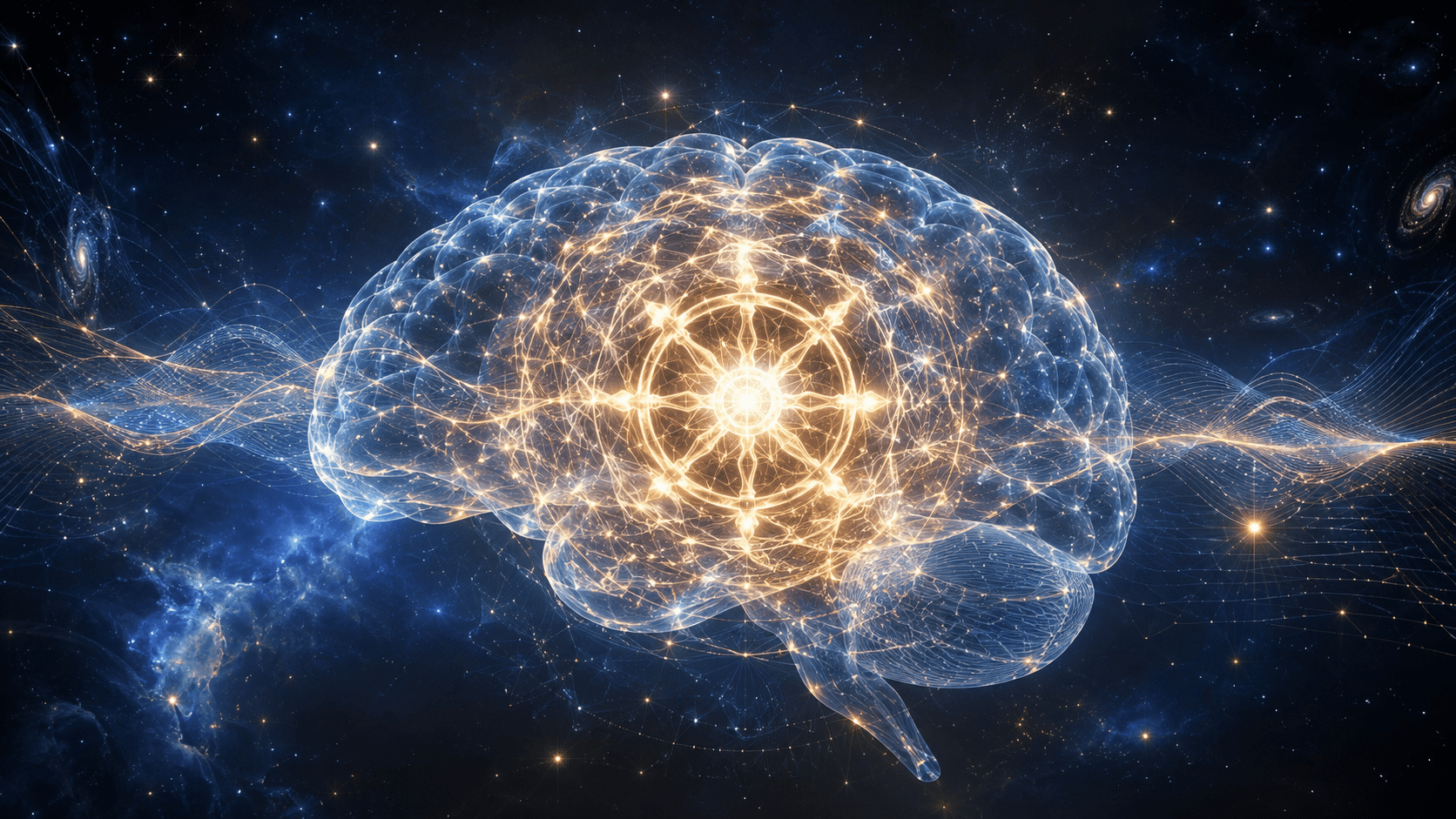
Orch-OR theory — Orchestrated Objective Reduction, proposed by Roger Penrose and Stuart Hameroff — is one of the most ambitious attempts in modern science to explain where consciousness actually comes from. The theory proposes that consciousness emerges from quantum processes within microtubules, tiny structures inside brain cells, and that these quantum states collapse in a way that produces conscious experience. What I find genuinely remarkable is that Buddhist philosophy, particularly the Yogacara school and the principle of dependent origination, arrived at a structurally similar conclusion through an entirely different method — not mathematics, but meditation and direct inquiry. Two traditions, separated by centuries and culture, circling the same truth.
Orch-OR Theory and Buddhist Dependent Origination — A Surprising Convergence

The theory proposes that consciousness emerges from quantum processes within microtubules, tiny structures found in brain cells. These quantum states, according to the theory, collapse in a way that leads to conscious experience. Interestingly enough, Stuart Hameroff has suggested that plants and trees, which also have microtubules, likely possess a form of consciousness, albeit at a lower intensity or frequency. This statement tends to form at least partial support for my favorite theory, panpsychism, a topic I have discussed often here and also here.
Integrating this very interesting scientific theory with Buddhist theories of consciousness and dependent origination gives us a fascinating view between traditional science and eastern wisdom traditions. Orch-OR posits that consciousness arises from interconnected quantum processes, resonating with the Buddhist principle of dependent origination, which states that all phenomena are interconnected and arise from conditions and dependencies. This perspective suggests that consciousness is intertwined with the fundamental fabric of reality, very similar to how Buddhism views all phenomena as interconnected. The original Orch-OR framework is outlined in Penrose’s The Emperor’s New Mind and developed further in Hameroff’s published research.
What I find so compelling about this is the way impermanence weaves through both frameworks. The transient, flickering nature of quantum states within microtubules maps beautifully onto the Buddhist concept of anicca — the simple but radical truth that nothing stays the same. In both views, consciousness isn’t a fixed thing sitting somewhere in the brain waiting to be found. It’s more like a river — a dynamic, ever-moving flow where one state dissolves into the next, giving rise to perception, emotion, and experience before returning to some deeper ground. I think that’s a genuinely profound point of contact between these two very different traditions.
Yogacara and the Emergent Mind – Buddhism’s Process Philosophy

Here’s where it gets even more interesting for me personally. Orch-OR theory suggests that consciousness bubbles up from quantum events happening at the tiniest scales of brain structure — the very bottom of the physical world as we understand it. And when I look at a particular school of Buddhist philosophy called Yogacara, I find something surprisingly similar: the idea that consciousness arises conditionally, through a web of interdependent processes rather than from any single source or location. There’s no little homunculus running the show. It emerges.
Yogacara is arguably the most process-oriented of the Buddhist schools, which is probably why it feels like such a natural conversation partner for Orch-OR. Other traditions, particularly Theravada, would likely approach these parallels more cautiously — and that’s fair. But the resonance is hard to ignore.
Then there’s the question of observation, which is where things get almost uncomfortably relevant to daily practice. In quantum mechanics, the act of observation plays a strange and still not fully understood role in determining outcomes. Quantum potentiality — the idea that a system exists in multiple possible states until it interacts with something — has an odd echo in Buddhist mindfulness, which teaches that awareness of the present moment isn’t passive.
It shapes experience. It transforms what we see by the simple act of looking carefully. The Six Paramitas — the Buddhist virtues of generosity, ethics, patience, joyful effort, meditation, and wisdom — can be understood in exactly this light: as a set of tools for consciously shaping each moment rather than sleepwalking through it. Intention matters. Attention matters. Both science and Buddhism, in their very different languages, seem to be circling the same insight.
What Orch-OR Dosen’t Claim – And Neither Do I
I want to be honest that Orch-OR throry is not settled — far from it. Most mainstream neuroscientists and physicists remain skeptical, largely because the brain is a warm, wet, biologically noisy environment, and quantum coherence is notoriously fragile. No studies have confirmed the theory empirically yet. And I’m not claiming that Buddhism and quantum physics are saying the same thing, because they’re not — dependent origination is a philosophical and experiential framework, not a physics hypothesis.
What strikes me, and what keeps drawing me back to this territory, is that two traditions as different as cutting-edge theoretical physics and ancient Buddhist philosophy seem to have arrived independently at structurally similar intuitions. Consciousness is not a thing. It’s a process. It’s relational, emergent, and inseparable from the fabric of everything else.
That feels worth sitting with, whether or not the equations ever fully line up.
QP


Leave a Reply