
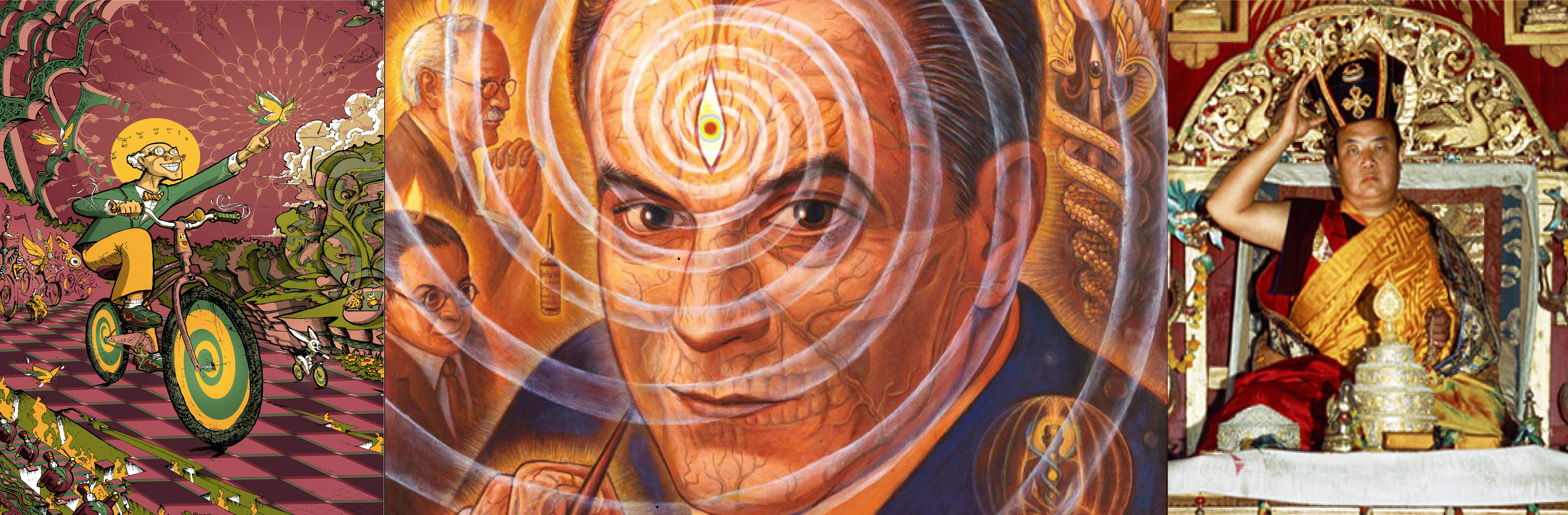

The question of LSD vs meditation has never been purely academic. It cuts to the heart of what we mean by enlightenment, by consciousness, and by the kind of transformation that actually sticks. Stanislav Grof spent decades mapping the territory that psychedelics open — and what he found looks remarkably like what Tibetan Buddhism has been pointing to for a thousand years. But there is a crucial difference between glimpsing the nature of mind and living from it. That difference is everything.
Psychiatrist Stanislav Grof conducted over 4,000 supervised sessions
In the 1950s and 60s, when LSD was still a legal research compound, psychiatrist Stanislav Grof conducted over 4,000 supervised sessions. What he documented wasn’t recreational hallucination — it was a systematic cartography of consciousness that reached into what he called transpersonal states: experiences where the boundary of the individual self dissolves into something far larger.
Grof described one class of these experiences with precision: subjects reported their consciousness expanding to encompass the entirety of the Earth, feeling not like an observer of the planet but as the planet itself — a living, sensing totality. Albert Hofmann, the Swiss chemist who first synthesized LSD, described Grof as the one who took his “problem child” furthest into genuine scientific territory.
What Grof found, repeated across thousands of sessions with thousands of subjects, is that the human psyche contains strata of experience that extend far beyond personal biography. There are perinatal layers — experiences tied to birth and death — and transpersonal layers that open into what mystics of every tradition have called the sacred. The psyche, it turns out, is not a closed room. It is a door.
What Does Tibetan Buddhism Say?
The Kagyu tradition of Vajrayana Buddhism has a rather different approach to the same territory — and a rather longer track record.
The Buddha taught that every sentient being without exception possesses what is called Buddha nature — the innate capacity for complete awakening. This isn’t a metaphor or an aspiration. It is the actual nature of mind, present right now, obscured only by habitual patterns of thought, emotion, and identification with the self as a fixed, separate thing.
The Six Yogas of Naropa — tummo, illusory body, dream yoga, clear light, bardo, and phowa — are not techniques for inducing altered states. They are methods for recognizing and stabilizing what is already present. The difference is subtle but essential: you are not going somewhere. You are seeing clearly where you already are.
Mahamudra, the fruition teaching of the Kagyu lineage, points even more directly. Subject, object, and the act of knowing arise together — co-emergently — as one undivided event. There is only this: the awareness, what it knows, and the knowing itself, arising all together. This is not a drug-induced state. It is the natural condition of mind when the agitation of habitual thinking momentarily settles.
The Door and the Path — Where LSD and Meditation Diverge

A friend who had practiced both extensively put it simply: “LSD can show you the door to the mind if you don’t know where it is. But only meditation and the dharma can take you through it.”
This is, I think, the most honest framing of the LSD vs meditation question.
Psychedelics — when used carefully, in supported settings, with genuine intention — can dissolve the illusion of the fixed self in a way that no amount of conceptual study can replicate. Grof’s research makes clear that these experiences can be genuinely transformative, even therapeutically curative. The resurgence of clinical psilocybin and MDMA research in the last decade has begun to confirm what Grof mapped fifty years ago.
But transformation and liberation are not the same thing.
The Buddha’s approach was not to induce peak experiences. It was to train the mind systematically so that the recognition of awareness — of Buddha nature — becomes stable, continuous, and expressed as genuine compassion in every dimension of life. Timothy Leary’s instruction to “turn on, tune in, and drop out” points toward the experience. But It offers no map for returning, integrating, and serving.
Meditation is not a slower or less exciting version of what psychedelics can offer. It is a fundamentally different orientation: not the seizure of an altered state, but the gradual revelation that the ordinary state of mind — when seen clearly — is the extraordinary one.
Panpsychism, C=E=mc², and the Shared Ground
Both Grof’s transpersonal model and Buddhist cosmology converge on something that physics is now beginning to take seriously: that consciousness is not a product of matter but a fundamental feature of reality.
Grof’s subjects, in their deepest sessions, reported not just expanded identity but something closer to what Vajrayana calls rigpa — pure awareness without an object, prior to the subject-object division. The physicist’s universe and the meditator’s universe appear, from the inside, to be the same universe.
The formula I’ve been working with — C = E = mc² — is a provocation as much as an equation. If energy and matter are interconvertible, and if consciousness is a fundamental property of reality rather than an emergent accident of neurons, then the transpersonal experiences Grof documented are not hallucinations. They are direct perceptions of the actual structure of things.
This is not mysticism dressed as science. It is an honest acknowledgment that our current scientific framework may be working with an unnecessarily narrow definition of what counts as real.
Why Meditation Is Still the Superior Path
None of the above is an argument for recreational LSD use, or even for therapeutic psychedelic use as a spiritual path. I want to be clear about this.
The advantages of a genuine meditation practice are practical as much as philosophical:
1. Continuity. A meditation practice operates in every moment of every day — on the subway, in a difficult conversation, at 3am when you can’t sleep. Psychedelic insights, however profound, occur in windows. Integration is real work and requires the very tools that meditation develops.
2. Community and lineage. The Kagyu tradition carries an unbroken transmission of practice going back through Milarepa, Marpa, and Naropa to Tilopa. The student-teacher relationship, the ngöndro, the retreats — these create a container for transformation that a solo session, however powerful, cannot replicate.
3. Ethics. The Bodhisattva ideal — committing to the liberation of all sentient beings before seeking one’s own liberation — is not an addendum to the path. It is the path. The genuine insight that LSD can precipitate (“we are all one, we are interconnected”) becomes embodied wisdom only when it shapes how you actually treat people. The Six Paramitas — generosity, meaningful conduct, patience, diligent effort, meditation, and wisdom — are the lived expression of what transpersonal experience points toward.
4. Legality and sustainability. This is not a trivial point. A path that requires substances that are illegal in most jurisdictions is not a universal path. The Buddha taught for all beings in all conditions.
The Practical Invitation
You don’t need a dramatic experience to begin. You need a cushion, ten minutes, and a willingness to look at what the mind actually is rather than what you think it should be.
The Learn to Meditate section of this site has specific practices — breath work, visualization, tonglen — drawn from the Kagyu tradition. The Six Yogas of Naropa pages go deeper for those drawn to Vajrayana practice. If Grof’s work has opened a door for you, these pages offer something to walk toward.
And if karma, impermanence, and the precious human birth mean anything to you — that we are here briefly, with an unusual capacity for awareness — then the question isn’t really LSD vs meditation. The question is: what will you do with the door you’ve been shown?
Closing Reflection:
Grof gave us a scientific language for the mystical. The Buddha gave us a method for living it. Both are pointing at the same moon. The finger you choose to look along matters less than what you do when you finally see it.
They are many and I am one.
— QP
Support the work: Ko-fi / Dana | The podcast remains free.
Footnotes:
- Stanislav Grof, A Holotropic Mind
- Albert Hofmann, quoted in Stanislav Grof, Realms of the Human Unconscious
- Stanislav Grof, Psychology of the Future: Lessons from Modern Consciousness Research


Leave a Reply to stockdalewolfeCancel reply