
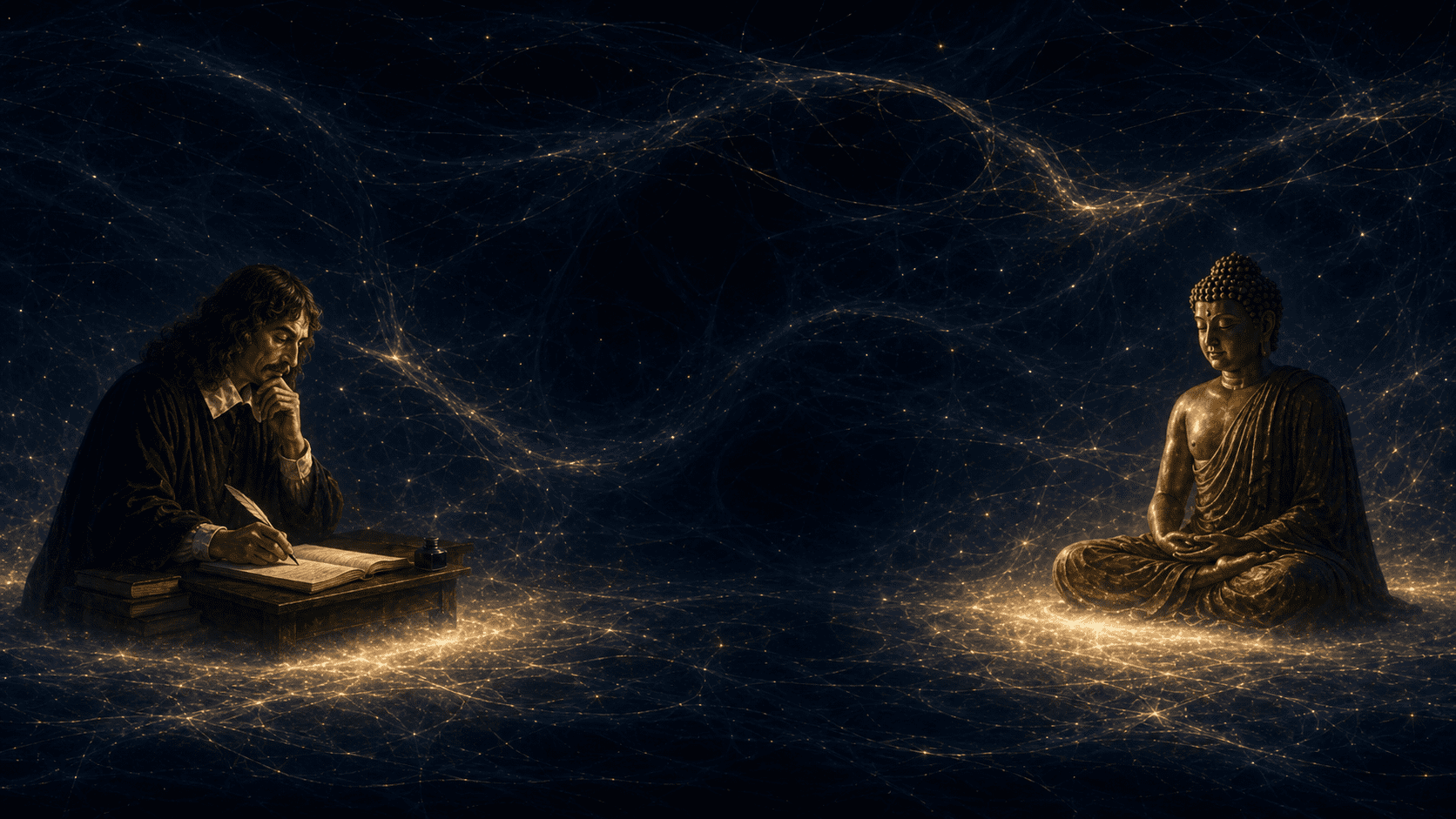
Descartes doubt is one of the most radical thought experiments in the history of western philosophy — and I keep returning to it, because the further I go in my own practice the more familiar it feels. René Descartes did not simply question one belief or two. He developed a method for dismantling the entire foundation of what we think we know, all at once, and sitting in the rubble of that. What I want to explore here is how close that method came to something far older and far more deliberate — the systematic dissolution practices of the Buddha Dharma, and what it actually means to doubt everything, including the one who is doing the doubting.
What Descartes Doubt Actually Was — And Why It Matters
Descartes is undoubtedly one of the most influential philosophers of our time. He shaped the way we in the west think about mind, self, and existence — and even though his thinking was heavily conditioned by the Catholic Church, his ideas are here to stay. What I want to discover is what genuine similarities exist between his western Christian framework and the Buddha Dharma, one of the most sophisticated wisdom traditions the world has ever produced. As I am always here to learn, I welcome you to reach out and share your thoughts with the community.
Descartes’ six meditations are a remarkable thought experiment. He systematically disassembles the entire foundation of everything he believes to exist and then slowly builds it back up — but only as far as he can genuinely prove to himself. What I find extraordinary is how similar this process is to aspects of the Tibetan practice I do almost daily. In Guru Yoga, after focusing on the four basic thoughts and taking refuge, we dissolve the conditioned world — the entire constructed edifice of concepts, habits, and assumptions — and then slowly rebuild it in a more awake, more meaningful way. The structures that return after dissolution are not the same structures that fell.
This is not a casual parallel. Both Descartes and the Tibetan practitioner are doing something that most people never attempt — deliberately and methodically questioning the ground beneath their feet, including the one who is standing on it.
🏛️ “I will suppose therefore that not God, who is supremely good and the source of truth, but rather some malicious demon of the utmost power and cunning has employed all his energies in order to deceive me. I shall think that the sky, the air, the earth, colours, shapes, sounds and all external things are merely the delusions of dreams which he has devised to ensnare my judgement.”
— Descartes, Meditations on First Philosophy, First Meditation
Dismantling the Wall — Radical Doubt and the Foundation of Belief
Descartes understood early on that he held far too many beliefs to examine and discard one at a time. So he developed something more efficient — a way to deny the existence of entire categories of experience simultaneously. Rather than dismantling the wall one brick at a time, he pulls away at the foundation and lets it collapse in on itself. He does this through a single principle: if he can find any reason at all to suspect he might have been deceived or mistaken, everything in that category goes. All of it. Even the external world. Even his own body. Even God.
The vehicle for this total demolition is the figure of the evil demon — a supreme deceiving power who has constructed the entire world of experience as an elaborate illusion. It is important to sit with how serious this move is. Descartes is not saying the senses are occasionally unreliable. He is saying that everything we take to be real could, in principle, be a fabrication planted directly into the mind. The sky. Other people. Your own hands. None of it provable. All of it potentially constructed.
I think this is what most serious philosophers and physicists eventually have to confront. There is a point you reach where you must genuinely doubt or deny the existence of everything — and stay there, honestly, without reaching for the nearest exit. Most people, encountering this vertigo, close the book and make a cup of tea. Descartes kept going. That is what makes the First Meditation remarkable.
🏛️ “Everything which I have thus far accepted as entirely true and assured has been acquired from the senses or by means of the senses. But I have learned by experience that these senses sometimes mislead me, and it is prudent never to trust entirely those who have once deceived us.”
— Descartes, Meditations on First Philosophy, First Meditation
Nihilism, Nothingness, and What Buddhism Actually Teaches
This is where nihilism enters the picture. Nihilism — the rejection of all religious and moral principles, the belief that existence itself is meaningless — sits close to the centre of what Descartes is circling in the First Meditation. He goes further than most western thinkers dare. It is not simply that values are questionable. It is that existence as a whole might be questionable.
Over the years I have noticed that many people assume Buddhism is a form of nihilism. This misconception seems to come from a few directions — the idea that there is no fixed right or wrong in Buddhism, only causes and consequences; the language around ego dissolution, which to some ears sounds like a desire to disappear; and above all, the teaching on emptiness. Almost every critic I have encountered assumes that Buddhist emptiness means we wish to end our existence in a pool of nothingness. This could not be further from the truth.
The Buddha Dharma does not deny the existence of anything or anyone. What it says, with great philosophical precision, is that things do not exist in the way in which it seems they do. Things truly exist — but they exist free of our concepts and judgements about them. Emptiness, śūnyatā, means empty of our projections, empty of the labels we paste onto experience when we decide something is purely good or purely bad, purely real or purely unreal. Nihilism says nothing exists and nothing matters. Buddhist emptiness says everything exists — but not the way you think it does. These are not the same claim. They are not even close.
Nagarjuna, the second-century Indian philosopher who systematised the Madhyamaka — the Middle Way philosophy of emptiness — was perhaps the sharpest logical mind in the entire history of Buddhist thought. He was not a nihilist. He was the most rigorous demolisher of nihilism the tradition ever produced.
“Whatever arises dependently is emptiness. That dependent designation is itself the middle path. Because there is no dharma that does not arise dependently, there is no dharma that is not empty.”
— Nagarjuna, Mūlamadhyamakakārikā, Chapter 24
What Nagarjuna is saying is not that nothing exists. He is saying that nothing exists independently, from its own side, without dependence on anything else. And that recognition — that all phenomena arise dependently — is precisely what liberates. Not the denial of existence. The understanding of its nature.

Descartes Doubt and the Tibetan Practice of Dissolution
What strikes me most about the First Meditation is not the conclusions Descartes reaches. It is the willingness to go all the way. To not stop the doubt halfway because the vertigo becomes uncomfortable. This quality — the readiness to follow the inquiry past the point of personal comfort — is something that any serious meditator will recognise immediately.
In Tibetan Guru Yoga, the practice of dissolution is methodical and deliberate. The entire constructed world — the physical environment, the sense perceptions, the conceptual architecture we live inside without noticing — is dissolved, layer by layer, until what remains is something prior to the construction of the self. The practice is not about annihilating experience. It is about touching the ground of experience. The space in which all of it arises.
Descartes doubt and Tibetan meditation are not the same practice — but they are travelling in a recognisably similar direction, and for a western philosopher to arrive there through pure reason alone is genuinely extraordinary. The crucial difference lies in intention. Descartes is using radical doubt as an intellectual tool to locate certainty. He needs bedrock — something he cannot doubt — in order to build from there. The aim is an unshakeable foundation for knowledge.
Tibetan practice is not looking for bedrock in the same way. It is not trying to find something that survives the dissolution. It is pointing at the nature of the mind that is doing the dissolving. The awareness that remains when the constructed world falls away is not a new discovery — it was always present. It was simply covered. The practice of Tibetan meditation does not create awareness. It reveals it.
This is the gap between where Descartes ends up and where the dharma begins. He correctly identifies that something remains when everything is doubted. What he calls the thinking thing — the res cogitans — the dharma recognises as the nature of mind itself. But where Descartes immediately begins using that something as a foundation for rebuilding a rational architecture, the dharma says: stop here. Look at this. This is what you were looking for, there is no need to go further.
Emptiness Is Not Nothing — The Crucial Distinction
There is a word in Tibetan — གཞི (gzhi, pronounced ‘shee’) — that translates roughly as ground, or primordial ground. It points to the basic state of mind before conceptual elaboration, before the machinery of thought starts running. It is not nothing. It is the most fundamental something there is — the ground of all experience, prior to the distinction between subject and object, prior to the split between the thinker and the thought.
What the Buddha Dharma offers that Descartes does not arrive at is the recognition that what remains when everything is dissolved is not an empty void, and not a thinking thing in a box — it is awareness itself, luminous and unobstructed. Not the awareness of a self looking at objects. Awareness as the nature of mind, prior to that split.
Descartes catches a glimpse of this territory in the First Meditation and then, understandably, retreats to more familiar ground. The evil demon, the radical doubt, the dissolution of the known world — these bring him to the edge. What he finds at the edge is the cogito: I think, therefore I am. Which is a remarkable discovery. But the dharma would gently suggest that he stopped one step short. The cogito is still a structure. Still a claim. Still subject and verb.
What lies before the cogito — what the thinking is arising in, what the doubting is happening within — that is the territory the First Meditation is approaching from the outside. And that is why this conversation is worth having, and why it does not end here. We will pick this up directly in the Second Meditation, where Descartes reaches the cogito itself, and where the Lichtenberg point opens something even more interesting.
QP
Go Deeper
In This Series:
Part 1 — Doubt, Nihilism, and the Buddhist Void , You are Here Now
→ Part 2 — The Cogito and the Inseparable Thinker
→ Part 3 — Consciousness, God, and the Nature of Mind
→ Part 4 — Truth, Certainty, and the Vajrayana View
→ Part 5 — Essence, Existence, and Buddha-Nature
→ Part 6 — Mind, Body, and the Tantric Reframe
→ The Cartesian Conundrum — Could Descartes Speak His Mind?
On Quantum Awareness:
→ What Are Shine and Lhaktong?
Further Reading:
→ Meditations on First Philosophy — Free Full Text
→ Stanford Encyclopedia — René Descartes
→ Stanford Encyclopedia — Nihilism
→ Stanford Encyclopedia — Buddhist Philosophy
→ Lotsawa House — The Middle Way
Leave a Reply