
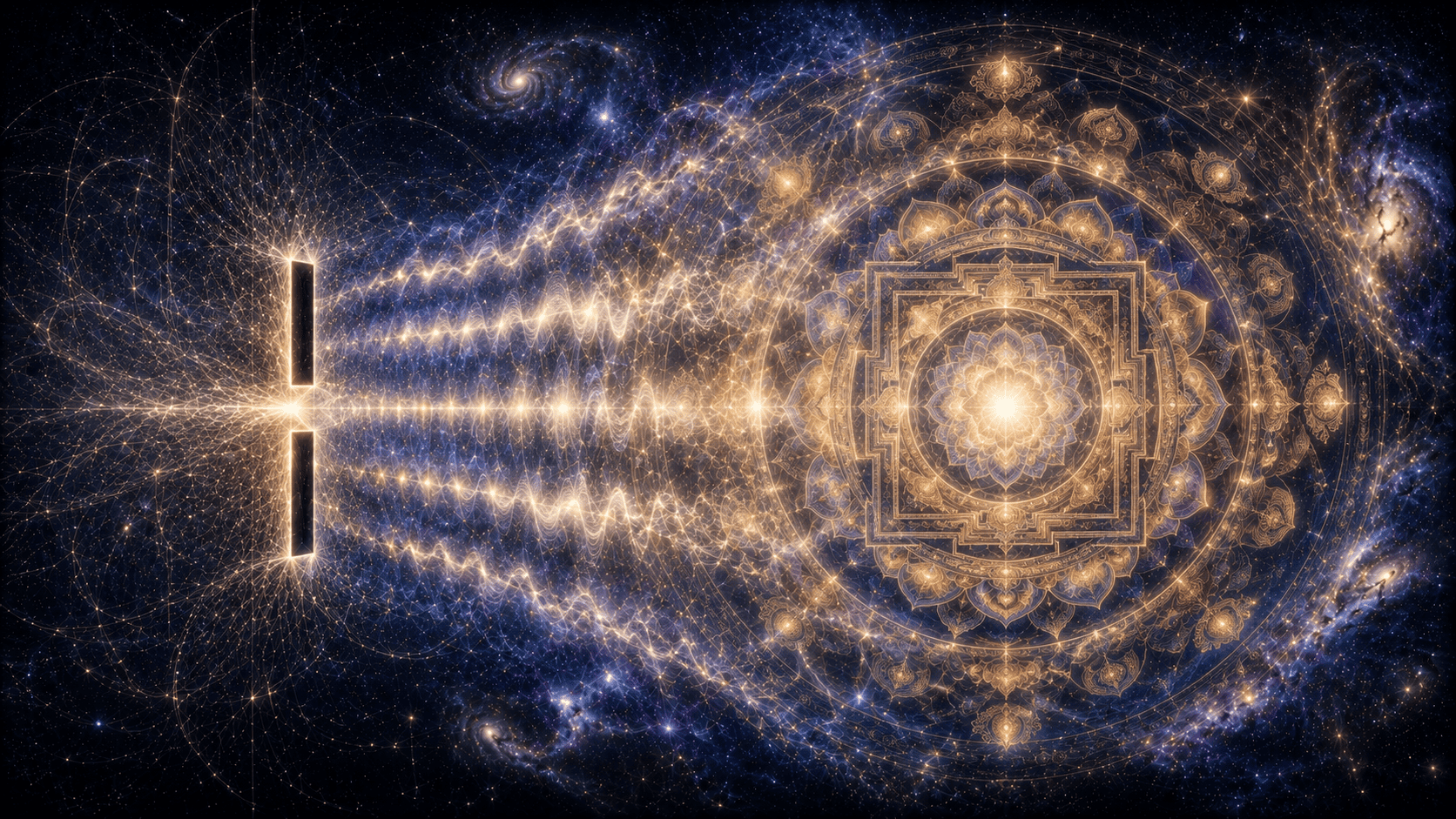
Wave particle duality and Buddhism seem, to the unlearned, to describe two very different worlds. But as we look deep down the quantum rabbit hole, we begin to see how words like non-dual and unity have a very big place in the quantum world of the tiny and unseen — and in Buddhism alike.
The Double-Slit Experiment

Although demonstrated by Thomas Young’s famous double-slit experiment in 1801, wave-particle duality only became widely accepted among quantum physicists in the mid-1900s. It is very interesting that the theory states particles can exist as waves, waves can exist as particles, and sometimes they exist as both at the same time.
Young discovered that when shooting particles or photons at a steel plate, one can observe either an interference pattern that indicates a wave function, or individual spots indicating particles. The experiment gets stranger still when we understand that particle patterns were observed when a detector was placed to track the particles, and when no detector was there, the wave pattern was observed instead. Even stranger: when a single photon was fired, it split into two at the slits, only to recombine once again at the screen — displaying qualities of both wave and particle.
ALBERT EINSTEIN
“It seems as though we must use sometimes the one theory and sometimes the other, while at times we may use either. We are faced with a new kind of difficulty. We have two contradictory pictures of reality; separately neither of them fully explains the phenomena of light, but together they do.”
The Karmapa’s Mahamudra
Buddhism, not surprisingly, has some 1,000-year-old insights that compare almost exactly to this modern quantum phenomenon. In roughly 1320, the 3rd Gyalwa Karmapa Rangjung Dorje wrote his crowning treatise on Mahamudra. Written in song-like stanzas, it shows us how things are not perceived as they truly are, and the role mind plays in our experience of reality.
“The ground is the two truths, free from eternalist and nihilistic extremes.” THE THIRD KARMAPA, RANGJUNG DORJE — ASPIRATION OF MAHĀMUDRĀ, VERSE 6
The Karmapa states here that our reality is the ground of two truths — free from any notion of permanent, unchanging existence, and equally free from the nothingness of nihilism. I would draw a direct comparison to Einstein’s words above, which point to the same contradiction between our materialistic world of particles and the unseen, wave-like world of possibilities. Einstein goes further to say that sometimes we need only one of the theories, sometimes we need both. Young’s experiment supports this too — demonstrating how sometimes we are seeing particles, sometimes waves, and sometimes both at once.
“It is not existent, for even the buddhas have not seen it. It is not nonexistent, for it’s the basis of all saṃsāra and nirvāṇa. This is not a contradiction; it’s the middle way of unity.” THE THIRD KARMAPA, RANGJUNG DORJE — ASPIRATION OF MAHĀMUDRĀ, VERSE 11
What Einstein initially framed as a contradiction, the Karmapa resolves as the middle way of unity — a conviction Einstein himself ultimately arrived at: “separately neither of them fully explains the phenomena of light, but together they do.” Young would agree too, having watched particles split, act as waves, and reunite as particles once again. This, to me, is a very clearly non-dual, co-emergent reality.
“Looking at objects, I see them as objectless mind; looking at mind, mind is absent, empty of essence; looking at both, duality is liberated there and then — may I realize mind’s true nature, which is clear light.” THE THIRD KARMAPA, RANGJUNG DORJE — ASPIRATION OF MAHĀMUDRĀ, VERSE 18
In complete agreement, Einstein and the Karmapa both point to the same truth: a full understanding of the seen and unseen — the particle and the wave-like — requires holding both at once. And one cannot ignore that Young and Einstein were both, in the end, talking about the same photons of light. Wouldn’t it be wonderful to see this clearly?
Meditation and the Collapsing Wavefront

Meditation helps us to see more clearly — or perhaps even completely clearly. Once the veils of our emotions, like jealousy and anger, are cleared away, we see our world free from their constant blurring effect. Our newly developed wisdom transforms suffering into joy.
In the double-slit experiment, we see the evidence of particles when our attention, or the sensor, is turned on — this is what we now normally see. If we can train ourselves in meditation, maybe we can see the world of waves and their functions too. Maybe we can even understand, or see, our consciousness in action — watching as our awareness interacts with the collapsing wavefront into our particle-based material world. It sounds a bit crazy, I know. But why not? It might be really amazing.
Closing — Three Friends Who Agree

So it seems to me that my three friends — Karmapa, Young, and Einstein — agree on quite a lot. Maybe the only thing they might disagree about is the path one takes:
meditation, or mathematics. Do both roads lead to Rome? Why not do both — that’s why people like me are here.
For nearly a decade, Quantum Awareness has been a free resource exploring where quantum physics, Buddhism, and neuroscience converge. Every blog post, podcast episode, and teaching is offered freely, in the spirit of the dharma.
With gratitude, QP
Further Reading
• Eight Consciousnesses & Five Skandhas
• Coemergence of Subject, Object, and Action
Sources
• Young’s double-slit experiment
• Aspiration of Mahāmudrā, tr. Adam Pearcey — Lotsawa House
QP


Leave a Reply