
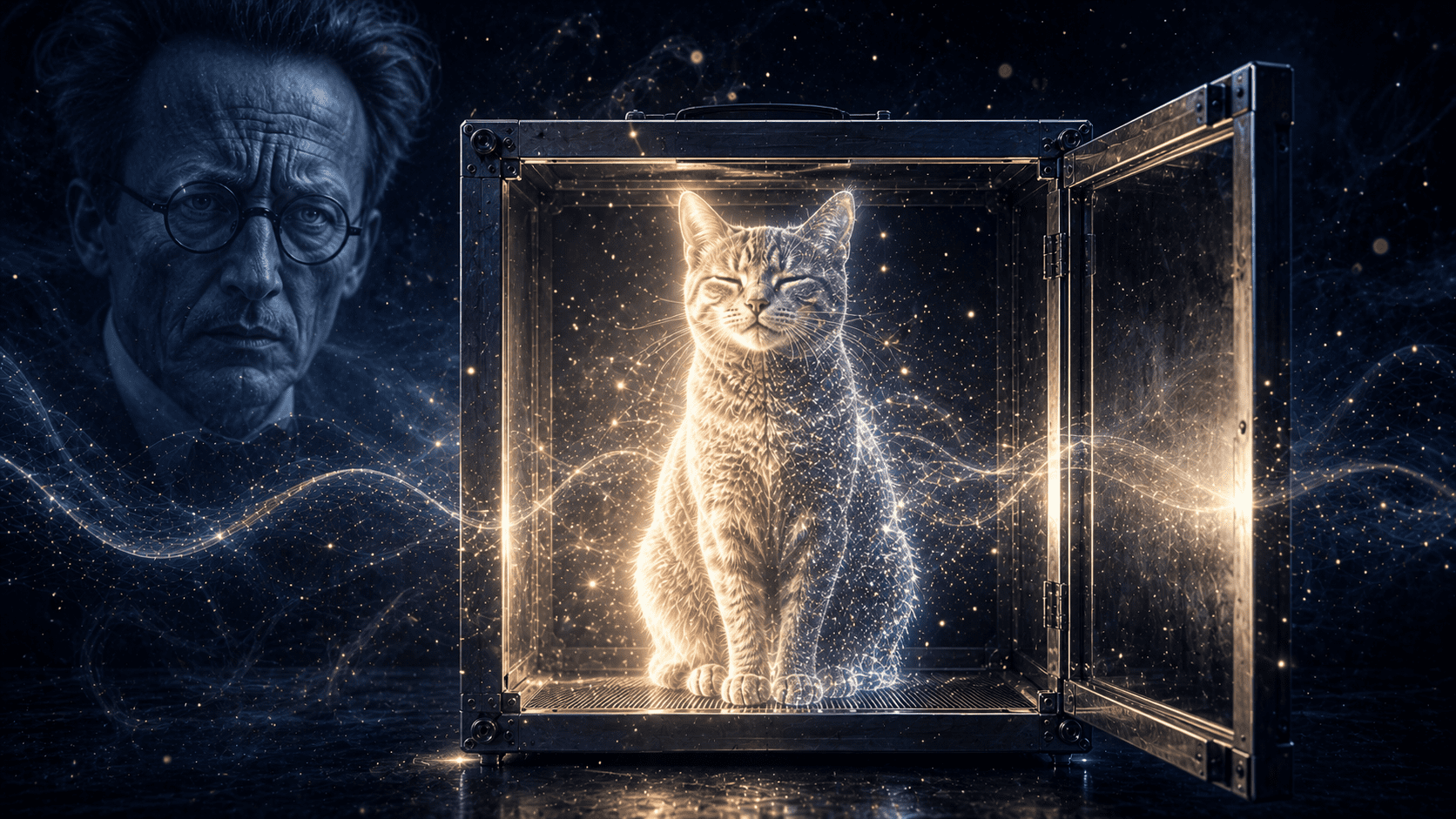
Schrödinger’s cat buddhism sounds like the kind of thing someone says at a dinner party after two glasses of wine to feel interesting. Erwin Schrödinger himself would probably object — he designed the thought experiment specifically to mock the Copenhagen interpretation, not to illuminate the nature of Buddha nature. And yet here we are, seven decades later, and the cat has something rather important to say about enlightenment. It always did. We just hadn’t opened the box yet.
🎧 Listen to this episode on Spotify or watch on YouTube below.
The Experiment Nobody Understood — Including Schrödinger
In 1935, Erwin Schrödinger placed an imaginary cat in an imaginary steel box alongside an imaginary vial of poison triggered by the decay of a radioactive atom. The atom decays at an unknown rate. Until you open the box and look, the cat is — according to quantum Physics — neither alive nor dead. It exists in superposition: all possible states simultaneously, until the moment of observation collapses everything into one outcome.
Schrödinger intended this as a reductio ad absurdum. He was essentially saying: look how ridiculous your quantum physics becomes when you apply it to everyday objects. He was pointing at the absurdity. He was not suggesting we take the cat seriously.
🔬 Superposition and the Copenhagen Interpretation The Copenhagen interpretation, developed by Niels Bohr and Werner Heisenberg in the 1920s, holds that a quantum system exists in all possible states simultaneously until measured. The act of measurement — of observation — forces the system to resolve into a single definite state. Before observation: everything. After observation: one thing. What does the observing, and why, remains one of the deepest unsolved problems in physics. Schrödinger found it absurd. Most physicists still find it uncomfortable. The cat, as it turns out, was onto something.
The irony is magnificent. Schrödinger built the most famous thought experiment in physics as a complaint, and it became the best accidental illustration of a Buddhist teaching he almost certainly never read.
Superposition and Buddha Nature — The Same Problem
Here is where Schrödinger’s cat buddhism stops being a dinner party observation and starts being a genuine argument.
In the Kagyu tradition of Vajrayana Buddhism, every sentient being possesses Buddha nature — tathāgatagarbha — the seed of awakening, present and complete from beginningless time. Not something to be achieved. Not a reward for good behaviour. Already there. Already perfect. Simply not yet observed.
This is superposition as a spiritual fact — not a metaphor borrowed from physics but the same structural reality described from two different directions, by two traditions that never met.
Many Kagyu teachers have said that enlightenment is closer to us than our own skin. This is not poetry. It is a precise statement about the nature of mind — that what we are searching for is not elsewhere, not in the future, not contingent on a certain number of meditation hours. It is the ground we are already standing on, unrecognised.
The parallel with superposition is not metaphorical. It is structural. The cat is both alive and dead until observed. We are both ordinary and enlightened until we look. The Buddha nature does not become present through practice — practice is the act of observation that allows it to be recognised as what it always already was.
Schrödinger would hate this. He was trying to make a point about measurement. He accidentally described rigpa.

The Observer Opens the Box — Can You Know Mind Using Mind?
This is the question that makes physicists uncomfortable and Buddhist philosophers quietly pleased. In quantum physics, observation changes what is observed. The act of looking is not neutral. The observer is not separate from the system. This was Wheeler’s great insight — that we live in a participatory universe, one that is shaped by the act of observation at every scale.
In the Kagyu understanding of mind, the same problem appears from a different direction. Can you know mind using mind? It is the only instrument you have. And yet the mind examining itself is the mind moving — which means you are never quite catching it still.
🔬 John Wheeler and the Participatory Universe Physicist John Archibald Wheeler spent decades arguing that the universe is not a machine running independently of its observers. His “It from Bit” proposal suggested that information — and therefore observation — is the fundamental substrate of reality. In his delayed-choice experiment, he demonstrated that the decision to observe a particle as wave or particle could be made after the particle had already passed through the apparatus, retroactively determining which path it took. The observer does not just record reality. The observer, in some sense, participates in its creation.
Meditation is the practice of turning this observation inward. Not thinking about mind — thinking is mind moving. But the steady, sustained, gentle returning of attention to itself that shamatha cultivates — that is the observation that begins to reveal what is already there. The box opening. Not forcing the outcome. Just looking.
A comment once left on this very page: “Perhaps I am the empty mirror. Schrödinger’s box cannot exist without me. Yet without the box I reflect nothing.” The reply: “I am, you are, we are all together the mirror, that which is projected, and that which projects. No separation between subject, object, and action.” This is not a conversation about physics. This is Mahamudra in a comment section.
Tim Willow’s final question in that thread was a good one: solipsism. If the observer creates the outcome, does anything exist without an observer? Is the universe just your dream?
This is where Schrödinger’s cat buddhism parts ways with the rabbit hole. Solipsism is the wrong conclusion from the right observation. Yes, quantum physics tells us that observation participates in shaping reality. No, it does not tell us that you are the only observer, or that the tree falls silently when you leave the room, or that other minds are a convenient fiction.
The Buddha addressed this directly — and with characteristic economy. To believe that things are absolutely real is the error of eternalism. To believe that nothing exists without your observation is the error of nihilism. The middle way is not a compromise between two wrong answers. It is a different question entirely: not does it exist but what is its nature?
Superposition does not say the cat isn’t there when you aren’t looking. It says the cat’s state is not fully determined until the interaction of observation occurs. That is a statement about the relationship between observer and observed — not the elimination of one in favour of the other. In Vajrayana Buddhism, this maps precisely onto the teaching that appearances and mind are inseparable — not identical, not independent. Co-arising. The box and the observer, as Tim correctly noted, cannot exist without each other.

The Cat on the Cushion — What Meditation Actually Does
A well-composed meditation practice shows us our natural beauty and divine essence — what we have had since beginningless time but have, through our own confusion, learned to forget. This is not self-help. This is not positive thinking. This is a precise technical process of removing the obstructions to seeing what is already there.
Most of us have reversed the sequence entirely. We try to think outside the box before we have ever learned to look inside it. We seek enlightenment at workshops and in books and in other people’s certainty, having never turned the observation toward the one doing the seeking. We are putting the cart so far in front of the horse they can no longer see each other.
What changes through sustained practice is not the Buddha nature itself — that is already complete. What changes is V̂, the valence operator, or what I call Quantum Observation, is the lens through which awareness looks at itself. Every session of shamatha gradually removes one more layer of distortion from the lens. Not by adding anything. By clearing what was always obscuring the view.
In the Kagyu tradition this ground state of undistorted awareness is called rigpa — pure recognition of the nature of mind, prior to any movement of thought or emotion. Not a blank state. Not a trance. The fully awake, fully open clarity that the cat in superposition was pointing at all along. The observation that doesn’t collapse the wave function because it is not separate from it.
Practice is not the journey toward something. It is the gradual removal of everything that was preventing you from seeing where you already are.
Superposition gives us a gateway to understanding unlimited potential. What we see and how we see it — the valence operator V̂ in action — is what we receive. In any given moment, in any given situation, anything is possible. The practice of meditation is not the acquisition of a new state. It is the observation of a state that already exists and has always existed. The collapse of superposition into a single outcome, not through force but through clarity.
And yes — if you are wondering whether the cat can meditate — the cat is probably already enlightened and would appreciate it if you stopped disturbing its nap.

Was the Cat Enlightened? Yes. And So Are You.
So was Schrödinger’s cat enlightened? Yes. But it may not have realised it. Much like us.
The cat in the box is not a grim scenario — not if you understand superposition correctly. It is the most hopeful thought experiment in the history of physics. Because if the cat exists in all possible states until observed, then so does every moment of your life. Every situation, every relationship, every version of yourself that feels fixed and finished and hopeless — exists in superposition with a version that does not. The observation has not yet been made. The box has not yet been opened.
Superposition is not a limitation. It is the most generous gift physics ever accidentally gave to Buddhism — the mathematical confirmation that nothing is finished until it is observed, and that observation is always, still, possible.
Buddhism does not ask you to become something you are not. It asks you to observe what you already are. Enlightenment is not earned. It is recognised. The cat was never not enlightened. Neither were you. You simply have not yet learned to see yourself as the perfect, luminous, slightly bewildered being that you already are.
Let’s choose to be amazing.
QP


Leave a Reply