
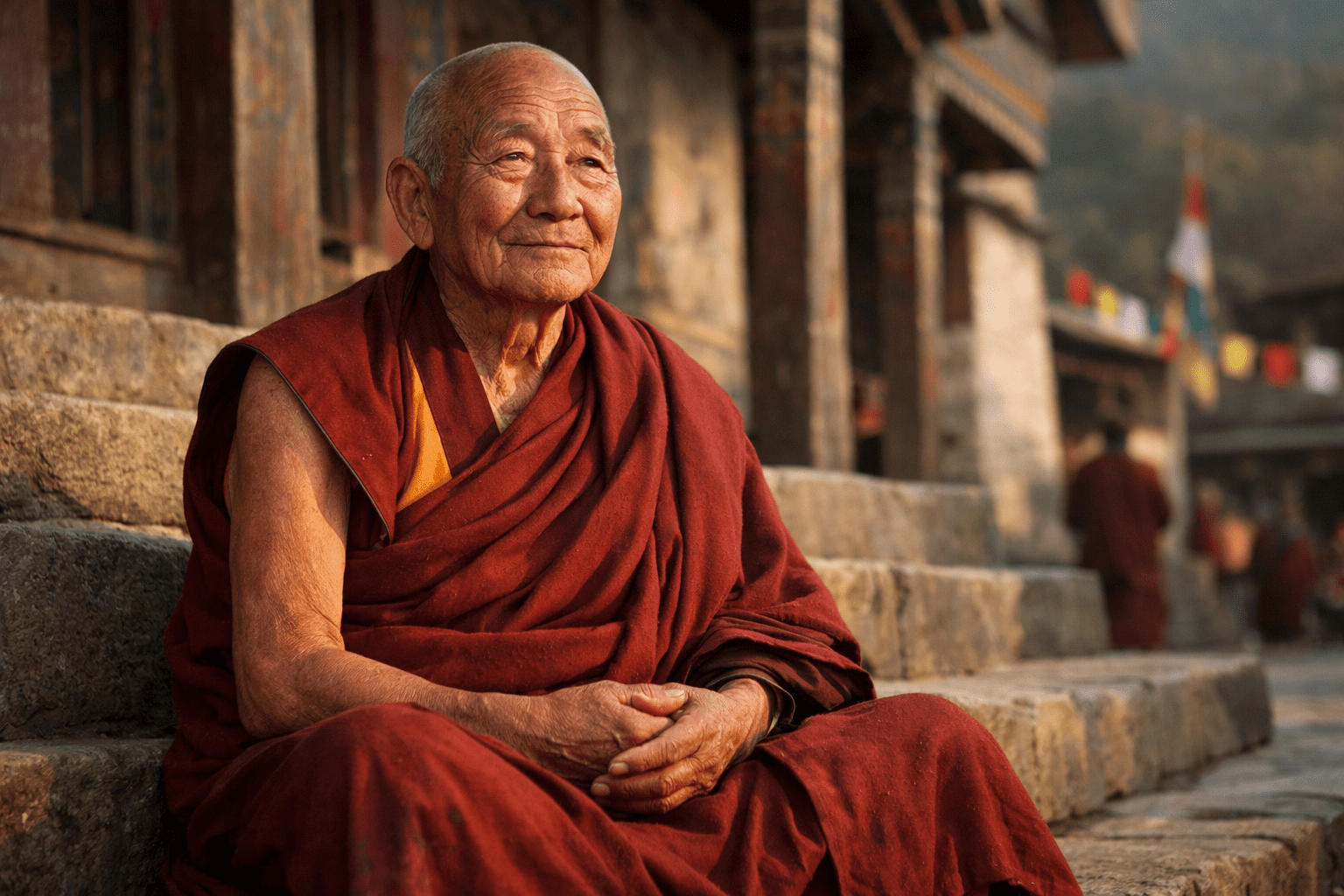
Patience is the third paramīta, and I’ll be honest with you: for me, it is the most difficult one. I can be generous. I can orient my behaviour toward others. But patience — real patience, not the gritted-teeth kind, not suppression dressed up as calm — is the practice that has asked the most of me, and probably always will.
In Sanskrit it is kṣānti — often translated as patience, forbearance, or tolerance. In Tibetan, zöpa: the capacity to bear, to endure, to remain open. But the definition I keep returning to is simpler than any of those translations: patience is the willingness to rest at ease with anything that is, as it is. Especially anger.
Shantideva’s Sixth Chapter
Shantideva devoted the entire sixth chapter of the Bodhicaryāvatāra to kṣānti — more pages than any other paramīta. That is not a coincidence. He understood that anger is the most destructive force on the Bodhisattva path, and that patience is its only genuine antidote. Not avoidance. Not suppression. The direct, clear, courageous willingness to face what is arising and remain open within it.
His argument is precise and worth sitting with. Anger, he says, destroys in a single moment the merit accumulated over thousands of aeons. My Lama always said this, every time he mentioned anger, and I couldn’t agree more. There is no evil equal to hatred, and no austerity equal to patience. A mind consumed by anger cannot find peace, cannot benefit others, cannot see clearly, and nobody ever made a good decision while angry, NOBODY. And yet the conditions for anger — difficulty, frustration, harm from others — are exactly the conditions that the Bodhisattva path leads us into. We do not practise patience in ideal circumstances. We practise it in the friction of actual life.
The Karmapa, in his teaching on this text, makes the same point with characteristic directness. Patience is not weakness. It is the inner strength that allows us to keep our orientation — toward openness, toward others, toward the path — even when something in us wants to close, to retaliate, to contract. It is, he says, one of the two paramītas that most directly protect the accumulation of merit. The other is joyful effort. Without patience, the field that meaningful behaviour prepares gets scorched really scorched.
The Three Types of Patience
In the classical Mahayana presentation, kṣānti has three dimensions that work together:
- Patience with harm from others. Not taking things personally when someone wrongs us. Easily said, not easily done. But this is where the practice begins — in the small aggressions and irritations of daily life, not in dramatic extremes.
- Patience with suffering and difficulty. The willingness to remain present with what is uncomfortable, painful, or unwanted, without immediately reaching to fix, escape, or deny it.
- Patience with the depth of the dharma. The willingness to stay with teachings that are vast, complex, and slow to ripen — trusting the process without demanding immediate results.

How to Work with Anger
Here is what the practice actually looks like from the inside. Anger, although the most destructive of all our emotions, gives us a kind of clarity — it shows us exactly how deeply we have divided ourselves from others, me versus them, desire versus aversion, self versus world. Patience gives us the space and time to respond in a compassionate, Bodhisattva-like way rather than simply react.
When we breathe, evaluate, and act, we always stand a better chance of success in emotionally laden situations. This is where meditation practice comes directly into play — that moment of just the breath, just the space we can find in it, grows and grows with practice. But we need patience with ourselves first, on the cushion, not judging our meditation. We simply do it, without measuring whether it was good or bad, focused or distracted. Then we practise with family. Then with friends. And eventually, even the most difficult people are handled with ease. Eventually is bold here for a reason; have patience with yourself first. If you cannot do it here, you have no chance anywhere else.
A good example of patience in action is simply not taking things too personally when someone wrongs us. We need to see the anger arise in ourselves — look at it, feel it, analyse it, measure it — and then, when it subsides back into emptiness, move on in clarity and act with compassion. Our best friends here are humour and ease. We need to understand the situation clearly in order to act well, and patience is what gives us that understanding. In this way, we develop inner strength and resilience. Yes, I know easier said than done, sorry.
What Neuroscience Found: Reappraisal vs Suppression
Science
🔬 In 2008, Philippe Goldin and James Gross at Stanford University published a landmark study in Biological Psychiatry that used functional MRI to compare two very different ways of dealing with negative emotion. The first was cognitive reappraisal — consciously reinterpreting the meaning of what you are experiencing, changing how you think about a situation rather than trying to fight the feeling. The second was expressive suppression — simply keeping a straight face, pushing the emotion down, not letting it show.
The results were striking. Cognitive reappraisal activated the prefrontal cortex early and quickly, and reduced activity in the amygdala and insula — the brain’s core emotion-response regions — producing genuine decreases in negative experience. Suppression, by contrast, produced late prefrontal activation and actually increased amygdala and insula activity. As Goldin put it: keeping your face still while the emotional intensity is rising means the reactivity is building internally the whole time, until it becomes hardest to maintain precisely when the emotion is at its peak. Suppression doesn’t resolve the emotion. It pressurises it. in other words the stiff upper lip, does not work!
Read those two strategies again against the paramīta of patience. What Shantideva teaches — what the Karmapa teaches, what any experienced practitioner knows from sitting with their own mind — is not suppression. It is reappraisal. See the anger arise, look at it, feel it, analyse it, measure it. Change your relationship to what is happening rather than fighting the feeling itself. Or as Gandhi said be the change you wish to see in the world. The brain’s own architecture confirms what the dharma has been teaching for two and a half millennia: the open, aware, recontextualising response is not weakness. It is the most neurologically effective strategy available. And it is exactly what kṣānti trains.
Be kind and patient with yourself today, and allow it to spread to others. #Gandhi Or as Gandhi said, be the change you wish to see in the world.
QP
Continue Reading
← Previous: The Paramita of Meaningful Behaviour
Next: The Paramita of Joyful Effort →
Source Notes
Shantideva on patience / Chapter 6: Bodhicaryavatara, Chapter 6 (Patience / Kṣānti). Recommended edition: Padmakara Translation Group (Shambhala, 1997). The claim that anger destroys aeons of merit in a single moment: verse 6.1. The claim there is no evil equal to hatred: verse 6.2. Both are standard and well-known; verify exact wording before publishing.
Thaye Dorje on patience as protection of merit: Bodhicaryavatara commentary series, Buddhism Today. Cross-reference his teaching on the 37 Practices, Part 3, which covers patience directly
Goldin, McRae, Ramel & Gross 2008: “The neural bases of emotion regulation: reappraisal and suppression of negative emotion.” Biological Psychiatry 63(6): 577–586. doi: 10.1016/j.biopsych.2007.05.031. Free full text
ScienceDaily write-up with Goldin quote: sciencedaily.com/releases/2008/03/080318094522.htm — useful for accessible phrasing but cite the primary paper.
Gampopa on kṣānti as protection of merit accumulation: Jewel Ornament of Liberation, Ch. 15. The pairing of patience and joyful effort as the two paramītas that most protect the accumulation is standard Kagyu teaching — cross-reference against your JOL edition.