
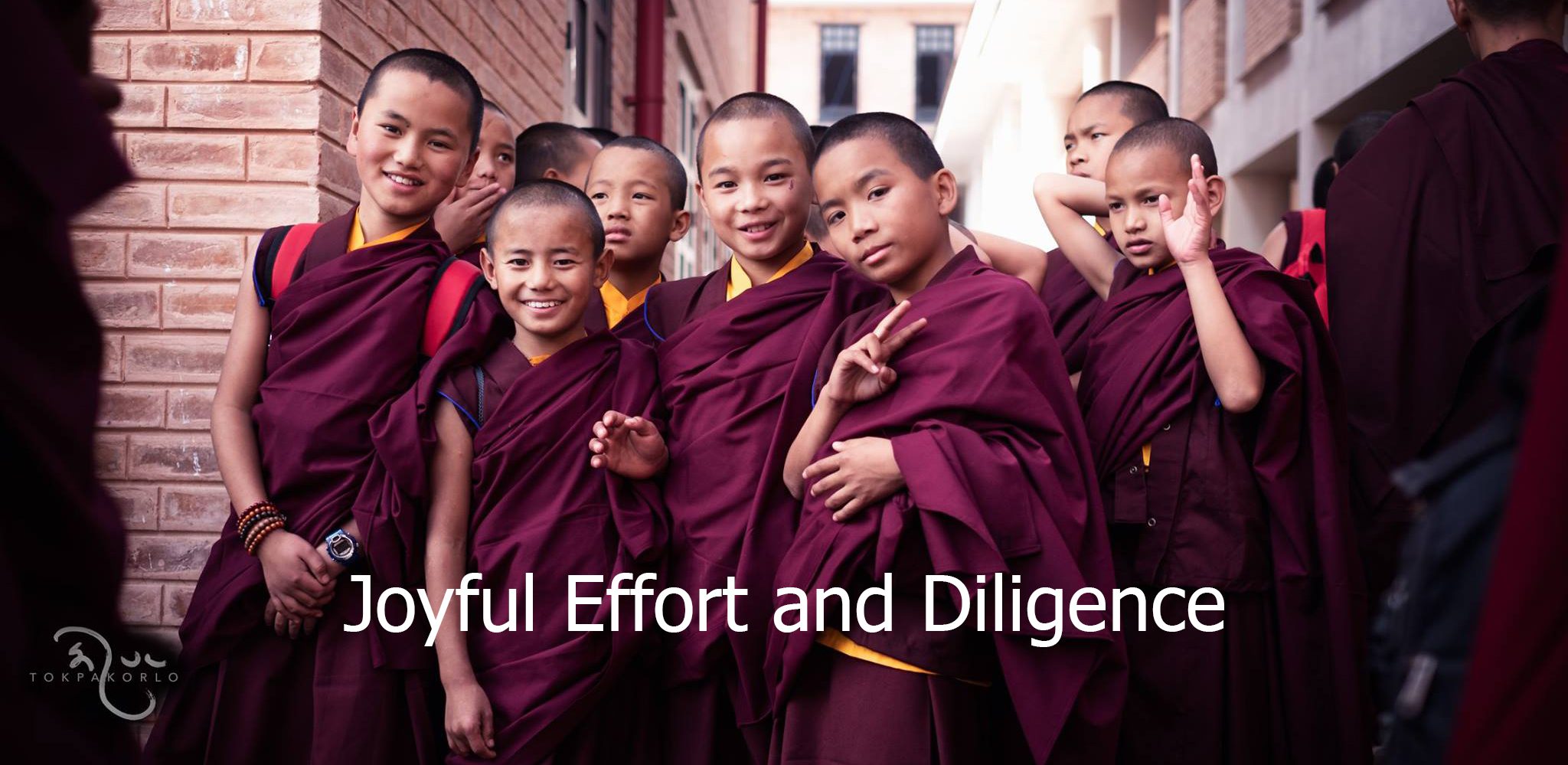
Joyful effort is the fourth paramīta, and in some ways it is the most misunderstood one. The English word “diligence” is correct enough but it points in the wrong direction — toward gritted teeth, toward discipline as endurance, toward the image of someone pushing through. That is not vīrya. The Tibetan is tsöndrü — perseverance, yes, but with a quality of joy that is not incidental to the practice. It is the whole point.
Vīrya is a protective way to not become sour and angry in daily life. It means following the bliss and beauty all around us. It means giving others our best with our full presence, and finding that it is fun — that the joy in doing it is itself a huge motivation. We can think of how children react most of the time: pure joy and amazement, not yet calculating whether the effort is worth it. That quality of engagement is what we are cultivating here.
Shantideva’s Seventh Chapter
Shantideva devoted Chapter 7 of the Bodhicaryāvatāra entirely to vīrya, and his treatment is characteristically precise. He identifies the enemies of joyful effort as laziness in its three forms: the laziness of procrastination, the laziness of faint-heartedness, and the laziness of distraction — the habit of attaching ourselves to what is not the path. Against all three, the antidote is the same: a mind that is genuinely delighted by the practice itself.
His key insight is that joyful effort is not separate from the other paramītas — it is what makes them sustainable. Generosity without joyful effort becomes duty. Meaningful behaviour without it becomes rigidity. Patience without it becomes suppression. And meditation without it becomes drudgery. Vīrya is the energy that keeps the whole path alive and moving, not because we are forcing it, but because we genuinely want to be here. If you are gritting your teeth with diligence and discipline you might have the wrong motivation.
The Karmapa, teaching the Bodhicaryāvatāra at KIBI, describes joyful effort alongside patience as the two paramītas that most directly protect the accumulation of merit. Patience keeps the field from being scorched. Joyful effort is what keeps planting in it, season after season, without exhaustion or resentment.
The Three Kinds of Vīrya and Diligence
In the classical Mahayana teaching, joyful effort takes three forms that together describe a complete orientation toward the path:
- Armour-like diligence. The resolute commitment to the path that armours the mind against discouragement before we even begin. A settled joy in the direction we have chosen. It’s the decision that you know from the get-go, I am doing the right thing no matter what. Post hoc ergo propter hoc 😉
- Diligence of application. The actual engaged practice — showing up, doing the work, planting the seeds of love and positive energy through consistent action. Love is carfully planted garden where you can not only eat everything, it’s all delicious.
- Insatiable diligence. The quality of never being satisfied with doing a little good when more is possible — not from compulsion, but from a delight in the practice that keeps growing the more we do it. Yes, and the fruit from this labour is most tasty!

Following the Bliss
We plant the seeds of love and positive energy when we choose to act in this powerful way. We diligently apply the Buddha Dharma in all areas of our life, and the law of karma takes care of the rest. This includes the parts of the eightfold path of the Theravāda way: right view, right resolve, and right mindfulness. They all belong here, they always have and always will be.
If you want more joy in your life, the easiest way to find it is to bring it to others first. Buddhism is not magic — it starts and ends with our own actions. You don’t go to a party and hang out with the most exciting person there, hoping to soak up all their goodness. You go to the party and be part of the group. You reflect the joy of others back onto them, with extra joy on top.
This magnification of joy is the goal. And we needn’t do this only at parties — joyful effort at work and at home is perhaps even more beneficial. We bring the greatest amount of joy to most people for the maximum amount of time!
I personally find joy when I am thankful — consciously observing all things around me during my day. When I see something beautiful or inspiring, I simply say “THANK YOU.” In that small moment, my heart fills with joy that I then pass on to those around me. This simple mirror-like reflection reminds me that the joy and beauty I see outside of me are only possible because the same is within my mind and my being. Of course, some days are easier than others. Sometimes I can only think: “oh, how wonderful—Emaho— amazing just because it can happen.” Even in this very basic view, every experience can be a step along the way to enlightenment.
What the Neuroscientists Found: The Joy Problem
Science
🔬 In 1971, psychologist Edward Deci at the University of Rochester made a discovery that turned motivational psychology upside down. He found that when you introduce external rewards into an activity that someone already finds intrinsically enjoyable — paying them, grading them, giving them prizes — their intrinsic motivation for that activity actually decreases. The joy in the doing diminishes when the doing becomes about something outside the doing itself. This became one of the most replicated findings in psychology.
Decades later, neuroscience caught up with an explanation. Di Domenico and Ryan, in a 2017 review published in Frontiers in Human Neuroscience, traced the neural basis of intrinsic motivation to the brain’s dopaminergic systems — specifically what neuroscientist Jaak Panksepp called the SEEKING system: the ancient mammalian circuitry that drives exploration, curiosity, and engagement with the world for its own sake. When we act from genuine inner motivation — when the activity itself is the reward — these dopaminergic pathways are fully engaged, this does not just happen with your smartphone! When the motivation shifts to external reward, the quality of engagement changes at the neural level.
The Bodhisattva path has known this for two and a half millennia. Vīrya is joyful effort precisely because it is not done for reward, not done for result, not done out of duty or obligation or fear of consequence. It is done because the practice itself is where we want to be. That quality of engagement — what Shantideva calls insatiable diligence, what the child on the toboggan knows instinctively, what you feel when you say THANK YOU to a beautiful moment and mean it — is what the dopaminergic SEEKING system was built for. The brain, it turns out, is designed for joyful effort. We just have to let it.
QP
Continue Reading
← Previous: The Paramita of Patience
Next: The Paramita of Meditation →
Source Notes
Shantideva on virya / Chapter 7: Bodhicaryavatara Chapter 7 (Diligence / Vīrya). Three forms of laziness and three kinds of diligence are standard teaching from this chapter. Padmakara Translation Group edition (Shambhala, 1997) recommended for verification.
Thaye Dorje on joyful effort protecting merit alongside patience: Bodhicaryavatara commentary series + 37 Practices Part 3, Buddhism Today. buddhism-today.org
Deci 1971 original finding: Deci, E.L. (1971). “Effects of externally mediated rewards on intrinsic motivation.” Journal of Personality and Social Psychology 18(1): 105–115. This is the foundational undermining-effect study. Widely replicated.
Di Domenico & Ryan 2017: “The Emerging Neuroscience of Intrinsic Motivation: A New Frontier in Self-Determination Research.” Frontiers in Human Neuroscience 11: 145. doi: 10.3389/fnhum.2017.00145. Free full text
Panksepp SEEKING system: Panksepp, J. (1998). Affective Neuroscience. Oxford University Press. The SEEKING system description is from this foundational work.
Gampopa on virya: Jewel Ornament of Liberation, Ch. 16. The armour-like / application / insatiable three-fold structure is standard Kagyu teaching — verify against your JOL edition.