
The Meditating with Descartes series on this site traces six meditations — six steps in the most influential philosophical project in western history. What emerges across those six pages is not just a comparison with the Buddha Dharma. It is the outline of a tragedy. In the Third Meditation, Descartes found infinite perfection inside his own mind — not derived, not invented, simply present.
He used it as a stepping stone to prove God’s existence outside himself and moved on. But the observation he made first — that something infinite is intrinsically present inside the mind of a finite being — was pointing in an entirely different direction. This post asks the question the series leaves hanging. Descartes suppressed what he found. What if he hadn’t? And what happened to the ones who said it anyway?
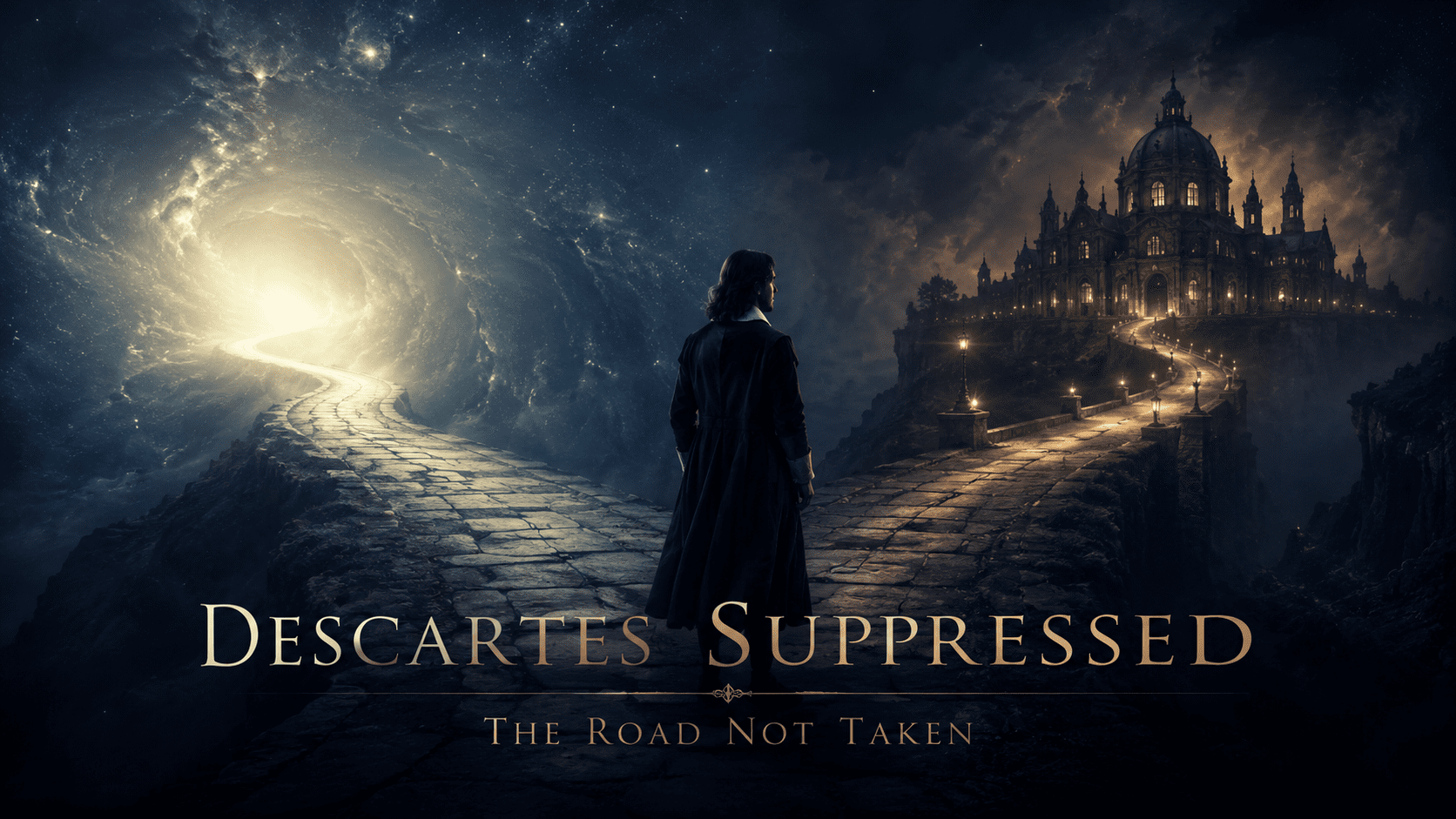
The Road Not Taken — What Descartes Found in the Third Meditation
In 1633, Descartes heard that Galileo had been condemned by the Inquisition. He was weeks away from publishing Le Monde — his treatise on the nature of the world, which endorsed the Copernican heliocentric model. He withdrew it immediately and did not publish it in his lifetime. The Cartesian Conundrum on this site tells that story. What is less often discussed is what the suppression cost — not Descartes personally, but western thought as a whole.
The Third Meditation is where the cost becomes visible. Descartes finds the idea of infinite perfection inside his own mind — innate, not derived from experience, not invented. He has two options at that moment. He can follow the observation inward — what is this quality of infinite perfection that is simply present in the mind? What does its presence tell us about the nature of the mind that contains it? Or he can use it as a logical bridge outward — this idea must have come from somewhere; something at least as infinite and perfect as the idea must have placed it here; therefore God exists, externally, separately, as guarantor.
He takes the second option. Western philosophy inherits the division. But the first option was available. Others took it. They paid the price Descartes was not willing to pay — and in taking it they pointed at something the Meditations approach from the outside and never enter.
Descartes Suppressed — The Silence That Shaped Western Thought
Descartes suppressed not just Le Monde but the full implications of what the Third Meditation found. His own language betrays this. He knew the idea of infinite perfection was inside the mind — present, innate, intrinsic. He chose to interpret it as the trace of an external creator rather than the nature of the mind itself. Whether from genuine conviction or calculated survival, the result is the same: Descartes suppressed the inward interpretation and gave western philosophy the outward one.
— Descartes, Letter to Mersenne, 1633
🏛️ “I would not want, for anything in the world, to publish a discourse in which a single word would be found of which the Church might disapprove… I desire to live in peace and to continue the life I have begun under the motto of living well who hides well.”
He who hides well lives well. That is the motto of a man who knows exactly what he found and exactly what it would cost to say it plainly. Descartes suppressed freely — not reluctantly, not tragically, but deliberately and systematically. The Meditations are an extraordinarily careful piece of philosophical engineering, constructed to reach orthodox conclusions from heterodox premises. Every move that approaches the inward interpretation is redirected outward, due to church censorship. Every observation that touches the nature of mind as the ground of the divine is converted into evidence for the divine as external guarantor. This did not happen by accident. It happened by design.
Spinoza — The One Who Said It

Baruch Spinoza was born in Amsterdam in 1632 — the year before Descartes suppressed Le Monde. He died in 1677, thirty years after Descartes. He read the Meditations carefully. And he followed the Third Meditation where Descartes did not go.
Spinoza’s Ethics — published posthumously in 1677, the year he died — proposes a single substance. Not two substances in uneasy union — the res cogitans and res extensa of Cartesian dualism — but one reality, which Spinoza calls Deus sive Natura: God or Nature. Mind and body are not separate substances requiring a pineal gland to mediate their interaction. They are two attributes of the same substance — two ways of describing the same reality from two different angles. The order and connection of ideas is identical to the order and connection of things because they are both expressions of the one substance that underlies both.
— Baruch Spinoza, Ethics, Part II
🏛️ “The order and connection of ideas is the same as the order and connection of things. For example, a circle existing in Nature and the idea of the existing circle, which is also in God, are one and the same thing, which is explained through different attributes.”
This is the statement Descartes was approaching and swerved from. The pantheist God Spinoza describes — identical with nature, present in everything, not an external being requiring philosophical proof — is precisely what the Third Meditation was pointing at before Descartes redirected it. Spinoza was excommunicated from his Jewish community at twenty-three, in a cherem of extraordinary severity. He lived modestly, grinding lenses for a living, refusing academic positions that would have required intellectual compromises. He was called an atheist, a dangerous man, a corrupter of morals and religion. He died at forty-four. His ethics were too dangerous to publish while he lived.
What he was, was honest. Honest in the way Descartes chose not to be, at a cost Descartes chose not to pay.
Meister Eckhart, Bruno, and the Beguines — Burned for Saying It More Plainly
Spinoza was at least allowed to die in his bed. The thinkers who said the same thing before him were less fortunate. Meister Eckhart — Dominican friar, theologian, and mystic — preceded Descartes by three centuries and taught what Descartes could not. The soul and God share the same ground — the Grunt, the abyss from which both arise. The divine is not external to the soul. The recognition of God and the recognition of the self’s deepest nature are not two recognitions.
— Meister Eckhart, Sermon 23
🕯️ “The eye through which I see God is the same eye through which God sees me; my eye and God’s eye are one eye, one seeing, one knowing, one love.”
Twenty-eight of Eckhart’s propositions were condemned as heretical by Pope John XXII in 1329 — one year after Eckhart died. The Church could not burn him but it could condemn him posthumously, and it did. The teaching it condemned: that God and the soul are not separate. That the divine is not external. That the ground of the soul is the ground of God. That no intermediary is required between the human person and the ultimate reality.
Giordano Bruno was not so fortunate in his timing. A Dominican friar, philosopher, and cosmologist, Bruno argued for an infinite universe, the plurality of worlds, and the immanence of the divine in all things. He did not separate God from nature. He did not separate the soul from its ground. He was burned at the stake in the Campo de’ Fiori in Rome in February 1600 — two years before Descartes’ fourth birthday. Bruno died because he refused to recant. Descartes heard the echo of that bonfire in every careful sentence of the Meditations.
— Giordano Bruno, as cited in Coulson Turnbull, Life and Teachings of Giordano Bruno (1913)
🕯️ “The Divine Light is always in man, presenting itself to the senses and to the comprehension, but man rejects it.”
— Giordano Bruno, on receiving his death sentence, Rome, February 1600
🕯️ “Perhaps you who pronounce my sentence are in greater fear than I who receive it.”
The Beguines were communities of laywomen across northern Europe in the twelfth through fourteenth centuries who practised a form of Christianity centred on direct encounter with the divine — without convent, without institutional rule, without male ecclesiastical supervision. Their very existence was a threat to the Church’s model of mediated grace. They were suppressed throughout the fourteenth century. Marguerite Porete, a Beguine mystic, was burned in Paris in 1310 for her book The Mirror of Simple Souls — which taught that the soul in full union with the divine requires nothing further: no Church, no sacrament, no priest.
— Marguerite Porete, The Mirror of Simple Souls
🕯️”This Soul neither desires nor despises poverty nor tribulation, neither mass nor sermon, neither fast nor prayer… for this Soul is so full of God that she has nothing else to desire.”
The pattern is exact and consistent. Every thinker who taught that the divine is intrinsically present in the soul — that no external guarantor, no institutional mediation, and no philosophical proof is required — was burned, exiled, condemned, or ground into obscurity. Descartes read the pattern correctly. He chose to write on the other side of it.
One Night in a Stove-Heated Room — What Descartes Actually Received
Before we name what was lost, it is worth pausing on what was found — and how it was found. The entire Cartesian project does not begin with cold rationalism. It begins with a dream.
On the night of 10 November 1619, Descartes was twenty-three years old, alone in a room heated by a porcelain stove somewhere in Germany, an ice storm outside. He had no career, no published work, no philosophical reputation. He fell asleep asking the question that the poet Ausonius had asked centuries before him — what way of life shall I follow? — and in the night he received three dreams that changed the entire course of western thought. He woke, by his own account, with the conviction that the foundations of a wonderful science had been revealed to him. His biographer recorded that he believed the Spirit of Truth had descended to give him his mission.
— Descartes, Cogitationes Privatae (Private Notebooks), 10 November 1619
🏛️ “On 10 November 1619, filled with enthusiasm, I discovered the foundations of a wonderful science.”
This is not the language of a rationalist discovering a method. This is the language of a man who received something in the dream state and spent the next thirty years trying to translate it into terms his tradition could accept. The Meditations, Le Monde, the Discourse on Method — all of it is one man’s attempt to honour a transmission he had no framework to understand.
The Vajrayana tradition has been working with dream transmissions for over a thousand years. Dream yoga is not an accident of sleep — it is a specific practice for recognising the nature of mind in the state where the ordinary waking constructions are partially dissolved. What Descartes received in that stove-heated room — the sudden luminous clarity, the sense of a unified knowledge, the conviction of a mission — is recognisable to any serious practitioner as a moment of contact with something prior to ordinary mind. He just had no teacher to tell him what it was, what to do with it, or where it was actually pointing.
The tragedy of Descartes is not that he was dishonest. It is that he received something real and had no container for it. He built the most rigorous rational architecture he could around an experience that was prior to rationality. He translated a glimpse of rigpa into the language of the cogito. He named the infinite perfection he found inside himself as an external God. He took what the dream had given him and gave it back to the Church in language the Church could bless.
He did the best he could with what he had. The cost was paid by everyone who came after him.
The Church Was Not Protecting Doctrine — It Was Protecting the Division, From Itself!
This needs to be said plainly. The suppression of Eckhart, Bruno, Porete, the Beguines, and the pressure that kept Descartes suppressed was not primarily theological. It was structural. Every one of the condemned thinkers taught — directly or by implication — that the divine is intrinsically present in the soul, accessible through direct practice and recognition, without institutional mediation. If that teaching is true, the Church has no necessary function. No confessional. No ordained priest as the gateway to grace. No hierarchy of authority between the human person and God. The business model collapses.
The division — God sent outside, the human person declared fundamentally insufficient, the divine placed carefully out of reach except through institutional channels — is not a theological accident. It is the condition of possibility for institutional religious power. The Church was not protecting doctrine. It was protecting the division because the division was the business model. Descartes gave that model its most durable philosophical foundation. Western philosophy has been living inside it ever since.
Leibniz, writing in the generation after Spinoza, came close from another angle — his monadology gestures toward a more unified reality than Cartesian dualism permits. He was marginalised within the tradition that followed Newton and Descartes. The western philosophical mainstream chose the version of reality that kept God outside and the institutional intermediary necessary. It was not an accidental choice.
What the Dharma Says About What They Were All Touching

Spinoza, Eckhart, Bruno, Porete, the Beguines — and Descartes himself in the unspoken moment of the Third Meditation — were all approaching the same recognition from different directions, through different frameworks, at different costs. The divine is not external. The ground of the self and the ground of God are not two. The separation between the perceiver and the ultimate reality is not a fact about the universe. It is a fact about unrecognised mind.
The Buddha Dharma does not claim to have discovered this. It claims to have mapped it with the greatest precision — through two and a half thousand years of direct meditative investigation, transmitted in an unbroken lineage from teacher to student. What Descartes found in the Third Meditation, what Eckhart called the Grunt, what Spinoza called the one substance, what Bruno died for refusing to deny, what Porete described as the soul so full of God it requires nothing further — the Vajrayana calls rigpa. The nature of mind. The ground of all experience. Already present. Never absent. Requiring no proof, no intermediary, and no philosophical architecture to be what it already is.
The tragedy of western philosophy is not that Descartes was wrong. It is that he was right — closer than almost any western thinker before or since — and chose not to follow it. The mystics who followed it paid with their lives. The philosophers who followed it were marginalised or died in obscurity. The institutional pressure that produced this outcome is still legible in the shape of western thought today — in the subject-object split, in the mind-body problem that has no solution within its own framework, in the God who must be proved because he was sent outside in the Third Meditation.
What Descartes suppressed is still here. It was never destroyed by the burnings. It was never eliminated by the condemnations. It does not require philosophical rehabilitation. It simply is what it is — present, undamaged, exactly what it always was. The instruction has not changed across two and a half thousand years of transmission.
— Tilopa, The Ganges Mahamudra
“Don’t recall. Don’t imagine. Don’t think. Don’t examine. Don’t control. Rest.”
That is what Descartes could not do. In six meditations he recalled, imagined, thought, examined, and controlled with extraordinary precision — and arrived at the edge of what thinking can reach. The one instruction he never received, the one the tradition behind this site has been transmitting for over a thousand years, is the one that resolves what the Meditations leave open. Not another argument. Not another proof. Rest.
QP
GO DEEPER
THE MEDITATING WITH DESCARTES SERIES:
→ The Cartesian Conundrum — Could Descartes Speak His Mind?
→ Part 1 — Doubt, Nihilism, and the Buddhist Void
→ Part 2 — The Cogito and the Inseparable Thinker
→ Part 3 — Consciousness, God, and the Nature of Mind
→ Part 4 — Truth, Certainty, and the Vajrayana View
→ Part 5 — Essence, Existence, and Buddha-Nature
→ Part 6 — Mind, Body, and the Tantric Reframe
ON QUANTUM AWARENESS:
→ What Are Shine and Lhaktong?
FURTHER READING:
→ Stanford Encyclopedia — Spinoza
→ Stanford Encyclopedia — Meister Eckhart
→ Stanford Encyclopedia — Giordano Bruno
→ Stanford Encyclopedia — Marguerite Porete
→ Spinoza’s Ethics — Free Full Text
→ Meditations on First Philosophy — Free Full Text
Leave a Reply