
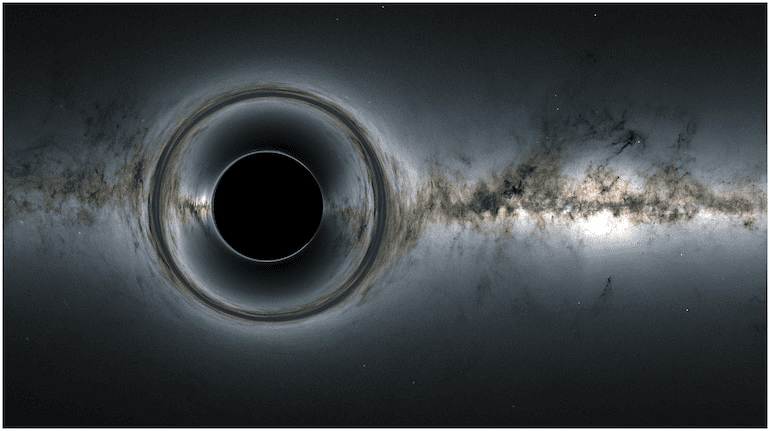
Of course, flying into a black hole is a journey beyond the limits of physical survival and one we would never take. Your ship and body would be torn apart by tidal forces, a process called spaghettification. But black hole consciousness — what happens to awareness itself when the last physical support dissolves — is a question neither physics nor the dharma has fully let go of. Can we spaghettificate our consciousness?
The Physics No One Survives — Except Consciousness?
A black hole forms when a massive star — typically more than twenty times the mass of our sun — collapses under its own gravity at the end of its life. What remains is a region of spacetime where gravity is so extreme that nothing, not even light, can escape. The boundary of this region is called the event horizon. Cross it, and by the laws of classical physics, you are done. Finished. Not even a forwarding address.
John Michell first proposed the concept in 1783, calling them “dark stars” — which honestly sounds more poetic than anything physics has managed since. Einstein’s general relativity formalised the mathematics a century later. In 1971, astronomers confirmed the first real candidate in Cygnus X-1. And in 2019, the Event Horizon Telescope produced the first direct image — the supermassive black hole M87*, some 6.5 billion solar masses, glowing like a cosmic smoke ring and briefly breaking the internet.
► LINK: Event Horizon Telescope →
At the centre lies the singularity — a point where density becomes theoretically infinite and the known laws of physics simply give up and go home. General relativity predicts it. Quantum Physics refuses to accept it. That tension is one of the great unsolved problems in all of science, and it is exactly where things get interesting.
🔬 Hawking Radiation
In 1974, Stephen Hawking demonstrated mathematically that black holes are not entirely black — quantum fluctuations at the event horizon cause them to slowly emit thermal radiation. He spent the next forty years arguing about what this means and changed his position at least twice. This is not a criticism. It is the actual scientific process.
🔬 The Evaporation Problem
The Hawking temperature of a solar-mass black hole is around 60 nanokelvin. The cosmic microwave background — the ambient temperature of the universe — sits at 2.7 Kelvin. Black holes are currently colder than the space around them, meaning they absorb more energy than they radiate.
“Eventually they evaporate” is technically true. Eventually is doing a lot of work in that sentence.
Black Hole Consciousness and the Information Paradox
Modern physics suggests black holes obliterate physical information at the singularity. Quantum physics insists that is impossible — information cannot be destroyed, it is one of the foundational laws of the universe. If Hawking radiation carries nothing meaningful out and the black hole eventually evaporates, where does everything go? This is the black hole information paradox, and it has kept physicists in productive disagreement for five decades.
► LINK: NASA — Black Holes →
Science
🔬 The Holographic Principle and the Firewall Paradox The holographic principle, developed by Gerard ’t Hooft and Leonard Susskind in the 1990s, offers one answer: everything falling into a volume of space is encoded on its two-dimensional boundary — like a hologram. Applied to black holes, nothing is truly lost. It is archived, written into the geometry of the event horizon itself. In 2012, the firewall paradox (Almheiri, Marolf, Polchinski, Sully) complicated things further, suggesting the horizon may not be the gentle threshold once imagined but a wall of high-energy radiation that would incinerate anything crossing it. Maldacena and Susskind countered with ER=EPR — the conjecture that wormholes and quantum entanglement are fundamentally the same phenomenon. The universe, it turns out, may be more connected than anyone is comfortable admitting.
Quantum theories like the holographic principle propose that all information — possibly including consciousness — might persist on the black hole’s event horizon. Several well-known lamas have compared their experience of mind to a holographic reality. Maybe black holes are the universe’s recycling depot where everything is stored and somehow reconstructed in the singularity. Many theories even include so-called Einstein-Rosen bridges or wormholes — exiting at what might be a white hole, somewhere on the other side of the galaxy, the universe, or in another realm entirely.

The Bardo and the Event Horizon
From a Vajrayana Buddhist perspective, consciousness transcends physical form. It is seen as a continuum, not bound by the body or material space or time. Because it is not made or composed of anything, it cannot be reduced or taken apart. Entering a black hole might be akin to entering a bardo, or transitional state, where the mind could experience vast, non-ordinary perceptions as it confronts the ultimate dissolution of matter.
Other bardos in the Karma Kagyu tradition include waking and dreaming, living and death, as well as the bardo of luminosity. Here the bardo of luminosity is the most interesting. The luminosity of our true nature. Our consciousness is compared to light — note it is not light, but like it; not nothing, but no thing. Is this what is pushed out on the other side of the black hole, out the theorised white hole?
In Vajrayana understanding, the nature of mind — rigpa — is not produced by causes and conditions. It cannot be destroyed by tidal forces any more than space can be torn by a storm. A star collapses. The space it occupied does not. Consciousness, in this innerstanding, is more like space than like matter. The black hole swallows the star. It cannot swallow the awareness that was never material to begin with.
This maps onto something the Tibetan tradition has understood for centuries. At the moment of death, when the physical support dissolves, awareness does not disappear — it transitions. The dissolution of the body in the bardo of dying is followed by the dawning of dharmata — the luminosity of the true nature, bright and unobstructed. What the black hole enforces physically, the bardo teachings describe experientially. The physics and the dharma are pointing at the same threshold, from opposite sides.
► LINK: “the bardo of dying” →

Wormholes, White Holes, and the Cosmic Recycling Depot
White holes are the mathematical time-reversal of black holes. Where a black hole draws everything inward, a white hole expels matter outward and lets nothing in. They have never been observed. That has not stopped anyone from writing papers about them, which is very on-brand for theoretical physics.
Science
🔬 Bouncing Singularities and the Loop Quantum Cosmos Some cosmologists propose that the Big Bang itself may have been the white hole counterpart to a black hole collapse in a parent universe — our entire cosmos, born as overflow from someone else’s singularity. Loop quantum cosmology (Ashtekar and Singh) goes further still, suggesting the singularity inside a black hole may not be a true endpoint at all. Quantum gravitational effects could halt the collapse and produce a “bounce” — a transition into an expanding region of spacetime. Not annihilation. Continuation.
The dharma has a word for that too: bardo.
Are Black Holes Conscious?
If a black hole contains the compressed, integrated information of everything it has ever consumed — every star, every planet, every quantum event — has anyone seriously proposed that it might itself be conscious? A few brave souls.
Giulio Tononi’s Integrated Information Theory defines consciousness as integrated information — phi (Φ). A sufficiently complex system that processes and integrates information is, by this measure, conscious to some degree. A black hole containing the encoded holographic record of everything it has swallowed would have staggering phi. No one has done the calculation. The implications are uncomfortable enough that no one seems in a hurry to.
John Archibald Wheeler — one of the great physicists of the twentieth century — proposed that information is the fundamental substrate of reality: “It from Bit.” If reality is information all the way down, then the singularity, as the universe’s most extreme information processor, sits at a rather interesting position in that framework.
Roger Penrose and Stuart Hameroff, via Orchestrated Objective Reduction, argue that consciousness arises from quantum gravitational collapse in the microtubules of neurons. The singularity is the most intense quantum gravity environment that exists anywhere in the known universe. The theory was not written with black holes in mind. The overlap is left as an exercise for the reader.
And Ervin Laszlo’s Akashic Field theory proposes a field underlying all of reality that records and transmits information across space and time — with black holes as the cosmic nodes through which that field is processed and redistributed. Not consciousness in a human sense. Something larger. Something that makes consciousness possible.
None of this is mainstream science. All of it is worth sitting with.
Black Hole Consciousness as Enlightenment Itself
In this view, your consciousness might experience a paradoxical duality: disintegration in the singularity yet preservation as a hologram on the edge of existence. Black holes, then, challenge the boundary between annihilation and continuity — much like the nature of consciousness itself. This would be sort of a “both and” — an ultimate transition to quantum enlightenment, or even a journey to the singularity that might itself be consciousness or enlightenment.
The question black hole physics keeps returning to is the same question Mahamudra practice keeps returning to: what is the nature of awareness when all its supports are removed? Physics strips away the body, the planet, the star, spacetime itself. Vajrayana strips away the concepts, the emotions, the narrative self. Both arrive at the same precipice, staring into the same irreducible mystery.
The black hole does not answer the question. Neither does the meditation cushion — not in words. But they both point to the same place: the ground that remains when everything composite has dissolved. Not nothing. No thing.
QP
Leave a Reply