
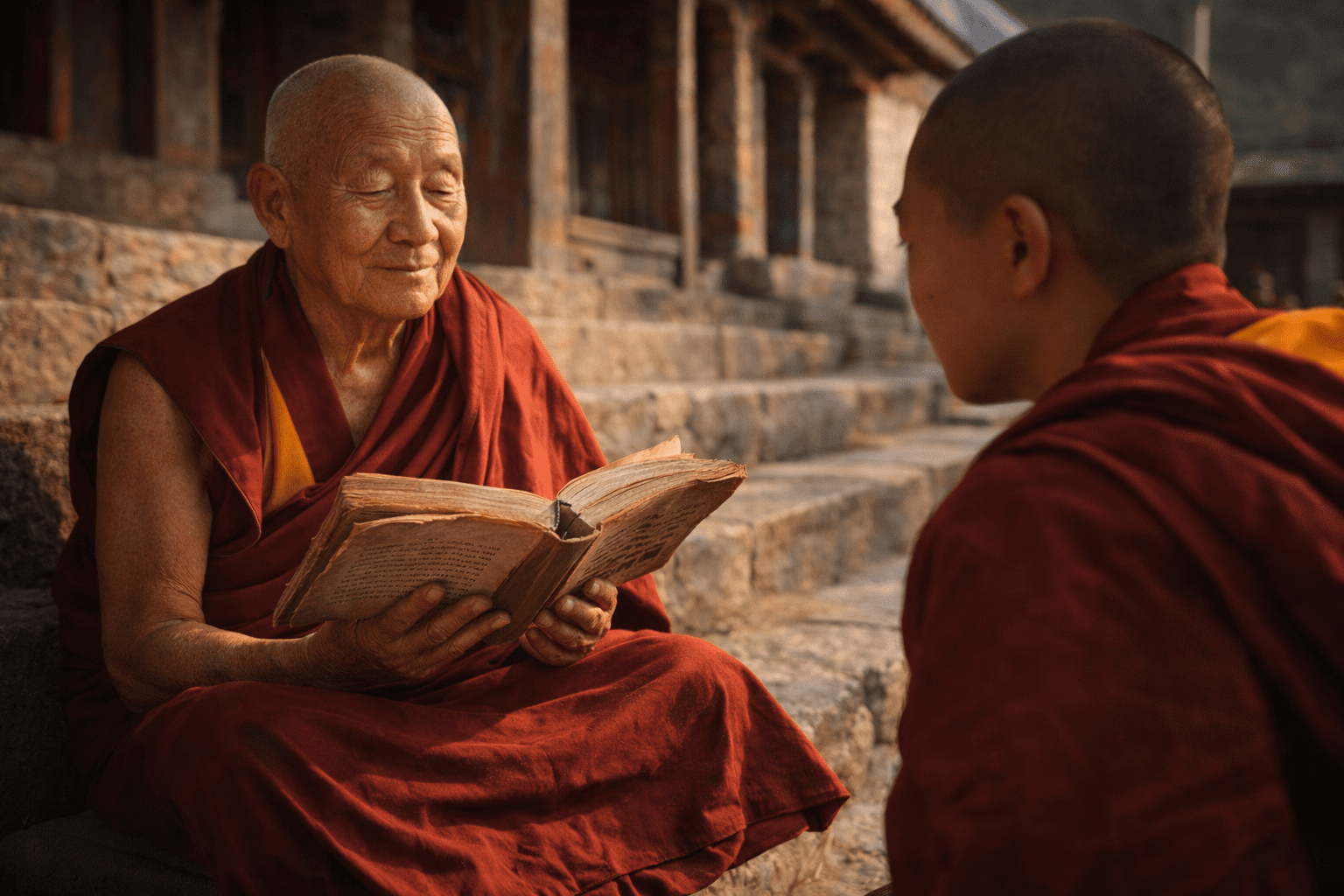
We have arrived at the sixth and final paramīta of Wisdom. And it is worth pausing here, just for a moment, to notice what has happened across the first five. Generosity opened the hand. Meaningful behaviour aligned the whole of body, speech, and mind toward others. Patience held the field steady under fire. Joyful effort kept planting, season after season. Meditation turned the gaze inward and let the noise settle. All of that was preparation. Everything was pointing here.
Wisdom arises from our experience of meditation. It is an innate part of our existence — it is always there, but we cannot see it unless we look. Looking within, in the laboratory of our own mind, is not as easy as one might think. We have distractions and overwhelming feelings, especially fear, that must be overcome. This takes practice. But it is worth it.
What Prajñā Actually Means
IIn Sanskrit, prajñā — in Tibetan, sherab. The word is usually translated as “wisdom” but that translation flattens something that is actually very precise. Sherab: sher means “best” or “foremost,” rab means “knowledge” or “intelligence.” This is not the wisdom of experience alone, not the wisdom of years or accumulated skill. Sherab is discerning intelligence — the precise, penetrating capacity of mind that cuts through confusion and perceives the nature of phenomena directly. It is the sword of the path.
In the classical teaching there are three kinds of sherab that arise in sequence. The wisdom of hearing and learning — the conceptual understanding that comes from study and reflection. The wisdom of contemplation — the deeper understanding that arises when we sit with what we have heard and turn it over in the mind. And the wisdom of meditation — the direct, non-conceptual recognition that can only arise in practice. Each prepares the ground for the next. And the third cannot be borrowed, taught, or faked. It has to be cultivated, on the cushion, by you.
In the Kagyu tradition, this cultivation moves through deepening layers of understanding. The Rangtong view — the “empty of self” — recognises that phenomena do not exist in the fixed, independent way that ordinary mind assumes. Things arise interdependently. The assumed solid self, when examined, cannot be found. This is the foundation.
The Shentong view goes further: emptiness is not merely the absence of inherent existence, but the presence of something — a luminous, aware ground that is primordially pure. The mind is not just empty of a self; it is awake. And the Detong view — bde stong, bliss-emptiness — is the Lama’s emphasis: the recognition that this luminous awareness is not cold or neutral, but suffused with a quality that the tradition calls bliss, because ordinary language has no better word for what is encountered when grasping finally releases.
Then there is yeshe. In Tibetan, ye shes — primordial wisdom. The ye is the key: since the beginning, from the very start. Yeshe is not cultivated in the way sherab is cultivated. It is not built. It is not a destination. It is what was never confused to begin with — the timeless awareness that is the ground of mind itself, present before the first thought arose, untouched by everything that followed.
Sherab is the intelligence that cuts through obscurations. Yeshe is what the cutting reveals. In a fully awakened Buddha, the five wisdoms — mirror-like wisdom, wisdom of equality, discriminating wisdom, all-accomplishing wisdom, and the wisdom of dharmadhātu — are all expressions of yeshe. Not capacities developed along the path, but the natural radiance of what was always already there.
Prajñā is grammatically feminine in Sanskrit — and this is not incidental. The entire iconographic tradition holds it with precision. In Vajrayana, wisdom is the feminine principle. Her counterpart is upāya — skilful means, compassion, method — the masculine principle.
Neither is complete without the other. Every yab-yum image in the tradition encodes this: the union of method and wisdom, inseparable in the moment of recognition. The Prajñāpāramitā — the Perfection of Wisdom — is depicted as a female Buddha: white, luminous, serene, holding the text of the great sūtra in her hands. She is not a symbol standing in for an abstraction. She is the direct representation, in form, of what yeshe is when it takes shape in the world of appearance. Eyes that see through the frame rather than at it.
The Karmapa, in his teaching on the Bodhicaryāvatāra, describes prajñā as the liberating wisdom that completes all the others. The first five paramītas generate merit. Wisdom is what transforms that merit into genuine liberation. Without prajñā, the other five are excellent practices that produce excellent karma. With it, they become the path to enlightenment itself. Shantideva knew this. It is why he gave wisdom its own chapter — and why that chapter is the eye through which everything else in the text finally sees.
The Most Important Chapter
Shantideva devoted Chapter 9 of the Bodhicaryāvatāra entirely to prajñā — the chapter on wisdom. It is the most philosophically dense chapter in the text, possibly the most celebrated single chapter in all of Mahayana literature. It begins with a statement that frames everything that came before: the entire Bodhicaryāvatāra, all nine preceding chapters, were taught for the sake of wisdom. The first five paramītas without prajñā, he says, are blind. They do good. They build the conditions. But wisdom is the eye that makes the path genuine liberation rather than merely meritorious behaviour.
His argument rests on a single insight: the root of all suffering is the belief in a fixed, independent self. Not just the thought of it — the deep, unexamined, moment-by-moment assumption that there is a solid “me” at the centre of experience, separate from everything else, requiring protection, enhancement, and defence. Prajñā is the direct recognition that this assumed self — when looked at carefully, directly, with a mind that has been trained through the first five paramītas — cannot be found. Śūnyatā: emptiness. Not a void, not nihilism. The recognition that things arise interdependently, relationally, without fixed independent existence. And from that recognition, the suffering that arises from protecting and defending the self naturally begins to dissolve.

Milarepa’s Calloused Bottom
Many of us know an older, wiser friend who has experienced many things, good and bad, in life. This is what we call the wisdom of experience. While it is wonderful to have such wisdom, it does not compare to someone who also has the wisdom of experience from looking within for many years. This inner wisdom is only found on the meditation cushion.
The great Milarepa once told his student Gampopa: “If you want my realisation, you need to meditate like me.” He then lifted his cloak to show him his calloused bottom — to drive the point even further home. Real and lasting wisdom can only be achieved through meditation. And only through wisdom will we be able to discriminate between illusion and reality. So the real questions are: how wise do we want to be, and how much are we willing to meditate to get there?
What Yale Found: The Network of “Me”
Science
🔬 In 2011, neuroscientist Judson Brewer and colleagues at Yale University published a landmark study in the Proceedings of the National Academy of Sciences. Using fMRI, they scanned the brains of experienced meditators and matched controls as both groups practised three different types of meditation — concentration, loving-kindness, and choiceless awareness. The finding was consistent across all three types.
The main nodes of the default mode network — the medial prefrontal cortex and the posterior cingulate cortex — were significantly less active in experienced meditators during meditation, across every condition tested. The default mode network is the brain’s self-referential processing system. It is what generates the continuous narrative of “I, me, mine” — the inner monologue of judgement, evaluation, fantasy, and anxiety that the mind defaults to when not engaged in a specific task. A Harvard study found that minds wander in this self-referential mode for nearly 47% of waking life, and that a wandering mind is, reliably, an unhappy mind.
What meditation trains, Brewer’s data showed, is the capacity to step out of that network. Not by suppression — not by fighting the self-referential chatter — but by gradually, through practice, becoming less identified with it. The experienced meditators were not trying harder to quiet the DMN. They had simply, through years of practice, loosened the default grip of the self-referential mode.
Read that again against Shantideva’s Chapter 9. The root of suffering is the belief in a fixed self. Wisdom is the direct recognition that the self, when examined, cannot be found. The default mode network is the neural machinery of that fixed self-belief — the biological substrate of the very thing that prajñā sees through. When Brewer’s meditators showed reduced DMN activity, they were demonstrating in an fMRI scanner the beginning of what the dharma calls the arising of wisdom. The “I” loosening its grip. The projector becoming visible alongside the screen.
Meditation is simply the greatest gift we can ever give ourselves. It is here where Wisdom arises. And only through wisdom — through prajñā, through sherab, through the direct recognition of how things actually are — will we be able to discriminate between illusion and reality. This is where the six liberating actions have been leading all along. Not to a better version of the self. To the recognition of what was always already here, before the self arose to obscure it.
QP
Continue Reading
← Return to The Paramita of Meditation
Source Notes
17th Karmapa Thaye Dorje on prajna completing the paramītas: Bodhicaryavatara commentary + 37 Practices Part 3, Buddhism Today. His footnote defines the six liberating actions and prajna as “liberating wisdom.” buddhism-today.org/karmapa-on-adopting-the-bodhisattva-mind/
Shantideva Ch. 9: Bodhicaryavatara, Chapter 9 (Wisdom / Prajñā). “All these branches of the Dharma were taught for the sake of wisdom”: verse 9.1. The root-of-suffering-as-self-belief argument runs through 9.55–9.80. Padmakara Translation Group (Shambhala, 1997) recommended.
Three kinds of prajna (hearing / contemplation / meditation): standard Mahayana and Kagyu teaching. Cross-reference Gampopa JOL Ch. 18 for the Kagyu presentation.
Milarepa and Gampopa / calloused bottom: traditional teaching story, widely cited across Kagyu literature. Not in need of a specific citation but can be referenced to Tsangnyön Heruka’s Life of Milarepa if needed.
Brewer et al. 2011: “Meditation experience is associated with differences in default mode network activity and connectivity.” PNAS 108(50): 20254–20259. doi: 10.1073/pnas.1112029108. Free full text:
Killingsworth & Gilbert 2010 (47% mind wandering / wandering mind is unhappy): “A Wandering Mind Is an Unhappy Mind.” Science 330(6006): 932. doi: 10.1126/science.1192439. This is the Harvard study referenced in the text.
Gampopa on prajna as sixth paramīta completing the accumulation of wisdom: Jewel Ornament of Liberation, Ch. 18. The two accumulations framing (merit = first five, wisdom = sixth) is core to the Kagyu presentation throughout the series.