
Phowa (འཕོ་བ — ‘pho ba) is the sixth and final practice of the Six Dharmas of Naropa. It is also the most immediately practical. Where the other five practices work with the bardos of this life — with dream, with meditation, with the dissolution sequence that can be entered in controlled conditions — Phowa works with the bardo of dying directly. It is the practice for the moment of death itself. The practice that makes conscious what would otherwise be involuntary. The practice that turns the final threshold into a doorway rather than a wall.
In the Karma Kagyu tradition, Phowa is never taught in isolation. It is always transmitted together with the bardo teachings, because the two are one teaching — the map and the vehicle that navigates the map. The Bardo page described the territory. This page is the vehicle.
→ Bardo — The Intermediate State
Phowa means Moving
That is the word. Not a state. Not a destination. A verb. Kalu Rinpoche used it precisely — Phowa means moving. The transfer of consciousness. The directed passage from one condition to another at the most disorienting moment available to a sentient being.1
Everything in this series has been preparation for this word. Tummo (གཏུམ་མོ — gtum mo) built the inner fire. Gyulü (སྒྱུ་ལུས — sgyu lus) trained the recognition of appearances as display. Milam (རྨི་ལམ — rmi lam) rehearsed the dissolution in the safety of the dream state. Ösel (འོད་གསལ — ‘od gsal) entered the clear light directly. Bardo (བར་དོ — bar do) mapped the territory that comes next. And now — Phowa. The practice that takes everything that has been built and makes it operational at the moment it is needed most.
A ticket to the land of bliss. That is what it is. Kalu Rinpoche said so, plainly, at Samye Ling in March 1983. The land of bliss is Dewachen — བདེ་བ་ཅན (bde ba can), the Pure Land of Amitabha, the Blissful. The ticket is real. The destination is real. And the practice is the means of getting there consciously, by choice, at the moment of death, rather than being carried there by fear or habit or the accumulated weight of karma.2
The Five Elements Dissolve
“Our body is composed of five elements. At the moment of death, they are reabsorbed into each other. This gives place to all kinds of mental experiences that are often described as painful and frightening. At this moment one can practise Phowa, the transfer of consciousness.” — Kalu Rinpoche, Samye Ling, March 19833
The conditioned world — protons, neutrons, electrons, the entire architecture of matter that has been functioning as the measurement apparatus, the observer that collapsed the wave function of awareness into a specific experienced reality moment by moment — begins to dissolve. Earth into water. Water into fire. Fire into air. Air into consciousness. The physical gives way to the subtle. The subtle gives way to the very subtle. And what remains is awareness without its usual container.
Being in superposition is not easy. Without the physical body as measurement apparatus — without the familiar observer that has been collapsing infinite possibility into a specific experienced reality for an entire lifetime — the wave function expands back toward its uncollapsed state. All possibilities simultaneously present. No fixed reference point. No ground. For an untrained mind this is the disorientation the Bardo page described as painful and frightening. For a trained one it is recognition — the vast open sky the practice has always been pointing at, now finally, completely, unobstructed.
Phowa does not prevent the dissolution. It provides a direction within it. Like a vector in Hilbert space. A conscious choice made at the moment when choice seems most impossible. Open hands. Open sky. The falling is not falling. It is fearlessly moving.
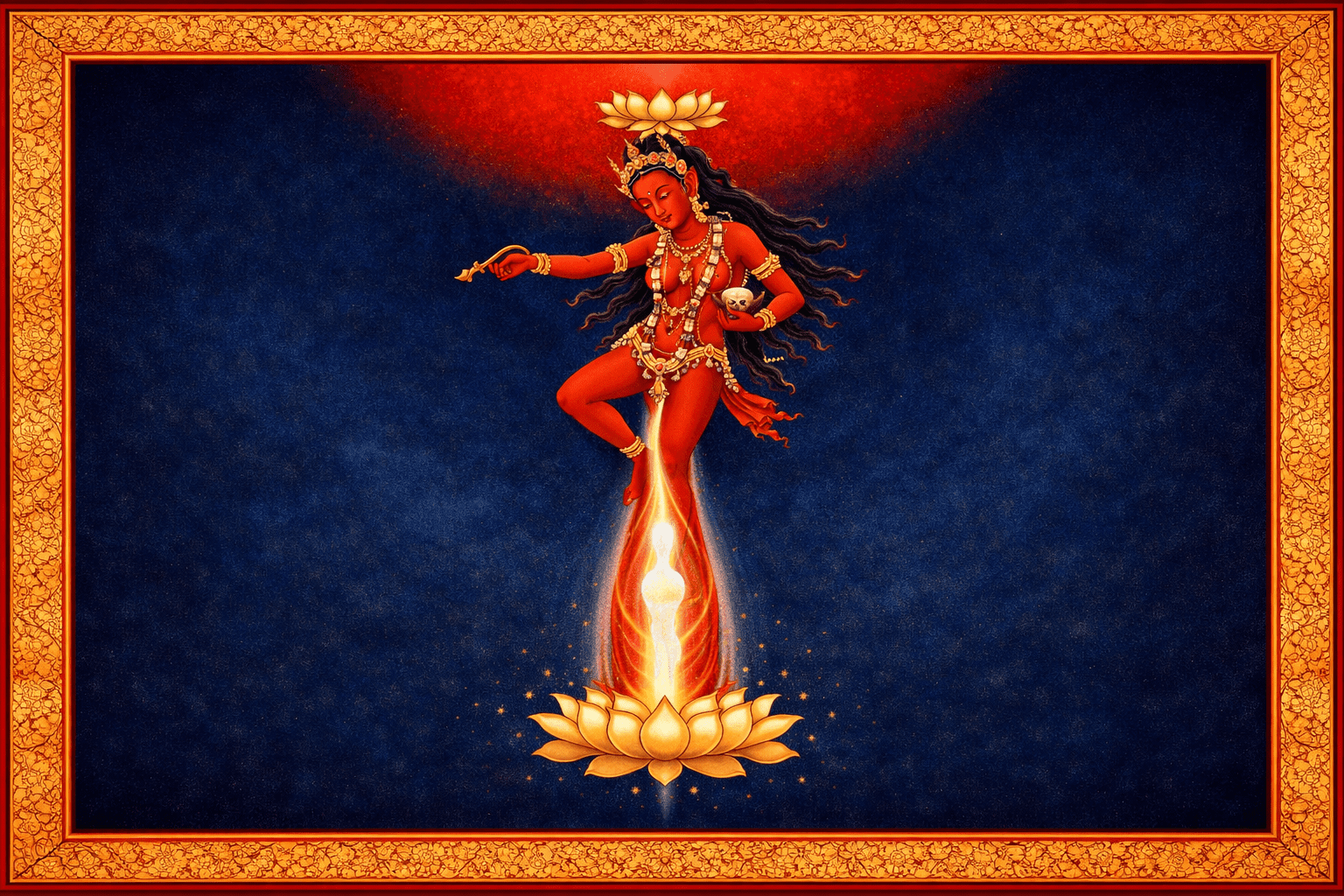
She is already there. At the crown. At the aperture — brahmarandhra (ཚངས་པའི་བུ་ག). Waiting. She has always been waiting. This is what she was born for — what she has always been for. The red Ḍākinī (མཁའ་འགྲོ་མ — mkha’ ‘gro ma) at the aperture, the iron hook extended, the HRĪḤ (ཧྲཱིཿ) already sounding in the space above the head. She does not need to be summoned. She needs to be recognised.
The Crown Aperture — The Gate That Was Always There
On the interactive map of the Black Crown (ཞྭ་ནག — zhwa nag), the Spinel sits at the apex. Its subtitle: the gate. The crown aperture — brahmarandhra (ཚངས་པའི་བུ་ག — tshangs pa’i bu ga) in Sanskrit, the opening at the very top of the skull through which consciousness exits in Phowa — is physically marked on the Karmapa’s ceremonial crown. It has been marked there for eight centuries. Every Black Crown ceremony performed by every Karmapa has been, among many other things, a pointing at this aperture. Here. This is where. This is how.
The seven petals of the lotus at the crown of the Black Crown are not ornament. They are the aperture itself — the iris of the camera of consciousness, the opening through which the light of awareness exits at the moment of Phowa. Seven petals. The aperture open. The destination written on the gate.
The Bhumpa (བུམ་པ — bum pa) — the ritual vase on the crown — carries the subtitle: the gate between ordinary mind and the Pure Land is permanently open. Not opened by the practice. Already open. The practice is the recognition that it has always been open. Phowa does not force consciousness through a closed door. It teaches consciousness to find the door it has always been standing in front of.
→ The Black Crown — Bhumpa and Spinel sections
The petals of the lotus are her fingers. The aperture is her invitation. She is the destination and the guide simultaneously — the one who receives and the one who calls. In the Karma Kagyu iconography she is red because she is the fire of awareness itself, the warmth at the centre of the practice, the colour of the life force rising toward the crown.
The Practice — HRĪḤ at the Heart, AH at the Navel
The Phowa practice in its Sambhogakaya form centres on two seed syllables and one visualisation. The AH (ཨཱ་ཿ) syllable sits at the navel — the base, the ground, the point from which the consciousness rises. The HRĪḤ (ཧྲཱིཿ) syllable sits at the heart — Amitabha’s seed syllable, the sound of the Pure Land, the resonance of the destination already present in the body. In the oral tradition we say SHRI; in the written transmission it is HRĪḤ. The syllable and the sound are one pointing.
At the heart centre, inside the central channel (རྩ་དབུ་མ — rtsa dbu ma) — like a knot in a length of bamboo, hollow, luminous, open at the crown — sits an eight-petalled red lotus. On it, a moon disc. On that, the seed syllable HRĪḤ, radiant, on the point of ascending.
Above the crown, in the space of the sky, Amitabha (‘od dpag med — འོད་དཔག་མེད) is visualised — red, seated, radiating the warmth of unconditional compassion. Below him, just above the crown aperture, Vajrayogini (རྡོ་རྗེ་རྣལ་འབྱོར་མ — rdo rje rnal ‘byor ma) stands — red, fierce, tender, the hook of compassion extended. Between her and the consciousness at the heart: the channel, the aperture, the direction.4
With the mantra and the visualisation established, the practice is the directed movement of consciousness — upward through the central channel, through the crown aperture, into the field of Amitabha’s awareness. Moving. The verb. The conscious enactment of what Phowa means.
The signs of accomplishment are physical and verifiable. After sustained practice, a small depression or indentation appears at the crown of the head — the aperture beginning to open from use. A flower placed there stands upright. In more advanced stages, a small amount of blood or lymph may appear at the crown. These signs are not metaphor. They are the body responding to the practice.5
When the signs appear the practice has found its direction. The gate is not just visible — it is open. She has accepted the invitation. The hook is already in the heart, already drawing. The question is no longer whether the practice works. The question is whether the recognition will hold at the moment it is needed.

The Three Results — And the Bodhisattva’s Return
Kalu Rinpoche was precise about what Phowa accomplishes, and honest about the gradations. According to the capacities and purity of the person who practises, it has three results.
At best — rebirth in a pure realm. The Dewachen (བདེ་བ་ཅན — bde ba can, Skt. Sukhāvatī) of Amitabha. This is the ticket Kalu described. The land of bliss. The formless ground of the Dharmakaya (ཆོས་སྐུ — chos sku) experienced as an environment of total recognition — no obscuration, no suffering, no confusion about the nature of mind. The door open in every direction.
If not — a god realm (ལྷའི་རིས — lha’i ris). Vast, luminous, free from ordinary suffering. Still conditioned. Still impermanent. Still not the final resolution. But spacious enough to continue the practice, to deepen the recognition, to prepare for what comes next.
If not — a human rebirth with good conditions for practising the Dharma. The precious human existence the Four Thoughts describe — rare, meaningful, equipped with the faculties and the circumstances to continue the path. Not paradise. Not permanent. But the ground for the work to continue.
In all three cases: the agonies of an unguided dissolution are avoided. The practice provides a direction where there would otherwise be only disorientation. This alone is Kalu Rinpoche’s teaching at Samye Ling in March 1983 — not a promise of paradise, but the gift of a direction at the moment direction is most needed.
And then — this, which is almost never said plainly in Western presentations of Phowa:
The pure realm is not the destination. It is the rest stop.
The Bodhisattva vow (བྱང་ཆུབ་སེམས་དཔའི་སྡོམ་པ — byang chub sems dpa’i sdom pa) does not end at Dewachen. The vow is to return — to come back into the conditions of confusion for as long as confusion remains, bringing the benefit of the practice back to all beings. The 1st Karmapa left a letter promising his return before he died. Seventeen Karmapas have kept that promise. The pure realm is where the Bodhisattva gathers strength, deepens recognition, rests in the open sky of the Dharmakaya — and then chooses the conditions of the next rebirth deliberately, consciously, in service of the vow.
My Lama always said: don’t stay too long. Time moves differently in the pure lands — one minute there is a hundred years here. The beings who need you are waiting. The vow is still running. The river still has waves to make.

The 16th Karmapa — The Dharmakaya Phowa
The highest form of Phowa requires no external direction. No visualisation of Amitabha above the crown. No mantra. No technique. The Dharmakaya Phowa (ཆོས་སྐུའི་འཕོ་བ — chos sku’i ‘pho ba) is the recognition of the nature of mind at the moment of death — the direct meeting of awareness with its own ground, without obstruction, without the need for a vehicle because the destination and the point of departure are recognised as never having been different.
The 16th Karmapa Rangjung Rigpe Dorje (རང་བྱུང་རིག་པའི་རྡོ་རྗེ, 1924–1981) demonstrated this at Zion, Illinois, in November 1981. The thukdam (ཐུགས་དམ — thugs dam) — the post-mortem meditative state in which the body remains fresh, warm at the heart, undecayed — was confirmed by attending physicians and students. He remained in that state for three days after the cessation of outer breath. Three days at the threshold. Three days of the door open. Then the signs appeared and the transmission was complete.

At the summer solstice in 1980, in Colorado, he had told his students to come back on the first day of the eleventh month of the following year. To bring friends. He was inviting them to his own cremation twelve months before he died, from a summer evening in Colorado, with complete knowledge of the date.
“Do not be bothered by death. Nothing happens.”6
For the 16th Karmapa the Dharmakaya Phowa was not a practice. It was the permanent condition of his awareness — the sky that the Black Crown’s midnight blue had always been pointing at. The crown aperture was not a gate he needed to find. He was already on the other side of it. He was already the sky.
→ Bardo — The Intermediate State
Ayang Rinpoche, Ole Nydahl, and the Living Transmission
Lama Ole Nydahl received the Phowa transmission from Choeje Ayang Rinpoche (ཨ་ཡང་རིན་པོ་ཆེ) of the Drikung Kagyu lineage, in 1972, at Rumtek Monastery in Sikkim — in the presence of the 16th Karmapa, who blessed the transmission and asked that it be brought to his Western students. Nydahl began teaching it publicly in 1987 at the request of Shamar Rinpoche, and has since guided more than 75,000 people through the practice.7
The complete practice text exists as a small booklet, trilingual — English, German, Spanish. It is not sold in bookshops. It is not available online. It is given by hand, in a Diamond Way centre, after the Lama has transmitted the practice. It is, in the most literal sense, a transmission text — words that are only fully legible to someone who has already received what the words are pointing at. The instructions without the transmission are a map without a compass. The transmission without the instructions is a compass without a map. Together, in the hands of someone whose Lama has given them both, they are the profound path of the transference of consciousness.
Pim van Lommel, M.D. — the Dutch cardiologist whose 2001 Lancet study on near-death experiences remains the most rigorous clinical evidence for non-local consciousness — endorsed Nydahl’s Fearless Death on its back cover, writing that the book could be of great help in daily medical practice in the Western world, where death is still a huge taboo. The cardiologist and the Buddhist teacher were describing the same territory from opposite sides of the same threshold. Van Lommel had the data. Nydahl had the transmission.8
The Phowa transmission is not something that can be received from a book or a website, including this one. It requires a qualified teacher, the proper empowerment, and the direct pointing that only transmission can provide. What these pages can do is prepare the ground — the same way the gong ter (དགོངས་གཏེར — dgongs gter) prepares the ground, the same way Misha prepared the ground in Hong Kong in 2011, before I knew what I was walking into.
The Hook of Compassion — For Misha
She is always in the room. Sometimes standing. Sometimes only her warmth — the red heat at the edge of the moment, the iron hook already present before it is seen. She was in the room in Hong Kong in 2011. She was in the room in 2023, on a phone line, with a nurse holding the receiver to a dying man’s ear.
There is a man this page is for.
His name was Misha. A yogi amongst the monks — the kind of practitioner who moves through the world with the Dharma so completely absorbed into his bones that it stops looking like religion and starts looking like the way a river moves. He knew things without needing to explain how he knew them. He laughed easily. He dragged people toward the practice the way water finds its level — not with argument, but with the simple gravity of someone who had already been there.
His life ran along the thread that Milarepa walked. Full of difficulties that were not obstacles to the practice but were the practice itself — given by existence, or by karma, or by a teacher who trusted him enough not to make it easy. The tower rebuilt. The cliff approached. The yogi shaped by what would have broken someone less committed. Misha was not broken. He was refined.
In 2011, Misha dragged me to Hong Kong for my first Phowa.
I did not know what I was walking into. I knew only that when Misha said come, you came. That was the transmission, before the transmission. The teacher was already working through him before I had met the teachings.
When the Lama introduced the red Dakini and the central channels, Misha smiled so wide. He leaned over and whispered: “It’s all connected.”
Twelve years later, in 2023, Misha was dying.
The nurse held the phone to his ear.
And I gave him the hook of compassion.
I said to him: Misha, the red Dakini is here. Amitabha is above your head. I recited the mantra for what seemed like hours. I reminded him of the central channel — the hollow bamboo, the arrow of light. When you are ready, you go up. OM AMI DEWA HRĪḤ.
The iron hook that Vajrayogini (རྡོ་རྗེ་རྣལ་འབྱོར་མ — rdo rje rnal ‘byor ma) extends at the moment of death — the red Dakini’s arm reaching across the threshold to receive the consciousness as it rises toward the crown — I had learned to offer that because Misha had brought me to the practice in the first place. The circle closed across twelve years, across a phone line, across the threshold between this life and whatever comes next.
Moving. That is what Phowa means. Kalu Rinpoche said it was a verb. In 2023, on a phone call, with a nurse holding the receiver to the ear of a dying yogi, I finally understood in my body what the verb means.
The practice is not preparation for a moment that may come. It is preparation for a moment that will come — for everyone you love, for everyone who loves you, for you. Misha knew this. He spent his life knowing it. And he died with someone on the other end of the line who knew it too, because he had made sure of it twelve years earlier in Hong Kong.
This is what transmission is. This is what it is for. Transmission completes the circle. It’s all connected — like the red band lining the Black Crown.
The red Dakini was in that room. She is always already in that room. She does not wait to be invited. She waits to be recognised.
The Red Band — Her Signature
In the 8th Karmapa Mikyo Dorje’s meditation, the dissolution moves through Highest Bliss — the blue Buddha Chakrasamvara (བདེ་མཆོག — bde mchog) — into light. What remains last, the final trace before the body dissolves into rainbow light, is the red form of the Wisdom Dakini.
The red, before the rainbow.9
The Black Crown (ཞྭ་ནག — zhwa nag) was woven by Vajrayogini from the hair of hundreds of millions of wisdom dakinis and bestowed upon the 1st Karmapa, Dusum Khyenpa, as a symbol of his realisation. The physical crown made by the Chinese emperor is the material replica of that original dakini-hair crown — midnight blue, gold-emblazoned, and at its edge, a red band.10
The red band that lines the Black Crown — that trace of warmth at the edge of the midnight blue — is, I believe, her signature. The dakini hair made visible in the physical object. She was there at the beginning of the crown’s origin. She is there in the dissolution sequence of the 8th Karmapa’s practice. She is there in the Phowa visualisation, standing at the crown aperture, the hook extended. She is there at the end of every life, receiving what is offered.
The hints are everywhere. In every meditation. In every empowerment. It’s all connected.
The Fourth Phowa — The Gate That Stays Open
For those without the formal transmission. For those who arrive at the threshold without the practice established. For those whose lives ran along different threads and who find themselves at the door without the map.
The fourth Phowa: the recitation of 500,000 Amitabha mantras. OM AMI DEWA HRĪḤ (ཨོཾ་ཨ་མི་དེ་ཝ་ཧྲཱིཿ). The seed syllable of the Pure Land, repeated until it is no longer a recitation but a direction — a vector established in the mindstream that, at the moment of dissolution, provides the same pointing that the formal practice provides through a different route.
My Lama taught this always alongside the other three. Not as a consolation for those who had missed the transmission. As a practice in its own right — available to anyone, requiring nothing but sincerity and the willingness to let the mantle of the mantra become the direction of the mind.
The practice rewards the kind of practitioner who trusts that the river reaches the ocean by flowing, not by leaping. The kind Misha was. The kind Milarepa was. The kind that knows the difficulty is the teaching and keeps moving anyway.
OM AMI DEWA HRĪḤ. She is in that sound. She is the resonance of it — the warmth, the red, the welcome that does not exclude. Five hundred thousand times the sound of the gate. Five hundred thousand times the recognition that the gate was always open.
One Taste — The Completion
This is the sixth practice. The last page. The completion of an arc that began with Tummo — with the inner fire, the warmth at the base, the recognition that the ground of the path is already present in the body. Every practice since has been a refinement of that same recognition, moving upward through the subtle body, through the central channel, through the dissolution sequence, through the bardo territory, arriving here at the crown aperture, at the gate, at the moment of moving.
The Six Dharmas are not a curriculum that ends with graduation. They are a single continuous practice that reveals itself progressively — each stage showing what the previous stages were always pointing at, each recognition making the next recognition possible. Phowa does not replace the other five. It completes them. It is the moment the entire system becomes operational. A dear friend once described it as the horseshoe in the glove — you don’t know what the glove is really for until the horseshoe is inside it.
In Mahamudra (ཕྱག་རྒྱ་ཆེན་པོ — phyag rgya chen po) we call this རོ་གཅིག (ro gcig) — one taste. The Tummo fire and the Phowa gate are the same recognition at different points in the arc. The inner heat rising from the navel and the consciousness rising through the crown aperture are the same movement in different registers. The fish pulled from the water and the fish arriving in the ocean are the same fish. The river and the ripples and the waves arise from the ocean itself. Misha knew this. He learned it the hard way, the Milarepa way, the only way that goes all the way through.
In the 8th Karmapa’s meditation the dissolution moves through blue light, through red light, into rainbow. In the Phowa practice the consciousness moves through the hollow bamboo, through the HRĪḤ, through the crown aperture, into Amitabha’s field. In the Bardo the child luminosity moves through the dissolution, through the blackout, into the meeting with the mother. Different registers. The same movement. The same recognition. The same gate.
And at the edge of the midnight blue — her red trace. Always.
Those who have received the Phowa transmission from a qualified Karma Kagyu teacher will understand this immediately. The rest is transmitted.
CONTINUE THE SIX DHARMAS
← Previous: Bardo — The Intermediate State
← Back to: Naropa — The Living Lineage of Awakening
← Back to: The Black Crown — Zhwa Nag
FOOTNOTES
1. Kalu Rinpoche, Secret Buddhism (Clear Point Press), p. 99. Kalu uses Phowa as a verb meaning ‘moving’ in the context of the transfer of consciousness at the moment of death.
2. Kalu Rinpoche, Secret Buddhism (Clear Point Press), p. 99. Samye Ling teaching, March 1983.
3. Kalu Rinpoche, Secret Buddhism (Clear Point Press), p. 77. Samye Ling teaching, March 1983.
4. The bamboo-arrow central channel visualisation is standard Karma Kagyu Phowa instruction. The image ‘like a knot in a length of bamboo’ appears in Karma Chakme’s Commentary on the Transference of Consciousness (Lotsawa House, lotsawahouse.org) and in multiple Phowa lineage texts.
5. The signs of Phowa accomplishment are described in Jamgon Kongtrul Lodro Thaye, Treasury of Knowledge (Tib. Shes bya kun khyab), Book Eight, Part Four, and in oral Karma Kagyu transmission. The physical indentation at the crown is the standard sign cited by Kalu Rinpoche and other Karma Kagyu masters.
6. Ole Nydahl, Fearless Death (Diamond Way Press, 2012), pp. 196–197.
7. Ole Nydahl’s official biography (lama-ole-nydahl.org): ‘Phowa (the Practice of Conscious Dying) from Ayang Rinpoche (1972).’ Nydahl’s own account: ‘Our method is the Drikung-Kagyu practice given by Ayang Tulku to Hannah and me in the presence of the 16th Karmapa in Rumtek, Sikkim in 1972 with the wish that I should teach it to our many friends.’ The 16th Karmapa’s blessing and commissioning of the transmission is the thread that connects it to the Karma Kagyu lineage.
8. Pim van Lommel, M.D., endorsement of Ole Nydahl, Fearless Death (Diamond Way Press, 2012), back cover. Van Lommel’s clinical research: ‘Near-death experience in survivors of cardiac arrest: a prospective study in the Netherlands,’ The Lancet, Vol. 358, December 2001, pp. 2039–2045.
9. The 8th Karmapa’s parents were, on a secret level, the Buddha Highest Bliss and the Dakini Red Wisdom. In his own visions he encountered ‘the blue Buddha Highest Bliss in union with the female Buddha Red Wisdom.’ (Buddhism Today, ‘A Look in the Life of the 8th Karmapa Michö Dorje’, buddhism-today.org.) The dissolution sequence — blue into red into rainbow light — is reflected in the structure of the practice itself.
10. Grokipedia, ‘Black Crown’: ‘According to longstanding tradition, the original Black Crown was manifested by the dakini Vajrayogini, who wove it from the hair of one hundred thousand dakinis.’ Dakinitranslations.com, translation of 8th Karmapa’s Praise to the Source of the Black Crown: ‘Hundreds of millions wisdom ḍākinīs of supreme activity, Created a splendid, deep blue crown.’
FURTHER READING & SOURCES
Kalu Rinpoche and Lama Lodü Rinpoche — Bardo Teachings: The Way of Death and Rebirth — Snow Lion Publications
Jamgon Kongtrul Lodro Thaye — Treasury of Knowledge (Shes bya kun khyab), Book Eight, Part Four — signs of Phowa accomplishment
15th Karmapa Khakyab Dorje — Chariot for Traveling the Path to Freedom — Phowa in the Karma Kagyu transmission
Ole Nydahl — Fearless Death — Diamond Way Press, 2012 — 16th Karmapa’s teachings, Colorado account pp. 196–197
Karma Chakme — Commentary on the Transference of Consciousness — Lotsawa House (lotsawahouse.org) — bamboo arrow central channel visualisation
Gerd Bausch — Radiant Compassion — 16th Karmapa’s bardo and Phowa activity
Science & Research
Pim van Lommel et al. — Near-death experience in survivors of cardiac arrest — The Lancet, Vol. 358, December 2001, pp. 2039–2045
Pim van Lommel — Consciousness Beyond Life — HarperCollins — endorsement of Fearless Death on back cover
Series Navigation
Six Dharmas of Naropa — Return to the Main Hub