
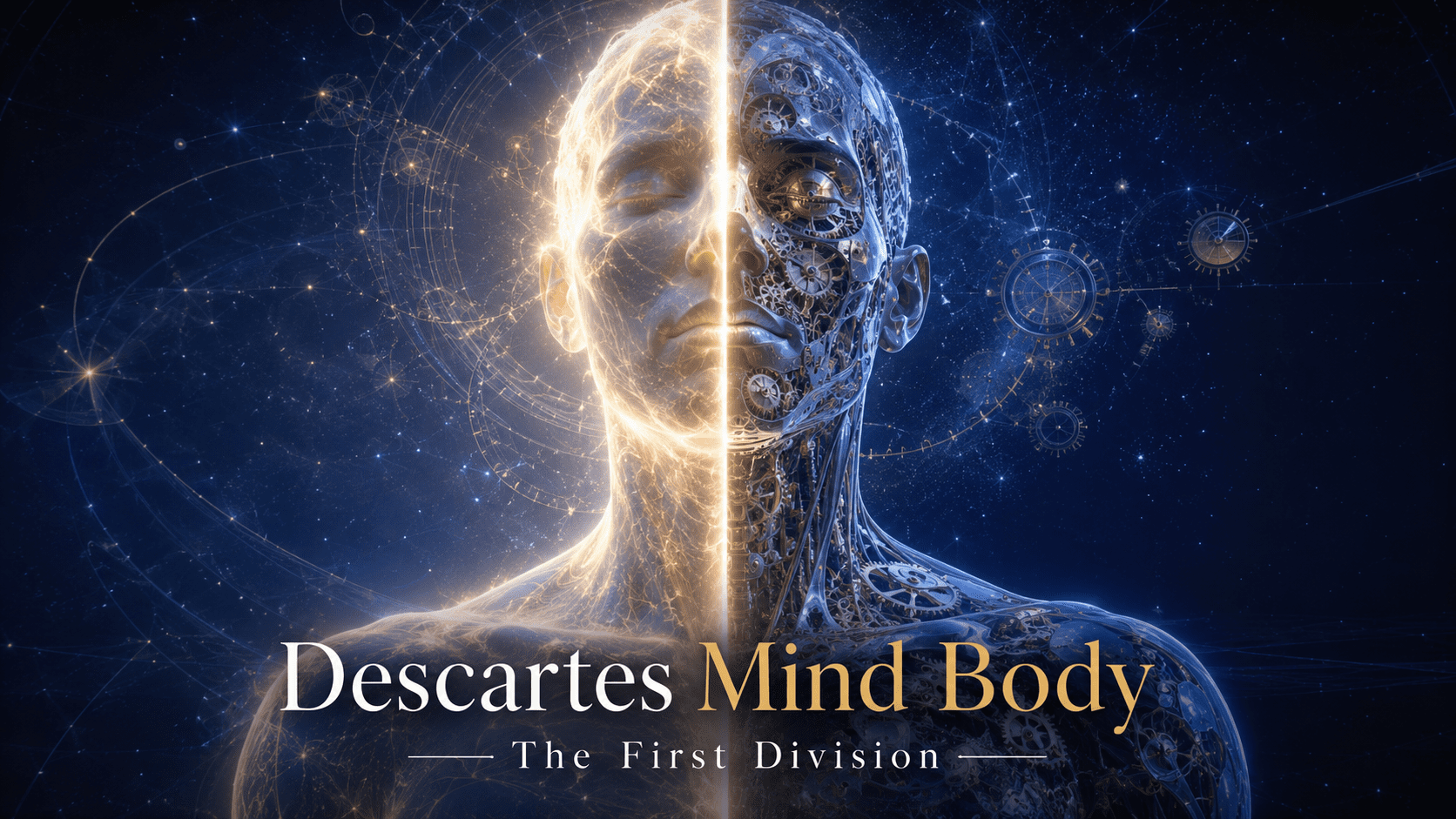
The Sixth Meditation is where Descartes mind body problem becomes the inheritance of western civilisation. Having sent God outside in the Third Meditation — the first division — Descartes now splits the human person itself in two. Mind and body declared categorically separate substances. Res cogitans and res extensa. The ghost and the machine. This is the second division, and it follows directly from the first. Once the self has been separated from its own deepest nature, the body becomes a problem — something the mind inhabits but is not, something that must be managed, treated, and eventually escaped. Western medicine, western psychiatry, and western neuroscience are all still working to close this wound.
The Vajrayana tradition, through the Six Yogas and the teaching of the body as temple, never made the split in the first place. Understanding why — and what it means that Descartes sensed he was wrong even as he wrote the Sixth Meditation — is what this page is about. And it is where the entire Descartes mind body series finds its resolution.
The Sixth Meditation — The Second Division
By the time Descartes reaches the Sixth Meditation, Cartesian dualism is effectively already established. The cogito declared the mind to be the one thing known with absolute certainty — a res cogitans, a thinking substance, whose entire essence is thought. The body, meanwhile, belongs to an entirely different category — res extensa, extended substance, occupying space, subject to mechanical laws, divisible and measurable in ways the mind is not. These are not two aspects of one thing. They are two genuinely distinct substances that happen to be joined in the human person.
The Sixth Meditation attempts to formally prove the existence of the external world and the body — and in doing so, to define precisely what the body is. What Descartes concludes is that the body is a machine. Not metaphorically. Literally. A clockwork mechanism of extraordinary sophistication, operating by the same mechanical principles as any other physical system. When the body is sick, it is like a clock that shows the wrong time — a machine functioning imperfectly. The res cogitans — the thinking substance, the self — inhabits this machine but is not made of it. Mind body dualism is now the foundational assumption of western thought about the human person.
This is the second division following directly from the first. In Part 4 of this series, self was divided from God — the infinite perfection found within the mind projected outward and declared external. Now mind is divided from body — the res cogitans declared to inhabit the machine of res extensa without being it. One root. Two wounds. The same original misrecognition multiplying through the structure of western philosophy.
Descartes Mind Body — The Machine and the Ghost
The Descartes mind body distinction rests on what he calls the real distinction — the argument that mind and body are really, genuinely, and completely separate things, not merely conceptually distinguishable aspects of one substance. The argument is straightforward: the mind can be clearly and distinctly conceived without the body, and the body without the mind. Since God can create anything that can be clearly and distinctly conceived, God could create a mind without a body. Therefore they are really distinct — two substances, not one.
— Descartes, Sixth Meditation
🏛️ “There is a great difference between mind and body, inasmuch as body is by nature always divisible, and mind is entirely indivisible… When I consider the mind — that is, myself inasmuch as I am only a thinking thing — I am unable to distinguish in myself any parts, but apprehend myself to be clearly one and entire.”
The res cogitans — the thinking, non-extended self — is indivisible, unlocatable in space, incapable of being measured or broken into parts. The body is all of these things. Cartesian dualism draws the sharpest possible line between them. The philosopher Gilbert Ryle, writing three centuries later, called this the ghost in the machine — and the phrase captures perfectly the bizarre metaphysical situation Descartes creates. A non-spatial, non-material mind somehow operating a spatial, material body. The Descartes mind body problem — how exactly these two categorically distinct substances interact — has never been satisfactorily solved within the western tradition. Because it cannot be. The division that creates the problem also makes the problem insoluble.
What the Descartes mind body split produces in practical terms is a civilisation that treats the body as an object to be maintained, improved, and eventually transcended — a machine that the real self, the res cogitans, happens to inhabit. The consequences run through every institution western culture has built around health, illness, and what it means to be human.
The Pineal Gland — Where Descartes Tried to Patch the Wound
The most revealing moment in the Sixth Meditation is not where Descartes makes the mind body dualism distinction — it is where he immediately senses that something has gone wrong and tries to walk it back. Having declared mind and body categorically separate substances, he faces an obvious problem. If they are genuinely distinct — if the res cogitans has no spatial properties and the body is pure mechanical extension — how do they interact at all? How does a thought move an arm? How does a thorn in the foot produce pain in the mind?
— Descartes, Sixth Meditation
🏛️ “Nature also teaches me by these sensations of pain, hunger, thirst and so on that I am not merely present in my body as a sailor is present in a ship, but that I am very closely joined and, as it were, intermingled with it, so that I and the body form a unit. If this were not so, I, who am nothing but a thinking thing, would not feel pain when the body was hurt.”
Descartes senses that the sailor-in-a-ship model is wrong — that the mind is not simply a passenger in the body-vehicle but is somehow genuinely intermingled with it. He proposes the pineal gland as the point of interaction — the single structure in the brain not duplicated on both sides, where the mind acts on the animal spirits and the body’s movements result. It is a remarkable piece of desperation from one of the greatest philosophical minds in history. He has made a division that his own lived experience tells him cannot be right, and he is trying to plug the gap with anatomy.
The pineal gland solution does not hold — as every philosopher who came after Descartes recognised immediately. If mind and body are genuinely distinct substances with categorically different properties, no amount of pointing at brain structures resolves the interaction problem. The Descartes mind body patch fails precisely because the division that required it was wrong.
The two stones were never separate. The string was always there. One could even say there is a very strong entanglement here — and not loosely. Quantum entanglement describes two particles that remain correlated regardless of the distance between them, such that what happens to one is instantly reflected in the other, with no classical mechanism of transmission required. Mind and body behave exactly this way. Work with the breath and the mind clarifies, work with prostrations — not because signals travel through the pineal gland, but because they were never two systems in the first place. The separation Descartes proposed, mind body dualism, was always a conceptual overlay on a reality that was not divided.
Two Stones on a String — The Tibetan Refutation

There is a traditional teaching in the Kagyu lineage — passed down through oral transmission without a single fixed text source, simply present in the stream of the teaching — that describes the relationship between mind and body as two stones tied together on a string. Throw one and the other follows. Pull one and the other responds. Work with one and you are always already working with the other. They are not the same thing — but they are not two things in the way Cartesian dualism requires them to be. Think “both and”.
This teaching is not a philosophical position arguing against mind body dualism. It is a description of direct experience that any meditator will recognise immediately. Sit still, straighten the spine, open the chest — and the mind clarifies. Let the breath deepen and slow — and mental agitation settles. Enter a state of concentrated awareness — and the body’s sensations become vivid in a way they are not in ordinary distracted consciousness. The body and mind move together not because of a pineal gland managing their interaction but because they are expressions of one underlying movement — the winds of prana, the energy of the life force, which is neither purely physical nor purely mental but the ground of both.
“Mind and body are like two stones on a string — throw one and the other follows. In meditation, when the mind settles, the body settles. When the body is open, the mind is open. You cannot separate them because they were never two things. Work with one and you are working with both. This is not a theory. Sit still for five minutes or do some prostrations and you will know it is true.”
— Traditional Kagyu oral teaching
What the two stones teaching points at is the Vajrayana understanding of lung — prana, wind, the breath-energy that carries consciousness. In Tibetan medicine and in the tantric system of subtle body anatomy, mind and body are understood as aspects of one system of channels, winds, and drops — tsa, lung, thigle. Cartesian dualism cannot get purchase on this model because the model never draws the line Descartes draws. The body as temple is not a poetic description. It is a technical one. The body is the vehicle through which awakening happens, the instrument through which the nature of mind is recognised, the temple in which the divine practice lives.
The Body as Temple — Six Yogas and Two Divisions Healed

The Six Yogas of Naropa are the direct practical answer to Cartesian dualism — though they were transmitted centuries before Descartes was born. Tummo, the yoga of inner heat, works directly with the body’s channels and winds to generate a state in which the nature of mind becomes recognisable. Illusory body practice reveals that the body’s apparent solidity is a construction — not because the body is unreal but because its nature is not what ordinary perception takes it to be.
Dream yoga and sleep yoga extend the practice into states where the body is ostensibly absent — and finds that awareness is not. The body as temple is not a metaphor in any of the Six Yogas. It is the literal working space of liberation or the Technology of Meditation.
“All the suffering, all the confusion of samsara arises from seeking a true reality where none exists — from the elaborations of a mind that cannot rest in its own nature. When prapañca ceases, when elaboration falls silent, what remains is not nothing. It is the clear light of mind itself.”
— Nagarjuna, Mūlamadhyamakakārikā — closing verses
Saraha is not making a devotional statement. He is reporting a direct recognition — that what every pilgrim travels across the world to find is already present in the very body they travel in. The body as temple is the experiential refutation of Cartesian dualism from the inside. Not a philosophical argument against mind body dualism but a direct recognition that renders the division impossible to maintain.
The Six Yogas teach that the body is not a machine the mind inhabits. It is the ground in which the winds of prana move, carrying consciousness. It is the vessel in which the channels hold the conditions for recognition. It is the temple in which the clear light arises. Every one of the Six Yogas uses the body as the path — not in spite of the body being physical but because of it. The tantric reframe of the Descartes mind body problem is not a philosophical counter-argument. It is a practice. Sit. Breathe. Work with the channels. And discover in your own experience that the string between the two stones was never cut.
Two divisions. One recognition. In the Third Meditation, Descartes found infinite perfection inside his own mind — buddha-nature knocking from within — and sent it outside. In the Sixth Meditation, he found the inseparability of mind and body — the two stones bound by the string of prana — and declared them separate substances. Both divisions came from the same root: a framework that could not permit what direct experience was showing him. The Church behind him, the Inquisition visible on the horizon, and a philosophical tradition that had no language for what he was actually touching.
The Vajrayana heals both divisions in the same recognition. When the nature of mind is recognised directly — through the practice of shine and lhaktong, through the Six Yogas of Naropa, through Mahamudra pointing out — nothing is sent outside, nothing is split. The infinite perfection that Descartes found in the Third Meditation is recognised as the nature of the mind doing the finding. The body that Descartes tried to separate from the mind in the Sixth Meditation is recognised as the temple in which the recognition happens. God returns from the inside out. Mind and body return from their division. The wave recognises it was always the ocean. Not because an argument succeeded. Because nothing was ever wrong — only unrecognised.
QP
GO DEEPER
IN THIS SERIES:
← Part 1 — Doubt, Nihilism, and the Buddhist Void
← Part 2 — The Cogito and the Inseparable Thinker
← Part 3 — Consciousness, God, and the Nature of Mind
← Part 4 — Truth, Certainty, and the Vajrayana View
← Part 5 — Essence, Existence, and Buddha-Nature
Part 6 — Mind, Body, and the Tantric Reframe , You are Here.
ON QUANTUM AWARENESS:
→ What Are Shine and Lhaktong?
FURTHER READING:
→ Meditations on First Philosophy — Free Full Text
→ Stanford Encyclopedia — René Descartes
→ Stanford Encyclopedia — Dualism
→ Stanford Encyclopedia — The Mind-Body Problem
→ Lotsawa House — Six Yogas of Naropa
→ 84000 — Translating the Tibetan Canon
Leave a Reply