
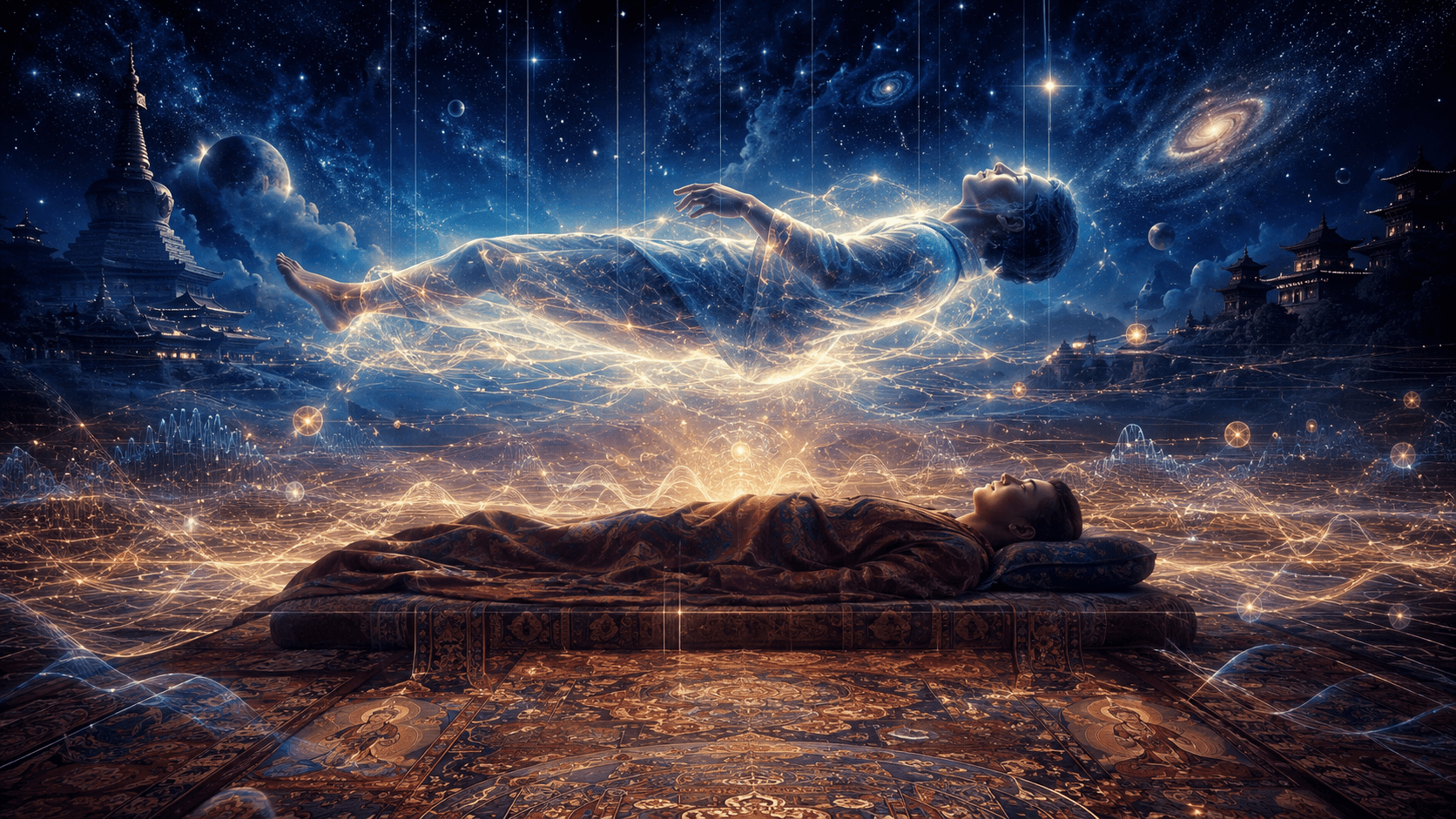
Lucid dreaming is not a New Age concept. It is a measurable neurological event, verified in a sleep laboratory at Stanford University in the early 1980s.
Stephen LaBerge’s subjects pre-agreed on a sequence of eye movements. While their EEG confirmed REM sleep, their eyes moved exactly as planned — a signal from inside the dream, received in the waking world. The impossible, proven real.
The Tibetan masters mapped the same territory over a thousand years earlier. They called it Milam — dream yoga. They were not interested in proof. They were interested in practice.
📺 Now With Video
The door William James left open
In the last episode we sat with William James and his filmiest of screens — his conviction that ordinary waking consciousness is just one form of consciousness, and that adjacent to it, separated by the thinnest possible membrane, lie forms of experience most people never enter.
Sleep is one of those membranes. Every night the continuity of self that has been running since you woke up this morning will dissolve. Your name, your history, your sense of where you end and the world begins — all of it will temporarily disappear.
Most people call it sleep. The Tibetan masters called it a doorway.
The question this episode asks is simple: what happens if you walk through it consciously?
LaBerge, Milam, and the same map

LaBerge’s Stanford sleep laboratory gave us something no previous era of contemplative practice had: external verification. Dreamers signalling from inside confirmed REM sleep. Real-time communication across the threshold most people cross unconsciously every night.
What the laboratory could not give us was a map of where to go once you were through the door.
The Tibetan tradition of dream yoga — Milam in Tibetan — had been building that map for over a thousand years. Not as speculation. As a curriculum with levels, progressions, and a very specific goal that has nothing to do with flying or controlling dream content.
The goal is recognition. The recognition that the luminous awareness present in the dream state is the same luminous awareness present in waking life. And that both are expressions of something that does not sleep.
Four levels of lucid dreaming practice — and a fifth

This episode gives you four levels of practice you can begin tonight.
The first level is stabilisation — the hands technique, the most reliable anchor for maintaining lucidity once you recognise you are dreaming. The second is intentional entry — LaBerge’s MILD technique, mnemonic induction of lucid dreams, adapted for consistent use. The third is the Tibetan preparatory practices — the specific visualisations and postures the Milam tradition uses to enter the dream state with awareness already engaged. The fourth is the Milam move itself — the pointing-out instruction the tradition has transmitted practitioner to practitioner for over a thousand years.
The fifth level is not a technique. It is where the map stops having labels.
We point toward it. The rest is practice.
FULL TRANSCRIPT
Prefer to read? The full transcript is available below. But I recommend listening first – my delivery adds context that’s hard to capture in text.
QUANTUM AWARENESS
Sound is Emptiness — Emptiness is Sound
Episode 13
PART 1 — (~22 MIN)
[GONG]
[OM CHANTING IN — 10 seconds]
COLD OPEN
Tonight, something will happen to you that happens every single night of your life.
You will leave.
Not the room. Not the house. You — the continuity of self that has been running since you woke up this morning — will dissolve. The voice in your head will go quiet. The story of your life will pause. And something else will take over.
Most people call it sleep.
The Tibetan masters called it a doorway.
The question they were asking — the question this episode is about — is whether you walk through it consciously. Or just fall through it in the dark.
By the end of this episode you will have something real to do tonight. Not a concept. Not a philosophy. Something you can take into the dark with you and use to fly.
Let’s go.
[OM CHANTING OUT] [MUSIC FADES]
Welcome back to Quantum Awareness — Sound is Emptiness, Emptiness is Sound. I’m QP, your Quantum Preceptor.
EARLY CTA
Before we begin — I would love to reach 500 subscribers and every single one of you got us here so far. I have a big thank you. If this conversation is reaching something real in you, share it with one person who might be ready to hear it. It costs nothing and it means everything. Thank you.
SECTION 1: THE NIGHTLY DISAPPEARANCE
Here is a fact that should stop you cold.
Every single night, the self disappears.
Not metaphorically. The electroencephalograph — the EEG — goes into deep slow wave sleep and the coherent signal that we associate with a continuous, aware self simply stops. The default mode network — the brain’s storytelling system, the thing that generates the running narrative of I — powers down. Whatever you think you are, that thing takes a break.
And nobody told you. You’ve been dying a small death every night your whole life and it’s filed under unremarkable.
The question that the Tibetan tradition has been asking for over a thousand years is: who notices? When the self steps out — what remains?
That question is the spine of everything that follows.
SECTION 2: WHAT LABERGE FOUND
In the early 1980s, a psychophysiologist at Stanford University named Stephen LaBerge did something that should have been impossible.
He proved that people could be consciously aware inside a dream — and communicate from inside it — while their body was verifiably asleep.
His subjects trained in lucid dreaming — the ability to know you are dreaming while the dream is happening. When they achieved lucidity inside REM sleep, they signalled to the lab using pre-agreed eye movements. Left-right-left-right. The polysomnograph confirmed: body asleep, REM state active, eyes moving deliberately. Conscious signal from inside the dream.
Let that land.
A sleeping person, locked inside a dream, choosing to move their eyes in a specific pattern — and the signal arriving in a Stanford laboratory. Awareness operating inside a state we had written off as unconscious.
LaBerge went further. Brain scans of lucid dreamers showed that during lucid dreaming, the prefrontal cortex — the seat of self-awareness and executive function — lights up almost identically to the waking state. The dreaming brain, when it knows it is dreaming, is functionally awake.
Which raises the obvious question. If the dreaming brain can be as awake as the waking brain — what exactly do we mean by awake?
LaBerge had just handed science a crack in the wall. On the other side of that crack, the Tibetan masters had been living for centuries.
SECTION 3: WILLIAM JAMES PASSES THE THREAD
In our last episode we spent time with William James — the father of American psychology, the man who knew that the proof of any inner work is its fruits.
James wrote something that didn’t get nearly enough attention. He said that our ordinary waking rational consciousness is just one special type of consciousness — and that all around it, separated from it by the filmiest of screens, there are entirely different forms of consciousness waiting.
The filmiest of screens.
He left the door open. He didn’t know what was on the other side. He just refused to close it.
The Tibetan tradition walked through that door a thousand years before James was born. And what they found there wasn’t mysticism. It was a map.
SECTION 4: THE TIBETAN MAP OF SLEEP
The Tibetan tradition identified three states of consciousness with a precision that took Western neuroscience until the twentieth century to begin approaching.
Waking mind. Dream mind. Deep sleep.
And they didn’t stop at naming them. They mapped the dissolution sequence — what happens as you fall from waking into sleep — in exact detail. The progressive withdrawal of awareness from the senses. The arising of the dream state. The dissolution into deep sleep where even the dream dissolves.
More than that — they identified each state as a doorway into a dimension of reality.
Waking consciousness corresponds to the Nirmanakaya — the form dimension, the world of ordinary appearances. The dream state corresponds to the Sambhogakaya — the dimension of subtle form, of energy and light. Deep dreamless sleep corresponds to the Dharmakaya — the ground state, the open field prior to all form.
Every night, without practice, without a teacher, without a single day on retreat — you pass through all three. You dissolve through the Nirmanakaya into the Sambhogakaya into the Dharmakaya and back again. You do it automatically. You do it like breathing.
The masters asked: what if you did it consciously?
SECTION 5: THE HANDS
So, I need to tell you something personal.
For as long as I can remember — since childhood — I have been able to dream differently from other people. For years I thought I was just creative. That my mind was particularly vivid at night and in the early morning, ok especially in the early morning! I didn’t have a name for it. I didn’t know it was unusual. It was just how sleep worked for me.
Then one summer — I was a young adult, somewhere in the interior of British Columbia — I found myself at a gathering that had more going on than music and dancing. There were talks. Workshops. People taking consciousness seriously in a way I hadn’t encountered before. And I met someone very interesting.
He was younger than me. Which made what happened stranger still. We got talking after one of the sessions and I started describing what happened to me at night — the awareness inside the dream, the knowing that it was a dream, the ability to move within it deliberately.
He looked at me and said: you know people have been doing this for thousands of years.
I didn’t know.
He taught me something that night. Something so simple it sounds almost too simple to be the door to everything.
Before you sleep, look at your hands. Really look at them. Hold them in front of your face and say: these are my hands. And when I see my hands in my dream, I will know that I am dreaming.
Ten times. Slowly. With full intention.
I still remember his face. The way he said it — not as information, as transmission. And I still do this practice. Because it works. Because the waking mind and the dreaming mind are not as separate as we think. An instruction planted with clarity and repetition in the waking state follows you through the door.
I never learned his name. I hope he knows what he gave me.
SECTION 6: THE FOUR LEVELS — AND WHAT LIES BEYOND
So let me give you what he gave me. And more.
The first level is the hands. You already have it. Tonight, before you sleep. Ten repetitions. Full intention. Plant the recognition trigger.
The second level is the daytime practice. The hands technique only fully works at night if you’ve been doing it during the day. Every time you look at your hands during waking hours — really look, count your fingers, notice the detail — ask yourself: am I dreaming? You won’t be. But the habit of asking follows you into sleep. And one night, inside the dream, you will ask it and the answer will be different. LaBerge formalised this as MILD — Mnemonic Induction of Lucid Dreams. The Tibetan tradition knew it as maintaining the recognition thread between states. Same practice. Different centuries.
The third level is wake back to bed. Set an alarm for five or six hours after sleep. Wake up. Stay awake for twenty to thirty minutes — read something about lucid dreaming or dream yoga, hold the intention clearly in mind. Then go back to sleep. You re-enter REM sleep with the prefrontal cortex already partially activated. LaBerge documented this extensively. The Tibetan tradition schedules early morning practice for exactly this reason — the mind at that threshold is already thin. The door is already ajar. And for me, I just did this naturally, I didn’t control or train it, I just did it.
The fourth level is what to do when it happens. Because most people achieve lucidity for the first time and immediately wake up from excitement. The stabilisation techniques: spin the dream body, rub the hands together inside the dream, fix your gaze on a specific detail in the dream environment. These keep the REM state stable. But then — and this is where Milam diverges from everything Western lucid dreaming offers — you stop directing the dream. You don’t fly. You don’t transform the landscape. Don’t get me wrong here all of that is really fun, but! You turn the lucidity back on itself. You ask: who is watching this?
[PAUSE]
The dreamer looks for the dreamer.
[PAUSE]
That is the Milam move.
[PAUSE]
That is the practice that has no ceiling.
[PAUSE]
And then there is a fifth level.
I’m going to name it. I’m not going to teach it here — not because it’s secret but because it requires more than a podcast episode. It requires a teacher, a lineage, and a body of practice behind you before it opens properly.
As you fall asleep there is a sequence. Lights. Geometric patterns. The sense of falling. Voices without a source. Most of us pass through this unconsciously every single night. The Tibetan masters called this the Bardo of falling asleep — a transitional state as real and as mappable as any waking experience. The practice of remaining aware through this sequence — not following it, not suppressing it, just watching it arise and dissolve — is the doorway into what the tradition calls the Clear Light. The ground of being. The Dharmakaya that the sleeping mind touches every night without knowing it.
If you reach that — and it takes years of sustained practice to reach it reliably — what you find is not a dream. It is the awareness that was always underneath the dream. The same open field that Mahamudra points to in waking practice. Recognised now in sleep.
That is where this path leads.
I’ll put everything you need to begin the practice on the Quantum Awareness site. The Milam page is waiting for you.
CLOSE
So here is where we land.
Every night, without exception, the door opens. It has been opening your whole life. You fall through it asleep, you come back in the morning, and the extraordinary territory in between gets filed under dreams and forgotten by breakfast.
LaBerge proved the territory is real. The Tibetan masters mapped it. And the map they drew leads somewhere that no sleep laboratory has fully measured — to the recognition that the awareness watching the dream is the same awareness that watches your thoughts, your sensations, your entire waking life.
That awareness has never been asleep. It doesn’t need to.
[PAUSE]
Tonight when you close your eyes — look at your hands. Say the words ten times. Slowly. With intention. And somewhere in the night, when the dream shifts and something clicks into place, don’t wake up.
Stay. Look around. Ask the nightmare what it wants.
If you find yourself falling — don’t grab, don’t struggle.
[PAUSE]
Be fearless. Turn toward it.
[PAUSE]
Open your eyes wider and see what the dream is trying to show you.
[PAUSE]
NEXT EPISODE BRIDGE
In the next episode we go further.
The territory that Level 5 points toward — that Clear Light at the base of sleep, that open field beneath all dreaming — some people have stumbled into it not through years of practice but through a single night of chemistry. In an hour. Without a teacher. Without a lineage. Without any preparation at all.
What that means. What it produces. What it confirms — and what it cannot replace.
That is where we go next.
Until then — sleep well. And pay attention, to the one who is dreaming.
LIKE & FOLLOW CTA
If this landed for you — share it with someone who needs it. Subscribe wherever you listen. And if you want to go deeper tonight, the Milam page on QuantumAwareness.net has everything you need to begin the practice. I’ll link it directly in the show notes.
Catch you next time, dreaming or not.
[GONG]
[OM CHANTING OUT — 10 seconds]
FULL TRANSCRIPT
Prefer to read? The full transcript is available below. But I recommend listening first – my delivery adds context that’s hard to capture in text.
QUANTUM AWARENESS
Sound is Emptiness — Emptiness is Sound
Episode 12: The One Thing Nobody Can Do For You — William James and the Proof of the Path
[GONG]
[OM CHANTING BEGINS, FADES IN]
COLD OPEN
Let me tell you something that nobody in the spiritual world likes to say out loud.
Buddhism alone cannot do it for you. You don’t say a few mantras and whoosh, your world changes. It’s not magic.
Your teacher cannot do it for you. Your sangha cannot do it for you. The most beautiful teaching ever given, the most precise map of the mind ever drawn, the most compassionate tradition in human history — none of it can do the one thing that actually matters.
It cannot sit on the cushion for you.
It cannot walk through the door for you.
It cannot cultivate kindness in your heart, or patience in your nervous system, generosity in your hands or wisdom in your mind. Not for you. Only you can do that.
By the end of this episode you will understand why that is not a burden. It is the most liberating thing the dharma ever said.
Our guide today is a Harvard professor who nearly lost his mind, found it again, and spent the rest of his life trying to understand what had happened. Sounds like my kinda guy. His name was William James. And he had a word for the proof of any spiritual path that I think is the most honest word anyone has ever used.
He called it the fruits.
[MUSIC FADES OUT]
Welcome back to Quantum Awareness — Sound is Emptiness, Emptiness is Sound — where we explore the fascinating intersection of quantum mechanics, neuroscience, and Buddhist philosophy. I’m QP, your Quantum Preceptor.
EARLY CTA
Before we begin — if these conversations are reaching something real in you, please follow, like, and share with one person who might be ready to hear it. We are building something here together. Your engagement makes it possible. I’m very grateful.
SECTION 1: A FACE I STILL REMEMBER
A few years ago I wrote a post on this site called Your Local Buddhist Centre Is Not a Replacement for Your Therapist. I still stand by every word of it. But a reader responded — a woman who described herself as bipolar — and she said something that has stayed with me ever since.
She said it felt like I was painting a picture without hope.
I still remember her face. Even though I don’t know her. We’ve never met. But I remember the face I imagined as I read her words — someone reaching for something real, being told carefully and kindly that the door might not be open for her.
I wrote back. I told her that the Buddhadharma is so multifaceted that there is something for everyone — you just need to find it. That was true. But today I want to give her — and everyone like her — the fuller picture. Because that post said what not to do, but it didn’t say what the work actually is, or why it’s worth doing, or what it produces in a human life when it’s done honestly.
That’s what today is about.
SECTION 2: WILLIAM JAMES — THE MAN WHO LIVED THE QUESTION
William James was born in New York in 1842. His brother Henry became one of the great novelists in the English language. William became something harder to label — a doctor who never practised medicine, a philosopher who distrusted pure abstraction, a psychologist who thought psychology was only just beginning to ask the right questions.
And he suffered. In his twenties, he went through a crisis so severe that for a period, he could barely function. He described it as a pit of insecurity — a terrifying sense that reality had no ground, that the self was a fiction, that nothing held. He sat with it. He didn’t run. Slowly, he came through.
And what that crisis left him with was a question he spent the rest of his life pursuing with total honesty: what actually is the mind?
Because here is the thing about going to the edge of your own consciousness involuntarily — it raises a question that comfortable people never have to ask. If the self that I took myself to be can dissolve like that, what exactly was it? And what remained when it did?
As a mature philosopher, with that question burning, James went further. He began experimenting with nitrous oxide — not recreationally, but as a rigorous investigator trying to map the territory he had glimpsed in his crisis. He wanted to know: is ordinary waking consciousness the full extent of the mind? Or is it, as he suspected, just one thin layer of something vastly larger?
What he found confirmed his suspicion. The boundary between self and world dissolved. The sense of a separate, solid, observing self — the narrator we all take ourselves to be — flickered and disappeared. And what remained was not nothing. It was something he spent years trying to describe accurately.
Now — I want to be careful here. James was not advocating a chemical path. He was using every tool available to a nineteenth century philosopher to investigate a question. And what the investigation showed him was not an answer. It was a territory. A vast, mostly unmapped territory of consciousness that ordinary waking life barely touches.
The chemical door opened the window. It did not build the house.
For that — he turned to the contemplatives. To the mystics and monastics who had been mapping that territory for centuries without chemistry, through sustained, disciplined inner work. And what he found there became his masterwork — The Varieties of Religious Experience — in which he documented hundreds of genuine inner transformations and asked: what do they have in common? What makes the difference between a transformation that holds and one that doesn’t?
His answer was simple and ruthless.
He called it the fruits.
The proof of any spiritual experience, any inner work, any transformation — is not how it felt. It is not how profound the insight was, how blissful the meditation, how many books you’ve read or retreats you’ve attended. The proof is what it produces in your life. What it produces in your relationships. What flows out of you toward other people.
By that measure — and I think James was right — nothing counts except what you actually do with it. If it doesn’t change how you live, how you treat people, what flows from you toward the world — you have been, as he would say, merely visiting. And visiting, however beautiful, is not the same as arriving.
SECTION 3: NOBODY DOES IT FOR YOU
Here is the thing about the Buddhist path that is both its greatest beauty and its most demanding truth.
The Buddha pointed at the moon. He didn’t hand you the moon. He pointed.
Every teaching, every practice, every retreat, every moment of transmission from teacher to student — all of it is pointing. Refined, compassionate, sophisticated pointing toward something you have to turn and look at yourself. With your own eyes. In your own mind. In your own life.
The Six Paramitas — generosity, ethical conduct, patience, joyful effort, meditation, wisdom — are not commandments. They are recommendations. Invitations. Descriptions of what a waking mind naturally begins to do. But the doing — that is yours.
I have to sit on the cushion. Not my teacher. Me.
I have to cultivate patience when someone cuts me off in traffic, or says something that lands wrong, or when my own mind is doing that thing it does at 3am. Nobody can cultivate patience in me. It has to be grown, slowly, through repetition, through noticing, through choosing again and again the wider response over the reactive one.
I have to walk through the door.
There is a story about Milarepa and his student Gampopa that I think is the most honest teaching on this subject ever given — and it has the advantage of being completely true.
Gampopa was leaving his teacher for the last time. He had studied, practised, sat, endured. And as he prepared to go, he waited for the final transmission. The secret teaching. The thing that would be placed in his hands to carry with him.
Milarepa called him back.
Gampopa turned around thinking — this is it.
Milarepa lifted his robe and showed his student his backside — covered in calluses from decades of sitting on bare rock.
That is the transmission. Not a secret. Not a hidden teaching whispered at the last moment. Just the evidence of a human body that had done the work. Over and over. Without anyone doing it for him.
Sit. That’s the teaching. Nobody does it for you.
This is where James’s pragmatism cuts right to the bone. He wasn’t interested in what you believed. He was interested in what you did. Not the meditation you planned to do, the retreat you’re going to book, the teaching you’re going to receive. The actual sitting down. The actual looking. The actual work.
Because without that — without the actual doing of it — nothing changes. The most beautiful map in the world doesn’t move you an inch closer to the territory. If you don’t take agency, if you don’t act, by yourself — the map stays a map.
SECTION 4: CLEANING UP THE DREAM
Now here is where my Lama’s teaching comes in. And it is one of the most practical pieces of wisdom I have ever received about this path.
It is much easier to wake up from a good dream than from a bad dream.
You know this from experience. When you’re deep in a nightmare, the dream has its hooks in you. It feels completely real. You fight it even in your sleep. Waking up from a nightmare is violent — you’re pulled out gasping, heart pounding, the body still responding to a threat that was never there.
A good dream releases you gently. You float up into awareness. There’s no struggle.
Now apply that to the spiritual path. Awakening — genuine awakening, the recognition of the nature of mind — is at its root a waking up. The self that you took yourself to be is recognised as a dream. The ego construction, solid and real as it seemed, is seen through.
The inner work — the psychological work, the shadow work, the honest looking at what’s in the basement of your own mind — that is cleaning up the dream. Not because you’re broken. Not because you need to fix yourself before you’re worthy of the path. But because a cleaner, lighter dream releases you more gently into waking.
And the contemplative traditions took this further than metaphor. They said — what if you could become aware, inside the dream, that you are dreaming? Not just clean up the dream. Not just make it lighter. But actually recognise, from within the dream state itself, that it is a dream. That moment of recognition — that’s not just a sleep phenomenon. That is the very mechanism of awakening. And it turns out — it can be trained.
That is where we are going next time. But first — the work that makes it possible.
This is why the Buddhist centre isn’t a replacement for the therapist. And equally, the therapist isn’t a replacement for the cushion. They are doing different work at different levels — one is cleaning up the dream, one is waking you from it. Both matter. And nobody can do either one for you.
SECTION 5: THE SURPLUS — WHERE THE PARAMITAS COME FROM
So why do the work? If it’s hard, if nobody can do it for you, if it asks everything of you — why?
Here is the answer that James found in every case of genuine transformation he documented. And it’s the answer the Buddhist tradition has always given, though it’s easy to miss when you’re focused on the practice itself.
You do the work so that you have something left over. Surplus. To give.
Freely.
You cannot help others while confused and disturbed yourself.
A mind that hasn’t done its work is a mind that is fully occupied with itself. With its wounds, its defences, its stories, its fears. There is nothing wrong with that — it’s the human condition. But there is nothing spare in it either. Every drop of energy is being used to manage the inner weather.
But a mind that has sat on the cushion, that has looked honestly at what’s in the basement, that has slowly, patiently, repeatedly chosen the wider response over the reactive one — that mind begins to have capacity. Quiet. Space. And from that space, something flows outward naturally.
This is the surplus. And this is the heart of the Paramitas.
If you’ve spent time on this site, you’ll know I’ve written about the Six Paramitas — generosity, ethical conduct, patience, joyful effort, meditation, and wisdom. Each one its own page, each one its own door. I’ll link them all in the show notes. But here is something those pages don’t fully say.
These are not practices you perform. They are not items on a checklist. They are not virtues you strain toward through gritted teeth.
They are what naturally overflows from a mind that has done its work.
Generosity isn’t something you decide to practice. It’s what happens when you’ve stopped hoarding yourself — when the inner scarcity has been met, examined, released. Then giving becomes as natural as breathing.
Patience isn’t something you sustain through willpower. It’s what remains when the reactive ego has been quietly, consistently, honestly worked with over years of sitting. Then patience isn’t an effort. It’s just what’s there.
Compassionate activity isn’t performed. It’s what overflows when you’ve sat with enough of your own pain to recognise it in someone else’s face.
You cannot give what you don’t have. But a mind that is genuinely cleaner, quieter, more awake — that surplus flows outward without effort. That is the fruit. That is what James was looking for. That is what the Paramitas actually are.
This is the technology of compassion.
SECTION 6: THE FACE I REMEMBER
I want to come back to her. The woman who said I was painting a picture without hope.
I wrote back early on a Saturday morning. And I want to be honest about what I actually said — because it matters.
I didn’t just offer generic comfort. I told her that the path she had been trying to walk might not be the right door for her. Not because the dharma wasn’t available to her. But because the Buddha gave 84,000 teachings for exactly this reason — consciousness arrives in this world in 84,000 different conditions, carrying 84,000 different wounds, needing 84,000 different medicines.
The medicine this podcast is largely about — the rigorous, demanding, show-up-every-day Vajrayana path — that was not her medicine. Not yet. Maybe not ever. And saying that clearly is not a rejection. It is the most compassionate thing a teacher can do.
What she needed was a different door. Walking meditation. Gentle Theravada practice. Yoga. Somatic bodywork. Body-based, grounded, soft. The kind of practice that meets a fragile nervous system where it actually is — not where the tradition expects it to be. The kind of dharma the Buddha gave to people who needed to start with the body, with the breath, with the simple physical fact of being alive before anything else.
I told her that. Imperfectly, the way all human communication is imperfect. But I told her.
I don’t know if it helped. I hope it did. I think about her sometimes — that face I imagined, reaching for something real across a screen at whatever hour she was sitting with her pain.
But here is what I understand about that Saturday morning now. That reaching — the willingness to look carefully at what this particular person actually needed rather than what I happened to be teaching — that was a Paramita. Not a grand gesture. Not a formal teaching. Just a small, quiet overflow of something that had been slowly cultivated over years of sitting and looking and trying.
You cannot give what you don’t have. But when you have it — even a little, even imperfectly — it moves toward people without being asked.
That is the surplus. That is the fruit. That is why you do the work nobody can do for you.
Not for yourself. For the face you haven’t met yet.
SECTION 7: WHAT JAMES POINTED AT — AND WHERE WE’RE GOING
William James spent the last decades of his life circling a question he never fully answered. He had documented the fruits. He had confirmed that genuine transformation produces real changes in real people. But he kept asking: what is the territory the mystics are making contact with? What is the dimension of mind that lies beyond the ordinary?
He called it the subconscious region — vast, mostly unmapped, connecting us to something larger than the ordinary self. He didn’t claim to know its nature. He just said: it’s there. And it’s real. And our thin layer of ordinary waking consciousness is only touching its edge.
His nitrous oxide experiments had shown him the edge. The contemplatives he studied had gone further. But the method that goes furthest — and that anyone can use, without chemistry, without crisis, without waiting for a teacher to hand you something — is the method we have been circling all episode.
The sitting. The looking. The slow, patient, unglamorous cultivation of a mind that is clean enough and quiet enough to see what has always been there.
Next time we go into the dream itself. Because it turns out — the dream state is not just a metaphor. And the practice of recognising awareness within it, of waking up inside the experience rather than after it — that is one of the oldest and most precise technologies the contemplative traditions ever developed.
Milam. Dream Yoga. The practice of the luminous night.
But right now — before the next episode, before the next teaching — there is something simpler.
Right now, as you listen to this, there is something listening. Not just processing sound. Not just following words. Something that is aware of the listening itself. The witness behind the experience. The listener that was there before this episode started and will be there after it ends.
You don’t have to understand it. You don’t have to name it. Just notice it.
We are listening to the listener of silence.
That’s where we’re going. That’s what the work is for.
LEAD-OUT / NEXT EPISODE TEASER
Today we sat with the hardest and most liberating truth of the path — nobody does it for you. We met William James, who knew that the proof of any inner work is not the insight but the fruit it produces in a life. We sat with my Lama’s teaching that it is much easier to wake up from a good dream than from a bad dream. And we arrived at the Paramitas — not as a list of virtues to perform, but as the natural overflow of a mind that has done its work.
If you want to go deeper into any of the Six Paramitas — generosity, ethical conduct, patience, joyful effort, meditation, wisdom — they are waiting for you on QuantumAwareness.net. I’ll link each one directly in the show notes.
Next time — we go into the dream. Milam, Dream Yoga, and the ancient technology of waking up from the inside. If this episode was about cleaning up the dream — next time is about recognising it while you’re still in it.
This is QP. Sound is emptiness, emptiness is sound — and the work only you can do is the greatest gift you will ever give.
See you next time.
[OUTRO MUSIC FADES OUT]
[GONG]
Episode Runtime: Approximately 26 minutes of content
Episode Runtime: Approximately 26 minutes of content
🌐 Milam / Dream Yoga: https://quantumawareness.net/%5BMILAM-PAGE-LINK%5D
🌐 The Six Yogas of Naropa: https://quantumawareness.net/six-yogas-of-naropa/
🌐 Quantum Awareness: https://quantumawareness.net
☕ Support on Ko-fi: https://ko-fi.com/quantumawareness
#QuantumAwareness #LucidDreaming #DreamYoga #Milam #Buddhism #Consciousness #WilliamJames #StephenLaBerge #Meditation #Vajrayana #KarmaKagyu #Mindfulness #SpiritualPractice #TibetanBuddhism #SleepScience #Mahamudra #Dharmakaya #SixYogasOfNaropa
Further Reading:
Onsite:
EP12 — William James: The Work Only You Can Do
Off Site:
Wikipedia — Lucid Dreaming
Wikipedia — Dream Yoga
Wikipedia — Stephen LaBerge
Leave a Reply