
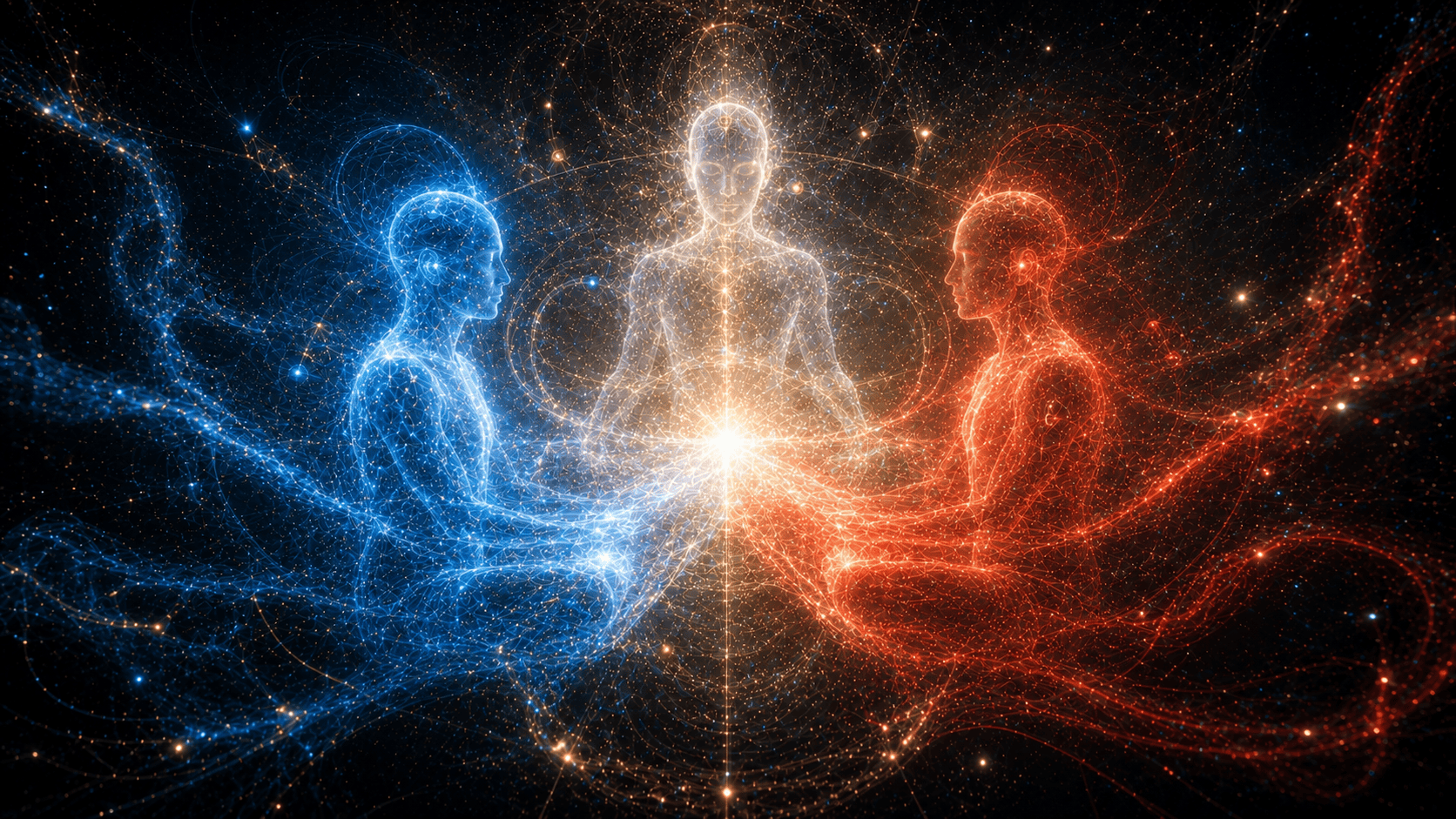
The three kayas are the three bodies of a Buddha — and the strange, useful thing about them is that they aren’t three separate things to learn one at a time. Recognize one, and you recognize them all. The Dharmakaya is recognized for yourself. The Nirmanakaya and Sambhogakaya are recognized for others. That single distinction — self-recognition and other-recognition — is the door into everything that follows.
What Are the Three Kayas?

Kaya simply means body. The three kayas — Dharmakaya, Sambhogakaya, and Nirmanakaya — describe three ways a Buddha’s awakened state is present, not as three different beings but as three inseparable aspects of one enlightened nature. A traditional image compares them to the sun: the Dharmakaya is the sun itself, the Sambhogakaya is its rays, and the Nirmanakaya is the light landing on the ground, touching the objects and beings it illuminates. All three arise together. None comes before or after the others.
The doctrine didn’t arrive fully formed. It grew out of a very old question the early tradition kept circling: what, exactly, was the Buddha? A man who lived and died in northern India, clearly — but the awakening he pointed to was described as timeless, unconditioned, beyond birth and death. So which was the real Buddha, the person or the realization? The three kayas are the tradition’s mature answer: both, and a third thing that unites them. The framework was formalized over centuries, developed in depth by the Yogachara thinkers, and it remains one of the most complete maps we have of how awakening actually expresses itself.
What makes the three kayas more than a piece of doctrine to memorize is that they aren’t only a description of a Buddha out there. They are a description of your own mind, seen clearly. This matters enormously for practice, because it means the three kayas are not a distant goal to reach but a structure already present in every moment of awareness — the empty, open nature of mind; its unobstructed clarity and capacity; and the specific forms that clarity takes as thoughts, perceptions, and experiences arise. In meditation, you are not building the three kayas. You are learning to recognize what was always already there.
Nirmanakaya — The Emanation Body (White Light)
The Nirmanakaya is the emanation body — the form a Buddha takes to appear in the world for the benefit of others. The historical Buddha Shakyamuni is the most familiar example: an actual person, born, teaching, dying, entirely within ordinary time and space. Where the Dharmakaya is recognized for yourself, the Nirmanakaya is recognized for others — it’s the body other beings can actually meet. In the Secret Refuge, the Nirmanakaya is visualized as white light.
In meditation, the Nirmanakaya corresponds to the actual forms that arise within awareness — the specific, concrete appearances of experience. Every thought, every image, every sensation that arises and takes a definite shape is, in a sense, an emanation: form appearing out of the open ground of mind. White light is the natural image here because white contains all colors, all possible forms, undivided — the pure potential for any appearance to arise.
The Nirmanakaya is recognized for others because it is the level at which awakening becomes meetable, touchable, teachable. A realization that stayed only in the formless Dharmakaya could help no one; it is precisely by taking form — a teacher, a word, a gesture, a face — that compassion actually reaches another being. This is the body that shows up, that walks into the room, that can be loved and learned from.
The Nirmanakaya is recognized for others because it is the level at which awakening becomes meetable, touchable, teachable. A realization that stayed only in the formless Dharmakaya could help no one; it is precisely by taking form — a teacher, a word, a gesture, a face — that compassion actually reaches another being. This is the body that shows up, that walks into the room, that can be loved and learned from.
Sambhogakaya — The Joy Body (Red Light)
The Sambhogakaya is the joy body, sometimes called the body of mutual enjoyment or the enjoyment body — the level at which enlightened qualities communicate, teach, and can still be met by advanced practitioners as a kind of doorway, even though it isn’t bound to ordinary physical form the way the Nirmanakaya is. Like the Nirmanakaya, it is recognized for others. In the Secret Refuge, the Sambhogakaya is visualized as red light.
In meditation, the Sambhogakaya is the luminous, energetic quality of awareness — the clarity and vividness and sheer aliveness of experience, the felt sense that mind is not a dead blank but a radiant, expressive capacity. It is the bridge between the formless Dharmakaya and the concrete Nirmanakaya: the level where empty spaciousness begins to shine and stir before it settles into any particular form.
Red is the color of warmth, of blood and life and heat, of passion transformed into blissful energy — which is why the joy body wears it. This is also the level most alive in yidam practice and the higher tantras, where the deity appears in radiant, luminous form, met not as flat physical matter but as living light. The Sambhogakaya is where practice stops being merely quiet and starts being luminous — where emptiness reveals itself as inseparable from bliss.
This is also the level most alive in yidam practice and the higher tantras, where the deity appears in radiant, luminous form, met not as flat physical or personal matter but as living light and energy. The Sambhogakaya is where practice stops being merely quiet and starts being luminous — where emptiness reveals itself as inseparable from bliss.
Dharmakaya — The Truth Body (Blue Light)
The Dharmakaya is the truth body — empty, formless, beyond concept, beyond even existence and non-existence. It is what you recognize for yourself, in your own direct experience of mind’s nature, not something anyone else can hand you or verify on your behalf. In the Secret Refuge, the Dharmakaya is visualized as blue light.
In meditation, the Dharmakaya is the open, empty spaciousness of mind itself — the awareness that remains when you stop chasing after and running from your thoughts and simply rest. It isn’t a blank nothingness; it’s a wakeful openness, aware and clear, with no fixed center and no edge. The blue light is not arbitrary.
Blue is the color of vast open space, of the depth of the sky and the deep of the ocean — the natural image for something boundless, unmoving, and endlessly deep. When a practitioner rests in the nature of mind in Mahamudra practice, it is the Dharmakaya they are resting in, whether or not that word is being used. This is why it is recognized for yourself: no one can point it out to you as an object, because it is the very awareness doing the looking.
The Secret Refuge — Taking Refuge in the Three Bodies
Here’s what the colours are actually doing.
When you receive empowerment, it moves through you in a fixed order — body, then speech, then mind. Never scrambled. Each gate opens the next.
The body is purified first. White light. This plants the seed of the Nirmanakaya — the body that takes form, that walks into the room, that others can actually meet.
Then speech. Red light. This plants the seed of the Sambhogakaya — the joy body, the luminous energy of communication.
Then mind. Blue light. This plants the seed of the Dharmakaya — the open, formless truth, subtlest of the three.
Body, speech, mind. White, red, blue. Nirmanakaya, Sambhogakaya, Dharmakaya. Three gates, walked one at a time, and then a fourth thing happens: they stop being three. The Svabhavikakaya is what you call them once you can’t pry them apart anymore.
🕯️ ON THE SECRET REFUGE
But keep going. Because the refuge isn’t information. It’s a pointing-out instruction — a pith, hiding in plain sight as a list.
Look at what you’ve been taking refuge in. The Buddha, the Dharma, the Sangha. Then deeper — the Three Roots: your Lama, your Yidam, your Protector. Then deeper still — the three kayas, the three lights. Every one of them either points at Mind, or it’s impermanent and it will dissolve. The Buddha died. The Sangha scatters. The Lama who pointed out the nature of mind will one day die too. The Yidam dissolves back into space at the end of every session. Even the kayas are a teaching — a raft, not the shore.
Strip it all away and see what’s left standing.
Mind. The refuge that doesn’t dissolve, because there’s nothing in it to dissolve. That’s the top secret refuge. Not a better object than the others. The one thing that was never an object at all.
That’s the whole point of the practice. Everything else was pointing here.
Why the Three Kayas Matter in Practice

It would be easy to treat all of this as classification — a tidy set of categories for a philosophy exam. But the three kayas change how a practitioner actually relates to three of the most important things in the path: their teacher, their own mind, and death itself.
With a teacher, the three kayas explain something that otherwise seems contradictory. The lama in front of you is an ordinary human being — Nirmanakaya, a person who gets tired and eats lunch and will one day die. And yet in guru yoga you relate to that same teacher as a doorway to awakening itself. Both are true at once.
You are not pretending the person is more than human; you are recognizing that through this human form, the Sambhogakaya’s living transmission and the Dharmakaya’s formless truth are actually reaching you. The three kayas let you hold the ordinary and the sacred in the same person without collapsing either one.
With your own mind, the three kayas become a map you can actually check against your own experience in meditation. The open spaciousness when thoughts settle — that is Dharmakaya. The clear, vivid aliveness of awareness — Sambhogakaya. The specific thoughts and appearances that arise — Nirmanakaya.
Recognizing these not as three stages but as three faces of a single mind, present in every moment, is a large part of what Mahamudra and Dzogchen are pointing at. The framework turns meditation from a vague attempt to feel calm into a precise recognition of what is already here.
And with death, the three kayas map directly onto what the tradition teaches about the dying process and the bardo — the same dissolution, the same dawning of luminosity, the same recognition of clear light that practices like Phowa prepare a practitioner to meet. What you learn to recognize in meditation as the three faces of mind is exactly what arises, in a far more intense form, at the moment of death. This is why the framework isn’t abstract. It is preparation for the most important recognition a practitioner will ever be asked to make.
A Closing Note
Recognize one, and you know them all — that’s not a simplification. It’s the actual shape of the teaching. The Nirmanakaya that walks and teaches and dies, and the Dharmakaya you find resting in your own mind, are not two different discoveries. They are the same recognition, worn three different ways: as the specific, precious forms experience takes, as living radiance, and as open space. White, red, and blue are not three separate lights from three separate sources. They are one light, seen from three sides.
And you already know where that one light leads. Back to the only refuge that was never an object at all. Everything on this page has been a finger. Mind is the moon.
QP
Continue Reading
- The Four Common Preliminaries→
- Why is Human Existence so Precious?→
- What is Impermanence?→
- What is Karma?→
- What is all this about Suffering?→
- What is Buddhist Refuge?→
- What do Shiné and Laktong mean?→
- What do Kyerim and Dzogrim mean?→
- The Three Kayas→
- What Is a Yidam?→
Sources
Sound is Emptiness — Emptiness is Sound